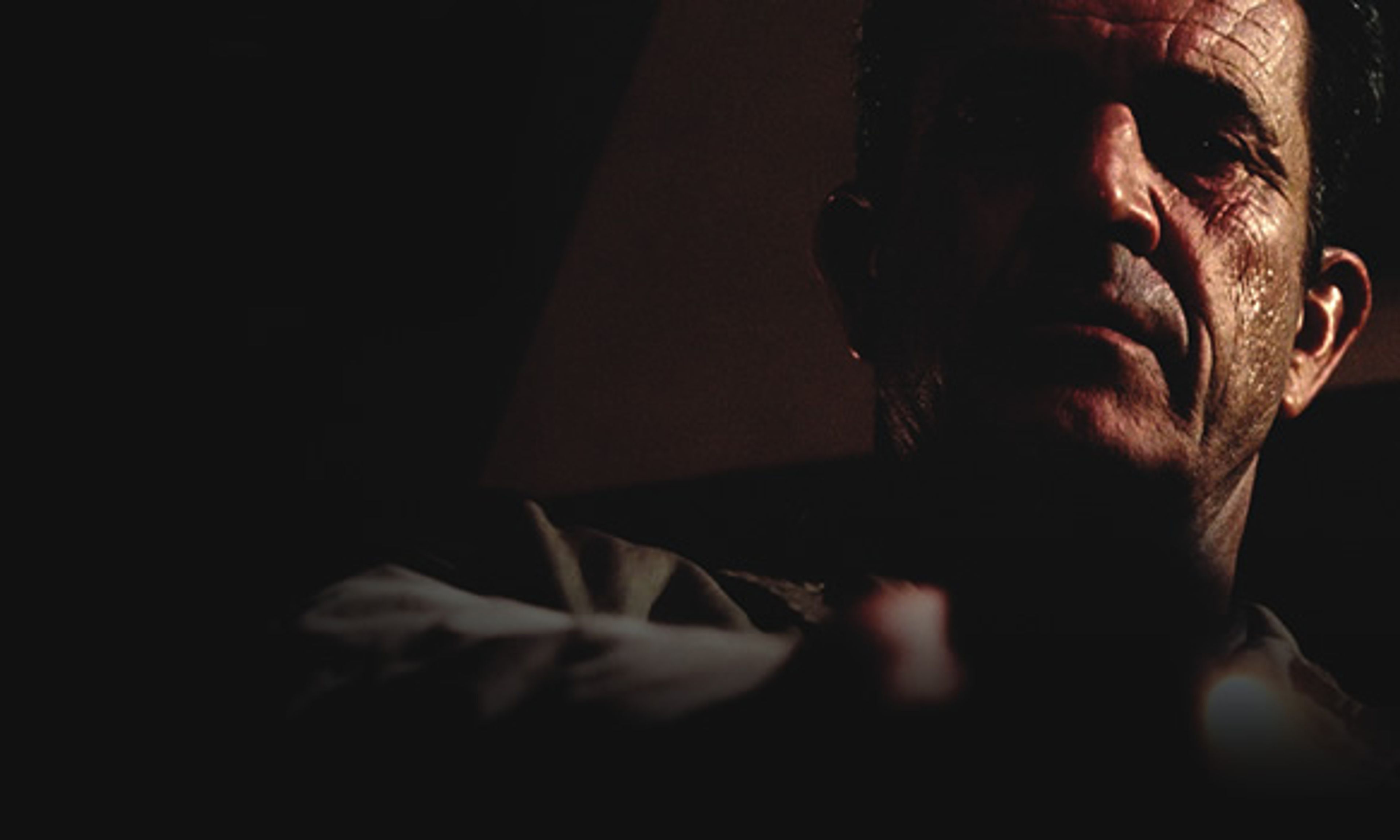
There’s a fine line between being a crazy, paranoid, violence-obsessed genius, and just being plain old crazy. In the first half of the 2000s, Mel Gibson managed to stay (just barely, sometimes) on the genius side of the line. His obvious instability was balanced, if not excused, by the weird, mad brilliance of his two self-financed directorial efforts, The Passion of the Christ and Apocalypto. Sure, he grew a Jeremiah Johnson beard and said bizarre things to interviewers, but he also made two of the decade’s most distinctive, arresting, and uncompromising movies — with subtitles, no less!
By the time Apocalypto hit theaters, though, Gibson had delivered his famous post-DUI tirade against the international Jewish conspiracy, offered his round of apologies, and vanished from the public eye. In the next four years, there were no more movies; instead, there was a mistress, a love child, and the end of his 29-year marriage. The rant against the Jews cemented his reputation as an anti-Semite. The mistress and the divorce demolished his credibility with The Passion’s religious fan base. And the absence of any creative work made it easy to forget about Gibson’s talent, and remember only his nuttiness.
Sad to say, his return to theaters as the star of this month’s Edge of Darkness isn’t likely to improve his reputation. Gibson didn’t direct the thriller, but it still feels like a Mel movie. There’s the man-on-a-mission plot, the bone-crunching violence, and the air of martyrdom; there are echoes of Braveheart and the Lethal Weapon saga, Conspiracy Theory and The Passion. What’s missing, unfortunately, is originality, intelligence, and narrative coherence — not to mention anything resembling art.
With a better script, the plot could have been straightforward and grimly satisfying. Gibson plays Craven, a widowed Boston cop, whose daughter Emma (Bojana Novakovic) is gunned down on his doorstep, by bullets that everyone assumes were meant for him. But it quickly becomes apparent that Emma had more enemies than her father. She was an intern for Northmoor, a shady Massachusetts-based outpost of the military-industrial complex, where she uncovered a Vast Conspiracy, tried to do something about it, and ended up at the wrong end of a professional rubout.
The only question is whodunit. Was it the eco-terrorist group Nightflower, to whom Emma turned for help? Or her jumpy, guilty-seeming boyfriend? Or Northmoor’s chief executive, embodied by Danny Huston, who excels at playing characters with something of the night about them? Or perhaps the mysterious Darius Jedburgh (Ray Winstone), a British-accented spook who hovers around the proceedings, trailing smoke from his cigars? Or even Sen. Jim Pine, a Massachusetts Republican (!) with incriminating ties to Northmoor?
Where the senator’s implausible party affiliation is concerned, I suppose that Edge of Darkness deserves points for prescience, even if the sinister Pine seems more like a John Kerry–esque Brahmin than a Scott Brown populist. And the cucumber-cool Jedburgh is an amusing fillip of a character, carried off with pure attitude by Winstone.
But the rest of the film is a dreadful mess. The mystery is basically resolved before the movie is half over: You know roughly how Emma died and why, and the only question is how long it will take the bad guys to realize that Craven’s on to them, and how long it will take him to wreak his vengeance.
The answer, unfortunately, is quite a while. The script is adapted and condensed from a six-hour 1980s British miniseries — with War on Terror conspiracy theories replacing Thatcher-era nuclear-power panic — but somebody should have condensed things a bit more. Every time you think the movie will take a clever turn, it takes a stupid one instead. The good guys leave obvious leads unfollowed and self-evident stratagems untried. The bad guys murder some characters for no apparent reason, leave obvious targets very much alive, and engage in a hilarious kind of overkill when it finally comes time to take the fight to Craven. In the movie’s closing scenes, he’s variously poisoned, beaten, shot at, kidnapped — and, perhaps worst of all, threatened with a long, drawn-out court battle in the litigious state of Massachusetts.
The lawsuit aside, this cascade of agony is quintessential Gibson. But it’s Gibson without any of the qualities that make his better movies fascinating. Edge of Darkness offers violence without weight, paranoia without insight, and martyrdom without a deeper meaning. If you’re inclined to dismiss Mad Mel as an artless masochist, you won’t find anything here to change your mind. And if you’ve been hoping that he’d emerge from his four-year hiatus with a movie worthy of his talent, you’re in for a grim, unthrilling disappointment.












Comments