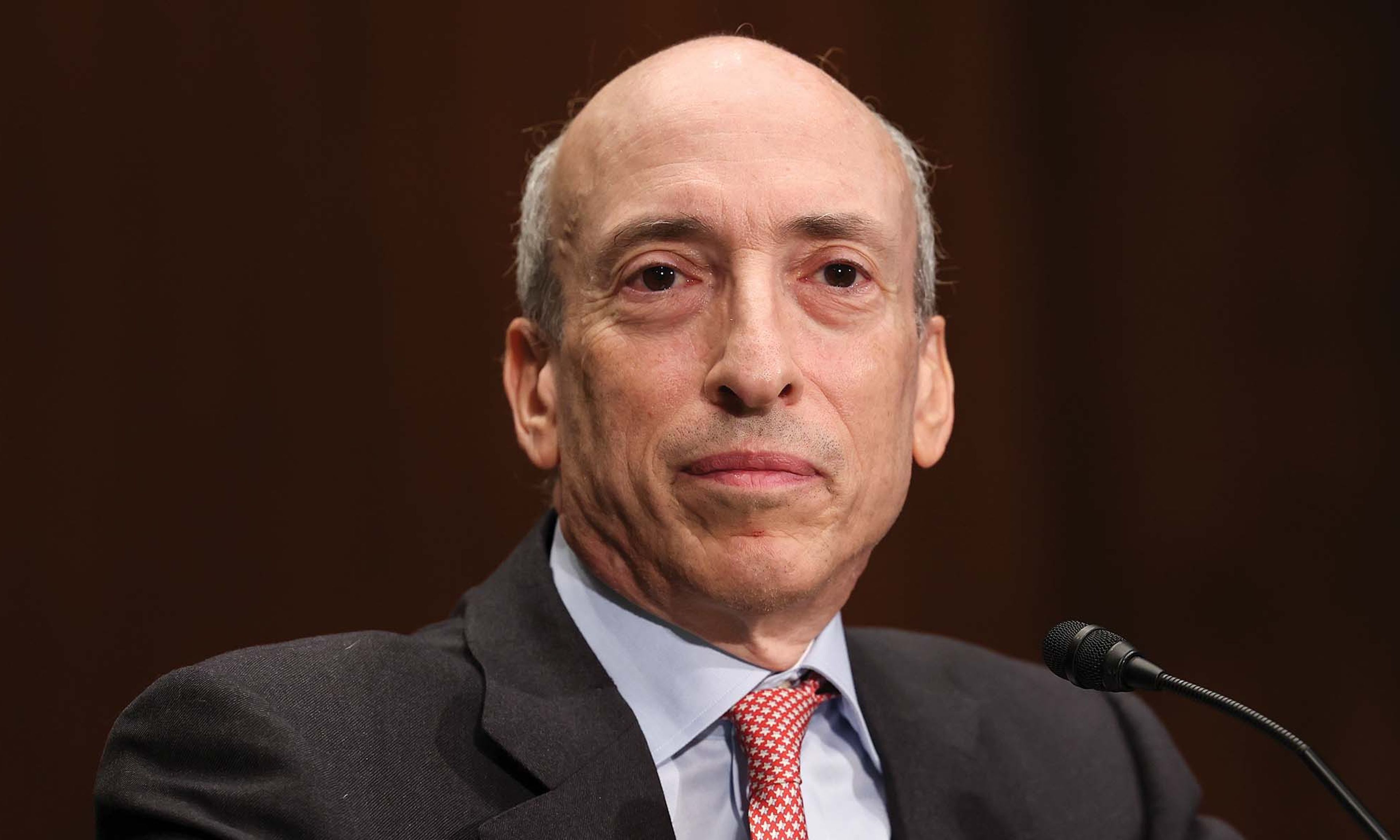
When Joe Biden appointed Gary Gensler as chairman of the Securities and Exchange Commission, progressives celebrated. They had one of their own at the head of Wall Street’s regulator. As promised, Gensler has moved fast in pushing more government regulation, even when the regulation would overstep the SEC’s authority. But now that unified Democratic government is a thing of the past, Gensler will face more scrutiny. In November, Representative Tom Emmer (R., Minn.) said Gensler will be spending so much time before Congress that he “might as well bring a cot.”
The SEC was created by the Securities Exchange Act of 1934, which was signed into law by Franklin Roosevelt with the New Deal in full swing. Its purpose is to protect investors, maintain fair and orderly markets, and facilitate capital formation, according to the Congressional Research Service. It oversees basic securities laws, plus additions such as Sarbanes-Oxley and Dodd-Frank.
One of the primary ways it fulfills its mission from Congress is by requiring that certain information be disclosed to investors. These disclosure requirements came into being after the stock-market crash in 1929, when confidence in financial markets weakened in part because of a perceived lack of transparency on the part of corporations.
The SEC is an independent agency, which means the president is not directly responsible for its actions. There are five commissioners, appointed by the president, who serve five-year terms, and no more than three commissioners may be from the same party. Three of the current commissioners, including Gensler, are Democrats appointed by Joe Biden.
Gensler has been going back and forth between government, higher education, and the private sector for decades. He was a partner at Goldman Sachs in the ’80s and ’90s, until Bill Clinton appointed him assistant secretary of the Treasury for financial markets in 1997. In 1999, he was made undersecretary for domestic finance (undersecretary being a promotion from assistant secretary), where he stayed until Clinton left office.
He then joined Paul Sarbanes’s staff, where he helped write Sarbanes-Oxley, one of the laws he is now tasked with overseeing. Barack Obama appointed him chairman of the Commodity Futures Trading Commission in 2009, a role he held until 2014. He then worked in Maryland state government for a while before becoming a professor at the MIT Sloan School of Management, whence he was appointed by Biden to chair the SEC. Through it all, Gensler has done quite well for himself, with an estimated net worth of as much as $119 million, according to Bloomberg in 2021.
Democrats saw him as a formidable regulator, and the Wall Street Journal has said he put the SEC on a “regulation raceway.” The commission has repeatedly set unusually short public-comment periods for sweeping regulatory changes. The public-comment period, especially for significant regulations, is often when bugs are ironed out of proposed rules, and even some Democrats who support Gensler’s actions have spoken up against the speed with which the SEC has acted under his watch.
The proposed rule that has caught the most attention is on disclosure of greenhouse-gas emissions. It would require businesses to disclose not only their emissions but, in some cases, the emissions of other companies they contract with or that are part of their supply chains.
Two of the Gensler SEC’s most important critics are within the SEC. The first is commissioner Hester Peirce, the only Republican currently on the commission. Appointed by Donald Trump and serving since 2018, Peirce has used her post to argue against Gensler’s approach and to dissent from her Democratic colleagues’ decisions. Though the chairman sets the agenda and directs the commission’s resources, individual commissioners retain significant latitude to speak their minds.
In a lengthy statement from March 2022 titled “We Are Not the Securities and Environment Commission — at Least Not Yet,” Peirce argued that the climate-disclosure proposal “turns the disclosure regime on its head.” The purpose of disclosure requirements, Peirce said, is to provide investors with information about how a company is run. It would be a perversion of the SEC’s purpose to require disclosures that regulators want rather than disclosures that investors need.
The proposal would give stakeholder capitalism the force of federal regulation over part of the economy. “It forces investors to view companies through the eyes of a vocal set of stakeholders, for whom a company’s climate reputation is of equal or greater importance than a company’s financial performance,” Peirce said. Stakeholder capitalism is a theory of corporate decision-making by which businesses seek to satisfy various groups of people inside and outside the company, rather than focusing on financial performance. Corporations should be free to adopt or reject it without government’s putting its thumb on the scale in favor of particular groups (in this case, environmentalists).
Peirce argued that for climate-related risks that actually would affect financial performance, existing disclosure requirements are sufficient. “Under these existing rules, companies already are disclosing matters such as the risk of wildfires to property, the risk of rising sea levels, the risk of rising temperatures, and the risk of climate-change legislation or regulation, when those risks are material [to] the company’s financial situation,” she said.
The second critic is the SEC’s own inspector general. An IG report from October 2022 found that the SEC is overextended with new regulatory actions and less able to perform its basic functions.
The IG said that the SEC is pursuing a historically high number of rulemaking activities simultaneously and that this is putting stress on staff and hindering coordination within the agency. Managers the IG talked to reported higher attrition among employees and difficulty hiring experienced and productive people to replace them. They also said changes to internal processes made by Gensler’s office were poorly communicated and executed, leading to confusion about new rulemaking.
That echoes concerns from another independent agency with a Biden-appointed head, the Federal Trade Commission. As former FTC commissioner Joshua Wright and former staffer Derek Moore wrote for National Review Capital Matters in May 2022, the FTC under chairwoman Lina Khan has been characterized by low employee morale, high turnover, and little trust in leadership. Khan has sought a radical departure from the FTC’s ordinary role and, similar to Gensler, she has done so in ways that sometimes lack proper authority.
While the SEC has been preoccupied with this unusual amount of rulemaking, various frauds have been perpetrated on investors in cryptocurrencies. Whether the commission’s dysfunction under Gensler led to these frauds’ going unnoticed is impossible to tell. But one of the main purposes of the SEC is to prevent the kinds of frauds based on misinformation and lack of transparency that have been all too typical in the crypto space.
In September 2021, Gensler said of crypto regulation, “We have robust authorities at the Securities and Exchange Commission and we’re going to use them. We’ll also be the cop on the beat, bringing enforcement actions.” Yet, as we now know, the SEC did not stop FTX, one of the biggest players in the industry, from perpetrating what appears to be old-fashioned fraud of the sort that the agency is supposed to prevent. As Allysia Finley wrote in December for the Wall Street Journal, “that FTX hadn’t registered with the SEC doesn’t let Mr. Gensler off the hook. For months he’s claimed to have authority over crypto and warned about self-dealing at their exchanges. Why didn’t he investigate the company?”
That’s one of many questions that Republicans can and should investigate. And they’re off to a good start on SEC overreach already.
Republicans, both in Congress and at the state level, have been wise to the SEC’s actions. GOP members of the Senate Banking Committee called out Gensler’s lack of transparency in response to the senators’ request for more information on the SEC’s climate-disclosure rules. “Your response is wholly inadequate and unacceptable,” the senators wrote to Gensler, who brushed off the list of specific questions from the lawmakers by offering to set up a briefing with staffers instead. With former ranking member Pat Toomey (R., Pa.) no longer in Congress, it will be up to the new ranking member, Tim Scott (R., S.C.), to take the lead on the Senate side.
House Republicans will have more opportunities for SEC oversight since they won the majority and control the committees. Representative Patrick McHenry (N.C.) is the new chairman of the House Financial Services Committee. He began his tenure by eliminating the subcommittee on diversity and inclusion that Democrats had created and adding a subcommittee on digital assets, to better oversee the government’s approach to crypto regulation. McHenry was skeptical of Gensler from the start, saying when Gensler was nominated in January 2021, “I fear Democrats want to steer the [SEC] away from bipartisan common-ground in an attempt to achieve their most partisan goals.” He has also called out Gensler’s disregard for public comment in rulemaking and echoed the senators’ concerns about lack of transparency.
While the GOP was completely out of power in Washington, though, state officials took the lead. Sixteen GOP governors, many from oil-and-gas-producing states, wrote to Gensler in May 2022 about the consequences of the SEC’s proposed climate rules. They made an issue of the practicality of the rule as well as the authority of the SEC to make it in the first place. Eighteen GOP attorneys general also wrote to the SEC over its lack of sufficient public-comment periods.
The overarching objection that Republican elected officials, Peirce, and others have made is that the SEC has an authority problem on climate disclosure. Richard Morrison of the Competitive Enterprise Institute, who has written extensively about the SEC, told NR, “It’s not a question of the details in the 500-page proposed rule. It’s a question of whether the agency is allowed to do this at all.”
A unified Republican government would be able to pass legislation to make explicit that the SEC is not permitted to adopt climate rules. Representative Beth Van Duyne (R., Texas) introduced a one-page bill last Congress that would have clearly prohibited the SEC’s proposed rule and any other similar rule under securities law. Of course, under Democratic control, the bill went nowhere.
With the GOP now in control, Morrison expects a lot of hearings in the House. “Putting some heat on the agency and making clear that Republicans believe they are overstepping their authority can help relevel the playing field,” he said. But given Democratic control of the Senate and the White House, the authority question will be decided by a federal court, if (or when) the rule goes into effect. “We will almost certainly see that litigation play out, but it might take a while to get a final decision,” Morrison said.
Throwing a dubious claim of authority to the courts has been a hallmark of the Biden administration, with abuses of the Defense Production Act, the CDC’s emergency powers, and the Department of Education’s ability to forgive student loans as prime examples. Gensler may repeat that strategy with his push for climate disclosure.
The genius of the Framers was in creating a system of government that did not require people to be on their best behavior for it to work. The downside of FDR’s revision of that system, with independent agencies given sweeping grants of power, is that it requires us to trust appointees to behave within the rules and provides little recourse when they decide to act outside of them.
In the short term, House Republicans should conduct oversight of the SEC, with hearings and investigations to establish the exact nature of any of its wrongs of either omission or commission. In the long term, Republicans need to be prepared to rewrite and repeal laws that give independent agencies too much power. Otherwise, there will be more Genslers.









Comments