
• Joe Biden had better hope he doesn’t have a gas stove in his garage.
• “How anyone could be that irresponsible!” said President Biden in September, of the stash of classified documents found at former president Trump’s Mar-a-Lago home. Perhaps he can tell us, now that classified documents have turned up at Biden workplaces and residences, from Washington, D.C., to Delaware, evidently put there after his years as Obama’s vice president. Team Biden tried at first to claim that it was transparent about the matter, unlike Trump, who fought to keep the material he had taken, but that excuse crumbles in light of the fact that the first cache of Biden docs was discovered in early November before the midterms, yet the nation did not learn about it until the new year. Biden himself tried to pooh-pooh security concerns, saying that documents found at his Wilmington home were locked in a garage with his prize Corvette. Corvette garages are not, however, a recognized secure site. Biden is unlikely to offer the defense that he was losing his marbles as early as 2017. Attorney General Merrick Garland has appointed a special counsel to investigate, and House Republicans will launch inquiries of their own. The best case for Biden would be that he was carelessly amassing stuff for a memoir: illegal, but often done by D.C. bigwigs. Worst case would be that he was hiding links to Hunter’s crooked influence-peddling. To be continued.
• To hear Democrats in Congress tell it, any forthcoming House investigation of Hunter Biden will be a mean-spirited, inappropriate exercise in humiliating the president and his son, whose addiction issues and personal scandals are well documented. But the two scandals that were allegedly most of interest to federal law enforcement for the past year — alleged tax-law violations and making a false statement in connection with his purchase of a firearm — are among the less consequential, although Congress may legitimately ask whether Hunter Biden was given a pass for obvious lawbreaking because he was the son of the vice president. Much more troubling are Hunter Biden’s connections to people with ties to foreign governments. Meet the Press anchor Chuck Todd contended that “it is not a crime to make money off of your last name.” No, but the 2017 email from James Gilliar, one of Hunter Biden’s business associates, discussing a joint venture with CEFC China Energy, asked, “10 held by H for the big guy?” Many have suspected that “the big guy” is the current president. President Biden has insisted he was never involved in his son’s business dealings, while Hunter has said his only discussion with his father amounted to the elder Biden’s cautioning, “I hope you know what you’re doing.” Considering the elder Biden’s record of lying and the younger Biden’s record of risk assessment, it is hard to assume that everything both men did was honest, legal, and ethical.
• It was a concession of sorts that President Biden felt compelled to give a speech addressing the border crisis that he has previously either denied or blamed on his predecessor. The catchphrase was creating “safe and orderly” pathways to the United States. There’s a reason that that sounds a lot like Bill Clinton’s famous “safe, legal, and rare” line about abortion. Just as Clinton was using a euphemism for unrestricted abortion, the administration has come up with an anodyne way to describe largely unconstrained entry into the United States. It is going to allow up to 30,000 migrants from Cuba, Nicaragua, Venezuela, and Haiti into the U.S. every month, provided they apply from their home countries and follow a formal process. The idea is that rerouting illegal immigrants to new legal pathways will stop people from showing up at the border. The problem is that, even to work on its own terms, it would require the swift and certain removal of anyone who continues to show up at the border, and the administration doesn’t have the necessary will or wherewithal for that. Notably, New York City mayor Eric Adams, who has been struggling to handle a relatively small influx of migrants, traveled to the border and called for a national solution to the problem. Biden’s speech signaled that he’s not going to get one.
• As part of a deal to secure the speakership (on which see more below), Kevin McCarthy reportedly told his GOP detractors that he would agree to cap discretionary spending at fiscal year 2022 levels — a concession that could well result in a defense-spending cut in real terms. Some estimates say that that’s effectively a $75 billion reduction in military spending. Representative Chip Roy (R., Texas), one of the holdouts to McCarthy’s bid, later claimed that the deal would not in fact require defense cuts but instead result in cuts to nondefense discretionary spending. All of this hints at a likely massive intra-conference fight to come: Defense-hawk committee chairmen will likely go tit for tat with McCarthy opponents who were elevated to key committee posts as a result of the deal. The former group might be able to block some of the most damaging measures, but it’s also possible that the Pentagon budget will still get a remarkable haircut against the backdrop of continued inflation. Opportunities to save money should be sought in the defense budget as elsewhere, but not at the expense of readiness.
• C-SPAN has asked that its cameras have free access to the House floor. Normally, footage of the House is controlled by the leadership and consists of tight shots of whichever member is addressing the (often-empty) chamber. House rules lapse with each new Congress, however, so during Kevin McCarthy’s fight for the speakership, C-SPAN’s viewers got a taste of cinéma vérité — McCarthy and Representative Matt Gaetz (R., Fla.) exchanging spiky words, Representative Katie Porter (D., Calif.) showing contempt for the process by reading a book with a vulgar title. It was entertaining, a bowl game for Beltway nerds. But the last thing we need is greater fixation on politics as a spectator sport.
• In 2016, odd messages began appearing on Twitter: pro-Trump, often couched in unidiomatic English. Was Russia trying to sway the election? Of course: Russia runs troll farms that push candidates perceived to be less hostile while slagging their opponents, with confusion as a proximate aim. But a recent study by New York University’s Center for Social Media and Politics suggests that the online efforts bore no fruit. Its authors found “no evidence of a meaningful relationship between exposure to the Russian foreign influence campaign and changes in attitudes, polarization, or voting behavior.” Russian propaganda was dwarfed by the messaging of the Trump and Clinton campaigns and by American media coverage, and it targeted a slice of the market already disposed to like Trump. It didn’t take scheming Russians to convince Americans to vote against Hillary Clinton. Trumpism was not some virus injected into America’s bloodstream. We grew it ourselves.
• The 2022 midterms offered many examples of a uniquely destructive phenomenon: Donald Trump–endorsed Republican candidates who prevailed in their primaries, in some cases knocking off incumbent Republicans, only to lose in the general election. One example was Washington’s third congressional district, where Joe Kent, who served his country honorably as a Green Beret and lost his wife to an ISIS attack in Syria, narrowly defeated incumbent Republican Jaime Herrera Beutler only to lose to Democrat Marie Gluesenkamp Perez. It was an upset: Beutler, a pro-life Republican who voted to impeach Trump in 2021, won the district by twelve points in 2020, while Trump himself won it by four. After Kent’s loss, he raised questions about its legitimacy; a recount confirmed the loss. Only a few days after Gluesenkamp Perez was sworn in as a member of Congress, Kent declared his candidacy for the seat in 2024. Understandably unimpressed with his opponent’s record so far, Kent believes that he is uniquely equipped to defeat her in 2024. But this seems unlikely: Kent’s embrace of Trump’s stolen-election and January 6 myths, and the footsie he played with white-nationalist groups, surpassed the nose-holding abilities of area Republicans. Kent’s military service is admirable, his grief palpable; and some of his criticisms of U.S. foreign policy deserve a serious hearing. But he is a flawed messenger and a proven loser. Republicans in Washington’s third district deserve better and should look elsewhere.
• When the Born-Alive Abortion Survivors Protection Act came up for a vote in the House of Representatives on January 12, it passed with the support of all Republicans voting but only one Democrat. What possible reason did Democrats have to oppose a bill protecting living babies who are entirely outside the womb? Representative Jerrold Nadler (D., N.Y.), who led the opposition to the bill, said it could actually endanger the lives of infants born alive after an attempted abortion by mandating the “immediate” transfer of the infant to the hospital. It’s extremely difficult to imagine a scenario in which a very premature infant would be better cared for by the abortionist who just tried and failed to kill her than by a medical team at a neonatal intensive-care unit. But the law was clear that transferring the child to a hospital should occur only after the infant is treated by the attending health-care practitioner as a “reasonably diligent and conscientious health care practitioner would,” and this would preclude ordering a dangerous ambulance ride. Nadler’s preposterous argument was the best Democrats could come up with after the abortion lobby had ordered them to defend the indefensible.
• On January 3, the FDA issued a ruling allowing online and brick-and-mortar pharmacies to dispense abortion drugs commonly used to end the life of an unborn child during the first ten weeks of pregnancy. The ruling formalizes a temporary decision made by the agency in 2021 to suspend the requirement that the pills be distributed only in person. Abortion advocates praising the decision are ignoring its potential dangers to women. The abortion pills do not treat an ectopic pregnancy — when an embryo implants outside the womb — and an untreated ectopic pregnancy is a life-threatening condition. A visit to a clinic would include screening for an ectopic pregnancy, but the FDA appears more interested in making it easier to get an elective abortion than in protecting women’s health.
• The consumer-price index for all items fell by 0.1 percent month over month in December, bringing the year-over-year inflation rate down to 6.5 percent. It was the first negative reading for the month-over-month number since our post-pandemic inflation began. A decline in energy prices in December drove the trend. The price index for all items minus food and energy, however, increased by 0.3 percent month over month. The central bank will surely be comforted to see the overall number coming down. But it should not rest until long-run inflation has fallen back to 2 percent.
• Taxing a capital gain that does not in any real sense exist should appall anyone with a basic sense of fairness, but that’s what our tax code does. People selling an asset will pay tax on the nominal gain, even if that nominal gain might be a real loss. To take a simple example, an investor who buys an asset at $100 and sells it at $120 after a period when prices have risen by 30 percent will, in real terms, have lost $10. Nevertheless, that investor still faces a tax on the $20 nominal gain (for simplicity, we have not included any returns earned while the asset was earned, but they would probably have been taxable too). Even when prices are rising modestly, compounding can wreck real returns over time. The inflation tax discourages savings and investment, and there’s no better time to “repeal” it (by indexing capital gains to inflation) than when the damaging effects of rising prices are visible to all. The House should include indexing in any tax program it advances.
• For about a week, gas stoves were a deadly threat to Americans. A study from an environmentalist group purported to show that 12.7 percent of childhood asthma in the U.S. was attributable to gas stoves. Richard Trumka Jr., a commissioner of the Consumer Product Safety Commission, said, “Any option is on the table. Products that can’t be made safe can be banned.” Secretary of Energy Jennifer Granholm tweeted, “We can and must FIX this.” Then, when conservatives noticed, the chairman of the CPSC put out a statement saying there were no plans to ban gas stoves. That’s a relief, but environmental activists have been calling for the ban of gas-powered anything for years. Stoves and water heaters have featured prominently in their activism well before this imbroglio, and the dubious childhood-asthma study was little more than an attempt to up the alarmism. It served as a remarkable demonstration of how quickly progressives and their allies in the media can conjure a moral panic and then pretend it never happened.
• The commission presents a more serious policy problem, though. It’s an independent agency with a constitutionally questionable structure that allows it to be judge, jury, and executioner in matters over which it has jurisdiction. It is currently harassing a small business that makes lounge pillows for infants. Over 180,000 have been sold, and two infants have died while using them. In both cases, adults were using the product improperly, in direct contradiction of the company’s warnings and advertising. Nonetheless, the commission initiated an administrative action by itself (no consumer complained about the product), and it will be heard by an administrative law judge rather than an actual court. If the commission doesn’t like the decision, it can appeal it back to itself. No matter what happens, the commission has the first and last word on whether the product may be banned. But this power is not enough for some. A former CPSC chairwoman took to the pages of the Washington Post to argue that the commission should have power to regulate firearms. That would mean the commission could restrict Americans’ Second Amendment rights through the same unfair internal agency processes currently being used to persecute the maker of the infant lounge pillow. Americans increasingly need protection from this agency.
• If Pete Buttigieg thought he could hide out in the Department of Transportation, he has had a rude awakening. Mayor Pete, having never run anything larger than the country’s 310th-largest city (and Indiana’s fourth-largest), was given a minor cabinet post in a field where he had no experience and then promptly disappeared for two months of paternity leave. This was the wrong job for a dilettante who would rather talk culture war than attend to his department’s duties. The Biden administration asked him to help lead a task force to address the post-Covid global supply-chain crisis in 2021. It failed to break logjams at ports and stave off the inflationary effects of constricted supply, and Buttigieg’s absence was conspicuous. In 2022, when a national freight-rail strike loomed, the administration called on Secretary of Labor Marty Walsh — who had at least run a major city — rather than Buttigieg. And when the Federal Aviation Administration’s creaky, outdated Notice to Air Missions (NOTAM) system failed in January, resulting in the FAA’s grounding of all U.S. flights for the first time since the 9/11 attacks, Buttigieg was yet again out to lunch. There had been many warnings that the NOTAM system needed an upgrade, but the only major change to it that Buttigieg had overseen was to rename NOTAM in December 2021 from its original name, “Notice to Airmen,” deemed insufficiently gender-inclusive. Buttigieg’s planned trip to the presidency should be indefinitely delayed.
• But a better question than why NOTAM failed might be why the Department of Transportation runs air-traffic control in the first place. It is not a public good according to economic theory, and it could easily be provided by the private sector with funding from user fees. Canada adopted a nonprofit, private-sector air-traffic-control system in 1996, and it has maintained a high level of safety while also modernizing its technology faster than the U.S. — all without costing Canadian taxpayers a penny. One of the biggest problems the FAA faces is having to beg Congress for funding every year rather than having a consistent user-based revenue stream. In addition to the technological and fiscal benefits, privatizing air-traffic control would eliminate a public-sector union. Privatization proposals have bounced around for decades and include a 2017 House bill, which received bipartisan support, to create an equivalent to the Canadian system. It’s time to clear the runway for this idea.
• Madison Cawthorn, then an infamous young GOP member of Congress from North Carolina, lost his primary to state senator Chuck Edwards last May. Long before departing office, Cawthorn had apparently checked out mentally, ceasing any discernible effort on “casework” — requests from constituents over missing or delayed Social Security benefits, veterans’ care, etc. This would be bad enough, but departing members of Congress are required by law to turn over unfinished casework to their successors. According to Edwards, his staff spent at least a month trying to get casework information from Cawthorn and his remaining staff. All calls went to voicemail. Cawthorn’s final floor address in the House was, naturally, about the importance of taking responsibility and continuing to work hard through difficult times.
• Illinois has instituted a ban on so-called assault weapons. The new law prohibits the sale of many semiautomatic rifles, including the AR-15, and limits new ammunition magazines to those that can hold 15 rounds or fewer. Upon signing the measure into law, Governor J. B. Pritzker (D.) suggested that he had made “Illinois’ gun laws a model for the nation.” But this, of course, is backwards. Illinois is only the second state in two decades to ban a host of popular semiautomatic weapons, and it is the first to do so since the Supreme Court made it clear in the 2022 Bruen decision that it was serious about upholding the Second Amendment. Under the standard laid out in D.C. v. Heller, the Court’s landmark 2008 decision, Americans have a constitutional right to weapons that are “in common use.” Given that there are nearly 20 million in circulation in the United States — more than any other rifle — there is no question that the AR-15 fits this description. Thus far, 74 sheriffs in Illinois have refused to enforce the law, on the grounds that it deliberately violates the Constitution. Before long, they may have confirmation of this view from the highest court in the land.
• Vladimir Putin put Valery Gerasimov, chief of the general staff of the Russian armed forces, in charge of Russia’s invasion of Ukraine. Sending the top guy to the field could be a sign that Putin thinks a serious shakeup of his battlefield command is necessary to get the results he wants. Since even he must now realize that results will not include the conquest of Ukraine, what Gerasimov may aim for instead is an armistice in place, achieved by showing the West that Russia will accept any number of heavy casualties, while dismaying Ukrainians with terror tactics. As a taste of the latter, a Russian cruise missile hit an apartment building in the city of Dnipro, miles from the front, killing dozens. War crimes of this kind have already backfired; Putin has been the greatest stoker of Ukrainian nationalism in history. Ukraine, meanwhile, inched closer to acquiring Western heavy armament as Britain pledged to send it a handful of Challenger tanks. This move may prompt Germany to allow Leopard tanks owned by other NATO countries to go to Kyiv (Germany must sign off on re-export). Russia has announced that they will burn like any other tanks. If past is prologue, more of the burning will be on the Russian side.
• Déjà vu is the feeling of having previously had an experience that you know you in fact haven’t, which is why you shouldn’t pardon the media’s misuse of the term to describe the January 8 riots in Brasília as a repeat of our own January 6. Former Brazilian president Jair Bolsonaro’s supporters, who have been in a state of simmering public protest since he lost the runoff election last October, ought to have known better than to resort to attacking the national congress, the supreme court, and the presidential office in their capitol. That Bolsonaro’s successor — Luiz Inácio Lula da Silva, who served two terms as Brazil’s president, from 2003 to 2010, and is the first in his country’s history to have won a third — is an illiberal kleptocrat is beside the point. Violence and histrionics are not substitutes for legitimacy and authority in a constitutional republic. Americans should be grateful that, in our country, they are rare. This episode was a sad reversion to something all too common in Brazil’s history.
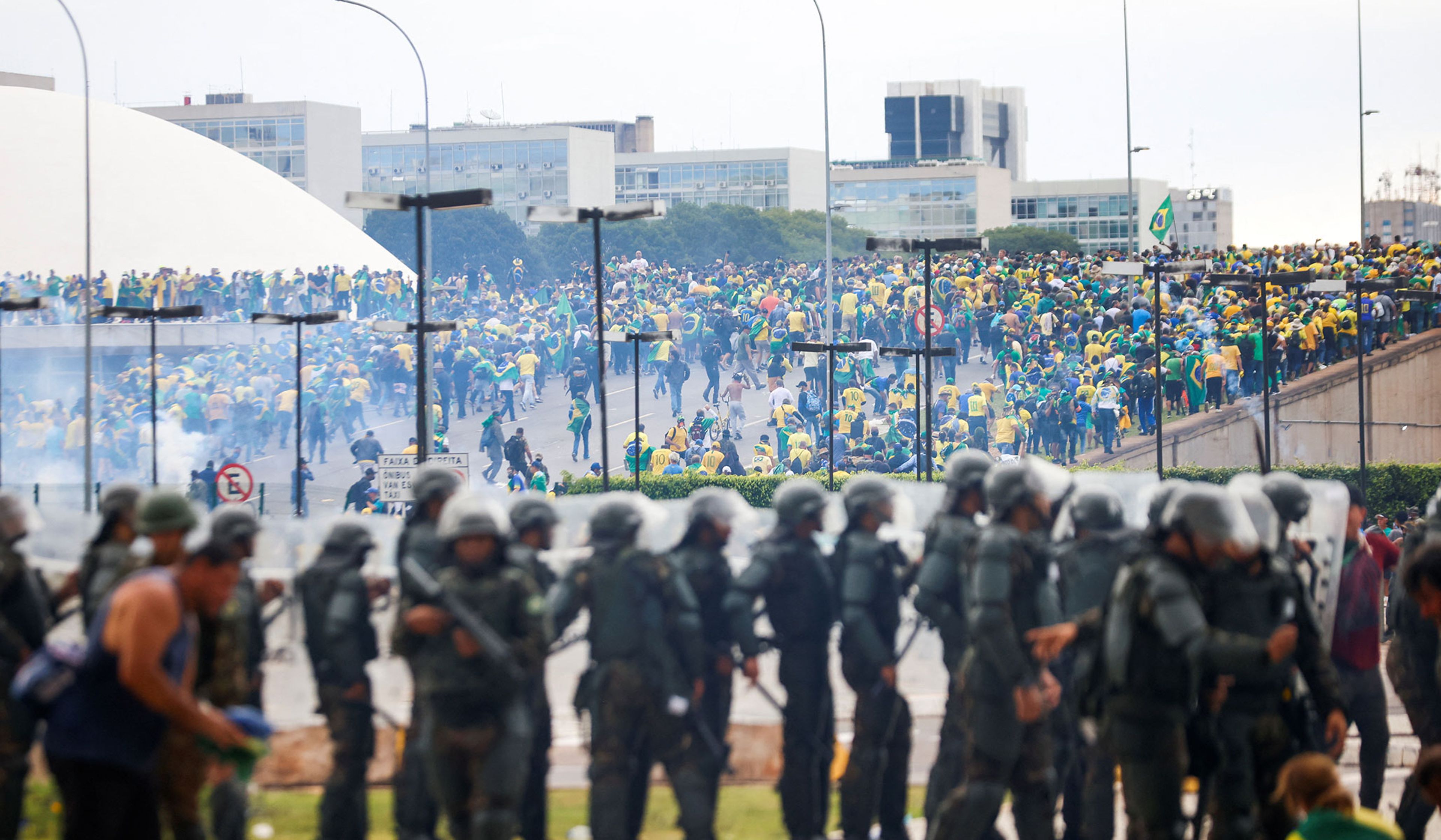
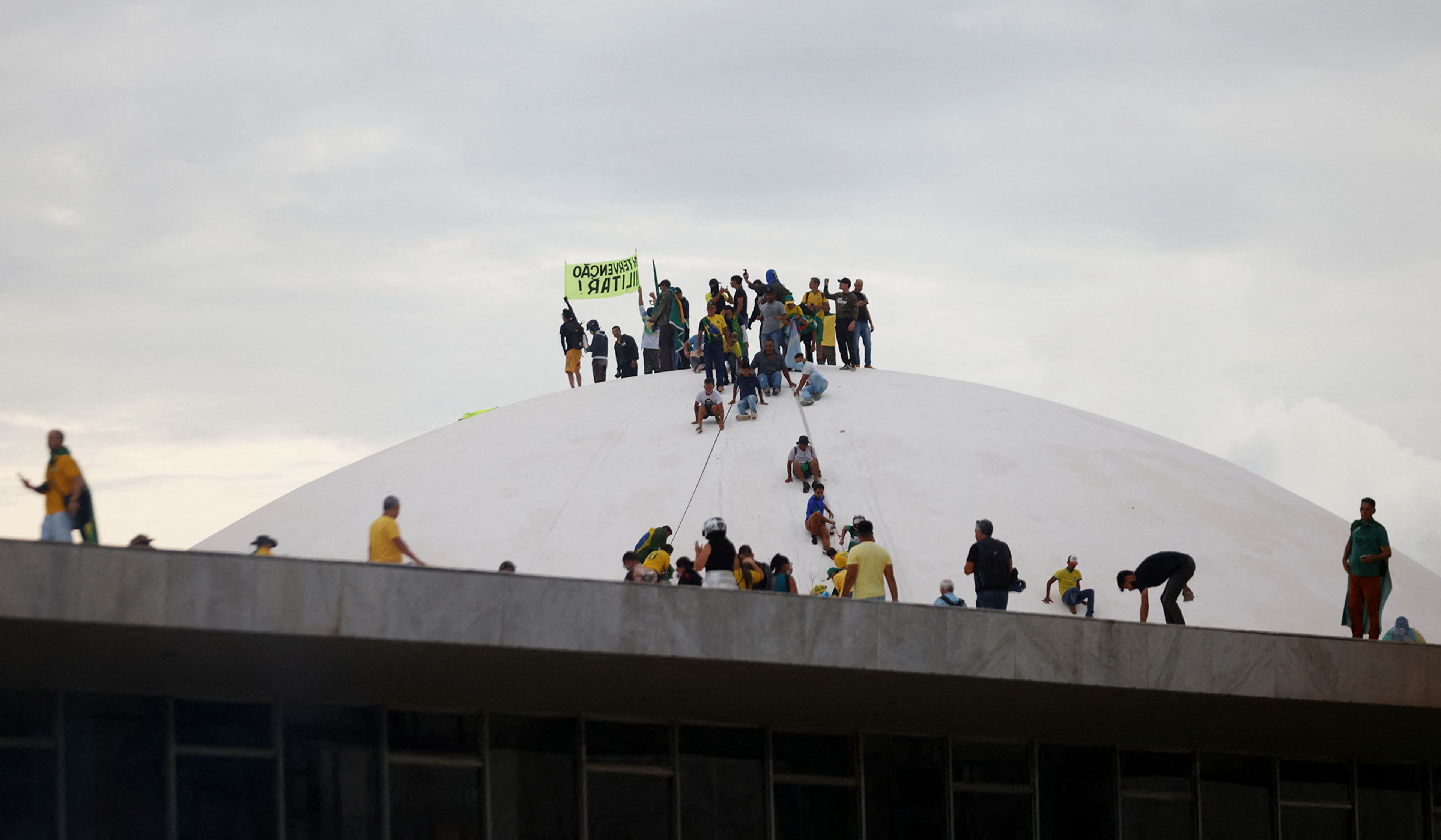

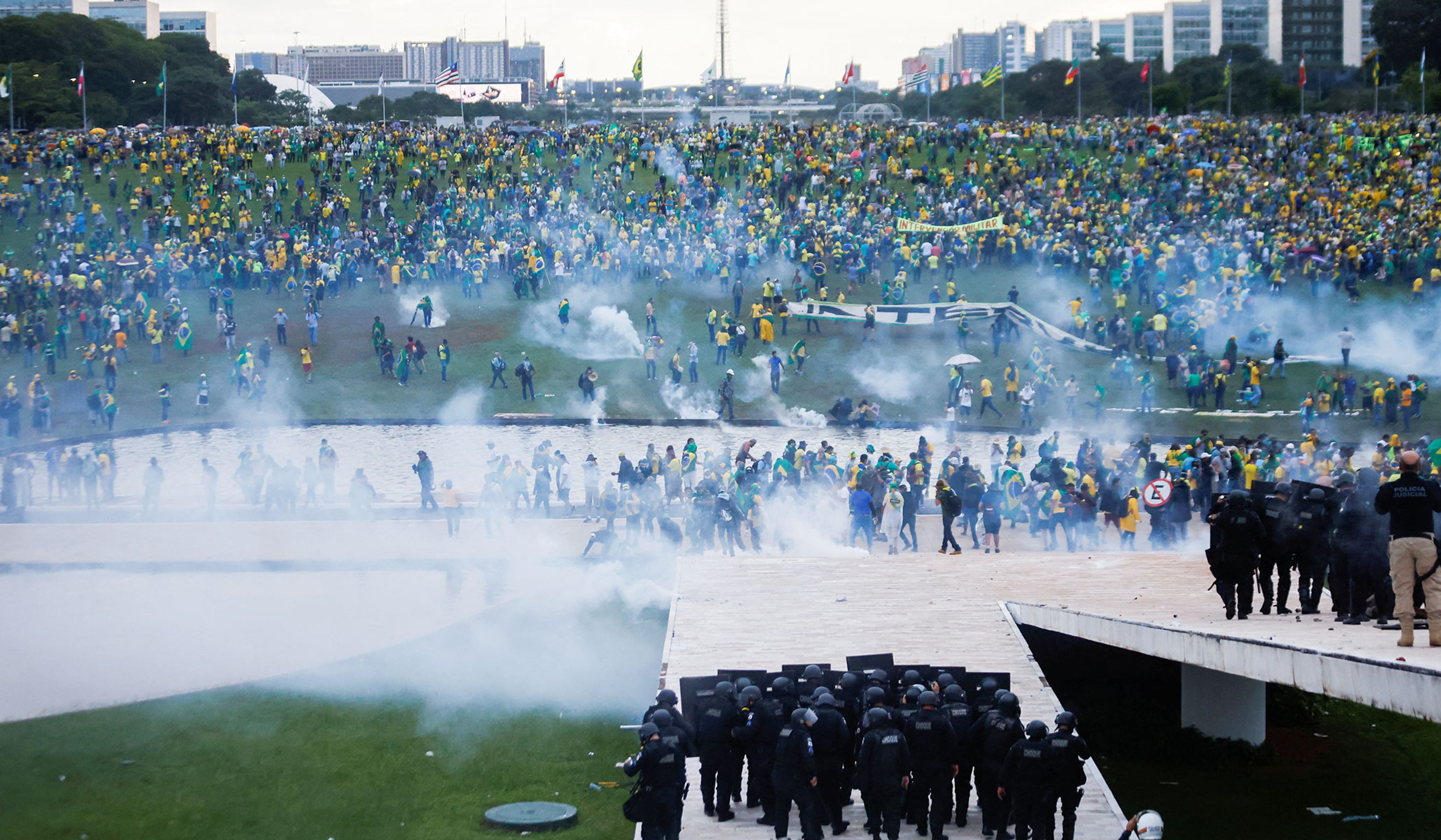
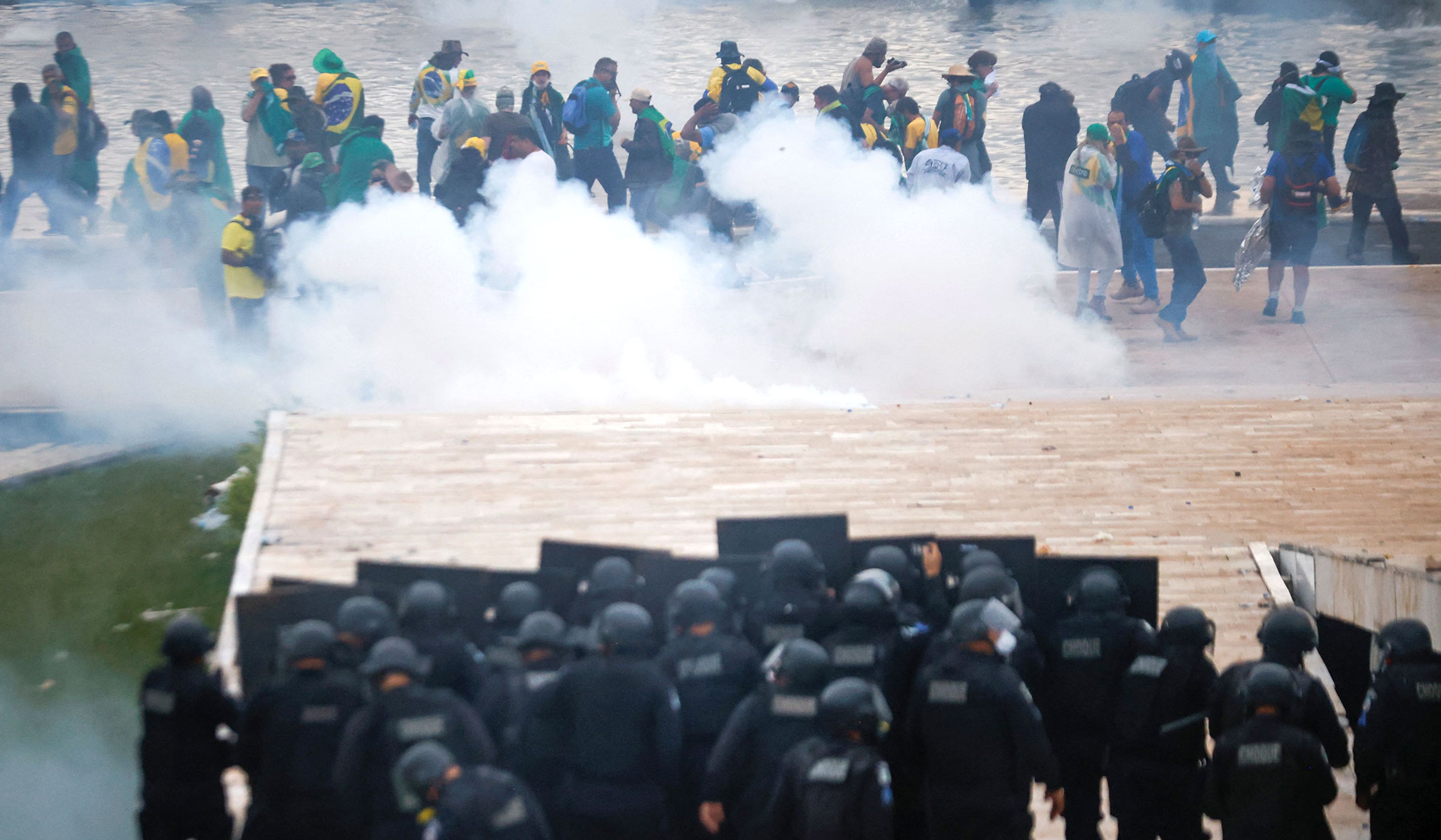

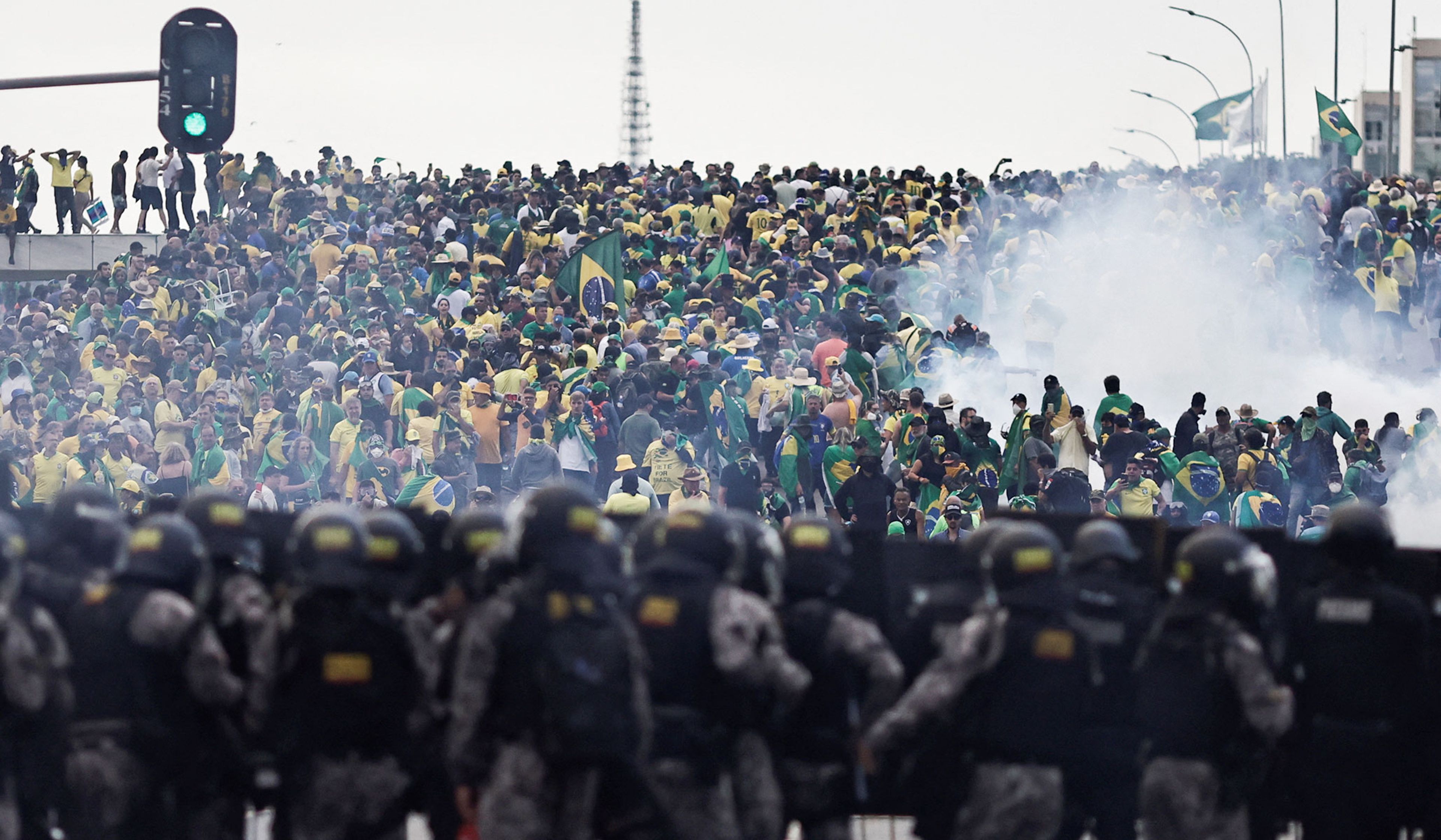
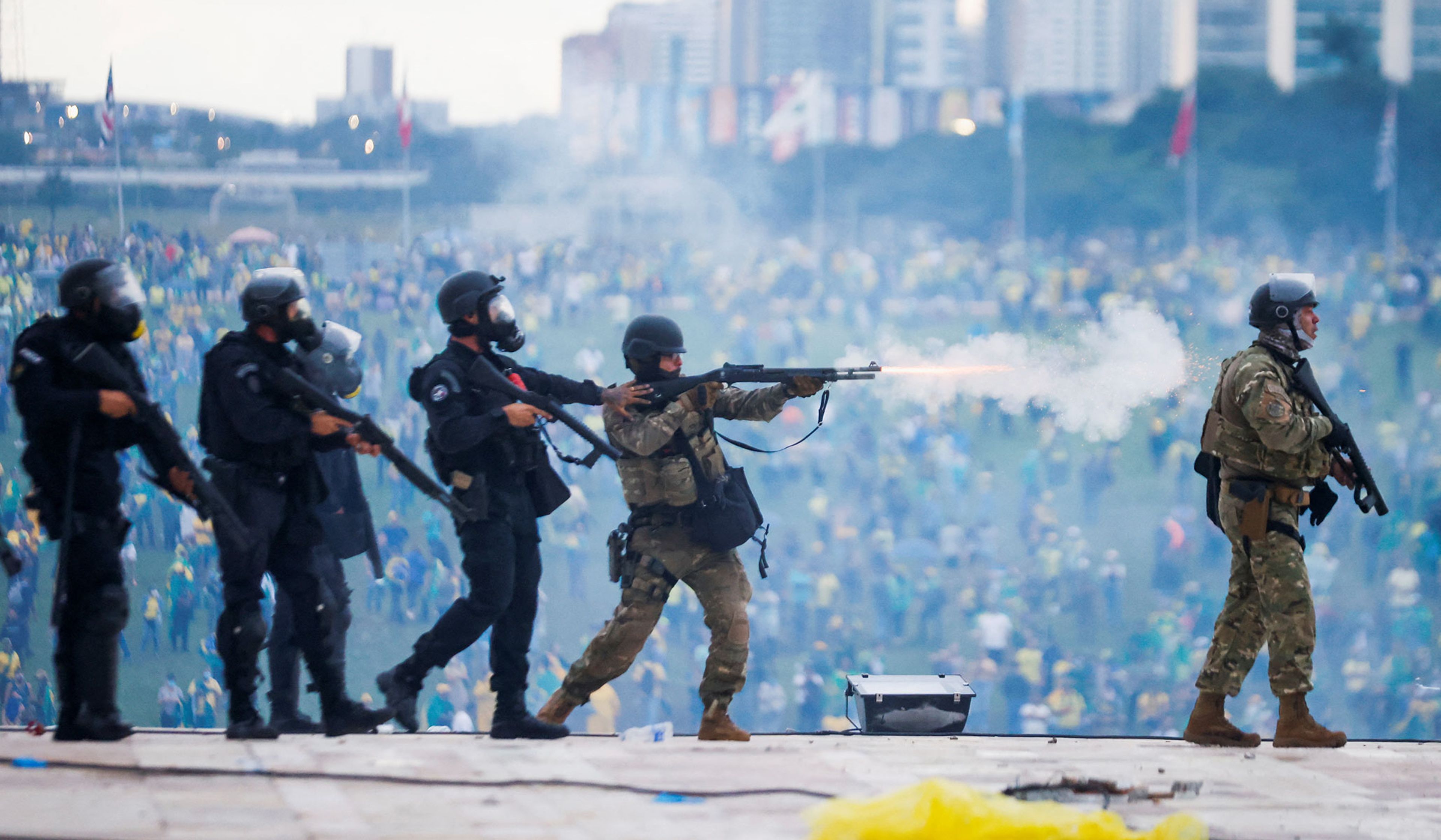


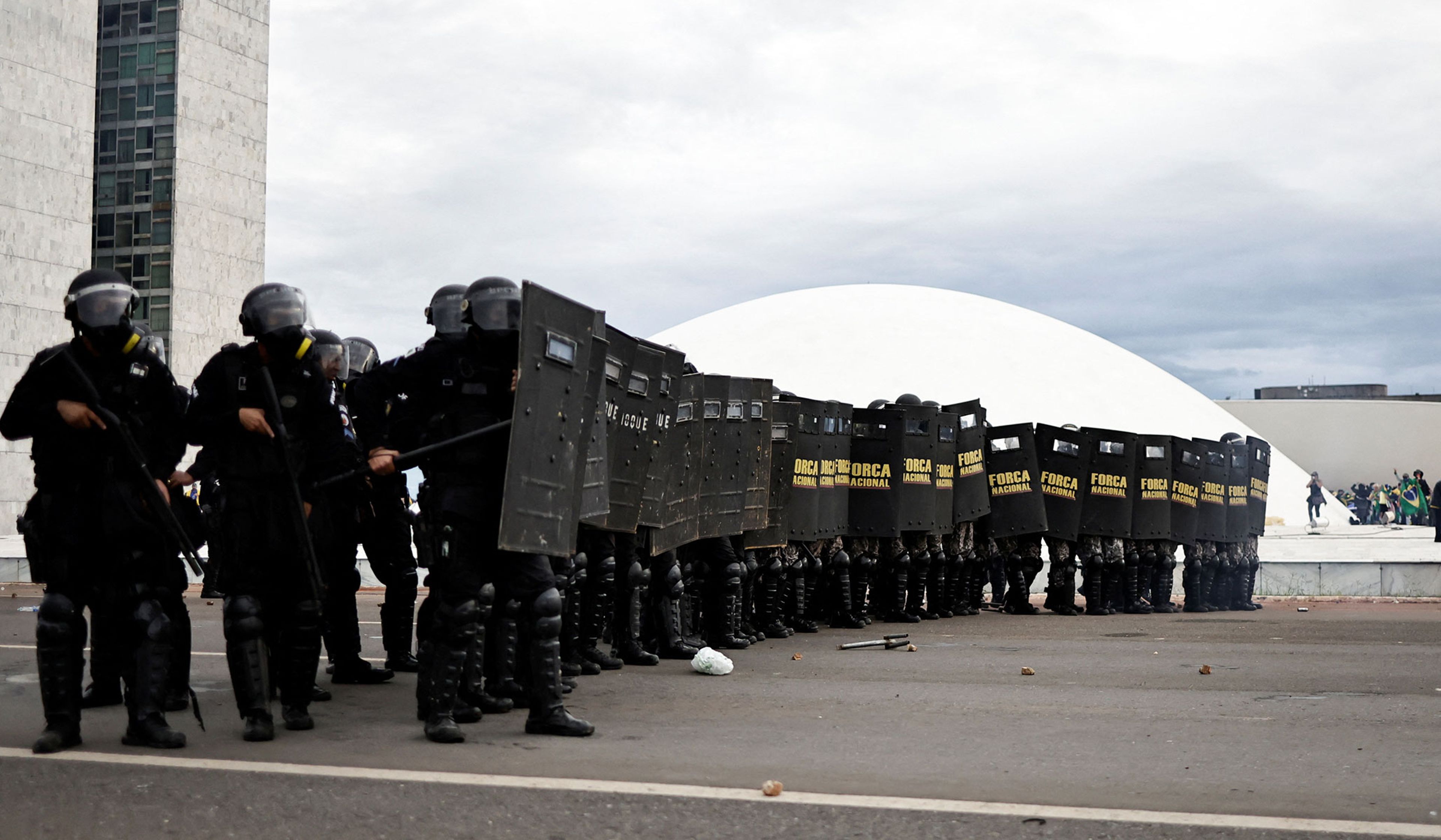
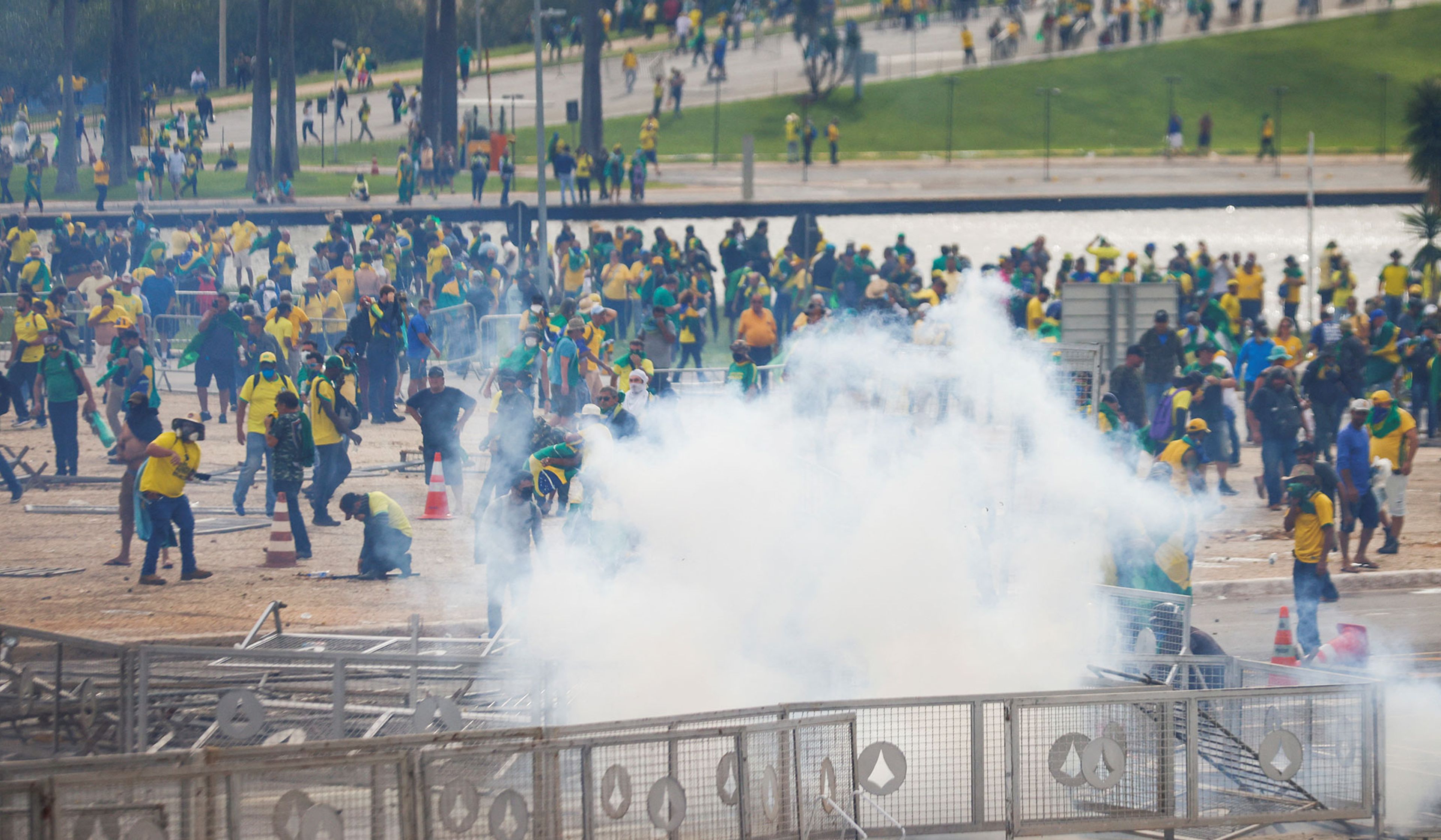
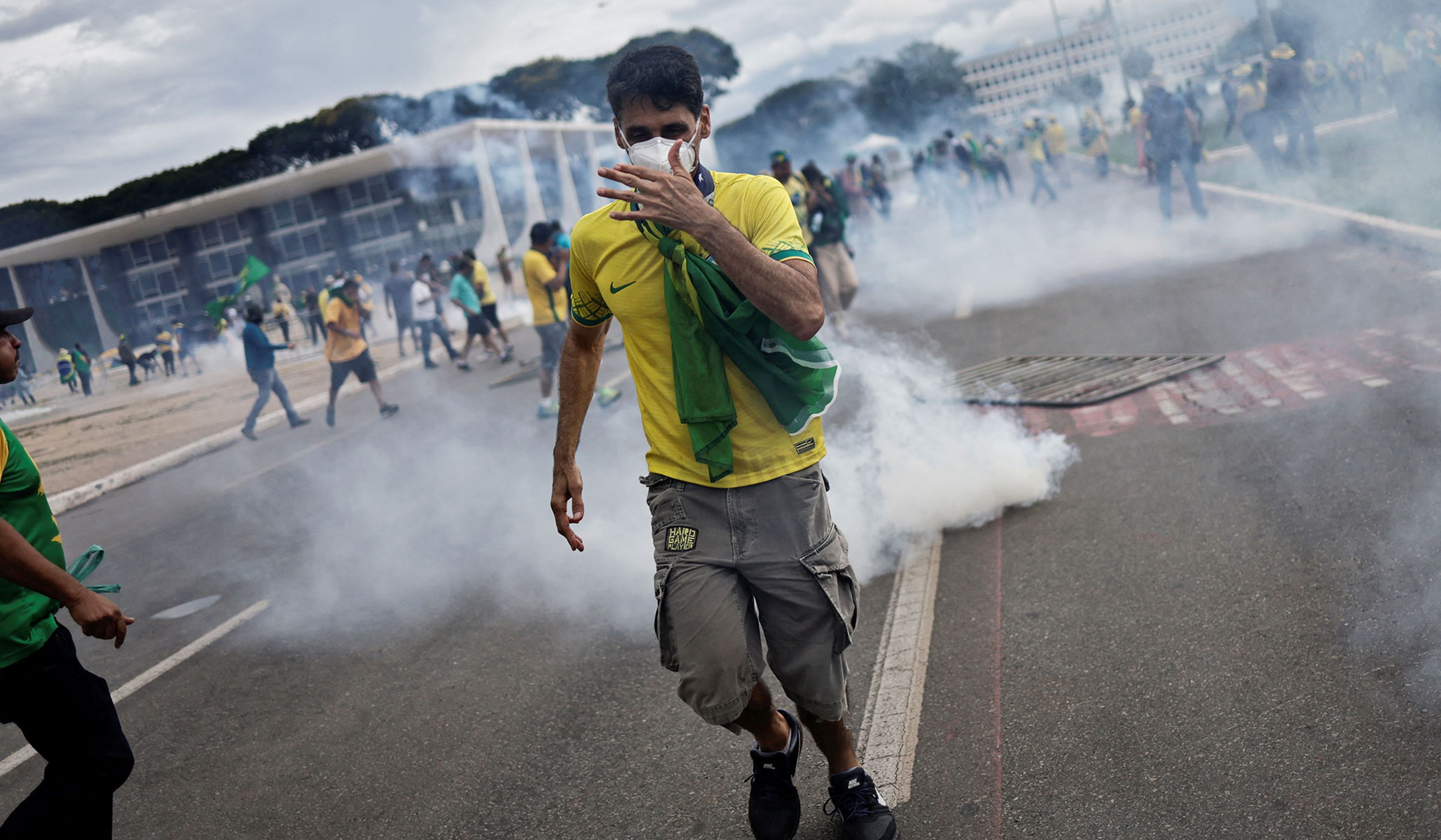
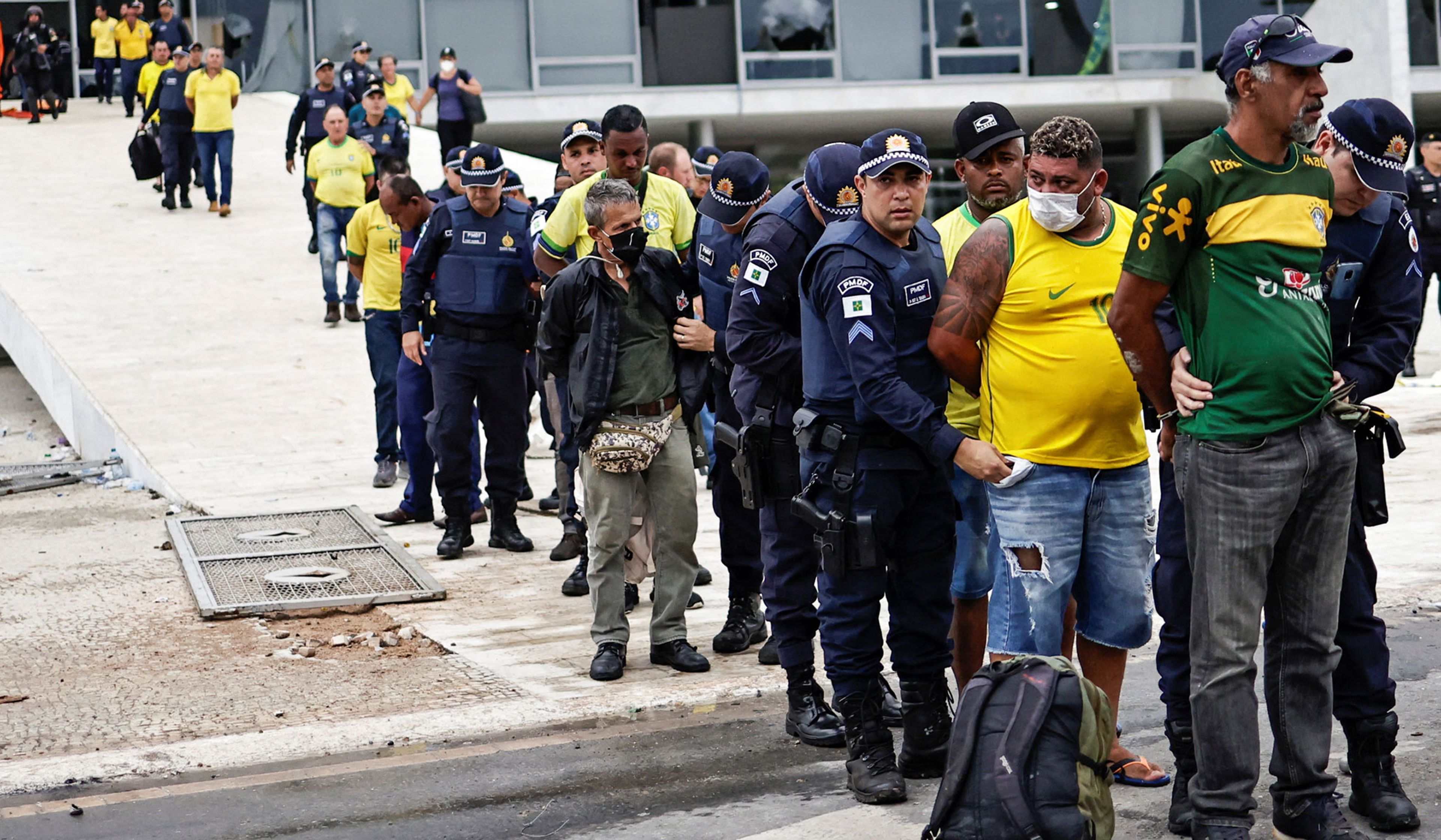

Security forces operate as supporters of Brazil’s former President Jair Bolsonaro demonstrate against President Luiz Inacio Lula da Silva outside Brazil’s National Congress in Brasilia, Brazil, January 8, 2023.
Adriano Machado/Reuters
• The West should worry about the opportunity that the switch to electric vehicles (EVs) is offering China (as Andrew Stuttaford explains in our cover article). Its EVs are already winning market share in Europe. More important, China has established a dominant position the whole way down the EV supply chain. Western companies are responding by building their own battery-manufacturing plants. But these plants will need raw materials, including various essential metals to which China has managed to secure access and of which it controls most of the processing. Making matters worse, these metals include rare earths, and China has the world’s largest known reserves of them. So it matters that a Swedish company, LKAB, has discovered a massive deposit of rare earths in Europe. It’s also a test. Europe and the U.S. must establish reliable EV supply chains of their own. This will include opening new mines, despite inevitable environmentalist protests, and doing so quickly, given the possibility of a supply squeeze if EV sales soar. How quickly LKAB can proceed will be one test among many of whether the West is serious about breaking free from yet another area of dependency on China.
• In December, the Scottish parliament passed a bill establishing a policy of self-identification alone as the requirement to change legal gender. The new bill would lower the minimum age for changing one’s legal gender to 16 years old, shorten the waiting period to make that change to as little as three months, and remove the requirement for a medical diagnosis of gender dysphoria. As with all bills passed in Scotland since the devolution of limited powers in 1999, it needs “royal assent” before it can become law. In an unprecedented move, however, the U.K. government blocked that process. Its Scottish secretary, Alister Jack, justified the intervention on grounds that the bill could invite “more fraudulent or bad faith applications” and cause “chilling effects on single-sex spaces.” Moreover, he argued, the bill’s effects would not be limited to Scotland. Rather, it would have a “significant impact” on the entire U.K. “Significant complications” would arise “from having two different gender recognition regimes in the UK.” Nicola Sturgeon, Scotland’s first minister, a strong supporter of radical transgender ideology, described the U.K. government’s action as a “full-frontal attack on our democratically elected Scottish parliament.” She intends to use radical gender reform as a battering ram for independence. The likelier scenario is that this strategy will backfire, leaving her with neither.
• A Canadian artist has come up with a lucrative side gig: selling used copies of J. K. Rowling’s Harry Potter books with new, custom-designed covers from which the author’s name has been removed. The market consists mostly of transsexuals who are offended by Rowling’s nonconforming views on gender. That seems like a narrow-minded view of literature, especially at $170 ($1,200 for the full set), though if someone is willing to pay that much to be spared the sight of an author’s name, it’s their decision. But somewhere, He-Who-Must-Not-Be-Named is laughing.
• In early January, Damar Hamlin, a safety for the Buffalo Bills, suffered a cardiac arrest on the field during a game against the Cincinnati Bengals. After being treated on the field, Hamlin was taken to a local hospital, where he was intubated and placed in a medically induced coma. Unusually for the NFL, which insists that games be completed in all circumstances, the game was postponed and then canceled outright. Happily, Hamlin woke up three days later and is set to make a full recovery. But, alas, that hasn’t stopped the incident from becoming politicized. In some quarters, Hamlin’s collapse was reflexively blamed on the unacceptable dangers of football — which, we were told, had been left unaddressed thanks to inertia, greed, and even racism. In others, figures were quick to blame the Covid-19 vaccine — which has supposedly been felling professional athletes left and right. The truth was both more prosaic and more unusual. Having been hit at exactly the wrong time in his cardiac cycle, Hamlin had been the victim of commotio cordis, an extremely rare eventuality in which a sudden blow to the chest can stop the heart. The odds of commotio cordis happening are about the same as those of being struck by lightning and certainly not high enough to provoke broad conclusions. Sometimes, bad things just happen. Godspeed to Hamlin in his recovery.
• When Cardinal George Pell spoke, his flock and often the global church and the world sat up and listened. A sanguine man of firm convictions, he starred as a ruckman for his high school’s football team in Ballarat, an hour west of Melbourne, Australia. A career in professional sports beckoned. Unable to shake the “conviction” that God wanted him “to do His work,” he entered seminary in 1960 and was ordained six years later. He served as archbishop of Melbourne and Sydney and as a voice for Catholic teaching in the spirit of Popes Saint John Paul and Benedict XVI. In 2014, Pope Francis appointed Pell to head the newly created Secretariat for the Economy, where his job was to reform the Vatican Bank. Other Vatican officials opposed and resisted his efforts. He returned to Australia in 2017 to stand trial on several counts of sexual offenses that he was alleged to have committed decades earlier. The allegations withered under examination. In 2020, the High Court acquitted him of a charge for which he had spent 404 days in prison. He knew the Sorrowful as well as the Glorious Mysteries. Dead at 81. Requiescat in pace.
• “Awake when others are sleeping” and “asleep when others are awake,” the poet is “a man about to be hanged cracking a joke,” Charles Simic wrote in “How to Psalmodize,” a poem. And what is a poem? “A piece of meat / Carried by a burglar / To distract a watchdog.” The dark humor of Simic’s elders in Belgrade during World War II impressed him. He crossed the Atlantic in the 1950s and moved with his family to Chicago. “Our winter afternoons have been known to last a hundred years,” he wrote in one of the weird and whimsical paragraphs, or prose poems, in The World Doesn’t End (1989), which won a Pulitzer. The Library of Congress appointed him poet laureate of the United States for 2007. His bibliography includes more than 30 collections of poetry and ten books of essays and memoirs. In more than a dozen volumes, he translated Serbian poets into English. In his introduction to one, he calls Serbian and English his “two mothers, or just one mother speaking from different corners of her mouth like some wonderful Byzantine icon.” Dead at 84. R.I.P.
• World War II had many villains and many heroes. One of the heroes was Adolfo Kaminsky, who knew how to forge documents. This enabled him to save thousands of lives — specifically, those of Jews in France. He was once asked to produce 900 documents for 300 children. Time was of the essence. As recounted in a New York Times obituary, “he toiled for two straight days, forcing himself to stay awake by telling himself: ‘In one hour I can make 30 blank documents. If I sleep for an hour 30 people will die.’” Adolfo Kaminsky has died at 97 in Paris. R.I.P.
• Paul Johnson had a Buckleyan output, writing more than 50 books and thousands of articles. WFB once warned that Johnson should not be penalized, or underrated, because of his productivity, or because of his routine excellence. (Jay Nordlinger quotes WFB on this in an appreciation of Johnson that appears in this issue.) Johnson was an English historian and journalist, born in 1928. He wrote some very, very big books: Modern Times, A History of the American People, Art: A New History, etc. He also wrote many slenderer books, including late-in-life bios of Socrates, Darwin, and Jesus. He was a prodigious researcher and a wonderful prose stylist — a literary artist. He was entertaining, as well as pedagogical, both in print and in person. He was a prized guest on NR cruises. On top of everything else, he was an ardent champion of freedom, and of Anglo-American liberties in particular. In 2006, George W. Bush hung around his neck the Presidential Medal of Freedom. They liked each other a lot. Paul Johnson, who helped millions understand the world more clearly, has died at 94. R.I.P.
A New Speaker, at Last
Kevin McCarthy became speaker of the House on the 15th ballot, after the last few Republican holdouts agreed to vote “present.” The spectacle, and the deals McCarthy made to end it, are said to have weakened him at the start of his tenure. But this is to mistake cause for effect. He has a narrow margin, and a small group of Republicans can get attention and other political prizes by thwarting the rest of the party.
Some of the concessions McCarthy made are smaller than they appear, and some are salutary. In the latter category are the fiscal reforms. The House now will supposedly vote on all twelve individual appropriations bills and require 72 hours for members to review bills, provisions aimed at ending the horror-show “omnibus” spending bills routinely presented as “must pass” legislation hard against some deadline or holiday.
McCarthy also agreed that fiscal year 2024 domestic discretionary spending will be no higher than it was in fiscal year 2022. Defense hawks worry that this will inevitably put the Pentagon budget on the chopping block. But if the House was going to attempt any fiscal discipline whatsoever, hawks were going to have to fight to protect their priorities.
The House Freedom Caucus also secured additional seats on the all-important House Rules Committee, which speakers use to move their agenda. This is a significant diminishment of McCarthy’s authority. Ideally, it will lead to a less centralized approach in the House, where committees have been effectively neutered over the years and there’s been a lack of policy entrepreneurship among members. But it also creates the possibility of hostage-taking.
Representative Chip Roy (Texas) pushed for many of these changes and has a compelling vision for how the House should work, with individual members having more power to reduce federal spending. He played a commendable role in the speaker fight, including, importantly, taking “Yes” for an answer.
Representative Matt Gaetz (Fla.) led a more destructive faction, one that shows no concern for the party or any ideological or other goals besides the next cable hit and fundraising email. Its main victory was McCarthy’s agreement to allowing any member to move to vacate the speaker’s chair. But any move to oust McCarthy that had a chance of success would have been able to meet the old threshold for calling a vote.
The next obvious moment of peril for him, and the caucus, is the looming fight over the debt limit. Republicans want spending cuts in exchange for raising the debt limit later this year. Seeking concessions is reasonable, but the party should be realistic about what can be achieved without control of the White House and the Senate. And what can be achieved will be smaller still to the extent Republicans are divided.










Comments