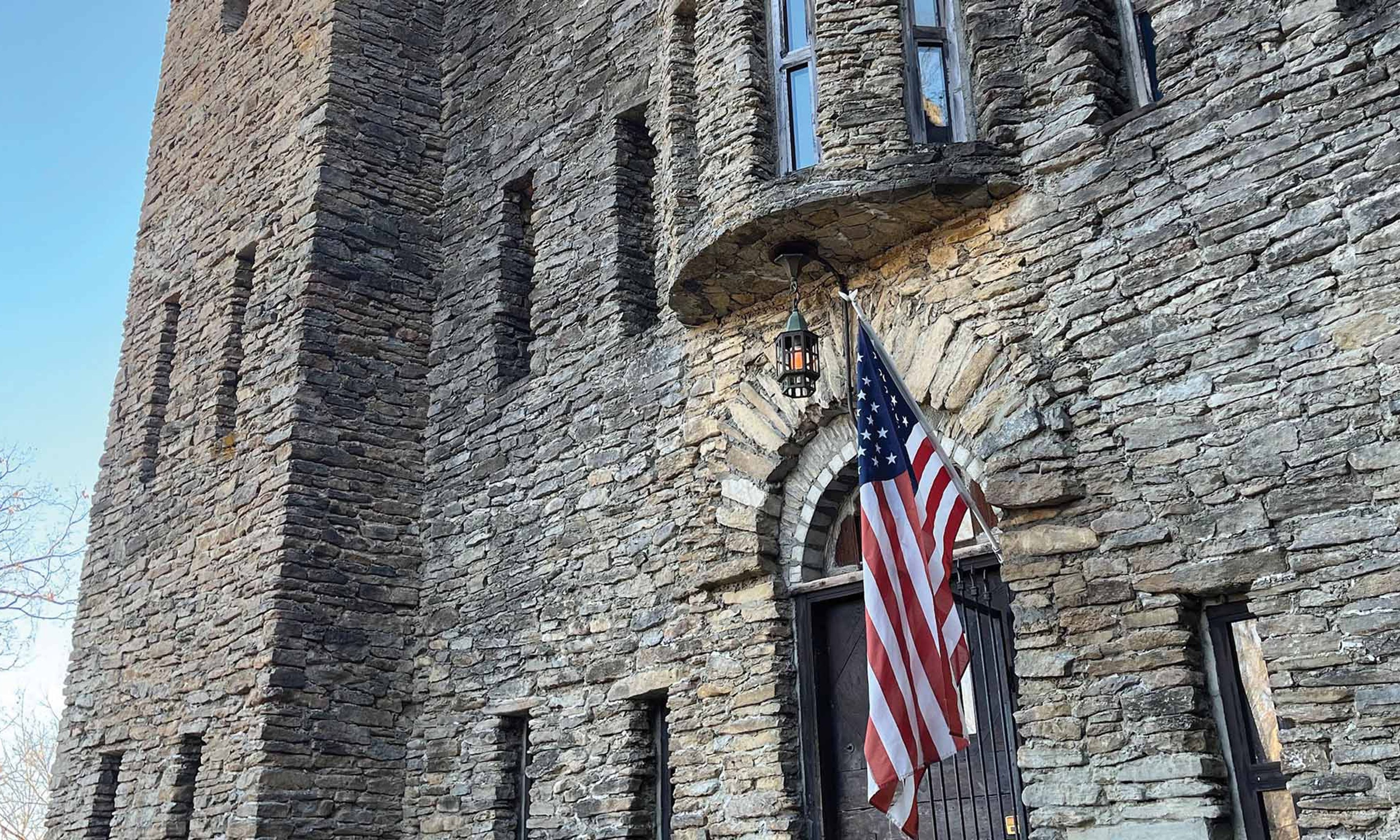
Loveland, Ohio — The bottom of a hill might seem like a strange place for a castle. Loveland (where I am from), a small town northeast of Cincinnati, may seem stranger still. Yet here, along the banks of the Little Miami River, sits Chateau Laroche (Rock Castle), a.k.a. the “Loveland Castle.”
Obvious questions arise from the presence in a modern suburb of a structure — stone walls, towers, and all — that seems a better fit for the Middle Ages. Who built the Loveland Castle? What is it doing here? How does it endure into the present day? The answers to these questions establish Chateau Laroche as a testament to the sprawling eccentricity and wonder that make this country great.
The story of the Loveland Castle begins with Harry Andrews. Born in 1890 in Oneonta, N.Y., Andrews was a precocious child, showing from a young age an interest in knights and building with stones. As a boy in school, he said to an interviewer in 1979, he would “tell the teacher even things he didn’t know about castles.” He attended Colgate University, majoring in economics, sociology, and architecture. He had a photographic memory and an IQ of 189.
World War I changed his life — but first, it nearly ended it. Drafted, Andrews went to boot camp at the then-new Fort Dix. Which is where he died. He became one of many to suffer in a camp outbreak of meningitis. Not long after his symptoms appeared, he was declared dead and taken to the morgue. But on the operating table, as doctors made an incision, they found something strange: He was bleeding. Thinking he might still be alive, doctors acted quickly, injecting him with adrenalin. “I heard one of the doctors say, ‘Let’s see if we can start his heart with this new stuff,’” Andrews, who said he was conscious but unable to move during this whole ordeal, told the Cincinnati Enquirer decades later. It worked. He was improbably, steadily returned to health. And he served as the basis for a treatment used on other meningitis patients at Fort Dix, becoming, he said, as a glorified “blood bank” for them.
Once convalesced, Andrews served overseas. But the eccentric young soldier, already entranced by the Middle Ages, objected to the war. He was a unique kind of pacifist, however. “Opposed to modern weaponry but not warfare itself, he was a conscientious objector,” reads the account of Loveland Castle in Weird Ohio: Your Travel Guide to Ohio’s Local Legends and Best Kept Secrets. That is, he “didn’t believe in guns,” says Sir Thomas Bell, one of Loveland Castle’s knights (about whom more later) — even though he received a commendation for marksmanship during his training. So he became a medic. Much of his service was in France, where he was enchanted by the old castles he saw. Including one, Château de la Roche, that Allied forces had converted into a military hospital. He lingered in Europe after the war, earning two more degrees: in medieval and French architecture, from Toulouse University in France. (His instruction was doubtless made easier by his fluency in seven languages.)
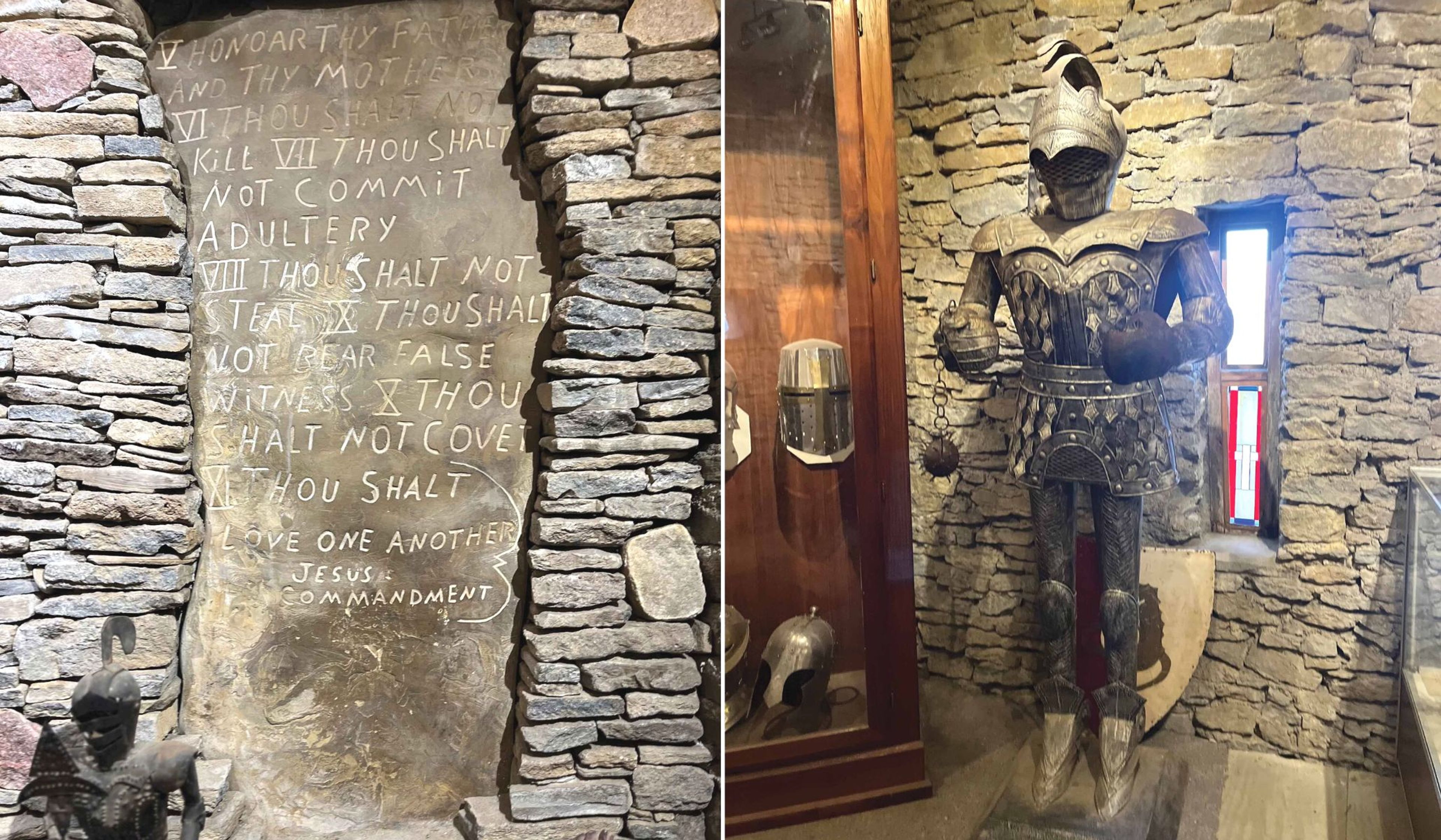
Returning to America after his further education, Harry Andrews settled in Ohio. He taught at a local school, and as a Sunday-school instructor at a nearby church he focused mostly, almost obsessively, on the Ten Commandments, which he believed were essential, especially in the 1920s. He believed that dark times were ahead and that only medieval and biblical virtues could prepare us for them. Inspired by his lessons, some of Andrews’s students formed the Knights of the Golden Trail in 1927. “They thought America was on the downslide and they wanted to save it,” says Sir Dave Hope, another castle knight. (The knights take a solemn vow to live in accord with the Ten Commandments.) Noticing a deal in a local paper, the knights purchased the land on which the castle now sits.
They used the space to camp, fish, swim, and boat. But the tents they put up didn’t last long. Besides, such housing was inadequate for a group of modern-day knights. “We decided we wouldn’t be real knights unless we had a castle,” Andrews said.
So he started building. The castle project commenced on June 5, 1929. He undertook the laborious process mostly by himself, using rocks from the nearby river. He and others, including the knights and assorted (typically young and male) aides, hauled bucket after bucket onto land and assembled the structure piece by piece. Additional equipment was sometimes “sledded” down the steep hill below which the steadily growing castle stood: a difficult endeavor in the days before there was much of a road to speak of. Difficulties abounded, though mostly of time: The Great Depression, World War II, and Andrews’s other jobs — outside the school year, he was a building inspector for Hamilton County and also worked for a publishing company — for many decades limited him to only about an hour a week to work on the castle.
He retired from his publishing job in 1955 and was able to devote far more time to the castle. That same year, he finished enough of one section of it to be able to move into the structure permanently. It wasn’t always comfortable. According to a brochure written in 1981 and available at the Loveland Castle, “camping was a bit ‘tough’ in the winter with no accommodations other than what the first settlers had.” Andrews “heated the one room by fireplace, after cutting wood by hand.” He was also occasionally harassed on the property; some local ruffians tried to break down its door, and others once beat him and left him for dead. He persisted through the adversity.
Through 1981, about 56,000 buckets of stones had gone into the structure, thousands of sacks of cement, 32,000 bricks (which he made by hand, using milk cartons as a mold), 22,000 hours of working time, and, surprisingly, only about $12,000. Present-day estimates put the number of rocks used at about 600,000. He had help over the years, but it was largely a solitary effort. “Sometimes I don’t feel like it,” Andrews said when well into his 80s and continuing to work assiduously on the castle. (He credited his spry longevity to his never having smoked, drunk, or married.) “But I work just the same.” Though he had made great progress by 1981, much work remained; he planned for the knights to continue the castle if he died before it was completed.
The day of that contingency came unexpectedly. In 1981, Andrews was burned badly in a garbage fire on the property. Skin grafts placed on his legs after the blaze didn’t take, leading to infection, and to doctors’ recommending amputation. But this was unacceptable to him. “He couldn’t go back to his castle without legs,” Sir Dave says. Fearless, he decided to suffer through the infection. “He had been dead once, so dying again would be nothing to Harry.” But die again he did, with his precious castle having taken on much of its current shape but still incomplete.
The Knights of the Golden Trail had to decide what to do next. They chose to keep the doors open, and to keep the castle for themselves. Though Andrews had willed it to the knights, who were incorporated as a nonprofit in 1973, he left open the option of letting the state take ownership of the castle. Choosing the former course meant selecting a new overseer of the group and of the castle itself, as well as resisting aggressive efforts by the local government to take over the property. Their resistance was aided by the establishment of a haunted house (naturally) on the property, which paid for the construction of a parking lot, allowing the castle to operate as a museum.
Today the castle is open during specified hours to any visitors willing to pay a $5 entrance fee. They can wander in and out of its main room, accessed via a three-part door made with 238 pieces of wood and 2,350 nails. There is a gift shop and the kitchen and office as Andrews himself left them. Visitors can explore the inner and outer courtyards, dining room, chapel, armory, and dungeon (with fake skeleton). And they can look upon (but not access; knights only) a flat roof with battlements. In its rooms, they can find swords, suits of armor, artwork, and pieces of castle history, much of it donated by the knights themselves.
Built onto part of the hill that one must descend to access the structure, the multistory castle is navigable by climbing the spiral stone stairs or by meandering through the garden (complete with Loch Ness monster–style rock sculpture) alongside. Though Andrews had the foresight to wire the place for electricity (with oil-based heating, since replaced by propane), there is still no indoor plumbing (though two portable toilets are available on-site, right next to a medieval-style stocks). It is a realization of Andrews’s vision. But it’s not quite finished. Lady April Dobbratz describes plans for further renovation as “a work in progress,” adding that “everything here is.”
Today, it is knights such as April (who address one another as “Sir” and “Lady”) who are responsible for maintaining the castle. Many have pasts connected to the castle or even to Andrews himself. April’s father was Forrest McRoberts, a longtime knight, who went by “Sir Frosty.” As a child, Sir Dave helped Andrews — the “nicest old guy you ever met,” he says, and “almost like a big kid” — haul up buckets of rocks and even occasionally guarded the place when Andrews was briefly away. (Andrews advised his guardians: “If any drunks, punks, or river rats come down here, you’re to pour water on ’em.”)
Sir Dave also owes his status as a knight to an awkward encounter with Sir Frosty. As a high schooler, Dave suggested the area of the castle as a place for him and some friends to hang out and drink one night. Not long after arriving, an older man angrily shone a flashlight on them and beckoned them inside. Expecting punishment, Dave and his friends instead came to an agreement over beers with Sir Frosty: He’d be willing to forget about this, he said, if they would serve as characters for the castle’s haunted house. They agreed. “We had so much fun, they couldn’t get rid of us — they knighted us,” Sir Dave says.
Sir Thomas’s entry into knighthood began when a friend, already a knight, asked for his help with a castle-maintenance project. After that, he “just got hooked,” eventually becoming a knight himself. This endeavor entails a yearlong trial period, mostly involving assisting on castle-maintenance projects while other knights get to know you. After that, a knight in good standing can sponsor your membership. After four years, one can become an executive officer. “We just keep Harry’s dream alive,” Sir Dave says.
Harry’s dream is now a famous local landmark, albeit one that locals sometimes overlook. Some Loveland visitors, seeing the place for the first time, are in awe. “I’ve lived my whole life here and never heard of this place,” Lady April paraphrases their reactions. Curious signage pointing in the direction of “Chateau Laroche” dots the area. There’s even a local skating rink, called “Castle Skateland,” that was designed and named in tribute to the castle. Visitors come from near and far to check it out, do photo shoots, hold the occasional wedding, participate in wine tastings, or even investigate the place for paranormal activity. (The knights are open to the possibility that it is haunted, though not by Andrews himself.) On the day I visited, the guest book logged visitors from nearby Harrison and Hamilton, Columbus, and Wadsworth (40 miles south of Cleveland), as well as California, Orlando, and Toronto. Many have brought rocks of their own: Within the castle’s structure are stones from all 50 states and 40 countries. One is from space (a meteorite that landed in Wisconsin).
America is sometimes characterized as a country too young to have developed its own historical charms. Chateau Laroche and its creator, Harry Andrews, and the knights who keep it alive provide ample evidence that the opposite is true. Those of us who love this country know that in the abstract. But at the bottom of a steep hill along the banks of the Little Miami River in Loveland, Ohio, a castle is there to prove it.












Comments