The statistics around disaffiliation from the Christian churches should alarm every Catholic and every Protestant in our country. The mainstream Protestant denominations have been losing members at an astonishing rate for the past roughly 50 years, and the Catholic Church is, sadly, fast catching up. Fifty years ago, 3 percent of Americans would have claimed no religious affiliation, and today the number stands at 26 percent — and the figures only go up when we focus on the young. Around 40 percent of Catholics under 30 now identify as “nones.”
Myriad studies have inquired into the causes of this rapid decline and, of course, the story is complex. To be sure, the clergy sex scandals have played a role, as has the general mistrust of institutions in our society. But a careful reading of the findings discloses a handful of common questions, concerns, challenges that the disaffiliated give as reasons for their departure from the churches. They are, first, simply the difficulty in believing in God; second, the seeming impossibility of reconciling God’s existence with the presence of so much evil in the world; and third, the issue of the unique correctness of Christianity vis-à-vis the other great religions.
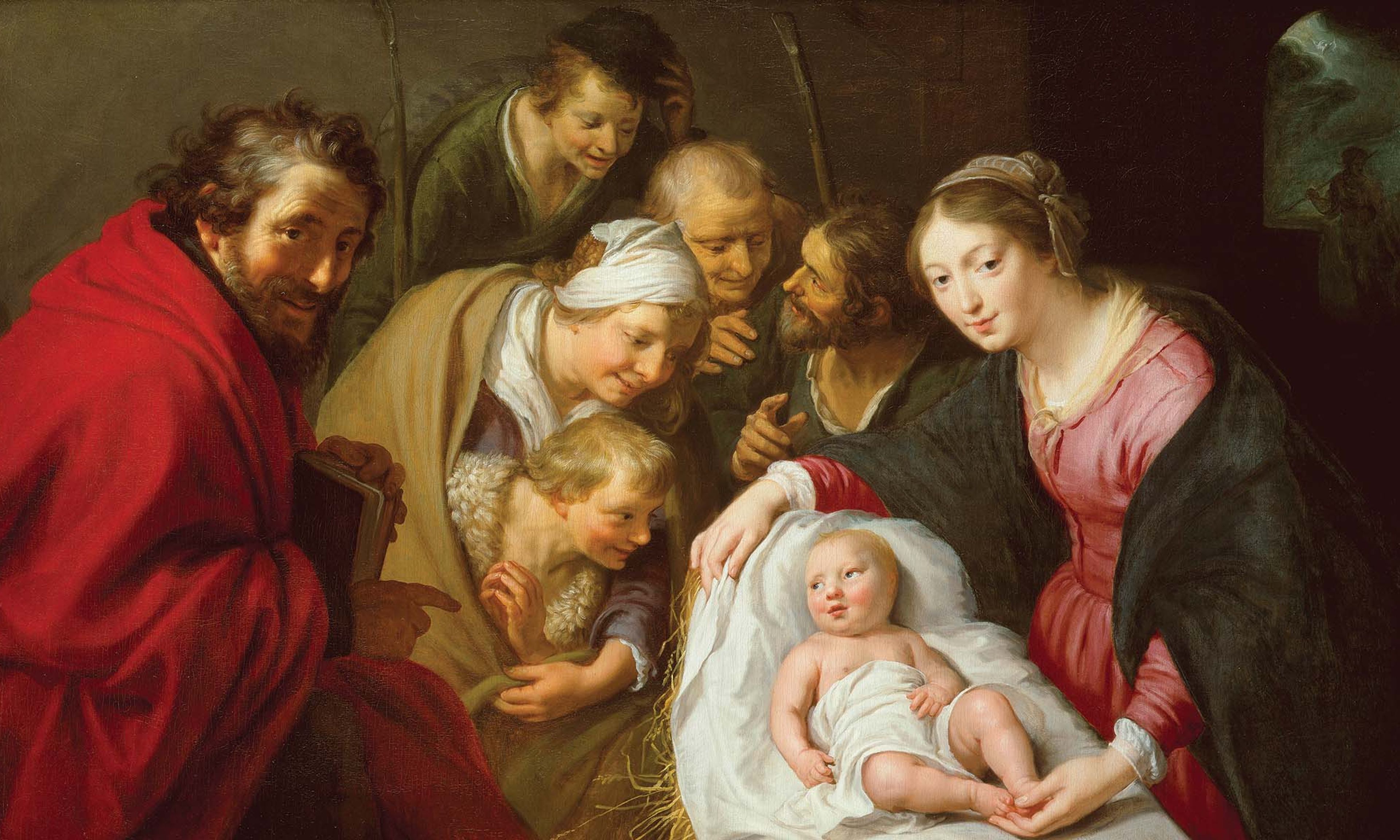
Might the feast of Christmas help us to address these matters, or at least to see them with fresh eyes? Consider first that a baby lies at the heart of the story. There is just something irresistibly attractive about a baby, a quality that serves to draw people together in shared fascination. The moment a baby is brought into the midst of a gathering, everyone drops what he was doing or saying and commences to coo at the infant. If two people were arguing, they would drop their tiff and probably endeavor to make funny faces at the child.
For the whole course of human history, God made himself known through the orderliness and rationality evident in nature. As the Psalmist put it, “the heavens proclaim the glory of God”; and according to Saint Paul, the invisible things of God are made manifest through the visible things of creation. And then, in the history of His chosen people, Israel, through covenant, prophecy, temple, and law, God spoke His word even more pointedly. Nevertheless, despite all of these manifestations, the human race remained tragically indifferent, even opposed, to the overtures of God. So, finally, in the fullness of time, God came as a baby, and we might be forgiven for speculating that this was simply to get the attention of the world in the most effective way possible. After Christmas, we are no longer looking upward to the face of God; rather, He is looking up at us from the infinitely charming face of an infant.
Now, once we have been beguiled by the infant of Bethlehem, might we revisit some of the particular concerns of the religiously disaffiliated. Let us address first the problem of God’s existence. Almost every atheist or agnostic today would say that the sciences have effectively disproved the existence of God. Like the Russian cosmonaut from the early Sixties who, having probed the realm of outer space, was reported to have said, “I don’t see any God up here,” skeptics today say that the natural sciences have so thoroughly accounted for the physical universe that there is no need to appeal to God.
That entire line of argument is predicated upon a category mistake, which is to say, the presumption that God is a being among beings, the supreme instance of the category of existence, the “biggest thing around.” But God is not in the universe, precisely because He is the one who made the universe in its entirety from nothing. Bertrand Russell, the greatest of the 20th-century atheists, once compared the quest for God to a search for “a teapot orbiting between earth and Mars,” and his disciples, the “new” atheists, took delight in likening God to “a flying spaghetti monster,” that is to say, some fantastic item within the observable universe and for which there is not a shred of evidence. But the true God, the one responsible for the existence of the physical world as such, cannot be anything like a teapot or flying monster. He cannot be, even in principle, a thing whose existence or nonexistence could be determined through empirical investigation. This is why Saint Thomas Aquinas typically refers to God not as ens summum (supreme being) but rather as ipsum esse subsistens (the sheer act of being itself). The point is that the sciences, geared necessarily to the examination of the observable universe, could never adjudicate the question of God’s existence. On their own terms, they could neither prove nor disprove it.
Now you might be wondering what this rather abstract musing has to do with the beguiling baby of Bethlehem. In a word, everything. The still-breathtaking claim of the Christian churches is that God became human and that He did so without ceasing to be God and without violating the integrity of the creature He became. In the baby of Bethlehem, two natures, divine and human, came together “without mixing, mingling, or confusion,” to employ the language of the Council of Chalcedon. And this means that God is not of a worldly nature, not a being among beings, for if He were, He would be in competition with other beings. Notice that an antelope can “become” a lion, but only by being devoured, and a desk can “become” a pile of ash, but only by being burned. But the God who is not the supreme being, not an item within the universe, can indeed become a creature in a noncompetitive, nonviolent manner.
One might consider, in this context, the Old Testament story of the burning bush. God spoke to Moses out of a bush that was on fire but not consumed. When the true God comes close to His creation, He does not do so aggressively. Nothing of the created order has to give way so that the divine might draw near. On the contrary, the proximity of God makes a creature more luminous and beautiful. This accounts, too, for the great Catholic affirmation of philosophy, art, politics, and friendship. None of them has to be suppressed or denied in order to embrace the spiritual life; rather, all of them are elevated to a higher pitch by the presence of the noncompetitive God. Pace the assumptions of so many of the disaffiliated, the sciences, as such, can tell against none of this.
A second major reason why people leave the churches is that they simply cannot understand how a good God could allow so much suffering in the world. There is, to be sure, a classical response to this problem, first formulated by Saint Augustine and then repeated by practically every major theologian since: that God permits evil so as to bring about a greater good or a good that wouldn’t have existed were it not for the evil under consideration. Sometimes we can see the truth of this — when someone realizes, for example, that he never would have gotten the job that he loves had he not been turned down, painfully enough, for a job that he originally applied for, or when a person understands that her terrible physical suffering produced marvelous spiritual and psychological growth. But to be fair, more often than not we don’t readily see the relationship between permitted evil and greater good. We are compelled to trust that the God who has lordship over all of space and time knows what He is about.
What gives us confidence to make that trusting move? Let us gaze again at the child of Bethlehem. When God became one of us, He didn’t appear as one of the grand and powerful of the earth, just the contrary. He appeared as a baby, too weak even to raise His own head, and surrounded not by sycophantic courtiers but by farm animals and shepherds. He had no wealth, no power, none of the goods of the world that make life comfortable. And in the poverty of the Bethlehem child, we see foreshadowed the Son of Man who would have no place to lay His head, the itinerant preacher, the Messiah nailed to a cross, abandoned by His friends, condemned by a corrupt government, left to die in agony. The point is that, in Christ, God entered into all of those conditions of suffering that bedevil human beings. He did not take them away (for in His design they had a purpose), but He deigned to embrace them with us, thereby giving us courage to bear them. We can trust God in the midst of our suffering precisely because God willingly suffered with us. If a baby is compellingly attractive, then how much more a baby in pain, threatened, deprived of comfort. This is the baby that God became.
A contemplation of the Christ child might also help to address the third concern of the “nones” mentioned above. How do we know that Christianity, among all of the religions and philosophies of the world, is “right”? It would require, obviously, a thousand-page tome to answer this question with even relative adequacy, but permit me to say something at least in defense of the claim that Christianity indeed holds out the greatest promise to humanity. When explaining the reason for the Incarnation, the fathers of the church routinely used a rather astonishing phrase: Deus fit homo ut homo fieret Deus, which can be rendered as “God became man that man might become God.”
These early theologians had far too keen a sense of the divine transcendence to think that any creature could turn into God or cease to be a creature, but they did indeed intuit that the purpose of God taking to himself a human nature was to elevate all of humanity into a real participation in the inner life of God, to become, in Saint Peter’s phrase, “sharers in the divine nature.” In the Middle Ages, Saint Thomas Aquinas did not hesitate to refer to the goal of spiritual life as “deification,” becoming conformed to God. Whereas classical philosophy might aspire to make human beings morally upright through education and habituation, and modernity might dream of political liberation and progress in scientific thought, nothing in these systems came close to the radical humanism on display in Christianity. The saint is not simply a person of great virtue or competence; a saint is someone who has commenced to participate in the very being of God, or — to put it in more precise, Trinitarian language — to share in the relationship that the Son has to the Father. There simply is no other philosophy or religion that makes a comparable claim or holds out a comparably compelling telos for human existence.
By way of conclusion, permit me to turn to a part of the Christmas story told by Saint Matthew alone. The narrative of the journey of the magi has captivated artists and poets throughout the Christian centuries, and perhaps it might speak a word to the “nones.” We know that there was a lively culture of stargazing among the Chaldeans at the time of Jesus, involving a combination of what we would consider both astronomy and astrology. Those ancient scientists were deeply interested in the patterns and harmonies that obtain among the heavenly bodies, but they were also seeking in and through those intelligibilities the will and purpose of God. It was the combination of science and theology that brought the magi to the Christ child.
As we saw, a common denominator among so many of the young people who have abandoned religion today is a reverence for the physical sciences, but sadly that devotion has led them to embrace the philosophical position of materialism. But this move is utterly unwarranted. Would that young devotees of the sciences today understood what their ancient forebears did, namely, that the objective intelligibility that is the foundation of all science is best explained through recourse to a great creative Intelligence that gave rise to it. Would that they would grasp, as Joseph Ratzinger put it, that Logos has a primacy over and against mere matter, or that they would at least be able to say, with Einstein, that “the most incomprehensible thing about the universe is that it is comprehensible.”
The magi looked down into the face of a baby lying in a manger and saw there, inchoately perhaps, the face of God. My Christmas prayer is that many seekers would look into that same captivating face and find at least the beginning of an answer to their questions about God.











Comments