Appleton, Wis. — Drop your gear. Say your name. Why’re you here? Thirty minutes of classroom instruction later, and there’s suddenly 489 pounds of machine between your legs. Some strains of Foucauldian film criticism consider motorbike imagery a phallic power arrangement. The reality is puritanical. There are a great deal of shalls and shall nots to motorcycling: you shall look into the turn despite your overwhelming desire to see where your wheels are in reference to the road’s edge, you shall not be an idiot or show up late to class. Learning to ride in Harley-Davidson’s backyard smacked more of boot camp in Great Lakes, Ill., than of Steve McQueen on the lam from the “cooler” in The Great Escape . . . and that’s probably for the best.
There may be no connection tighter than the one between the American military veteran and motorcycling, and that’s no accident. For one thing, bikes were mass-produced for World Wars I and II, which meant GIs were learning to ride and then had the chance to own a bike for not a lot of dough on the other side of the war, as thousands of bikes became military surplus. Harley-Davidson would not exist if not for that legacy and its repeated callbacks to its mid-century popularity. For another, the act of motorcycling provides for veterans the adrenaline fix that one tastes in and near combat. Once experienced, adrenaline, like sex, is tough to do without. Maybe most of all, riding is freedom to see the country a vet set out to defend at 18, knowing not much more about the place than his home address and the last four of his Social. The freedom bit has been especially true for me, having chafed at the Navy’s complete command of where I should be and the confines of shipboard life. It was time to learn how to ride and catch up to my little brother, already a qualified motorcycling instructor.
Raise the possibility of learning to ride in front of your grandmother or other polite society, and one can all but hear the needle scratch as conversation halts and all eyes fill with unease. A pronouncement of taking up semi-pro Russian roulette would be greeted with less consternation. The grisly stories of relations and acquaintances who met their ends off a county highway — up a particularly unyielding sugar maple or under the uncaring undercarriage of a Ford F-150 outside of Houghton — are manifold. The few in favor of your lessons will wait until you’re exiting the gathering to grab you by the elbow and, only then in a hushed whisper, support the motion.
That’s the thing about motorcycling — it’s a cult of steel and leather. Whether you’re on the smoke deck of the SS Badger or leaning on the wall at a house party, if another rider finds out you ride, you have a best friend for however long you need one. An invite to the garage is quick to follow, and an evening that promised no more than a nursed beer and bromides becomes reciprocal awe while examining a restored Italian-made Harley Sprint. It’s a small, committed club, and it’s never been more willing to add members as the primary cohort ages to canes and three wheels.
There were, as of 2022, under 10 million registered motorcycles in the country. Compare that with 300 million registered vehicles, and one can appreciate the minority position that bikes have on our roads. To be a biker is to be apart. Bikers call motorists “cagers” because of the cossetting framework separating drivers from the outside world. Our instructors at Harley — Austin (USMC) and Pete (U.S. Army) — also teach classes at the local tech school, and their primary concern is driving home the point that one must think differently when on a motorcycle. Nothing, not intersections, open two-lanes, a green light, or a following vehicle’s stopping, should be taken for granted. “Ride as if you’re invisible to everyone else on the road with you” is the modus operandi for the motorcyclus operarius.
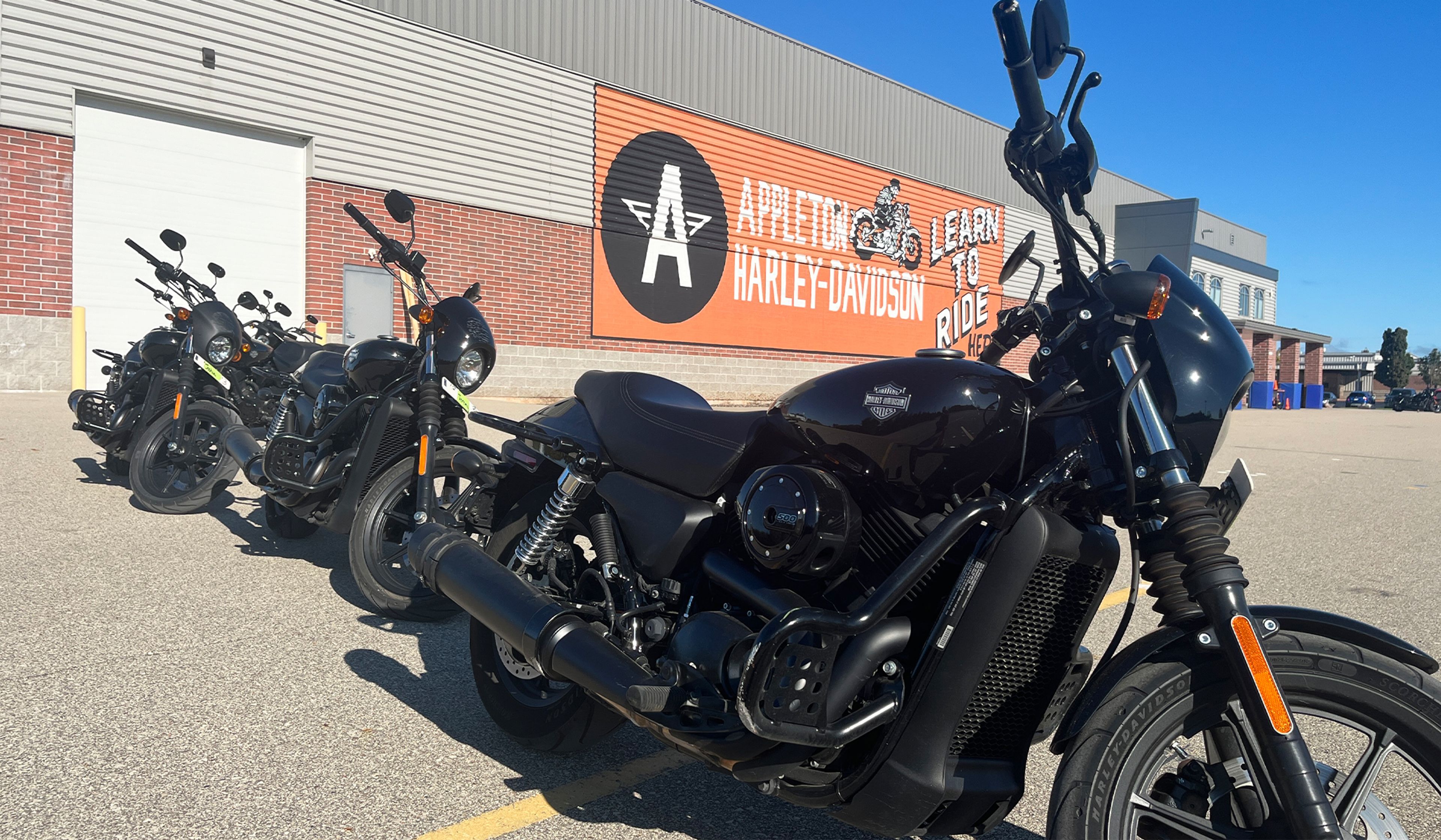
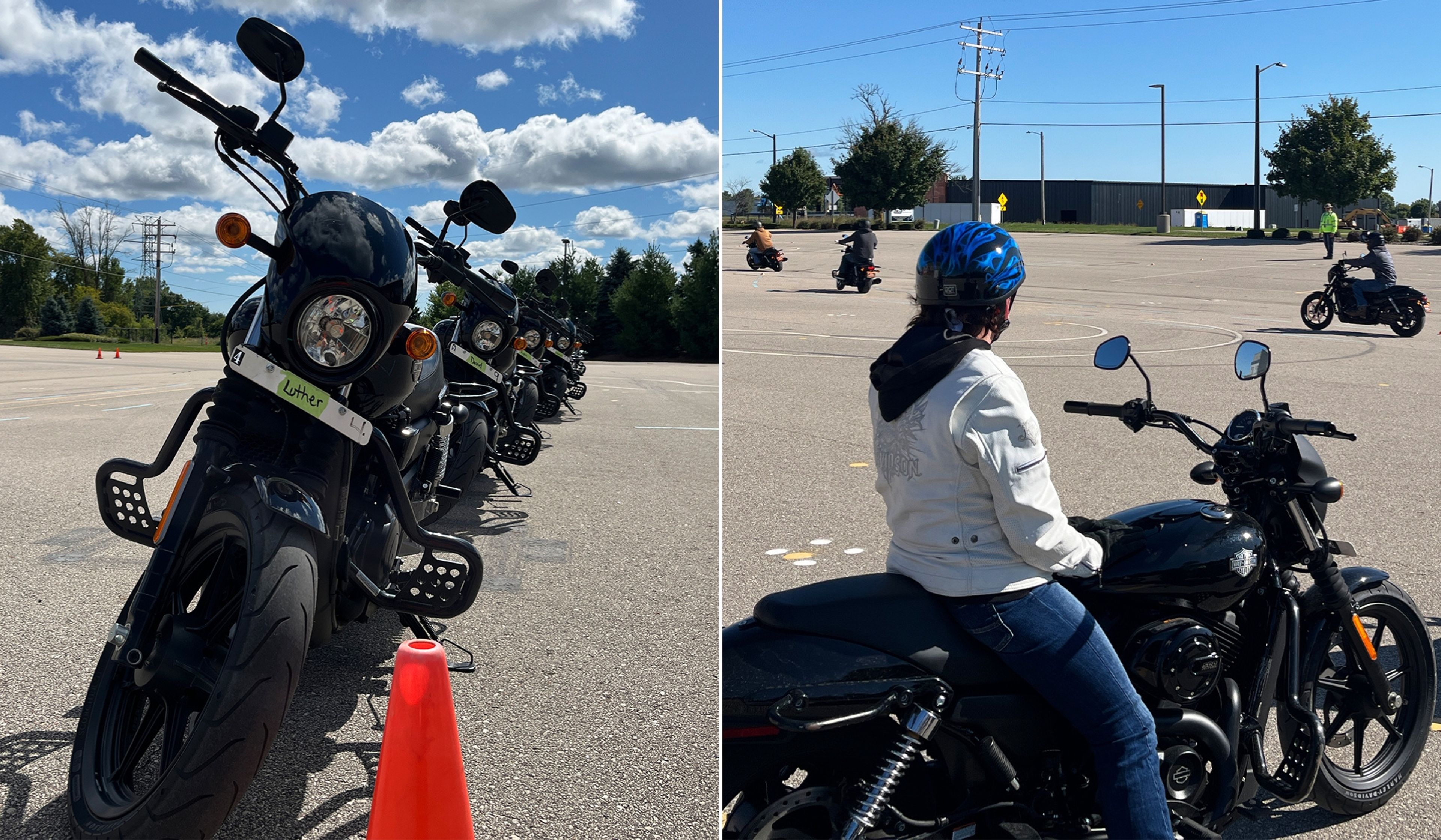
The course was two days, with a practical assessment at the end. My classmates were eclectic: among them a mother and son learning together, a woman who’d been in a motorcycle crash two years earlier and was testing her resolve to get back out there, a guy who promised his wife that he’d ride legal after 20 years off the books now that their first child was expected. We bonded over sore backs and lurching starts. The bikes we learned on, Harley Street 500s (motorcycle numbers denote the engine’s approximate displacement rather than weight), were as corporately rebellious as wearing jeans and a Huey Lewis shirt on a Tuesday, but their homogeneity allowed a novice to discern the friction zone (the position where the clutch and throttle begin to acknowledge one another) and keep things inside the lines. The final practical, composed of elements we’d practiced at higher levels of difficulty, was accomplished without a demerit, and there I was on a Sunday afternoon with nothing other than DMV business hours and a 25-question exam between me and bikes that could go from 0 to 60 in under two seconds and beyond 220 mph stock. Thrilling.
Not even knowing whether riding frequently was something I was sold on, I took to Facebook Marketplace, where most listings offered rose-colored assessments of a bike’s mechanical condition. Bikes tend to be owned for decades; people sell them either to make room for a teen child’s car or, later on, when a fella’s hips aren’t what they used to be. In the meantime, the bikes have probably sat for a good while as aspirational furniture. So I’m not saying it’s like showing up to buy a puppy and being given a 15-year-old dog’s urn, but I am saying it’s close.
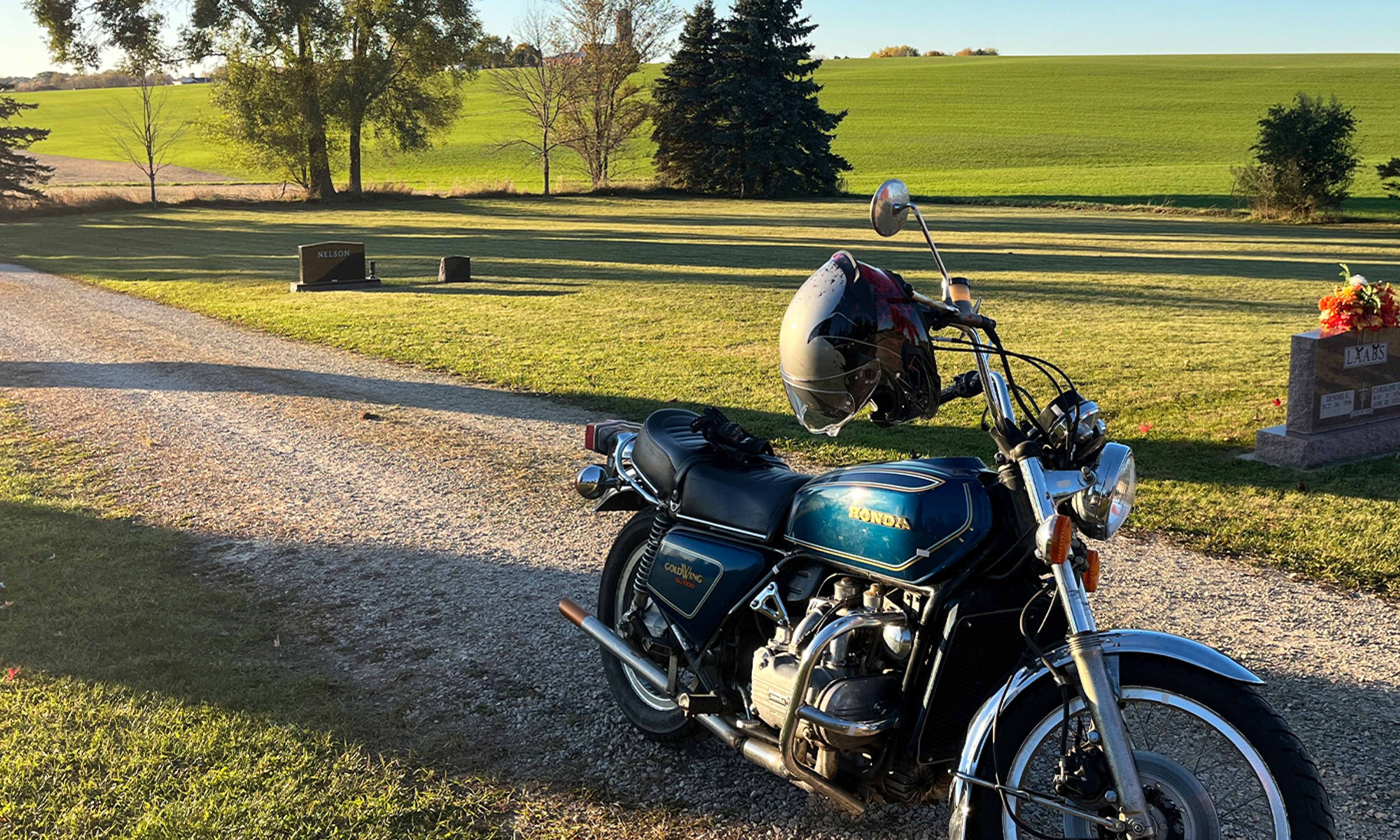
Ultimately, I bought a naked 1977 Honda GL1000, a Gold Wing, the first generation of Honda’s famously reliable interstate cruiser. Yes, it was straight-piped. Yes, its gauge cluster was erratic. And yes, it idled like a bull in heat, but it was $1,100, looked amazing from 20 feet away, and started more often than not. With a PDF of the tech manual, I would become unstoppable.
On my (spirited) ride home from the seller’s house, the rear tire’s sidewall cracked like Jericho. That meant a week in the shop while the bike’s entire rear was disassembled and a new tire sourced. Then the idle wouldn’t come down for anything and would bog and die at every third stoplight. Then the valve in the tire tube tore, meaning another trip to the mechanic and less time on the road. Via YouTube and the aforementioned tech manual, I learned that my bike had four carburetors . . . bugger. If you aren’t familiar with these inexpensive but temperamental alchemists of air and fuel, count yourself lucky. Most bikes have two “carbs,” and they have to agree on the engine’s consumption ratios. Add another two to the mix, and you’re more likely to get First, Second, Third, and Fourth Baptist Churches of greater Birmingham to manage a potluck without a decades-in-the-making dustup of millenarian proportions.
The trouble, you see, is that a carb is entirely mechanical. It does not know or care about fuel type, the temperature outside, or burnt spark plugs. It simply abides. You, the rider, must adjust each carb to harmonize with the others. This takes a tool, a manometer, with tubes and tines, to tackle. But good news! The carbs now agree (so long as nothing about the fuel, air, or engine conditions changes)! Strap on your gear, kiss your wife goodbye — make it a memorable one lest you should fall in battle with the byways — and head on down the road, pretending not to notice your neighbors’ tight-mouthed expressions as your 100 decibels (mentally add exhaust baffles to the to-buy list) rumble by.
But once you’re past the people who care, and the speeds surpass 30 mph, something happens . . . something sublime. You accelerate from the last city stoplight, and soon the country envelops you. An adventure begins. No ride will be the same as this one. In a car, the seat is programmed just for you, the temperature perfectly adjusted, and the radio set to your station. A car is a cocoon of consistency. Not so a motorcycle.
The late October chill attacks your exposed skin as your shadow races alongside, flickering through the dried cornstalks, lunging at you when the ditch rises up, and then pulling you toward the eastern horizon as the land falls away. You’re in a matched race, and you’re winning, losing, timeless. Two legs, two wheels, the wind pounding against your chest like King Kong, and your brain fitzing and fuzzing with exultation: God’s design that he deigned good.
A week later: Sitting on granite scree in front of the sign for Trinity Lutheran Church–Missouri Synod, a few miles out of Symco, I’m looking at a very dead bike (and Resurrection Parish is out of pushing distance).
The day had started at just above freezing, and while the sun had clocked in, it was doing a sailor’s job of appearing busy while accomplishing little. Forty minutes into the ride, my hands were cracklingly reporting back to the central nervous system like Major Tom stepping through the door. The church had appeared above the cornstalks, so I pulled in to clap my hands to restore contact with ground control.
Equipped with only a stator, the Gold Wing could not produce a charging current for the battery at idle as later alternator-equipped models would have. So there I sat, an involuntary addition to the Lutheran landscaping. Farmland is cleared for hunting now, the one exception being the cow corn left to dry on the stalk. One certainly notices more of one’s surroundings on a bike than in a car, as many claim, but I’d much prefer to do the sightseeing from the back of a running bike. Navy recruiters like to talk up the exotic locations you’ll see the world over, not mentioning that one sails past those enticing beaches and ends up back at Newport News, Va., where the only thing exotic entails a door fee and moral hazard.
An hour later, with a jump start from my slightly perturbed father, I make it to Whitefish Bay (my family’s cottage) before November gales set in and turn the minutes to hours. The next morning, on my return, I find myself on the side of the road. Out of gas. My high idle had managed to consume gasoline at three times the rate it ought. Switching to the reserve tank and limping into a BP in Northport, I had naught to do but feel pretty dadgum cool. Everyone else was snug in their cars, and here I was, white-knuckling it through an Emily Dickinson autumn — for the fields were wearing scarlet gowns as I chased the roses out of town.
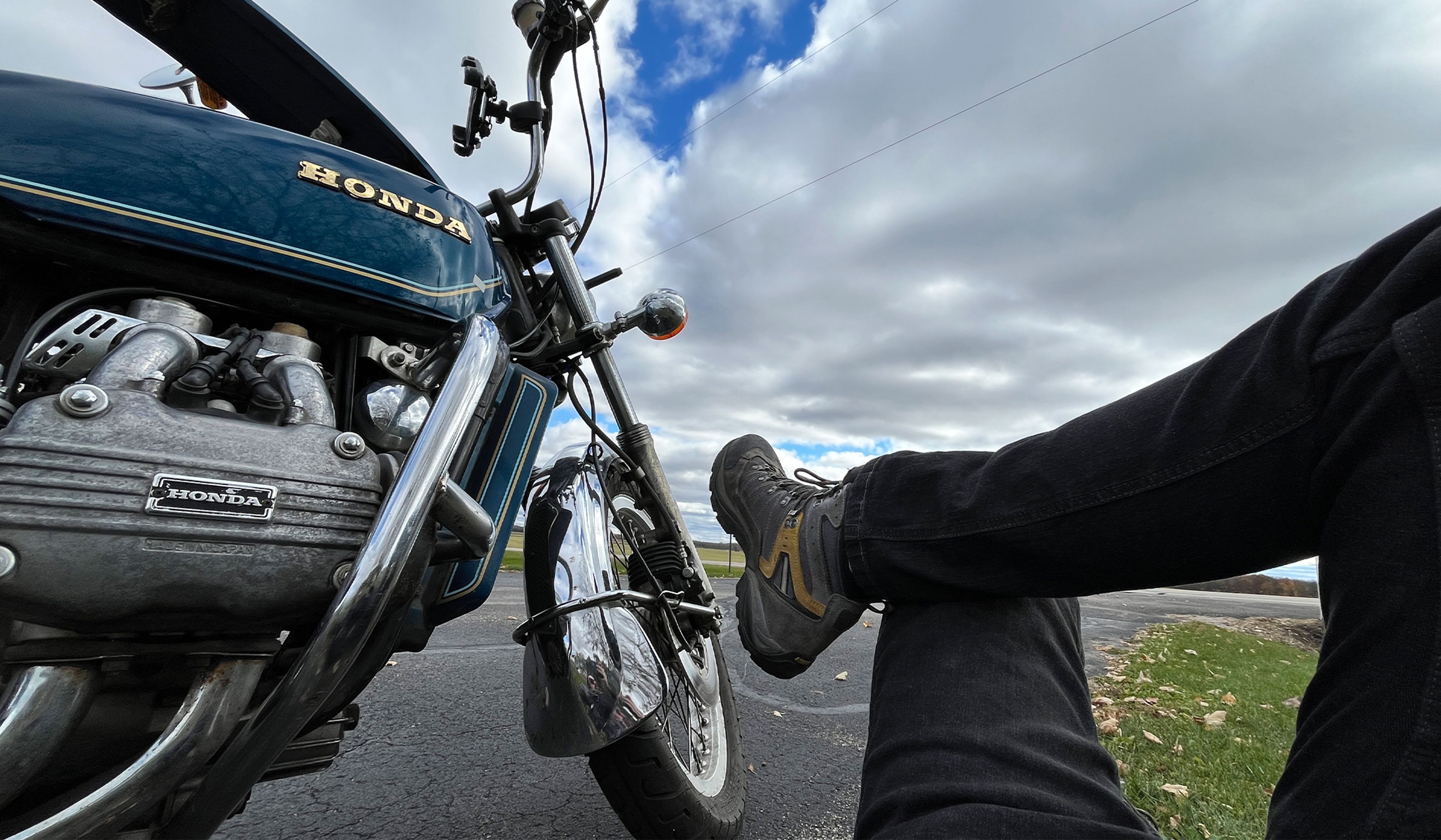
The Gold Wing is gone now, donated to the boys’ home at Rawhide. I don’t know when I’ll ever ride again. What I can say for sure, though, is that riding is just as dangerous as your grandma fears, but by golly is it every bit as glorious as midair McQueen made it seem.
Keep the rubber side down and ride on, America.











Comments