Since the publication of Patrick Deneen’s Why Liberalism Failed in 2018, a small but growing number of religious conservatives have been reevaluating the place of classical liberalism in America’s political culture. Deneen, a political-science professor at the University of Notre Dame, combines figures such as Francis Bacon, John Locke, Thomas Hobbes, James Madison, and John Dewey to create a unified (though largely imaginary) theory of liberalism. This liberalism has two key components, “the voluntarist conception of choice” and “human separation from and opposition to nature.”
For Deneen, liberalism is not merely a unified theory but a historical actor that has broken down “pre-liberal” institutions including the family. Because one does not choose one’s family of birth, liberalism is hostile to it, but liberalism also depends on the stability of the family to propagate itself. The family provides the basis for the very civil society that liberalism seeks to undo. The full realization of liberal autonomy arrived at precisely the moment when those pre-liberal resources were exhausted, resulting in the atomization of society and in the loneliness and alienation of individuals. Liberalism failed, Deneen concludes, because it finally succeeded. The moment of that success and subsequent failure is the present.
Such a claim requires, as critics such as Robert R. Reilly, Micah Watson, and Samuel Goldman observed, an overly broad definition of “liberalism” and tells an ideological “just so” story. As a book, Why Liberalism Failed was a provocative starting point for reevaluating conservative ideas, but as scholarship it was rather shaky. At first, Deneen refused to identify an ideological project “after” liberalism, since the ideological character of liberalism was, in his view, the heart of the problem. In a review in American Affairs, Adrian Vermeule, a professor at Harvard Law School, recommended that Deneen consider a revived Catholic integralism, or what I call “neo-integralism.”
Neo-integralism is an effort to revive the model of church–state relations that some in the Catholic Church favored for centuries before the Second Vatican Council. In that model, the state directly established Catholicism as the national religion and provided the church with resources to help it operate schools, hospitals, and other public institutions. The model rested on the principle of the “two swords,” described by Pope Gelasius I in a letter he wrote to the Roman emperor Anastasius I in 494. The pope wields the spiritual sword. It supersedes temporal authority, as the church rules over the soul even of the emperor. The emperor, wielding the temporal sword, must yield to the spiritual sword, as when a bishop requests state sponsorship of church activities. During the Middle Ages, the church used this rationale not only to call on governments to extirpate heresy or conduct crusades but also to insist on clerical immunity from civil law.
Deneen at first resisted Vermeule’s call to neo-integralism but today embraces it, joining Sohrab Ahmari, a founder and editor of Compact magazine. Together they formed a loosely coordinated school of thought with Vermeule and Edmund Waldstein, O.Cist., of the Austrian monastery Stift Heiligenkreuz, and Gladden J. Pappin, a political-science professor at the University of Dallas and a visiting fellow at a university in Hungary.
While neo-integralism might seem extreme to most American conservatives, it has drawn enough adherents and sympathizers to warrant scrutiny. Neo-integralists are wrong for four reasons. First, they wrongly conflate the ideology of liberalism with American constitutional republicanism. Second, they wrongly adopt a reactionary philosophy of History as their political foundation. Third, they use this philosophy to deny full human dignity to all, affirming that only baptized Christians can be citizens, thereby reintroducing the “Jewish question” into politics. They therefore seek to diminish if not outright repudiate the magisterial teaching of the Catholic Church on human dignity and religious liberty. Finally, neo-integralists openly admire authoritarian regimes — including those in Iran, China, and Russia — that they regard as superior to America in crucial respects, and they embrace as well leaders of European parties with historical ties to fascism and contemporary ties to Russia’s government.
A Republic If You Can Keep It
American republicanism rests on the maxim that individual persons possess God-given rights and corresponding duties to one another, to their communities, and most of all to God. Constitutions make plain how governments assist in the efforts of citizens to exercise these rights and duties. The Founders and their contemporaries did not frame a “liberal” constitution in Deneen’s sense. Rather, their view of republicanism drew from a variety of sources, some of whom, like Locke and Hume, would also influence liberal thinkers.
In a landmark 1984 article, Donald S. Lutz proved that the most commonly cited source during the Founding era (1760–1800) was the Bible, specifically the Book of Deuteronomy. The two most commonly cited political thinkers were Montesquieu and Blackstone. Locke was a distant third and tied with Hume, and Locke also was mostly cited in the earliest years of the Founding era, the 1760s.
Moreover, Lutz explained that Americans regarded Locke as a Protestant and an English Whig thinker, not a liberal one. Mark David Hall and Daniel Dreisbach have made multiple contributions to this area of research, as have Justin Dyer and Kody Cooper. Far from merely translating Lockean ideas into the Constitution, the Founders read widely among the ancients and moderns and reflected on their own experiences with state constitutions. American Catholics, too, played a role in founding the republic, as Michael Breidenbach has demonstrated in Our Dear-Bought Liberty: Catholics and Religious Toleration in Early America (2021). Maryland families such as the Calverts and later the Carrolls drew from their Catholic faith to defend their own republican commitments.
Neo-integralists reject the American republic because they believe it to be “liberal,” notwithstanding the overwhelming evidence to the contrary. Deneen has never sufficiently addressed the overbreadth and multiplicity of the definitions of “liberalism” he uses to fit his just-so story, and he seems unaware of the scholarship on the diversity of influences during the Founding era. He seems more interested in softening the ground for neo-integralism by fostering cynicism in his eager audience. What does neo-integralism offer that American republicanism does not?
The Neo-Integralist Philosophy of History
One answer is in what to many is the most interesting element of neo-integralism: its novelty. On the one hand, it is socially conservative, and, on the other, it is emphatically statist. The state, for the neo-integralist, must be big and strong to impose socially conservative values. Neo-integralism departs from American conservatism as well in its political foundations.
In his superb book Nature and History in American Political Development (2006), James W. Ceaser outlined a typology of political foundations that have grounded ideologies past and present. Political foundations are “idea[s] offered in political discourse as a first cause or ultimate justification for a general political position or orientation, . . . beyond which any further response is thought unnecessary.” He names three possible political foundations — nature, History, and religion. Americans have usually divided between nature and History. Either human nature determines how persons respond to events, or the events of History are leading to some great transcendence over human nature. Conservatives have adopted nature as a political foundation. Progressives have adopted History.
For the conservative, “nature” entails first principles, the permanent things, the proper starting points for understanding the world. Human nature is fixed. Statesmen and citizens can improve in virtue or improve a regime’s political or economic conditions, but human nature remains immune to their efforts. They seek to live in communities but also to retain a sphere of personal liberty. They want to own property but also to reckon with the common good. Persons are good in some measure but also self-interested, or sinful, and citizens and statesmen alike must constantly guard against sin to avoid a descent into tyranny.
Conservatives took that position in part because they believed it, but also to combat progressive ideology, which was grounded in History and opposed to any determinism of nature. The distinction between history and History has its origins in the German Enlightenment, in which “die Historie” is “history,” or the chronicle of events in a certain place over a certain time. “Die Geschichte” is “History,” or “philosophy of History,” in which a philosopher interprets events as the result of ideas in conflict, resolving dialectally and always toward better circumstances. As Thomas Leonard detailed in his book Illiberal Reformers (2016), progressives of the early 20th century adopted History as their political foundation and grounded it in Darwinian evolution. For them, Darwin had proved that human nature was contingent on circumstances, and that experts could use evolutionary theory to shape human nature and improve it through eugenics, racial hierarchies of immigration, and white-supremacist public policy to preserve and improve the existing white “Daniel Boone type,” as the sociologist Edward A. Ross approvingly put it.
One might expect that neo-integralists ground their proposals in religion. After all, that was the third category Ceaser offered. They don’t. As I argued in my book Religion in the Public Square, religious leaders as varied as the Venerable Archbishop Fulton J. Sheen, the Reverend Dr. Martin Luther King Jr., and the Reverend Jerry Falwell Sr. argued for religious foundations. For neo-integralists, however, religion is not a foundation but the source of the expertise that would enable them to master the historical moment and usher in the new age. As eugenics was to early progressives, a peculiar reading of Catholic theology is to the neo-integralists.
Neo-integralists have a political foundation in History, but their History is not progressive. It is reactionary. For most people, the meaning of “reactionary” is vague: “really, really conservative” or, perhaps, a big word for “fascist.” Neither understanding is entirely wrong, but neither is quite right. Although the reactionary philosophy of History has a past in America, with advocates such as Father Charles Coughlin and Triumph magazine, it has played a much greater role in the politics of Europe and Latin America, from the French Revolution through the end of the Second World War.
It is here that we discover the cause of the curious combination of social conservatism and statism. Reactionary History stipulates that the French revolutionaries promised consequence-free libertinism, which, when achieved, would plunge societies into chaos. For salvation, people would then look to the kings and clergy they once massacred. The kings and clergy would graciously return to build an even better monarchical regime than the one that the revolutionaries had destroyed, in what Vermeule calls liberalism’s “felix culpa.” Reformulating William F. Buckley Jr.’s description of conservatism, neo-integralists “stand atop History, murmuring Soon.” There are few similarities between American republicanism and the ideological extremes of the French Revolution, but Deneen obscures this fact by defining “liberalism” so broadly as to include both.
Neo-integralists are the few who are capable of understanding History’s movement and equipped with the rhetorical skill to explain it in terms of Catholic theology. They are destined to prophesy the new order, not to rule over it. They must ready the people; they must shift popular allegiance from the present, failed, liberal regime to the future kingdom of God on earth.
In the past two centuries, European reactionary authors — especially Father Augustin Barruel, Joseph de Maistre, Father Félix Sardà y Salvany, Juan Donoso Cortés, Louis Veuillot, and Carl Schmitt — have identified several groups who would undermine their efforts: Jews, Freemasons, the Illuminati, liberal Catholics, and Protestants. Pappin, at a 2021 conference at the University of Dallas, spoke highly of Sardà y Salvany and his tract Liberalism Is a Sin. Sardà y Salvany was a Spanish priest and journalist who propagated a “Judeo-Masonic” conspiracy theory like that of the Protocols of the Elders of Zion. Vermeule regularly refers to Maistre, Cortés, Veuillot, and Schmitt. Maistre and Cortés defended absolute monarchy. Veuillot was an antisemite who spent his later years calling for a Catholic dictatorship. Schmitt’s reputation for his contributions to political theory is compromised by his membership in and intellectual defense of the Nazi Party.
Today’s neo-integralists are less likely to focus on Jews and Freemasons than to target conventional American conservatives, labeling them as “right-liberals” or “market fundamentalists” attempting to reanimate the corpse of the liberal order. Any invocation of Ronald Reagan, Friedrich von Hayek, or even Richard John Neuhaus would only invite scorn — they’re dismissed as dupes. Neo-integralists believe that such figures bowed to the personal autonomy enshrined by liberalism, which has destroyed the family and natural communities while enabling the Left to win every major cultural and political battle. On the left, the “woke” take the liberal demand for autonomy to an extreme and, in doing so, intentionally violate the liberal value of tolerance by attempting to stop those who would defy them and to silence those who disagree with them. Right-liberals, according to neo-integralists, played the liberal game while the Left cheated and won. In view of the myriad of left-wing victories, they say, what has American conservatism ever conserved?
One might ask the same about integralism. One need only consult the reactionary Catholic theology that animated monarchist and clerico-fascist parties in Europe and Latin America. Those parties sought to restore Catholic confessional states for the purpose of extirpating the common enemies of throne and altar. Vermeule believes that there should be no restoration of the old America. He calls the imagined future of the United States the “Empire of Guadalupe” and argues that the administrative state would regulate subjects into virtue and, ultimately, ready them for their heavenly reward. The state would then heed the spiritual authority of the church, and the church would legitimate the state. The models for this empire have the same Continental and Latin American provenance as their ideas.
In 1899, during the Dreyfus affair, Charles Maurras formed a modern political party, Action Française, to join middle-class Catholics, the French military, and the French clergy against the Third Republic. After Pope Pius XI condemned the party in 1926, many Frenchmen renounced membership but remained associated informally. Throughout the 1920s and 1930s, similar integralist parties formed in Spain, Portugal, Austria, Argentina, and Brazil, modeling themselves after Mussolini’s fascist parties. Each came to one of two ends. Either they were co-opted and folded into authoritarian or fascist regimes (Spain, Portugal, Austria), or an authoritarian figure used their support to secure office and then marginalized them once he gained power (Argentina and Brazil). In none of the cases did the church have any independence to provide the degree of influence over the state that neo-integralists favor; the clergy either cheered the regime on or remained silent, except in a few heroic cases. Today these countries report low levels of religiosity and high levels of Catholic disaffiliation. One could rightly ask, What did integralism conserve?
The most important neo-integralist work to date is Integralism: A Manual of Political Philosophy (2020), by Father Thomas Crean and Alan Fimister. The authors adopt the “manual style” of early-20th-century theological works intended to standardize dogmatic instruction; Crean and Fimister do not so much argue their position as affirm it. Although the Manual is presented as simply expressing the doctrine of the Catholic Church, the book lacks a nihil obstat and an imprimatur, seals of approval that indicate that theological experts and church officials have examined a work and found it to be consistent with Catholic doctrine. The reason for that omission is clear: The authors take stances at odds with those of the Second Vatican Council and the Catechism of the Catholic Church.
One of the most troubling positions taken by Crean and Fimister is that citizenship should extend only to the baptized and that the unbaptized should live at the pleasure of the state. “Since a citizen simply speaking is a subject endowed with certain rights and duties within a society because of his presumed willing of that society’s common good, only someone who professes the Gospel, as taught by the Church, can be a citizen simply speaking in Christendom,” they write. “Hence, baptism confers full citizenship.”
Crean and Fimister cite no evidence for the claim. The reason is that there isn’t any. Their position runs directly contrary to Nostra Aetate, promulgated as part of the Second Vatican Council. There the Council Fathers affirmed the principle of religious liberty for all people and, given the church’s fraught historical relationship with Judaism, expressed particular concern for the rights of adherents of the elder religion: “In her rejection of every persecution against any man, the Church, mindful of the patrimony she shares with the Jews and moved not by political reasons but by the Gospel’s spiritual love, decries hatred, persecutions, displays of anti-Semitism, directed against Jews at any time and by anyone.” To deny Jews citizenship would be to deny them the religious liberty to which all persons are due by virtue of their human dignity; to deny citizenship is thereby to impose a persecution.
The Christian obligation to the common good of human salvation takes the form of bearing public witness to the Gospel and of practicing right religion. That obligation does not grant any regime the right to violate human dignity by abrogating religious liberty.
As one might imagine, the neo-integralist position on the Jews has caused some controversy, as in a book review that Father Romanus Cessario wrote for First Things in 2018. Cessario defended the Vatican’s taking of Edgardo Mortara, a Jewish boy living in the Papal States, from his family after a Catholic housekeeper gave him an emergency baptism when he was near death in the early 1850s. Mortara unexpectedly recovered, and his parents declined to raise him in the Catholic faith. The Vatican seized him to ensure that he would be raised in the faith.
During the initial firestorm over the book review, an anonymous author at the Josias agreed with Cessario and with the rationale behind — if not the consequences of — the laws concerning Jews in the Papal States. Vermeule tweeted his support: “Pius IX’s actions were valid, so [the discussion] seems to be about whether to say so publicly.” Other neo-integralists did likewise. In a discussion of the issue a few years later, Waldstein tweeted: “I think in certain circumstances it is just to limit the interaction of non-Christians with Christians in a society. In the case of the medieval Jews, I think the practice turned out to be mostly counter-productive.” In the same conversation, he condemned the principle of natural rights, characterizing it as a legacy of “freemasons in wigs.”
For neo-integralists, to object to their position on the rights of Jews is to object to Catholic doctrine and, therefore, to adopt the counter-theology of liberalism. Neo-integralists hold that all political conflict is ultimately theological, so that no neutral ground exists on which questions about the status of Jews in a neo-integralist state can be answered. The neo-integralist maintains that liberals claim their position to be neutral only because they seek to smuggle in their own theological commitments while disparaging Catholic dogma as sectarian. One must pick a side — either defend the corpse of the liberal order or affirm the true faith against those who would use a hard case to try to refute the understanding that neo-integralists have of Catholic social teaching. Vermeule, drawing on Schmitt, insists that politics rests on the friend–enemy distinction. No wonder, then, that Vermeule in the Josias recounts a question he received at a lunch: “In a fully Catholic polity, the sort you would like to bring about, what would happen to me, a Jew?” “Nothing bad, I assured him,” Vermeule writes. I doubt that his colleague was reassured.
Is Neo-Integralism Catholic?
Neo-integralists do not uphold in full the magisterial teachings of the Catholic Church. Their peculiar reading of Catholic theology serves a reactionary philosophy of History that the Catholic Church does not share. In the Brigham Young University Law Review, philosopher Francis Beckwith offers a Thomistic case against the reasoning behind the defense of the Mortara affair, arguing that Cessario’s “political vision implies a totalizing view of state power” contrary to natural law. At Public Discourse, law professor Robert T. Miller has argued that the moral obligation of the church to raise a baptized child does not entail the right to use state power to enforce that obligation. Also at Public Discourse, Nathaniel Peters, a theologian, has explained that the laws in the Papal States in Mortara’s time were antisemitic in origin and that Saint Thomas Aquinas argued that one could justifiably attempt only to persuade a child, not to seize or coerce him.
In Dignitatis Humanae (1965) at the Second Vatican Council, the Catholic Church affirmed the principle of religious freedom, precisely the opposite of integralism. In section two of the document, the church affirms that all people are “bound to adhere to the truth, once it is known, and to order their whole lives in accord with the demands of truth,” but that they cannot do so
in a manner in keeping with their own nature unless they enjoy immunity from external coercion as well as psychological freedom. Therefore the right to religious freedom has its foundation not in the subjective disposition of the person, but in his very nature. In consequence, the right to this immunity continues to exist even in those who do not live up to their obligation of seeking the truth and adhering to it and the exercise of this right is not to be impeded, provided that just public order be observed.
Furthermore, in Gaudium et Spes (1965), the church maintains that the Gospel requires “a sacred reverence for the dignity of conscience and its freedom of choice, constantly advises that all human talents be employed in God’s service and men’s, and, finally, commends all to the charity of all.” At the same time, the church cautions against “any kind of false autonomy. For we are tempted to think that our personal rights are fully ensured only when we are exempt from every requirement of divine law. But this way lies not the maintenance of the dignity of the human person, but its annihilation.” The plain reading of Gaudium et Spes is that each human person has a right against state imposition of religion, even of true religion. The church retains its teaching authority and obligation, and it can petition the state to fund those efforts. However, the church cannot rightfully enlist the state to coerce an unwilling population. School vouchers, yes; inquisitions, no.
Thomas Pink, a philosophy professor in England, has attempted to rescue integralism from the dustbin in which the Council Fathers threw it. He insists that the church did not change its doctrine but only its policy, meaning that the policy may become more integralist when conditions are more favorable. In response to Pink, Martin Rhonheimer argues that the change was not in the doctrine of the faith but “in its application and the consequences drawn from it.” The change in application is for the church not to demand a confessional state or to attempt to secure patronage and support from the temporal power but rather to insist on a recognition of the “autonomy and sovereignty” of the church and the state in their respective spheres. The church can “licitly intervene in the public forum by means of her magisterial teaching and by applying pastoral measures to the faithful,” but it cannot demand that the state intervene on its behalf.
For Rhonheimer, Dignitatis Humanae is at the heart of what Pope Benedict XVI called the “hermeneutic of reform.” Summarizing Benedict, Rhonheimer explains that “the teaching of Vatican II on religious freedom does not imply a new dogmatic orientation, but does take on a new orientation for the Church’s social doctrine — specifically, a correction of its teaching on the mission and function of the State. . . . The idea of a ‘Catholic State’ as the secular arm of the Church falls outside” principles that are rooted in “apostolic Tradition and Sacred Scripture” and that “suggest a separation between the political and religious spheres.”
Postconciliar popes have expanded on the teaching that human dignity requires that religious liberty be duly informed by the teaching of the church but rules out state coercion, as Nathaniel Peters has documented. His examples are many. Pope St. John Paul the Great explained the postconciliar balance in a letter to French bishops in 2005:
Correctly understood, the principle of laïcité (secularity), to which your Country is deeply attached, is also part of the social teaching of the Church. It recalls the need for a clear division of powers . . . that echoes Christ’s invitation to his disciples: “Render to Caesar the things that are Caesar’s, and to God the things that are God’s” (Lk 20:25). For its part, just as the non-denominational status of the State implies the civil Authority’s abstention from interference in the life of the Church and of the various religions, in the spiritual realm it enables all society’s members to work together at the service of all and of the national community.
Benedict XVI said to Italian Catholic jurists in 2006:
This conciliar assertion [in Gaudium et Spes] constitutes the doctrinal basis for that “healthy secularity” which involves the effective autonomy of earthly realities, not indeed from the moral order but from the ecclesiastical sphere. Thus, the Church cannot point out the preferred political and social order; it is the people who must freely decide on the best and most suitable ways to organize political life. Any direct intervention from the Church in this area would be undue interference. Moreover, “healthy secularity” implies that the State does not consider religion merely as an individual sentiment that may be confined to the private sphere alone.
Neo-integralists simply reject the plain meaning of the Council, theological extensions of that meaning, and papal statements affirming the conciliar position. Waldstein quotes Immortale Dei (1885), an encyclical of Pope Leo XIII:
Since, then, no one is allowed to be remiss in the service due to God, and since the chief duty of all men is to cling to religion in both its reaching and practice — not such religion as they may have a preference for, but the religion which God enjoins, and which certain and most clear marks show to be the only one true religion — it is a public crime to act as though there were no God. So, too, is it a sin for the State not to have care for religion as a something beyond its scope, or as of no practical benefit.
Ahmari, citing Waldstein, affirms something similar in his book The Unbroken Thread (2021). There, concluding a chapter on Saint Augustine, he writes that the “idea of Christian statesmanship” would make “the ruler duty-bound to protect the weak and to serve the common good of all, who views sound governance and the welfare of souls as different aspects of the same holistic business, who seeks not after his own, transient glory but the undying glory of God.” The church should “discipline, and even depose, the small and big would-be tyrants” in a way that binds “the political community to a higher power.”
As his exemplar of a Christian statesman, Ahmari looks to Saint Louis IX, the king of France from 1226 to 1270. Certainly, Louis was a holy man in many respects, as the church confirmed by canonizing him, but he is a peculiarly bad example for statesmanship. Leon Wieseltier in his magazine Liberties notes that Louis engaged in “a series of monarchically supervised catastrophes for the Jewish community of France” — for example, “in June 1242, twenty-four wagonloads with thousands of Jewish books were publicly burned in Paris.” That, for Louis, was a service that the temporal authority offered to the highest good.
Neo-integralists often praise authoritarian regimes. For neo-integralists, they are models for a post-liberal future. At his personal blog Sancrucensis, Waldstein has declared himself a “Shiite Catholic.” That was in reference to a bit the comedian Jim Gaffigan, intending to describe his wife as “really Catholic,” performed on his comedy album Beyond the Pale (2006). Waldstein, however, meant that he was a “Shiite Catholic” in that he admires the Iranian regime and found it comparable to integralism. No wonder, then, that Ahmari, whose family escaped Iran for America, has in the American Conservative recently criticized the liberalism he detects in the mass protest movement there.
In Providence magazine, Michael Sobolik lays out Vermeule’s admiration of the Chinese Communist Party, and Mark Tooley laments Ahmari’s praise of the CCP’s “natural virtue.” This past Feburary, Ahmari, Deneen, and Pappin penned an op-ed in the New York Times calling China a “civilizational equal” to America. Ahmari walks a careful line with respect to Russia’s invasion of Ukraine. He spares no opportunity to “ask questions” about the soundness of the pro-Ukrainian position and has published a sympathetic piece, by Michael Millerman, on Russia’s chief propagandist, Aleksandr Dugin. Days before the discovery of the mass grave of massacred Ukrainians in Bucha in March 2022, Compact (Ahmari is a founding editor) published an open letter advocating, for purportedly humanitarian reasons, an end to what was characterized as “escalation” by Ukraine’s allies. Pappin has been an outspoken advocate of Viktor Orbán’s Hungary, from his perch at the Mathias Corvinus Collegium, a university that Orbán founded to replace the liberal Central European University, which he had forced out of Budapest. Orbán is not as vicious as the mullahs, Xi, or Putin, but he has captured much of Hungarian media and has curtailed outside oversight of his government’s use of tax dollars and European Union subsidies.
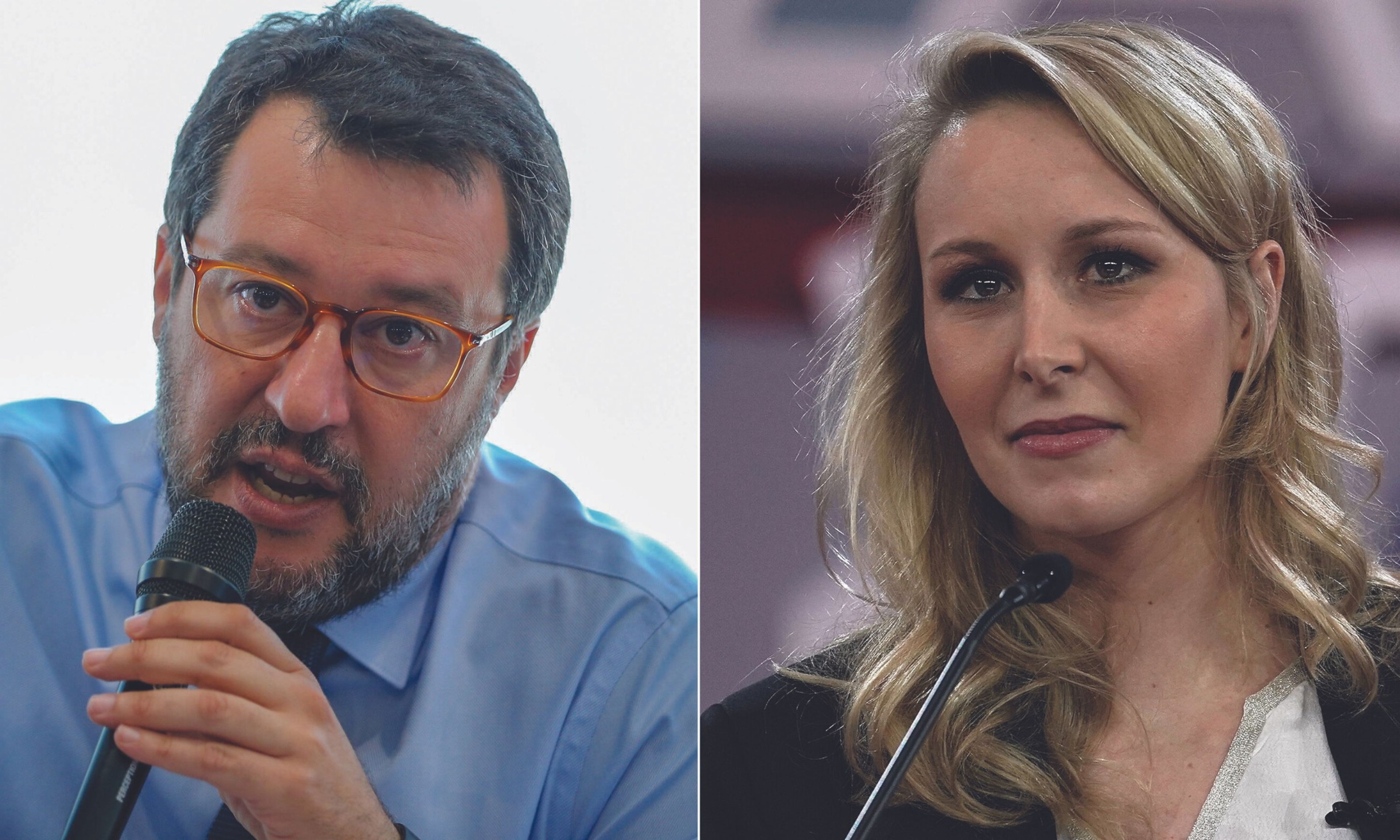
Other politicians celebrated by the neo-integralists include Matteo Salvini and Marion Maréchal. In 2019, Salvini, the leader of the Italian populist party the League, was caught in a scandal connecting his close associate Gianluca Savoini to Russian oil interests funding League campaigns. Maréchal is a granddaughter of Jean-Marie Le Pen, founder of the French political party National Rally, formerly the National Front, which has fascist and antisemitic origins. She represented the National Front in the French National Assembly in 2012–17. In the European Parliament in 2022, 17 members of National Rally voted against a resolution recognizing Russia as a state sponsor of terrorism. Maréchal backed Éric Zemmour in his failed bid for the French presidency in last year’s election. Zemmour has endorsed the “great replacement” theory, claiming that French immigration policy is aimed at “replacing” the French people. “Cultural Christianity” apparently entails associations with fascism, entertainment of conspiracy theories, and ties to Russia.
For those like me who oppose such a redefinition of American conservatism, it is not enough to laugh at the improbability of a neo-integralist America. We must ascertain why so many young conservatives find neo-integralism and authoritarianism attractive. We must make a new case for American constitutional republicanism, for a generation woefully misinformed about our own history and institutions — and refute a body of thought that would deform both politics and religion.
Editor’s note: A reference in the original article to “Roger Bacon” should have been to “Francis Bacon.” The error has been corrected.











Comments