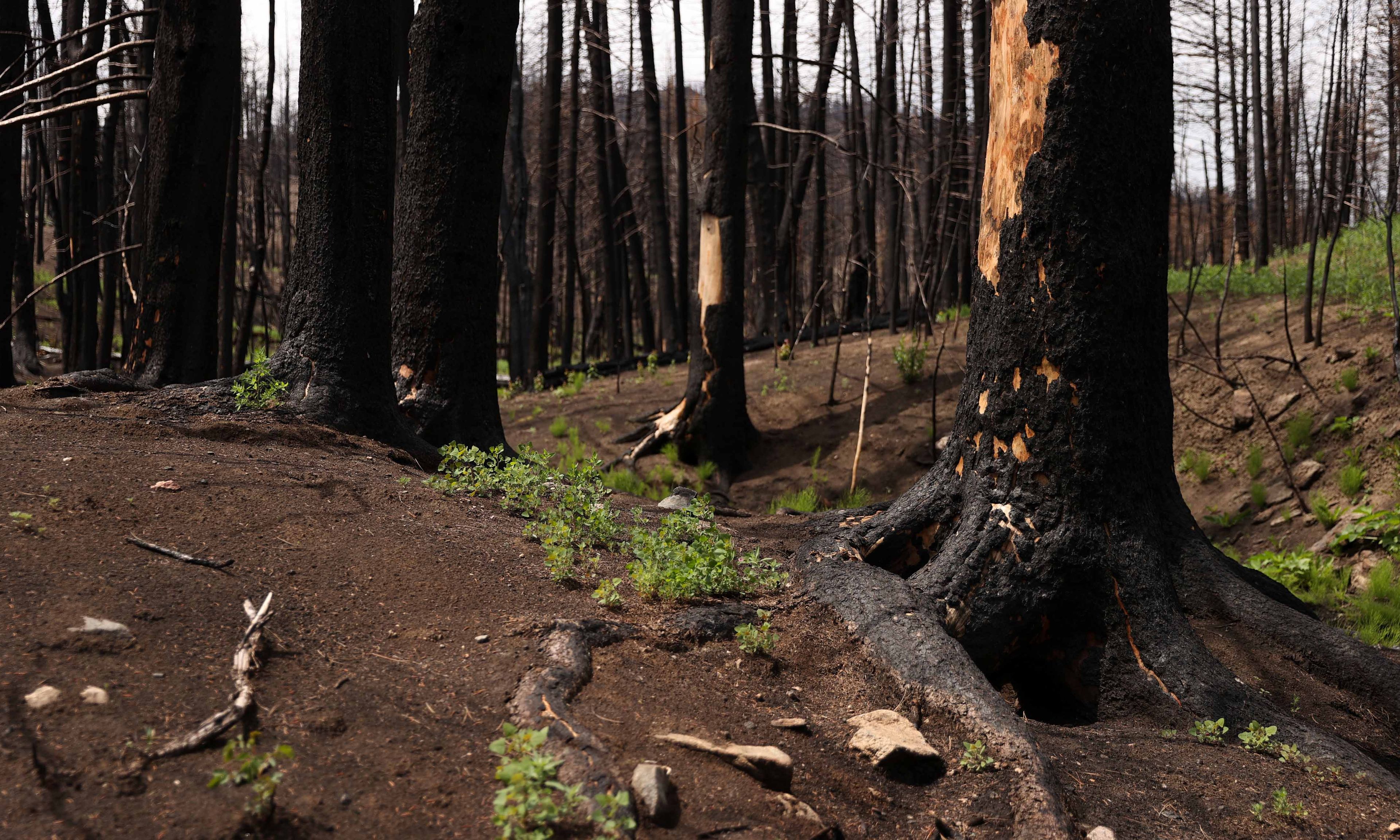
If you live in the woods, you have to deal with trees. There’s no way around it.
When we came back from an errand the other day I saw, as we pulled up the driveway, a large branch poking up over the crown of our roof. That will be a job to get off, I thought. How big a job I learned when I went behind the house and saw that a substantial tree, almost a foot and a half in diameter at the base, had snapped off, three or four feet above ground level, and fallen against us. In several ways it was a fortunate fall. A smaller tree that had stood next to it, an ironwood with bark smooth as skin, had come down with it, breaking its impact. Our slot of a bedroom is enlarged, visually if not actually, by a skylight; the fallen tree’s limbs just missed it. (The skylight looked, from inside, as if some mad decorator had framed one side of it with twigs.) No shingles or gutters had been bruised either, so that even though the space behind the house had become a tunnel of love made of trunks and branches, house and fallen tree looked like partners, not contestants. They recalled ballet, not mixed martial arts.
I called the man to call in such situations. We live in the foothills, he lives in the mountains. (Our mountains are not the Rockies, or the Brooks Range, but they are the mountains we have.) The man who removes trees is a jolly man who seems to like his work. Since every fallen tree presents a new problem, he is never bored, and since it is necessary that they be removed, he is well compensated. He came by to assess the project, then came back in a week with a partner and equipment and went to work.
Clambering on the roof with buzz saws, they took off the lesser limbs one by one. Relieved from pressure, the ironwood sprang back up a bit. Its topmost branches had to go, but the remover assured me there were enough left to keep it alive. He typically takes the largest pieces away to split for (his own) firewood, though he said that if I wanted the trunk, he could chop and stack it behind the shed. I said, Fine, although I will never burn such monstrous logs unless I am roasting an ox. The lesser shrubs that surrounded the dead soldier — holly bushes — also resumed their former stances. Their red berries are the bling of the woods this time of year. The winter flock — titmice and juncos, chickadees and sparrows — that will eat them only after they have foraged everything else took up their accustomed places, perching on the branches and bathing in the puddles of groundwater.
I had another job for the tree-remover. All the local ashes are being slain by a Chinese ash borer, doing the jobs American pests will not do. If I had my copy of The White Goddess in the country, I could see what the magical properties of ash trees supposedly are. As it is, my only literary reference is “The Ash Grove,” a Welsh song that got sad English lyrics when Victoria reigned. Fortunately, in all the woods around, there are enough maples and oaks, hickories and hemlocks, to disguise their loss in the aggregate. But there was a particular tall ash hard by the driveway, straight as a nail and just as dead. You could see the bark beginning to peel away from its trunk. If it fell across the driveway, we would be blockaded. Isn’t it better, I asked, to take it down now?
He agreed, and pointed out others, three or four on each side of the driveway, liable to take down power and telephone lines if they fell. Dead elms, he explained, can stand forever; dead ashes, whose trunks are more brittle, break in the wind. One had split already, about halfway up from the ground, and its top hung aloft only because it was leaning against a convenient pine. I told him to cut away.
He returned some days later to do the job. For hours we heard the whine of saws, the calls of boss to helper, and the crash of falling trunks. When all was done the fresh-cut stumps popped against the background of dead leaves almost as brightly as the holly berries. When it sleeted overnight, they shone like white dinner plates. I examined them with a tape measure. One pair of trees had left a common stump, with two circular halves, each a foot across. I tried counting the rings, and I may have double counted; it had begun growing either 50 or a hundred years ago, still in this century, until I recalled, okay Boomer, that the century I came up in, and that still supplies most of my touchstones, was the last one. A second pair of trees, separated almost at birth, had formed two distinct trunks at stump level. Their shared roots spread out like gigantic fingers, thick as human wrists. The borers had done serious work here; decay had sunk down in the core to ground level, leaving a dark, crumbling heart.
Who will take over in their places? There are nearby non-ashes that will probably feel relieved, as we do on an elevator when a crowd gets off before our floor. Lebensraum! And new saplings will appear. There are already volunteers — spindly hickories, feathery white pines.
My friend the tree-remover took away all the trunks, but there remains a litter of small broken branches, shards of bark. I collected the bigger pieces in a pile, but there are still more than I would like. Snow would cover them but it hasn’t snowed yet, and so will spring ground cover, but that is months away. If you live in the woods, you have to deal with trees. There’s no way around it.












Comments