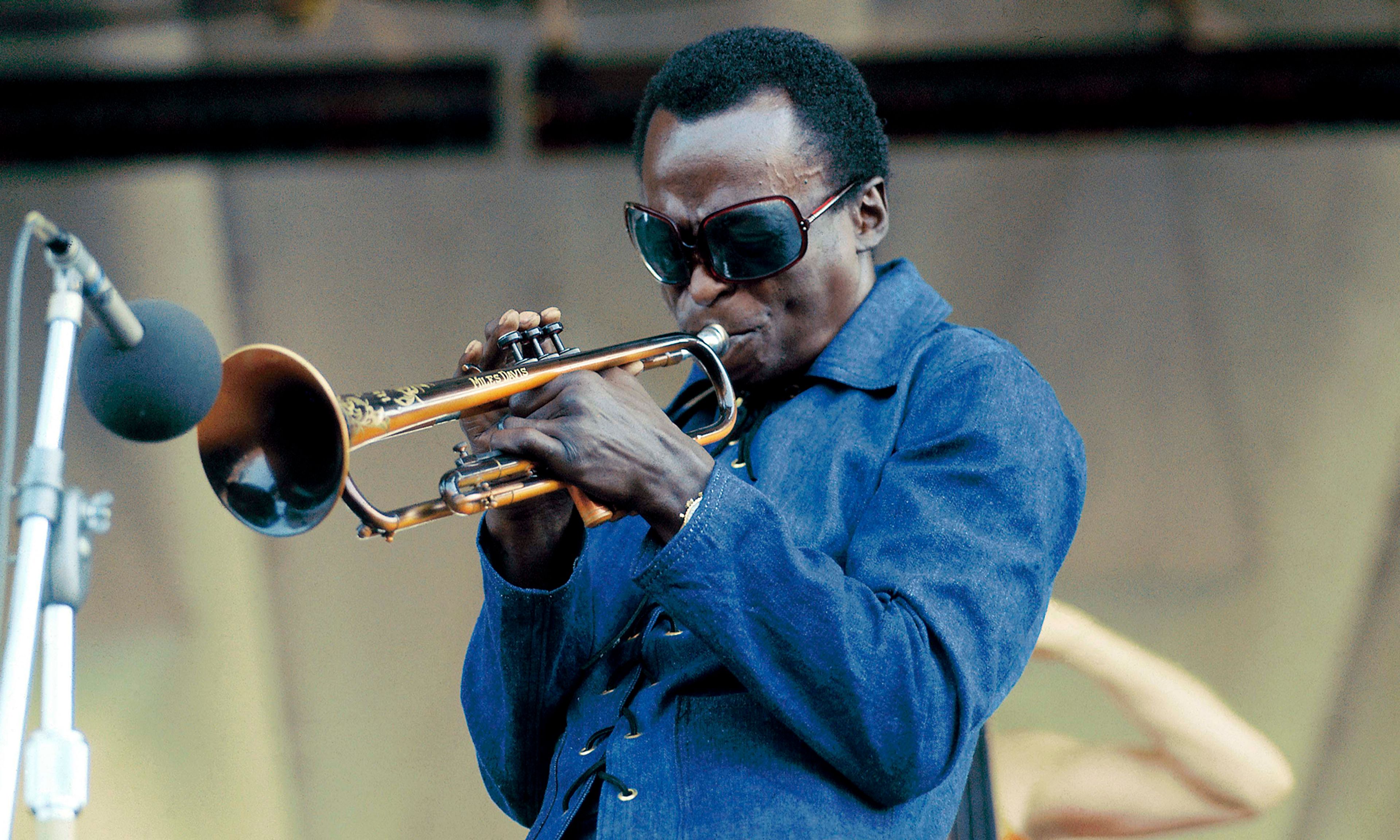
Miles Davis was born in Alton, Ill., on May 26, 1926. A year later, a tornado hit nearby St. Louis. In his autobiography, co-authored with Quincy Troupe, Davis ponders: “Maybe that’s why I have such a bad temper sometimes; that tornado left some of its violent creativity in me. Maybe it left some of its strong winds. You know, you need strong winds to play the trumpet.”
From the late 1940s until his death in 1991 (minus a four-year hiatus in the late 1970s), Davis tore through the musical landscape like, yes, a tornado. He was at the forefront of bebop, cool jazz, hard bop, modal jazz, and fusion. He even dabbled in hip-hop later on. He seemed to be running from his own past successes. Kind of Blue (1959) regularly tops critics’ lists of the best jazz albums and is the best-selling jazz album of all time. But Davis wasn’t interested in recording a Kind of Blue 2. When he played that album’s opening number, “So What,” live in the 1960s, he played it faster and more aggressively, pointedly not replicating the sound from the famous album. The version on Live at the Plugged Nickel (1965) was so deconstructed as to be barely recognizable.
His next album, Sketches of Spain (1960), another masterpiece, was a foray into an entirely different genre, flamenco. After that, Davis’s career went through what many critics, and Davis himself, regarded as a lull. The band with which he had recorded Kind of Blue fragmented as members, most significantly saxophonist John Coltrane, departed to pursue solo careers. It would take Davis until 1964 to assemble his second “great” quintet. The first studio jazz album recorded in this inter-quintet period, the successor to Kind of Blue, was Someday My Prince Will Come, released on December 11, 1961, just over 60 years ago. Someday is generally considered a second-tier Davis album, but it’s one of my favorites (and I’m familiar with many).
Okay, it’s not as good as Kind of Blue. Any follow-up to such a high artistic peak was bound to be something of a regression to the mean (in this case, a very high mean). As a criticism, that’s like saying that whatever Neil Armstrong did after being the first man to walk on the moon was less impressive. Some acts you can’t follow. I also concede that the album breaks no new ground: Davis is swimming in familiar waters. That’s fine by me — I’d welcome ten more albums like it. Some of his later work sounds frantic or abrasive; Someday is accessible and easy on the ears. His next release, Seven Steps to Heaven (1963), was the last album he recorded that was similar in spirit, with the arguable exception of In a Silent Way (1969).
Someday was recorded in three sessions in March 1961, at Columbia’s 30th Street Studio in New York City. Davis’s rhythm section comprised three veterans of his first quintet period: pianist Wynton Kelly, drummer Jimmy Cobb, and bassist Paul Chambers. Hank Mobley was supposed to substitute for Coltrane on saxophone; serendipitously, however, Coltrane was at the studio when the band was recording. Davis promptly invited him in and gave him the two best solo spots on the album: the title track and “Teo,” which would be the last track Davis and Coltrane recorded together before the latter’s tragic death on July 17, 1967, of liver cancer, at age 40.
The original LP consisted of six tracks, evenly divided between Davis originals and covers. Each of the three originals was named after someone Davis knew. “Drad Dog” — “Goddard” spelled backwards — was an homage to Columbia Records president Goddard Lieberson; “Teo” was named after his producer, Teo Macero; “Pfrancing” referred to his wife, Frances, whose image graces the album cover. (After their divorce, Davis said, “Whoever ends up with her is a lucky mother.” Well, that’s almost what he said.) The two non-original pieces besides the title track were “Old Folks” and “I Thought about You.” Two more songs from the sessions were released on later editions: “Blues No. 2” (on which Philly Joe Jones replaced Cobb on drums) and a version of the title track with Mobley in the prime solo slot.
“Someday,” from the animated Disney film Snow White and the Seven Dwarfs, leads the album. Interestingly, Coltrane had recently cut “My Favorite Things,” a tune from The Sound of Music. In both cases, the splendid results should silence any hoity-toity complaints about commercialism. “Someday” is the only song on the album, and I believe the only one ever recorded, that features Davis, Mobley, and Coltrane playing together. Kelly’s opening chords lead gracefully to Davis’s muted trumpet carrying the familiar melody. Mobley solos next, followed by Kelly, and then Coltrane, who steals the show.
“Teo” is as good a coda for the Davis–Coltrane partnership as anyone could have hoped for. The rhythm section is sprightly, and Davis, unmuted, energetically plays a Latin-sounding melody that sounds like it belongs on Sketches of Spain. (Indeed, the track is included on the 50th-anniversary edition of that album.) This provides Coltrane with a perfect setup, and by God does he deliver! He summons a solo that seems to come from deep within. It has a yearning quality to it. Thick braids of notes cascade from his horn like there is no tomorrow. Then he fades out and yields the floor to Davis for a final time. Both men seemed to know that this would be their last hurrah together.
Mobley was in an unenviable position. Davis expected him to fill Coltrane’s shoes, but Mobley was a different player. Coltrane, like Davis, was an innovator. He could play ballads as well as anyone but also produced rapid-fire solos that left the melodies in the dust. Gradually he moved toward “free jazz.” Mobley worked within the hard bop subgenre. His music was bluesy and swaggering, and his playing had a lighter touch than Coltrane’s. He modified his playing over the years, but he’d essentially found his sound and didn’t need to reinvent himself. Mobley’s Soul Station (1960), which is considered his best (and is another one of my favorite jazz albums), is probably the best point of entry into his oeuvre.
Sadly, Davis didn’t appreciate Mobley; he wrote that “playing with Hank just wasn’t fun for me; he didn’t stimulate my imagination.” Davis even seemed to have forgotten how much work Mobley had done for him. He recalled that Coltrane had recorded on “three or four” of the tunes on Soul Station and that Mobley had been on “one or two”; in fact, Coltrane cut two tracks and Mobley was on all except “Teo.” Circumstances might have affected Davis’s assessment. At the time of his brief partnership with Mobley, Davis was suffering from joint pain from sickle-cell anemia. That probably didn’t help his tempestuous temper any.
As a Mobley fan, I wish Davis had recognized his virtues. The two showed synergy on the live albums they recorded together in 1961, The Complete Black Hawk and Miles Davis at Carnegie Hall. Mobley’s solos on “If I Were a Bell” and “Teo” (called “Neo” on Black Hawk) were excellent. His playing on Someday is more reserved. Perhaps he felt the weight on his shoulders. But although his solos aren’t showstoppers, they’re pleasing and maintain the mood. I think he acquits himself well. Forget the comparisons: There’s only one “Trane” and only one “Mobe.” I love both.
After the recording, Cobb, Chambers, and Kelly formed the Wynton Kelly Trio in 1963. Coltrane continued his stellar solo career, culminating with A Love Supreme (1965). Mobley was stung by Davis’s rejection but tried to learn from his criticism. He went on to record several outstanding albums, including No Room for Squares (1963) and A Slice of the Top (1967), before health issues ended his career in the early 1970s. In 1964, Davis finally assembled his dynamic second great quintet, with Wayne Shorter on saxophone, Tony Williams on drums, Herbie Hancock on piano, and Ron Carter on bass, and recorded several albums with them before moving on, as he always did.
Davis hinted that he thought of himself as the prince in “someday my prince will come” because “I was Frances’s prince.” He acquired the nickname “Dark Prince of Jazz” for his brooding disposition. Shorter composed “The Prince of Darkness” about Davis, which is the opening track on the second quintet’s third album, Sorcerer (1966). Perhaps the title “Someday My Prince Will Come” refers to Davis’s impatience at a time when he was stultified, listless, and in physical pain. Listening to this album, though, I don’t feel at all restless. There’s no need to wait for the prince. He’s been here all along.











Comments