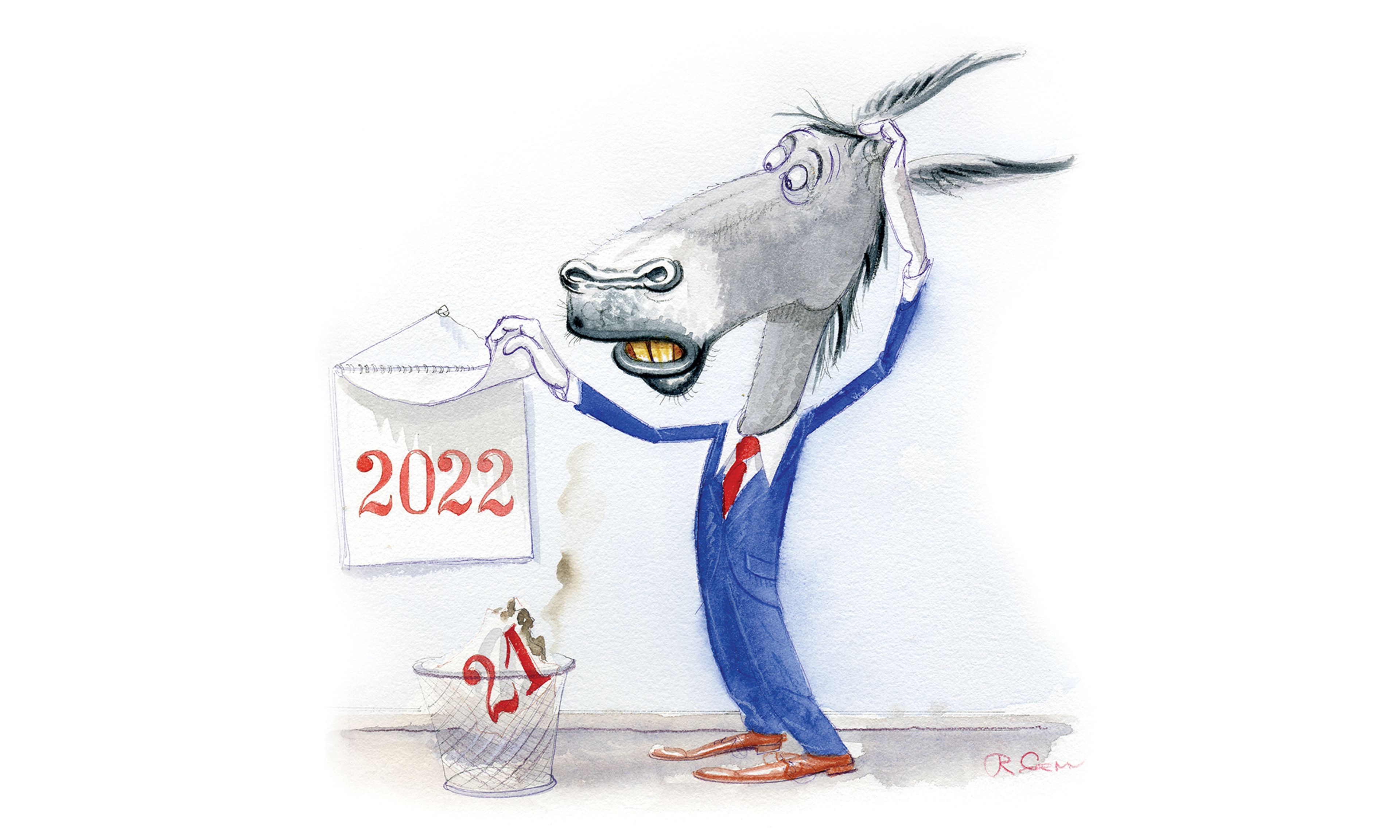
White House chief of staff Ron Klain circulated an op-ed in the days after Christmas whose headline read: “Let’s be honest: 2021 wasn’t all bad.” Nice try. It was a bad year, for Democrats in particular. This year may be worse.
The Democrats began 2021 with the presidency, a 221–213 House majority, and control of a 50–50 Senate. The partisan composition of the federal government remained stable throughout the year, but Republicans made impressive gains in localities and in states. The GOP candidate won the mayoral race in McAllen, Texas, where the population is overwhelmingly Hispanic. Republicans picked up two seats in special elections for state legislatures, including a Connecticut district that Biden won by 25 points. Republicans swept the off-year elections in Virginia and gained ground in New Jersey, where a truck driver with no political experience defeated the president of the state senate.
Dave Wasserman of the Cook Political Report says that Republicans could pick up between 44 and 51 House seats on Election Day 2022 if this dramatic swing toward the GOP persists. He might be understating things. None of the traditional gauges of electoral performance look good for Democrats. The president’s party has gained House seats in midterm elections only twice since 1933. The average loss for the president’s party has been 28 seats. That number rises to 37 seats if the president’s approval rating is below 50 percent. Republicans need five seats to take control.
At this writing, Biden’s approval rating is 43 percent in the FiveThirtyEight average. Republicans hold a slim lead in the congressional generic ballot. More Americans identify as Republicans than as Democrats. Republicans are more enthusiastic than Democrats about the upcoming midterm election. Important parts of the Democratic coalition are breaking from the president. The NPR/PBS NewsHour/Marist poll of adults released in late December showed Biden’s approval rating at 44 percent among non-whites, 33 percent among Latinos, and 29 percent among independents. Not a surprise, then, that 24 House Democrats have announced their retirements. Biden captains a sinking ship.
And he’s the one who punched holes in the hull. The president misread the results of the 2020 election. He interpreted victory as a call for transformation and progressivism rather than as a cry for stability and moderation. He believed the absurd press accounts likening him to liberal icons such as Franklin Roosevelt and Lyndon Johnson. He assumed that positive macroeconomic data would compensate for an eroding standard of living. He relied on a tight circle of advisers whose left-wing instincts and general ineptitude became apparent in contradictory public-health guidance, in record-setting illegal border crossings, in the collapse of the democratic government in Afghanistan and the deadly U.S. retreat from central Asia, and in the highest inflation rate in 40 years.
Biden’s habit of overpromising and underdelivering explains his growing reputation for incompetence. He and his team routinely make promises or assertions that turn out to be false. He said during the campaign that he would “shut down the virus,” but his first year ended with more coronavirus cases than ever before. He denied that there was a crisis on the southern border, and attributed the spike in detentions to seasonal migration patterns, before scurrying to contain the fallout when the equivalent of a Haitian town settled under a bridge in Texas. Biden continues to defend the calamity in Afghanistan as a success despite the deaths of 13 U.S. servicemen during an evacuation that left behind hundreds of American citizens and legal permanent residents. The inflation that he said would be “temporary” is about to celebrate its first birthday.
Biden’s age and tenuous position within his party prevent him from confronting the Left in a bid to win back the center. He will turn 80 years old in November, has described himself as a transitional figure, and wants his legacy to be an expansion of the welfare state that has eluded his predecessors. Many Democrats doubt that he will run for reelection. Nor has his tendency to go off message changed since he moved into the White House.
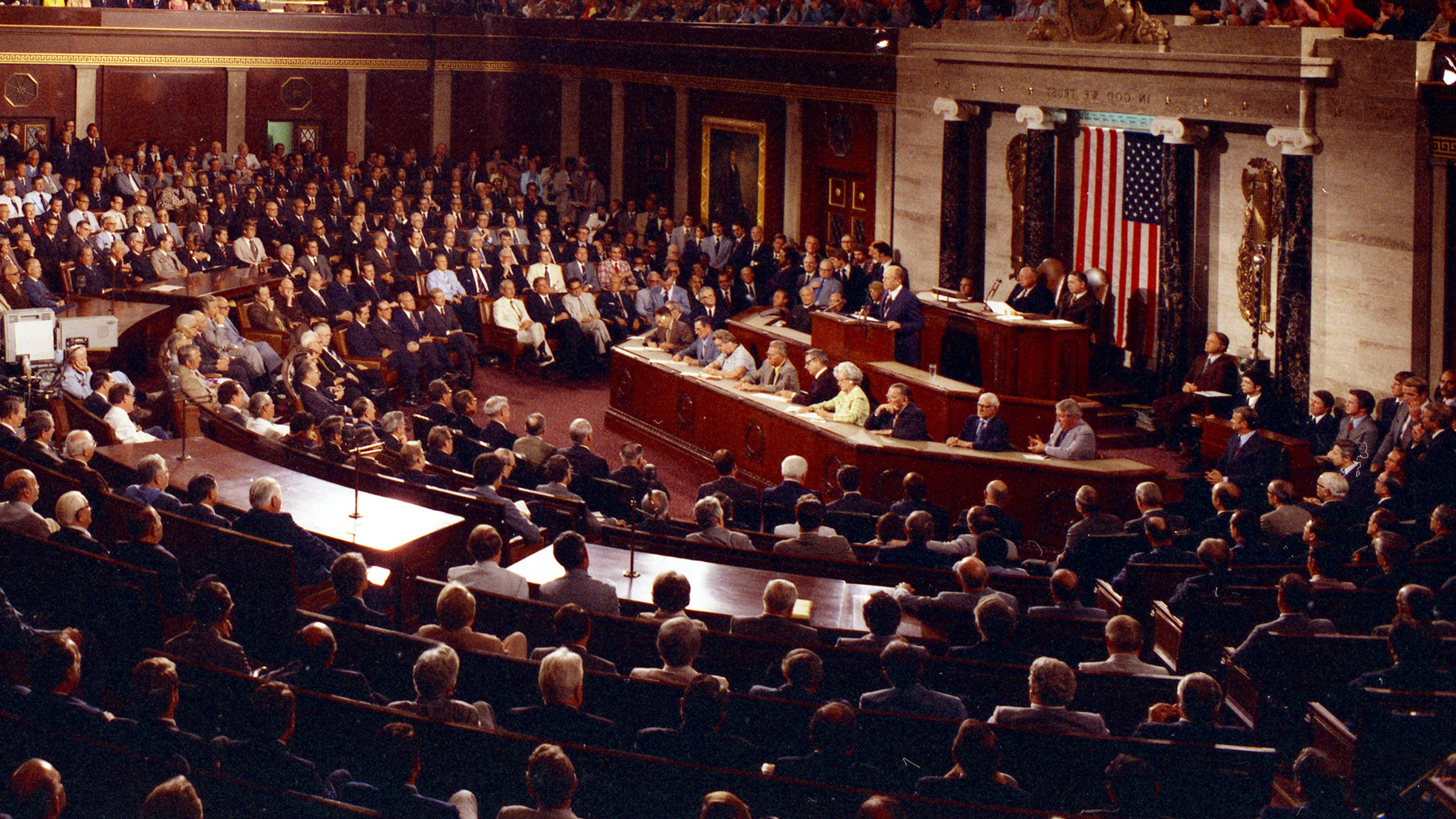
Biden’s staff treats him not as an asset but as a liability. They tightly script his public events and rarely put him in front of cameras. He agreed to far fewer one-on-one interviews during his first year in office than either Donald Trump or Barack Obama. He appeared at fewer press conferences than any president since Bill Clinton. His speech to a joint session of Congress in March was the sole occasion when he addressed the nation during prime time. Biden’s low profile doesn’t just remove him from day-to-day headlines and limit his potential to commit gaffes. It denies him opportunities to lead.
Biden is unique among recent presidents in that he has no connection to the culture of celebrity that grants its stars independence from parties and leverage over mere politicians. He won the Democratic nomination not because he enjoyed a groundswell of public support but because party leaders such as Representative James Clyburn (D., S.C.) and Barack Obama paved his way in a panicked attempt to prevent four more years of Trump. The precariousness of his status at the top of the Democratic heap reduces Biden’s willingness to say no to the Progressive Caucus and the socialist Squad.
Since he became the Democrats’ nominee, the candidate who once drew contrasts between himself and Senators Bernie Sanders (I., Vt.) and Elizabeth Warren (D., Mass.) has been solicitous of them both. The campaign that was proud not to chase the cable-news cycle and posture for retweets has turned into an administration devoted to Nicolle Wallace and to its chorus of tweeting toadies. Fear of a left-wing primary challenge to Senate majority leader Chuck Schumer (D., N.Y.) in 2022 or to either Biden or Vice President Harris in 2024 has spooked the Democrats into pursuing measures that cannot pass and avoiding issues that alienate progressives.
The result has been a cycle of incapacity and frustration. The Democrats in Congress hold multiple procedural votes on massive social-policy bills and radical changes to voting laws that go nowhere. The Democrats in the White House fail to reduce inflation, illegal immigration, crime, and coronavirus numbers. And Democrats across the country — especially in cities and schools — defend “woke” cultural values and educational curricula that are far to the left of the median voter. It is a sign of just how dire the situation is for Democrats that their best shot at keeping the Senate and limiting their losses in the House is the propensity of their opponents to nominate candidates who frighten suburbanites more than they do.
Even so, the various weaknesses of the Republican Party may not be enough to save the Democrats. Historical precedent and widespread dissatisfaction with the direction of the country, the state of the economy, the president’s half-baked leadership, the unending pandemic, and the mess on the border point to a Washington that will be a very different place at the midpoint of Joe Biden’s presidency than at its outset. That the White House has developed a herd immunity to reality doesn’t help Democrats either. If Joe Biden can’t shake off the Left before November, voters will do it for him.










Comments