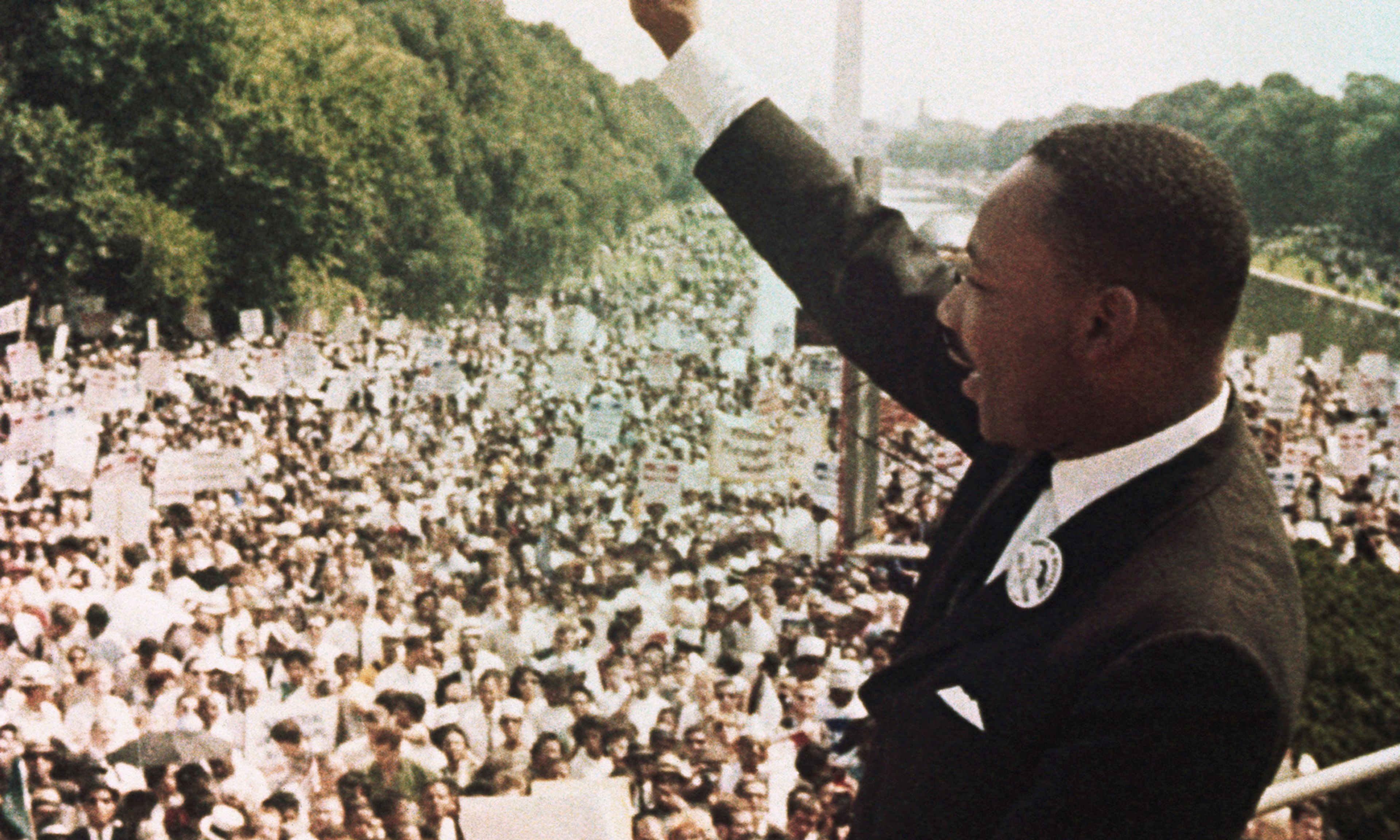
On August 28, 1963, at the climax of the March on Washington, Martin Luther King Jr. spoke from the steps of the Lincoln Memorial. The speech he delivered blended different materials — new, old, preacherly improvisation — and a variety of themes. He called for equal voting rights nationwide, and for liberal social policies. “We cannot be satisfied as long as a colored person in Mississippi cannot vote and a colored person in New York believes he has nothing for which to vote.” He iterated his commitment to nonviolence, as if he foresaw the gangsters and visionary crackpots who would ride the whirlwind of Black Power.
He began with an account of American racial history that might be called the “promissory note” story. The promise of American life, he argued, had been withheld from black Americans. “America has given its colored people a bad check, a check that has come back marked ‘insufficient funds.’” But what was the original check, and who made it out? “When the architects of our great republic wrote the magnificent words of the Constitution and the Declaration of Independence, they were signing a promissory note to which every American was to fall heir.” King had come to Washington to pressure President Kennedy, Congress, and white Americans generally. But he wrapped himself in the two premier documents of the Founding Fathers.
In doing so he was borrowing a page from the man at whose monument he spoke. Abraham Lincoln regularly enlisted the Declaration and the Constitution in the cause of resisting the expansion of slavery, and finally of ending it. In 1859, in describing Thomas Jefferson and the Declaration, he wrote thus: “All honor to Jefferson — to the man who . . . had the coolness, forecast, and capacity to introduce into a merely revolutionary document, an abstract truth, applicable to all men and all times.” A year later, at Cooper Union in New York, he spent half of a 90-minute speech analyzing the careers of the signers of the Constitution, to show that they believed the federal government had the power to regulate slavery in the territories. “As those fathers marked [slavery], so let it again be marked, as an evil not to be extended.” His epitome was the Gettysburg Address, delivered in 1863, a century before King’s. It is a 272-word microchip that begins with a biblical-sounding reverse countdown to the Declaration (“fourscore and seven years ago”) and ends with an allusion to the Preamble (“government of the people, by the people, for the people”).
Like all good advocates, Lincoln and King appealed to authorities their audiences acknowledged. (See who agrees with me; you already agree with them; therefore, you should agree with me too.) Like many advocates, they cited authorities that were venerable. Not very venerable — the United States is youngish as countries go — but the Declaration and the Constitution are as venerable as we get.
Advocates say lots of things, some of them even true. The Declaration and the Constitution, though they are different kinds of documents — one announces the creation of a nation, the other arranges its fundamental law — make statements of principle, explicit and implied. Were Lincoln and King right to cite them in support of their causes — limiting, then ending slavery; guaranteeing black Americans full civil rights?
Many thought, and think, not. The Constitution counted slaves in the representation of the House and the Electoral College, required the return of those who escaped across state lines, and guaranteed the existence of the slave trade for 20 years. Supporters, and critics, of slavery were well aware of these facts. John Calhoun told John Quincy Adams, when they served together in James Monroe’s cabinet, that the Preamble’s language about “establish[ing] justice” was “always understood” in the South “as applying only to white men.” William Lloyd Garrison agreed, calling the Constitution a “covenant with death” and an “agreement with Hell.” Karl Marx, covering the Civil War for a Viennese newspaper, praised Lincoln’s Emancipation Proclamation precisely because it “tears up the old American Constitution.” In our day, Garry Wills and Noah Feldman have praised Lincoln for doing essentially the same thing.
The Declaration offers some fine universalist rhetoric, but perhaps it too was meant only for white men. Stephen Douglas, debating Lincoln as they ran for the Senate in 1858, argued that if the Founders had believed the document they were signing applied to blacks, they would, as men of honor, have been obliged instantly to free their slaves. Jefferson, the slave-owning draftsman, was a racist besides, expressing opinions in Notes on the State of Virginia (blacks are oversexed, inartistic, smelly, etc.) that poison his other handiwork. A few years ago I found myself, while shooting a video in Washington, needing a volume of Jefferson’s greatest hits. I happened to be eating at Busboys and Poets, the radical café and bookstore (now a chain). I asked the cashier if they had anything by Jefferson. She told me proudly, “We do not.”
But let us look, as Lincoln and King did, at the documents. Although Congress edited Jefferson’s draft of the Declaration heavily, it left the philosophical opening paragraphs almost untouched. This was because, as Jefferson himself admitted, the ideas he put there were staples of contemporary political thought. The Declaration sketches a tripartite basis of just political societies: equality, rights, and self-rule. Each enlarges the others. All men could be equally servile; rights might be the property of some, not all; a despot might promise equality and freedom of action so long as all politics rested with him. Jefferson thought, and his colleagues agreed, that equality, rights, and self-rule must stand together.
The openly philosophical portion of the Constitution, the Preamble, is even briefer, and, as with the opening of the Declaration, was the work of the draftsman, in this case Gouverneur Morris. It is enfolded in a declaration of self-rule (“We the People . . . ordain and establish”). Its list of purposes for which the government has been ordained climaxes with “secur[ing] the Blessings of Liberty to ourselves and our Posterity.” Its provisions lay a foundation of equality. The executive is to be elected; federal and state governments alike are forbidden to grant titles of nobility; and slaves are never mentioned by that name, appearing always disguised as “Persons.” No kings, no aristocrats, no helots (no named ones, anyway). The prohibition against bills of attainder is another, subtler guarantee of equality: Legislatures may not punish individuals or classes of people who have not been tried and convicted of breaking some law.
How do early Americans’ acts stand up against these words? Badly, in many cases, as analyses of colonial and early American slavery show. But also well, in many other cases. When the Declaration was signed, every state permitted slavery (Vermont didn’t, but Vermont was not yet a state). By the time the Constitution was written, five of the original 13 had abolished slavery or begun a process of abolition, and the Northwest Territory had been declared free. By 1804 two more of the original 13 states joined the column of gradual abolition. Abolitionists in England and Quakers here had condemned slavery since the mid 18th century, but the impetus for American political manumission was the spirit of the Revolution, incarnated in the new nation’s founding documents.
As for Jefferson’s racial views as expressed in Notes on the State of Virginia, his supposedly scientific judgments of black people were common among Enlightenment thinkers such as Hume, Voltaire, and Kant. What was peculiar to Jefferson was the turn he made at the end of his argument, when he asserted that blacks were nevertheless morally the peers of whites. “We find among them numerous instances of the most rigid integrity, and as many as among their better instructed masters, of benevolence, gratitude, and unshaken fidelity.” Nature gave blacks and whites equally what Jefferson called “endowments . . . of the heart” — which, to his way of thinking, were marks of man’s entitlement to freedom.
So long as we are examining the convictions of draftsmen, we should add that the most pungent critiques of slavery at the Constitutional Convention were uttered by Gouverneur Morris — “it was a nefarious institution; it was the curse of Heaven on the states where it prevailed.” These views, as Jackson Barlow has shown in a recent paper, were consistent throughout Morris’s life.
Having good opinions out of the gate does not mean that those who hold them will win even the first race, much less future ones. Politics is work, because life is. But Lincoln and King were right to seek inspiration from Morris, Jefferson, and their comrades.












Comments