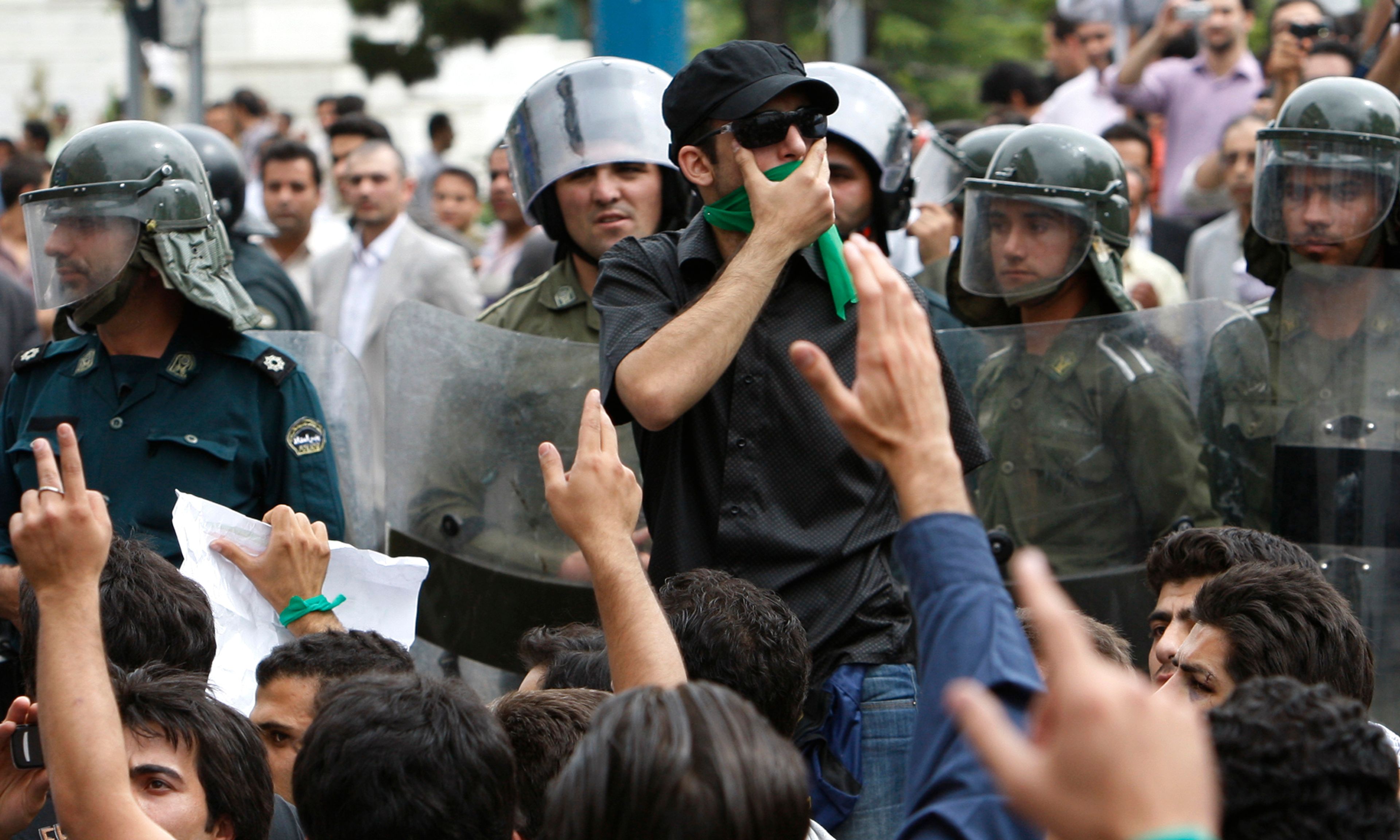
The current upheaval in Iran has the world holding its breath. A test of strength has opened between the hard-line Islamists of the regime and a good part of the population that is disappointed or angry with that regime. The mullahs have been incompetent, indulging in dangerous and extravagant foreign adventures, and above all corrupt, lining their pockets shamelessly. Iranians do not have to search for reasons to take to the streets. Many of them also fear that the country’s nuclear program is a gamble that could cost them their lives. Like everybody else, they take it for granted that under cover of lies the regime is acquiring the nuclear bomb. Iran has signed the nuclear Non-Proliferation Treaty, and the revelation that it had duplicitously developed such a weapon would be a blow to the structure of law on which the international order supposedly rests — a blow more damaging than Saddam Hussein’s invasion of Kuwait. The regime might then have brought retaliation and war down on the country. A different set of mullahs in Tehran, or better still professional politicians, might allow everyone to breathe again.
In a memorable phrase of Henry Kissinger’s, Iran has to decide whether it is a nation or a cause. That is what the current test of strength is about. The Islamic Republic is the handiwork of Ayatollah Ruhollah Khomeini. A genuine fanatic, he was untouched by anything like a general education, having no interest in ideas other than his own. In his view, Muslims compose a worldwide community, and he aspired to lead it to supremacy. Iran’s expansionist foreign policy and its sponsorship of terrorism derive from the perception of Islam as a cause, an end that justifies all means. Every opportunity to project the Islamic Republic’s power has been exploited, in Iraq and Afghanistan, in Lebanon and the Israeli–Palestinian impasse, and now in backing proxies in the exploding civil war in Yemen. It follows that the individual nation-state is rejected as a Western concept, by definition irrelevant and damaging to Muslims. Domestically, Khomeini set in place a system of rule known as “guardianship of the Islamic jurists,” a euphemism for his own installation as an absolute ruler. The dignified black robes and turban did not disguise the fact that the Supreme Leader was a typical Third World dictator, different from any other only in that he had a cause to fulfill. Under his successor, Ayatollah Ali Khamenei, the paramilitary Revolutionary Guards have acquired a military and economic grip on society that invites further comparison to the Third World.
Over the last ten years, protest has been gathering, each time in a bigger wave. The presidential election last June was the point of no return. According to the doctrine of the “guardianship of the Islamic jurists,” the president is merely the executor of orders from the Supreme Leader, and in that role Mahmoud Ahmadinejad has been loyal and might well have been reelected without undue trickery. Among those running against him were Mir-Hossein Mousavi and Mehdi Karroubi, both of them tried and tested members of the clerical establishment. The scandalous rigging of Ahmadinejad’s victory was evident for all to see. The refusal of Mousavi and Karroubi to accept the deception and the injustice of what had happened threw them straightaway into opposition, and it is quite possible that they did not fully grasp what they were committing themselves to. It would have been prudent on the part of Supreme Leader Khamenei to give some ground, for instance agreeing to allow another vote in areas where the result was ridiculous. He refused. Speaking as though infallible, he threw his weight behind Ahmadinejad and declared the subject closed.
Lenin and Stalin in their day had constantly warned that factionalism is the one great and abiding danger to an ideological cause. And so it proved in the Soviet Union. Once Mikhail Gorbachev and Boris Yeltsin had locked horns and recruited rival supporters in their struggle for power within the Kremlin, the Communist Party lost what had been its unique authority, could no longer command obedience, and Communism soon dissipated into thin air. Gorbachev concluded that police and military measures could not save Communism, and therefore Yeltsin was the winner in that test of strength.
Factionalism is similarly eroding the legitimacy of the Islamic Republic, giving people the chance to decide to whom they are willing to owe obedience. Mousavi and Karroubi have no political structure to support them and turn them into national leaders, but they are in the Yeltsin position of being able to count on popular emotion. Very large numbers of Iranians have come together in the so-called Green Movement. Their motives are mixed. Some are striving to abolish the Islamic Republic, others would reform it, and yet others don’t care but have grievances of their own. Conviction that Iran is a state is the sole basis of their solidarity, and this truly differentiates them from those for whom the Islamic Republic is a cause. “Death to the dictatorship” is one chant repeated at demonstrations. The Green Movement has also adopted the Muslim cry of “God is great,” which the mullahs and their supporters once used in their revolution against the shah. An original campaign of civil disobedience involves defacing banknotes with slogans, caricatures of Mahmoud Ahmadinejad, and images of those killed in demonstrations.
Many caught up in protests use the newest means of communication to photograph or describe on the Web what is happening, and this is then transmitted to various media in the West. The death of Neda Soltan was the moment that enraged the masses and brought awareness of the regime’s brutality to a worldwide audience. A particularly beautiful young woman, she was a bystander on the street when a policeman shot and killed her. A film was taken of her in her death throes. Her fiancé and a doctor who tried to save her have both fled into exile. Like the Czech student who burnt himself to death as a protest against Soviet tanks, Neda Soltan has become the symbol of ideals that ignorant barbarians are determined to stamp out. Another current video shows a young man shot in the groin and bleeding profusely. In yet another, two men in the provincial town of Sirjan are about to be hanged in public from a crane on the back of a truck, when protesters hurry to cut them down and save their lives (they have since been executed). The police then open fire on these protesters, so the final shots are of corpses. A police car has also been filmed deliberately running over someone in the crowd. In the past year, something like 400 people have been killed and perhaps ten times as many arrested.
Massive demonstrations on the street are reminiscent of the moment when a French crowd stormed the Bastille and modern times began to replace an outdated regime. The doomed King Louis XVI asked if this was a revolt. “No, Sire,” a courtier answered, “it is a revolution.” Revolt is now a fact of life in Iran but whether it evolves into revolution depends on the outcome of the ongoing test of strength. This is open to all sorts of imponderables, accidents, and misjudgments. More clerics than ever are finding the courage to protest what is being done in their name. One such was Ayatollah Hossein Ali Montazeri, at first a close colleague and possible successor to Khomeini, but who came to the view that clerics should return to the mosque and leave politicians to run the government. Placed under house arrest, he became a figurehead of opposition. By the time of his death at the very end of last year, he was 87. Instead of treating him as a venerable old man, the regime interfered with funeral arrangements and prevented people arriving in their thousands from paying their respects. Handed the initiative in this clumsy way, the Green Movement was duly able to stage yet more demonstrations. The greatest care has to be taken, however, not to overplay the hand, because heedless provocation gives the regime the excuse it needs for repression.
Showing signs of uncertainty and even panic, the regime is blaming foreigners for inciting trouble, refuses to allow journalists to cover events and has expelled several; and is also arresting people who have nothing to do with politics but whose persecution will serve as a warning. The police use live ammunition, and have already shot dead the nephew of Mir-Hossein Mousavi. Mousavi himself has declared, “I am not afraid to die for people’s demands. . . . Iran is in serious crisis.” Violence against compatriots and fellow Muslims signifies the complete failure of the Islamic Republic, but a test of strength as intense and fateful as this may very well end in an Iranian version of the Tiananmen Square massacre.
President Obama has to decide which side to come down on. Ten months ago, he gave Tehran till the end of the year to clarify its nuclear program. The talk is all about stricter sanctions but diplomacy somehow gets in the way. Possession of the nuclear bomb would leave Iran free to define itself fully and finally as a cause, and moreover one directed against the international order. That’s why negotiation on the issue spins out time to no purpose. Obama’s pronouncements are so careful and hedged that he seems to be working out how to back the Green Movement while staying engaged with the regime. He’s missing the chance to help turn revolt into revolution; he’s missing a historic moment.










Comments