• It looks like 2010 will see the advent of Obamacare and the return of the death tax. Coincidence?
• Just before the Senate passed his health-care legislation, President Obama said, “We are on the precipice” of a new era in health care. Precipice. The man does have a way with words.
• Ben Nelson is the Democratic senator from Nebraska who is pro-life except when he’s not — as when he signed off on the Senate health-care bill even though it gives tax credits for insurance plans that cover abortions. Nelson, who won reelection in 2006 with 64 percent of the vote, saw his unfavorable rating shoot up to 55 percent. “The good news” for him, according to Rasmussen Reports, “is that he doesn’t have to face Nebraska voters until 2012.” To start clawing back, Nelson bought a 30-second spot during the Holiday Bowl in which he defended the Senate bill on a number of points — except abortion. Nebraska Right to Life is not impressed. “One wonders,” says executive director Julie Schmit-Albin, if Nelson “misjudged the level of opposition to this legislation from his constituents, or if he had already made a decision to never seek office again,” which sounds like Cornhusker for bye-bye.
• Rep. Parker Griffith of Alabama left the Democrats for the Republican party, in a seat that has not had a Republican congressman since Reconstruction. He cited the health-care bill as his chief reason. So far, no serious Democratic competition to Griffith has emerged, although he does face Republican rivals. Around the same time, Sen. Byron Dorgan, North Dakota Democrat, decided not to run for reelection. In a state where polls find more than 60 percent of the public opposed to Obamacare, Republicans are favored to pick up the seat. If Democrats suffer losses this fall over the issue, they will not be able to say they were not warned.
• Chris Dodd of Connecticut is leaving the Senate. He’ll leave behind a lot of friends, too. Dodd was a “Friend of Angelo” — that’s Angelo Mozilo, former CEO of kamikaze lender Countrywide — and was thereby able to secure a sweetheart mortgage deal that saved him $75,000 or so. He was also a friend of Harry Reid, who helped keep the Senate’s ethics watchdogs, such as they are, off his ankle. Beyond the Senate, Dodd was a friend of financier Edward R. Downe Jr., who was convicted of insider trading, and of Downe’s business partner, William Kessinger, who helped Dodd buy a seaside spread in Ireland at a remarkably good price. But Senator Dodd is no mere pet of the plutocracy — in fact, he recently helped direct millions of dollars into the pockets of a favorite union constituency. Unhappily, that money came from a program to detect explosives coming into our airports; good timing is not Dodd’s characteristic virtue. Or is it? His political survival instincts are much more powerful than his ethical sense, and he was more than capable of detecting which way the wind was blowing. His resignation is a gift to Democrats: He was probably the only man in politics who could have cost them the Connecticut Senate seat in November.
• With Democrats in charge, liberals are again attacking the filibuster. The complaint seems to be that it ought to be much easier to enact sweeping legislation that the American people oppose. In their screeds, standing in the way of unpopular bills comes to seem downright undemocratic. The current Democratic supermajorities already seem like the product of a passing mood on the part of the public. In a well-designed government, a temporary majority ought to have trouble remaking society. That would be the effect of a political culture dedicated to confining government to a few legitimate and achievable aims. The filibuster is no substitute for constitutional constraints, but for now it will have to do.
• Opponents of the health-care bill, said Sen. Sheldon Whitehouse (D., R.I.) in the pre-Christmas marathon debate, “are desperate to break this president. They have ardent supporters who are nearly hysterical at the very election of President Barack Obama. The birthers, the fanatics, the people running around in right-wing militia and Aryan support groups, it is unbearable to them that President Barack Obama should exist.” Now discount maybe 20 percent of that as passion-of-the-moment. Put aside birthers, militia, and Aryans as rhetorical hood ornaments. Senator Whitehouse plays — prematurely? — Barack Obama’s ace of trumps. If Obama’s current travails portend a long decline, beyond the ordinary ebb and flow of popularity, the post-partisan, post-racial presidency must fall back on what has always been its main selling point — Obama, as first black president, is History in the making; in rejecting him you reject It. If he and his supporters think and talk that way, we are in for a wild ride.
• In Atlanta, Ben Bernanke gave a speech about the Federal Reserve’s interest-rate policy and its effect on the housing bubble, which may be summarized: “Don’t blame me.” To use Fed interest rates to prick investment bubbles, such as the Clinton-era dot-com boom or the Bush-era housing inflation, is to use a meat ax where a scalpel is needed, Bernanke argued. The chairman is half right. The Fed probably should not jack up interest rates in response to every episode of irrational exuberance, but its habit of over-aggressively slashing rates in response to downers like the dot-com collapse and the housing meltdown is an invitation to trouble. The Fed’s artificially low interest rates over the course of many years contributed to the housing bubble in a dozen ways, not the least of which was that the low rates subsidized mortgage lending while keeping fund managers hungry for higher returns, which they discovered in — surprise! — mortgage-backed securities. Bernanke blames poor regulation for the subprime crisis, but as one of the regulators in question (he was on the Fed’s board of governors from 2002) he is hardly outside the perimeter of culpability. If regulatory defects are obvious only in retrospect — and that is implicit in Bernanke’s defense of himself and the Fed — then why should we invest much hope in new regulatory initiatives today? Like the generals forever preparing to fight the last war, Bernanke is focusing his attention on the wrong end of the time line.
• What emerged from President Bush’s determination to abolish the estate tax and congressional Democrats’ zeal to keep it was a phased and temporary reduction, with the rate dropping to zero in 2010 and then snapping back up. Congress briefly debated doing something about this perverse situation but could not reach an agreement. The debate was, as usual, dominated by arguments about justice on both sides. The typical Republican believes that death should not be a taxable event. The typical Democrat believes that it is wrong to tax the worker but not the heir. Spare a moment to consider the practical side of the issue. The estate tax reduces the incentive to save and invest, and thus the nation’s capital stock; it adds immense complexity to the tax code and causes a lot of inefficient tax-avoiding behavior; and when these costs are taken into account it is not clear that it generates any money at all for the federal government. We have finally hit the right tax rate, if only for one year.
• The newest version of TurboTax, the tax-preparation software, adds a new question, in helpful bold type: “Do any of these apply to this W-2? . . . I worked in the U.S. for a foreign government or international organization and need to pay self-employment tax.” So simple that even a treasury secretary can understand.
• For this administration, jihad has an upside: It’s a shovel-ready stimulus opportunity. It promises to create jobs by having Uncle Sam relieve the pols in Obama’s home state of the $145 million Thomson Correctional Center, about 150 miles west of Chicago and currently less than 10 percent full. We would then spend untold millions more to harden Thomson for occupation by trained jihadists, all for the purpose of fulfilling the president’s reckless pledge to shutter Guantanamo Bay — on which taxpayers have already spent hundreds of millions to create a first-rate, Geneva Convention–compliant detention facility where the war prisoners in question are now securely held offshore under military guard. The scheme is financially irresponsible, and Democratic fantasies about creating thousands of new jobs were just the delusional catnip that caused the white-elephant prison to be built in the first place. Far worse, transferring the jihadists into the U.S. would increase the likelihood that federal judges would order some of them released within our borders — in addition to increasing the threat of domestic terror plots. The solution for detaining enemy combatants is already obvious: Gitmo.
• The John Birch Society is co-sponsoring the American Conservative Union’s big annual conference. The Society’s paranoia has outlived the Cold War that inspired it: A recent perusal of its website turned up the same old dreary theories about David Rockefeller and the New World Order, denunciations of the “American colonial enterprise,” and hints that maybe our soldiers should not follow orders in the pursuit of that enterprise. We have no idea what the ACU is thinking but assume that the Birchers are eager to ferret out any Communists in its ranks.
• Former president Jimmy Carter has been a harsh, sometimes unhinged, critic of Israel. He was a great friend of Yasser Arafat, and he has defended positions of Hamas. The title of one of his books, Palestine: Peace Not Apartheid, indicates his mindset. In a surprise move, he has offered what he called an “Al Het” to Jews. This term, in modern Hebrew, refers to a plea for forgiveness. In a letter sent to JTA, the global Jewish news service, Carter said, “We must recognize Israel’s achievements under difficult circumstances, even as we strive in a positive way to help Israel continue to improve its relations with its Arab populations, but we must not permit criticisms for improvement to stigmatize Israel. . . . I offer an Al Het for any words or deeds of mine that may have done so.” This was a rather thin apology. And cynics noted that Carter’s grandson, Jason, is poised to run for the Georgia state senate in a district where Jews are influential. Both grandfather and grandson laughed this off. In any case, we can think of a few other Al Hets that Carter might issue.
• The death of economist Paul Samuelson occasioned, in these pages and elsewhere, recollection of the great economist’s persistent overestimation of Soviet Communism and its economic policies. But as George Mason University economics professor Alex Tabarrok points out, it wasn’t just Samuelson: The standard economics textbooks also overestimated Soviet economic growth, from the 1960s right up until the bitter end. Samuelson originally predicted that the Soviet economy would overtake that of the United States in the literarily fraught year of 1984, but by the 1980s he was forced to push that date into the 21st century. “Samuelson provided no acknowledgment of his past failure to predict and little commentary beyond remarks about ‘bad weather’ in the Soviet Union,” Professor Tabarrok observes, and he notes with amusement that another standard economics text, Campbell R. McConnell’s Economics, estimated that the Soviet economy was half the size of the U.S. economy in 1963 but was growing at three times the American rate. In 1990, after ten editions of the textbook had been printed, McConnell still had the Soviet economy growing faster — and, in a mathematical impossibility, still half the size of the U.S economy. The academic economists weren’t alone — our CIA grossly overestimated Soviet economic and military strength — but it is fair, given the political climate of late-20th-century academia, to ask whether the professors were seeing what they wanted to see. Worth bearing in mind the next time you’re lectured on the recent death of capitalism.
• A tip of the cap to Scott Brown, a Bay State Republican with JFK’s good looks, for giving the GOP a shot at capturing Teddy Kennedy’s former Senate seat. A week before mid-January’s special election, a Rasmussen poll found Brown trailing Martha Coakley, the Democratic frontrunner, by nine points — not bad for a little-known conservative legislator in Taxachusetts. Despite the odds, Brown, dismissed as a pretty face by liberals (he posed for Cosmopolitan to help pay for law school), has run a solid, though imbalanced, campaign: While praised by Mitt Romney and John McCain, Brown aired an odd ad fading JFK’s image into his own and cited Princess Diana as an inspiration. Conservative enthusiasm aside, Brown’s chances remain slim — this is Massachusetts — but that he has a chance at all is a testament to the political climate that President Obama has created.
• After a court in Montana ruled that the state constitution protected assisted suicide, the state supreme court considered the question. It ducked the constitutional issue by ruling that the legislature had never banned assisted suicide in the first place: Unbeknownst to everyone, it was already legal. The court’s key move was to assume that allowing physicians to withdraw life-sustaining support, as Montana law explicitly does, is tantamount to allowing them to kill their patients. But ending treatment, even in the knowledge that death is highly likely to ensue, is not the same thing as performing an act that can be intended only to cause death. The law can regard these situations differently and in most places does — as it did in Montana until the court decided that the legislature had silently adopted its moral views and rejected the Anglo-American legal tradition.
Congress’s Bane
We have been so distracted by the health-care debate that we collectively missed an important milestone. Back in 2006, Republicans larded legislation with 9,963 pork-barrel projects, according to calculations performed by Citizens Against Government Waste. In fiscal year 2009, Democrats spent a smidgen less money on 10,160 pork-barrel projects.
That number, of course, understates the problem, since it excludes special favors that are not explicit spending. Ben Nelson’s shameful deal for Nebraska might be dishonorable, but it’s technically not pork.
Where do all the special favors come from? The answer is simple, and widely accepted: lobbyists.
Lobbyists are the most amazingly productive workers in society. If National Review decided to end its archaic and indefensible opposition to pork and instead rally political support for the William F. Buckley Jr. Museum — to be funded by taxpayers and placed on the Mall — it could probably achieve its goal by hiring the right lobbyist.
And while hot lobbyists are expensive — Heather Podesta’s six-person firm is reported to have made $3.4 million this year — they are worth every penny. A recent study by University of Kansas professors Raquel Meyer Alexander, Stephen W. Mazza, and Susan Scholz found that lobbying expenditures on one 2004 tax provision provided $220 worth of benefits for each dollar spent. As a Ph.D.-holding economist, I can assure you with great certainty that 22,000 percent is a good return on investment.
But for those of us who have not played the lobbying game, the process is extremely disconcerting. Lobbyists often twist the attention of legislators away from the nation’s problems and funnel taxpayer resources toward narrow interests.
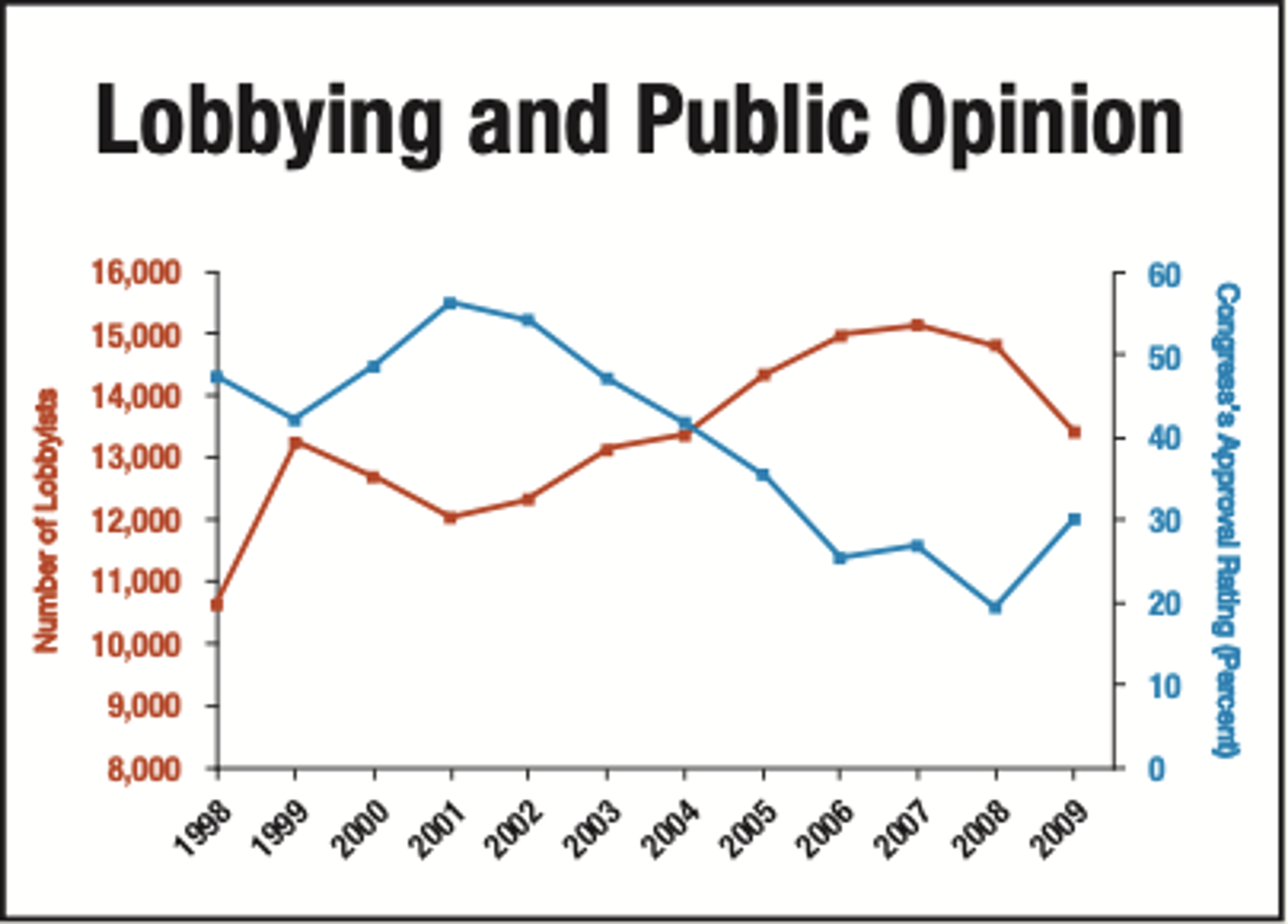
They are so good at what they do that subtle variations in their numbers have a visible impact on congressional approval. The nearby chart compares the ups and downs of congressional approval, as measured by averaging the year’s Gallup-poll data against the number of lobbyists. The negative correlation implies that the more lobbyists there are working in Washington, the lower will be Congress’s approval. Voters know when their money is being squandered.
The correlation is statistically significant, and sizable. Congress could, all else equal, increase its approval rating from today’s 25 percent to 50 percent simply by sending 1,500 lobbyists to Guantanamo. Maybe that’s why they haven’t closed it yet.
— KEVIN A. HASSETT
• Kingsbridge Armory, in the Bronx, is a cavernous building erected nearly a century ago to house a National Guard regiment. The Guard abandoned it in the mid-1990s, and after a decade and a half of sporadic use a developer proposed to convert the edifice into a shopping center that would bring some 2,200 jobs to the depressed borough. The New York City government, which owns the armory, was enthusiastic about the plan, but the city council said no way — unless retail outlets in the center agree to pay all their workers at least $10 an hour (the federal minimum wage is $7.25). This proviso, predictably, has killed the project. “We see how the interest of the people has prevailed over corporate America,” crowed borough president Ruben Diaz Jr. “We here maintain that the notion that any job is better than no job no longer applies.” That’s debatable, but if New York politicians keep preventing New York residents from selling their labor for what it’s worth, any job will certainly become scarcer than no job.
• The Copenhagen summit on climate change collapsed because China, the world’s largest greenhouse-gas emitter, refused to make any binding promises to reduce its emissions. President Obama had hoped to return from the summit with some evidence that, if the U.S. were to cap its own emissions, the developing world would emulate our folly. Instead the summit confirmed that global warming remains a Western fixation; the developing world has more pressing concerns. Without firm commitments from China, India, and Brazil, it is unlikely that the U.S. Senate will hamstring the American economy by passing the cap-and-trade bill Obama wants. That’s the good news. The bad news is that the EPA might well hamstring the economy anyway.
• The mainstream media, in their war coverage, are fond of “grim milestones” — ever-increasing death tolls, particularly ones that end with several zeros. When the total is a single zero, however, they lose interest. Case in point: Zero was the number of American combat deaths recorded in Iraq in December. This little-reported achievement was the result of several factors: continuing drawdowns, handovers of contested areas to the Iraqi army (which is also seeing reduced casualties), and a steady decrease in terrorist attacks on troops. All this has been made possible by the success of President Bush’s surge strategy, which brings up two more zeros: the amount of credibility enjoyed by Sen. Harry “The Iraq War Is Lost” Reid, and the probability that President Obama, so quick to blame everything bad on Bush, will give him any credit for this success.
• Of all the libels that were directed against Bush in relation to the Iraq War — and they were legion — the most offensive, and the least intelligent, was the calumny that he had engineered the war to enrich buddies in the U.S. oil business. Never mind the risible misreading of Bush and his agenda implicit in that belief; the simple economic fact is that if Bush had wanted to hand a juicy slice of Iraqi oil profits to American firms, he could have done so, at practically no cost, in exchange for lifting economic sanctions against the regime of Saddam Hussein. Iraq, as it happens, has lately completed a second round of bids on oil-development projects in the country, and U.S. companies are conspicuous by their absence from the list of winners. Sonangol, the state-run firm in Angola, was awarded a big contract, as were Royal Dutch Shell, the Russian giant Lukoil, and Norway’s Statoil. China’s CNPC won contracts in the first round, along with British Petroleum. Exxon Mobil and Occidental secured some relatively modest development business in the latest auction, but no American firm was given a contract. The Left’s slogan “No Blood for Oil” turned out to be accurate — as prediction.
• The Iranian theocracy’s war on Iranians continues. In year-end violence, government thugs in Qom disrupted the funeral of Ayatollah Hossein Ali Montazeri, a disaffected cleric, and attacked a car carrying opposition politician Mir-Hossein Mousavi. That was theater. In Tehran they went further, murdering Mousavi’s nephew. The protesters filling the streets to commemorate Shiite festivals and the deaths of their comrades have begun attacking pro-government militia forces. The regime, meanwhile, calls its enemies “mohareb” — enemies of God — while the chief of police warned, with a straight face, that the “era of tolerance is over.” President Obama, on his Hawaiian vacation, condemned “the violent and unjust suppression of innocent Iranian citizens,” while in the new year Secretary of State Clinton blasted “ruthless repression.” It’s many lives late, but better late than never. Let’s hope that the era of tolerance for the Iranian regime in Washington is ending.
• On the nuclear front, the administration is moving into its “next phase” with Iran, which promises to be as ineffectual as the last one. Now that Iran has blown through Obama’s end-of-the-year deadline for a deal on its nuclear program, the administration wants to apply a new round of sanctions. (There have already been three rounds of U.N. sanctions.) Needless to say, these will be carefully nuanced, consistent with the administration’s famous subtlety in dealing with Iran. Obama wants them directed only at the Revolutionary Guards, a worthy target to be sure. But the narrower the focus, the less likely the regime is to yelp. On top of that, the U.N. Security Council probably won’t approve anything too stringent, which means the administration will have to rely on a “coalition of the willing” that will lack key countries. Then the sanctions will have to be enforced, which is devilishly hard. In the end, we will have as much loophole as sanction, and will be left with the same essential choice we have now and have spent years evading: Either acquiesce in Iran’s acquiring a nuclear weapon, or use force to stop it.
• The Gaza Strip stands as a monument to the determination on the part of Palestinian Arabs to destroy every prospect they have ever had of enjoying a civilized life. The 1.5 million inhabitants of the place exist in utter wretchedness. There are chronic shortages of energy, food, and clean water. There is no economy to speak of. Health statistics are dire — except that female fertility is among the highest outside Africa. Government is by the terrorist gang Hamas — elected, of course — whose sole notion of statecraft is the inciting of incessant wars against Israel. Naturally the Israelis have responded by sealing off the Strip where it borders their nation. Gaza’s only other border is an eight-mile one with Egypt. Now, tired of the smuggling operations into Gaza via tunnels under that border, and also of Hamas fanatics’ proselytizing among their people, the Egyptians are building an “iron fence” — piles driven 30 yards deep, with pressure hoses to flood tunnels with sea water. Hamas has denounced the barrier as an atrocity, but the real atrocity here is the determination of Gazans to put their spite against Israel ahead of any consideration of their own welfare or their children’s future.
• Kurt Westergaard is the man who drew the famous cartoon of the Prophet Muhammad with a turban in the shape of a bomb. For him, it was all in a day’s work. Doesn’t free speech mean that you don’t have to censor observations even though they might be offensive? Not so for Muslims, evidently, numbers of whom have been sending Westergaard death threats. Luckily he has therefore taken precautions, and could hurry with his five-year-old granddaughter into a specially built safe room and press an alarm button when Mohammed Muhideen Gelle broke into the house. A Somali and a militant in the Islamist movement in that unhappy country, Gelle had armed himself with an ax and a knife and was screaming about “blood” and “revenge.” Police on the scene shot and wounded him in a hand and a leg before arresting him (Danes are saying that the police need more target practice). It turned out that Gelle had been in Nairobi last August at the same time as Hillary Clinton, and Kenyan police had arrested him on suspicion of being part of a plot against her. Released for lack of evidence, he had the necessary documents to fly where he liked for the next act of terror — yet another major security failure. The idea that a young man from Somalia would try to murder an elderly man in Denmark for his political artwork seems too outlandish to be real, but the world has come to that.
• “Lawfare” — the process whereby political ends are pursued in the courts — is a British specialty that has trapped prominent people, most notably the former Chilean president Augusto Pinochet. The latest victim of it is Tzipi Livni, Israeli foreign minister at the time of the anti-terror operations a year ago in Gaza and well known for her moderate stance toward all things Palestinian. Lawyers for Hamas in Gaza and in London heard that she was about to visit London and obtained a warrant for her arrest under “universal jurisdiction.” This invention allows courts everywhere to try cases of war crime and “war crime” even if the events occurred abroad and the suspect is not a citizen. Politics may thereby trump justice, as in this case. Duly warned, Livni stayed away. The Israeli government exploded with anger at the idea that self-defense could be considered a war crime, and the British blushed. Prime Minister Brown and his foreign secretary stated that officials from other countries must be allowed to travel freely as part of their responsibilities. They propose to change the procedure for obtaining a warrant in such circumstances, though “universal jurisdiction” looks set to remain a most useful weapon for lawyered-up propagandists.
• Liu Xiaobo is a name to bear in mind. He is a Chinese intellectual who spearheaded what is known as Charter 08. This is a document calling for nothing less than democracy and the freedom of man in China. It has been signed by about 10,000 others. Unsurprisingly, the PRC seized Liu, indicting him on December 10, which is International Human Rights Day — a nice touch. The government sentenced him on Christmas Day — to eleven years in prison. He has already spent five years in prison: two right after the Tiananmen Square massacre, and three later in the 1990s. Before Liu’s most recent sentencing, our State Department spokesman said that China’s actions “are uncharacteristic of a great country.” Yes, of course they are. But they are entirely characteristic of China under the Communists.
• If you head west 350 miles from Peking you are in Ordos prefecture, deep in the Chinese “autonomous region” of Inner Mongolia. The autonomy is perfectly theoretical; the population here is 88 percent Han Chinese, the native Mongolians having suffered the same fate as the Tibetans and Uighurs, but more comprehensively. It is a barren landscape, but very prosperous nonetheless, thanks to the prefecture’s containing much coal and mineral wealth. There is a city, also named Ordos — a bustling place, but one that developed fast and chaotically with the resources boom. The Chinese government, eager to pump some air into its GDP numbers via a huge infrastructure project, and perhaps vexed by the disorderliness of boomtown Ordos, has now built a new Ordos City 20 miles from the present one, laid out Brasília-style, with wide boulevards, grand modernist office buildings, and housing for a million people. Alas, the people have not shown up and the city stands empty. Revealingly, though, most of the living space has been purchased by Chinese citizens elsewhere, as investments. We wish the investors good luck, while wondering how you say “real-estate bubble” in Chinese.
• Moscow talk-radio host Matvey Ganapolsky said the following thing on air in October: “Stalin signed an order that children can be shot from the age of 12 as enemies of the nation. Which of the bastards dares say a single word in his defense?” Well, here’s one: Eugene Dzhugashvili, Stalin’s grandson. Loath to let the insult to his family’s honor pass unchallenged, Mr. Dzhugashvili has in fact initiated a lawsuit against the offending radio station, seeking 10 million rubles in damages. He probably has the support of many Russians: A respectable polling firm turned up 37 percent who look on the late vozhd with “respect, sympathy, or even admiration.” Rumors that Vladimir Putin’s administration will file an amicus brief on Mr. Dzhugashvili’s behalf are, however, so far unsubstantiated.
• We now have a score for the traditional New Year’s Eve car burnings in the banlieues — low-income-housing projects surrounding central Paris. The tally is 1,137, a tad below the 1,147 burnings reported last year. Impressive, nonetheless, in view of the fact that France’s interior ministry fielded 45,000 police during the night — 10,000 more than a year ago. Who is doing the burning? Why, “youths,” of course. Who did you think?
• Jacob Zuma, the president of South Africa, has taken himself a wife. That makes three: Polygamy is traditional among Mr. Zuma’s people, the Zulus, and is legal in South Africa. There have also been two former wives (suicide, divorced). In addition to the three current wives, Mr. Zuma has a fiancée, Gloria Bongi Ngema, age unknown. Estimates of the number of Mr. Zuma’s children range from 10 to 19, either two or three of them by the lady he has just wed, and one by the aforementioned fiancée. Mr. Zuma is 67 years old. His supporters are wont to describe him as a “Zulu traditionalist.” A conservative, then? We have alerted our Subscriptions Department.
• Remember those late-1990s movies about an asteroid on collision course with Planet Earth? It could happen, though the chances per century are infinitesimal. Among the candidate asteroids is Apophis, a thousand-foot, 30-million-ton rock whose orbit comes close to our own. Current calculations suggest a 1 in 250,000 chance of Apophis’s hitting us in the year 2036. Not to worry, though: Anatoly Perminov, chief of the Russian space agency, has announced plans to deflect the menacing asteroid. Let us hope that before this mission gets past the planning stage, someone apprises Mr. Perminov of the Law of Unintended Consequences.
• The folks at California’s Berkeley High School have a problem, or think they do: The school’s black and Hispanic students score much lower on standardized tests than whites and Asians. Their proposed solution: eliminate laboratory courses in science, which according to the East Bay Express are “largely classes for white students”; lay off the five teachers who teach them; and use the money thus saved to tutor underachievers. So high-school pupils in Berkeley — home of the University of California, where so many groundbreaking scientific discoveries have been made — will no longer learn to perform titrations, dissect frogs, or analyze circuits, for fear that the wrong sort of student will learn too much and thus increase the racial gap. Why not just break the smart kids’ glasses?
• The pianist Evgeny Kissin has done something remarkable. Born and raised in the Soviet Union, and now a British citizen, the 38-year-old Kissin is one of the most famous classical musicians in the world. And he wrote a fantastically eloquent letter to the BBC, lamenting and excoriating its “slander and bias” against Israel. He said that he heard echoes of “the old Soviet anti-Zionist propaganda.” When he became a British citizen in 2002, he explained, he was “inspired and proud to belong to the country of Winston Churchill,” whose contempt for anti-Semitism was magnificent. And the BBC “had always been a beacon of light, of truth and objectivity to those of us behind the Iron Curtain, in the ‘Evil Empire.’” What had happened to this sterling news service? The classical-music world, like the arts and academia at large, is not exactly friendly toward Israel. In writing as he did, sad to say, Kissin stuck his neck out.
• The Boykin (S.C.) Christmas Parade on the Sunday before Christmas is a special event, including a Road Kill Cook-Off and a gospel concert at the Swift Creek Baptist Church, and drawing 20,000 spectators. The lieutenant governor of South Carolina was supposed to be this year’s grand marshal, but snowstorms snarled his travel plans. So the organizers asked NR’s longtime managing editor, Priscilla Buckley, to do the honors. She writes: “I found myself riding around in a white carriage — white horse, driver in top hat and tails — making like Queen Elizabeth. It was great fun, and I felt pretty silly.” We’re sure it was easier than certain NR editorial meetings. Three cheers for Priscilla, for the new decade, and for Boykin, for asking the former to usher in the latter.
• In 1947 six men, led by Norwegian Thor Heyerdahl, set out to test the theory that pre-Columbian South Americans might have reached Polynesia by sailing across the Pacific on balsa-wood rafts. Heyerdahl and his colleagues built such a raft and launched it from Peru, making landfall 101 days later in French Polynesia. The subsequent book, Kon-Tiki, became a worldwide bestseller. Heyerdahl himself died in 2002, leaving only one member of his crew still alive, fellow Norwegian Knut Haugland. A hero of Norway’s World War II resistance to the Nazi occupation, Haugland had also taken part in the 1943 British sabotage raid on a Norwegian “heavy water” facility, thought by the Allies to be important to German nuclear-weapons researchers. After the Kon-Tiki adventure, Haugland served in the Norwegian military, and helped found and run both the Kon-Tiki Museum and a museum of the Norwegian Resistance. He died this Christmas Day past in Oslo, aged 92. R.I.P.
In a Twist
Umar Farouk Abdulmutallab aspired to change himself from a pampered, sad-sack 23-year-old to a martyr by blowing up Northwest Airlines Flight 253 to Detroit and its passengers on Christmas Day. But the lethal payload of plastique in his underwear failed to explode, and his attempt to ignite it achieved nothing more than the maiming of his genitals. (If that image found its way online, it could be a warning to other would-be martyrs.)
Prompt action by civilians helped avert mass murder: Abdulmutallab was jumped and subdued by passenger Jasper Schuringa as soon as his preliminary explosion went off; other passengers put out the flames. Also praiseworthy is the terrorist’s father, wealthy Nigerian banker Alhaji Umaru Mutallab, who was so worried by his son’s slide to radicalism that he contacted Nigerian officials and the U.S. Embassy in Abuja in mid-November to warn them.
There isn’t much other praise to go around. Janet Napolitano, homeland-security secretary, said “The system worked” two days after the bombing. This was such a howler that President Obama himself had to reverse course, blasting “human and systemic failures.” If he fired Napolitano, this would be merely a symbolic gesture, but symbols count: Punishing her inability to recognize failure when she sees it would at least get the attention of her soulmates, who are legion. And it is always possible that the administration, in a change of course, would find a suitable secretary.
What else went wrong? Young Abdulmutallab was trained and armed in Yemen (al-Qaeda in the Arabian Peninsula took credit for his deed). In its rush to close down Gitmo, the Obama administration had been dispersing the hard-core remnant to their home countries, which for many is Yemen: To purge ourselves of perceived sin, we recruited for the other side. Now the administration has wisely, if belatedly, stopped the Yemen Express.
Abdulmutallab had a valid visa. Though he was put on a terror watch list because of his father’s warnings, the visa was not yanked. Time to yank the granting of visas from the State Department, which values friendly relations with foreigners above all else, and move it to Homeland Security, where the focus might actually be on security.
More than eight years after 9/11, we do not connect dots or use all the technology we have. One positive step would be to put everyone who comes under any suspicion on a list for additional screening; another would be to expand the no-fly list. Boarding an airplane is not a right.
But bureaucratic and technical fixes will do only so much. America has to get serious about profiling. The Transportation Security Administration has picked 14 “countries of interest” and terror-sponsoring states, subjecting passengers on flights originating from or passing through them to extra scrutiny. Our policy should be, for want of a better word, discriminating.
Abdulmutallab was sent immediately to a civil trial. His lawyer, unsurprisingly, does not appear to have advised him to tell us everything he knows about his recruiters and handlers. We tried the 1993 World Trade Center bombers in regular courts. 9/11 then showed that we are up against international ideological pirates, not common criminals. We should treat them accordingly.
But the final lesson is one of stoicism. The enemy in this war treats every non-jihadist as a combatant, and the world as its battlefield. Every day, men and women in the military and intelligence agencies risk and lose their lives for us. Our duty is to understand that we too are on the firing line, and to go about our business with calm, defiance, and courage.
A Botched Operation
The House and Senate have now each passed a health-care bill. It remains to be seen whether they can agree to pass the same one, especially since their negotiations will take place amid public hostility to the entire enterprise.
The Senate bill is likely to provide the template for the negotiations. To the dismay of the Left, it lacks a new government-run insurer. Instead it imposes on the industry a new business model that could never survive in a free market and makes up for the imposition by forcing Americans to buy its products. As far as we can tell, the only reason to carry out this maneuver is to have an industry that can be called “private” while actually acting as an agency of the government. The industry’s products will be more expensive, and its profits pure waste.
Both bills expand Medicaid, ensuring that many Americans — some of whom lack health insurance and some of whom have good insurance — will now have low-quality insurance that many doctors refuse to take. They will also cut Medicare, crippling its popular private-sector elements and inducing doctors and hospitals to turn down Medicare patients, too. One of the Mayo clinics, touted by President Obama as a model for reform, has announced already that it will not be accepting Medicare payments because it does not want to accept Medicare price controls. Both bills include mandates on employers that are guaranteed to reduce hiring, wages, or both.
Scores of House Democrats have pledged to vote down any bill that lacks a government-run insurer. We will now see whether they are as good as their word or their threats are empty. Pro-life Democrats in the House may also be tested, since the Senate bill provides federal funding to help people buy abortion coverage.
Most of the bill will go into effect only after several years. Democrats are in a rush to pass it not because they long to provide immediate help to the sick but because they hope that public anger will fade before the elections. There is still time to persuade legislators to reject this senseless bill, or, failing that, to persuade voters to reject the legislators.










Comments