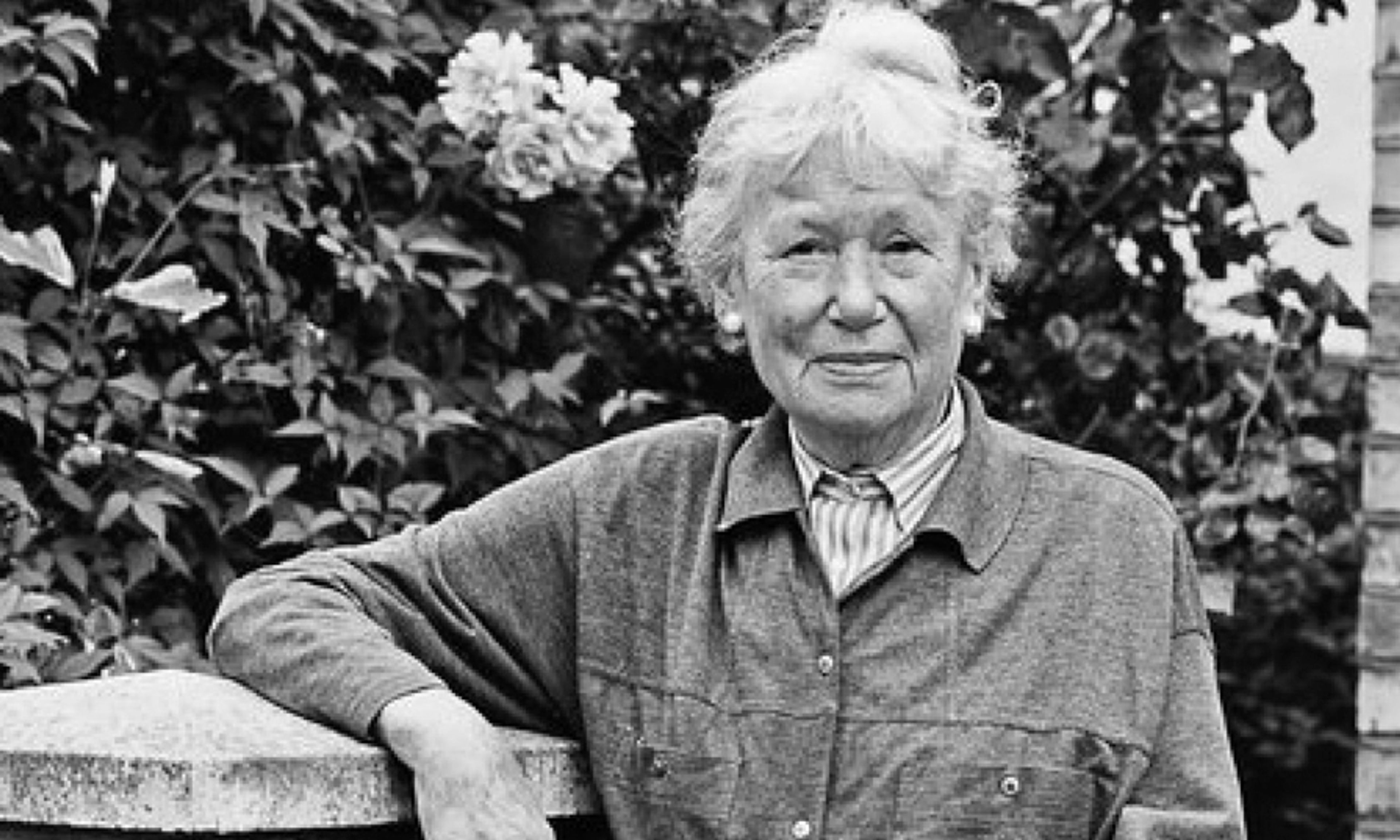
A couple of decades ago, in 1995, Penelope Fitzgerald published her ninth and final short novel. Though she had been shortlisted for the Booker Prize with The Bookshop (1978) and had won it for Offshore (1979), many English critics had treated her victories as flukes, perhaps out of dismay that a woman whose first novel was published when she was 61 should be welcomed to the club. Or perhaps because she had been pre-categorized as another female who wrote short novels à la Barbara Pym. Or because she was personally evasive in public, giving the impression that she was a dim, absent-minded grandmother. Or maybe because her novels were themselves so hard to define — “tragic comedies” she called them. Perhaps all of these and more. But with The Blue Flower, Fitzgerald was recognized in Britain and then in America. The novel came to our shores in 1997 and won the National Book Critics Circle Award. She was a star.
That star, whom A. S. Byatt later thought the greatest novelist of her generation, was nearly 80 years old and known as “Mops” to friends and family. The Blue Flower, which made her an international sensation, was about the obsessive love and desire for happiness the 18th-century German romantic poet Novalis (Friedrich von Hardenberg) focused on his dull, shallow, pleasure-loving, tubercular, teenage fiancée. Relentless in its detail of 18th-century Germany, giving us bureaucratic and technical aspects of salt mines, life in a German university (Jena, where Kant and Fichte made their reputations), and laundry in large houses, it brought to life in crystalline form gigantic themes that populate all her works: overpowering desire, the extraordinary revealed in the ordinary, disappointment, and perseverance. And though the plot centered on the brilliant young poet, it was equally about other members of the poet’s family and his circle of friends. Its emotional weight settles in the end on “the Mandelsloh,” a young woman who loves Hardenberg and is better suited to him, but who knows reality better than to think he will return her love. “But time given to wishing for what can’t be is not only spent, but wasted, and for all that waste we shall be accountable.” It was a theme the author knew well from her own life.
Penelope Mary Knox Fitzgerald (1916–2000) was the daughter of Edmund “Evoe” Knox, who edited Punch for many years, and Christina Hicks, both children of Anglican bishops. Though she was close to both sides of her family, the Knoxes, with their high achievement and eccentricity, defined her. I was introduced to her through The Knox Brothers, her 1977 group biography of her father and uncles. A codebreaker trained in classics and papyrology, Dillwyn decoded the famous Zimmermann Telegram, thus bringing the U.S. into World War I. He also helped crack the Enigma machine’s codes, used by Italy and Germany during World War II. Though he died in 1943, much of the intelligence he gathered would prove useful on D-Day. Wilfred was a New Testament scholar and a member of an Anglican religious order. And Ronald was the famous Catholic-convert priest, single-handed translator of the Bible, and mystery novelist. (Their sister Winifred Peck was also a novelist but was not featured prominently in the book.)
When her mother died young, Penelope’s father remarried Mary Shepard, the daughter of Winnie-the-Pooh illustrator Ernest Shepard. Shepard never forgave his 55-year-old Punch editor for marrying his 27-year-old daughter, but Penelope loved Mary and treated her as an older sister. Penelope studied at Oxford, then did some reviews and other pieces for her father and worked for the BBC during World War II, the latter experience providing her the setting for her novel Human Voices (1980). After the war, she married Desmond Fitzgerald, a dashing and literary young Irish soldier who had traveled in the circles of Robert Conquest at Oxford. The war broke Desmond, however: He would struggle with alcoholism for the rest of his life and never be able to provide for the family, even spending time in jail for forging checks and stealing from colleagues at his law firm.
Desmond and Mops co-edited a literary magazine called “World Review” in the early 1960s, publishing important European writers as well as Americans such as Bernard Malamud and Norman Mailer, but it’s not clear how much work Desmond did. Penelope’s need to keep the family afloat financially through teaching and editing prevented her from beginning her own serious writing career till her first book at 58 — a biography of Victorian artist Edward Burne-Jones — and her first novel at 61.
When I first picked up her novels, I thought she would be a female English domestic novelist in the tradition of Austen, to whom she was sometimes compared. She really writes, as Byatt put it, European fables. A lifelong lover of the Russian novelists, Fitzgerald was — according to her biographer, Hermione Lee — more like Turgenev than like Barbara Pym. Her plots, though often domestic, were meant to evoke the strangeness of life. They include hints of mythical backstories and, occasionally, appearances of the supernatural, as in The Bookshop, about a woman who moves to rural England and starts a bookstore that is plagued by a ghost. Conservatives will note that the ghost’s opposition is not as strong a factor in her downfall as is the economic and social opposition of various townspeople, channeled through the regulatory state’s maze, to an upstart entrepreneur.
This brings us to another un-Austenian aspect of Fitzgerald’s work. If she had written Pride and Prejudice, Mary Bennet and Charlotte Collins would have been front and center. Fitzgerald’s focus is on what she called “exterminatees,” or those who are in some sense fated to be among life’s losers but who nevertheless do not give up. Her novel Innocence (1986), set in 1950s Italy, has a main character, newly and unhappily married, exclaim at the end of the book, “We can’t go on like this.” The response of his wife’s phlegmatic cousin is pure Fitzgerald: “Yes, we can go on like this. . . . We can go on exactly like this for the rest of our lives.”
This was probably her vision of her own marriage. Offshore dealt with perhaps the lowest time in her life with Desmond, when the houseboat they lived on sank in the Thames, in 1963. Because her husband was largely drunk and useless, she arranged for them to live in a homeless shelter as she looked for a new place to stay. Around this time, she stopped sleeping with her husband, but she did not leave him or treat him badly in other ways. Her collected letters, So I Have Thought of You (2008), betray no bitterness or secrets. She did not complain out loud and she kept the secrets of her life and marriage. In the areas of resignation and perseverance, she practiced what she novelized.
While she mined her own experiences for such books as Offshore, The Bookshop, and Human Voices, she was remarkable for her ability to evoke other places and times. Whether she was writing based on her life or not, her work is very pointed because she situates her stories in times of historical transition. Human Voices recalls her own experience as a young single woman at the BBC during World War II. The Gate of Angels (1990) is about love and belief in 1912 Cambridge as physics reshaped views of the world. The Beginning of Spring is set in Moscow as the Revolution is about to start and the expatriate English-merchant community is about to end. In all of these, the feeling of exile and displacement is not just geographic but historical.
The passage of time, and the changes it wreaks on a place, heightens the dramas of personal relationships. Almost all of her novels deal at the deepest level with the yearning for love, for intimacy, for beauty and happiness that is beyond reach, symbolized very effectively by Novalis’s absorbing thought of the blue flower.
This yearning for what must be finally and fully reserved for the eschaton is what ultimately makes Fitzgerald’s writing so fine and emotionally taut. The yearning is always communicated through dramatic understatement and economy. This author was a master of the unsaid, the almost-said, and even the said-in-another-language. Frank Reid, the protagonist in The Beginning of Spring, has been abandoned by his wife. He hires as a nanny, and falls in love with, a young peasant who speaks no English. At a critical moment, he says, in English, not Russian, “Stay here, I’m in love with you.” We do not know whether Lisa understands, and Frank never says it in Russian to ensure that she does. Because of his failure to speak, we sense his loss more deeply when Lisa leaves. The poet Marianne Moore’s intuition was that “the deepest feeling always shows itself; / not in silence, but restraint.” Fitzgerald agreed. Her characters retain their sense of rightful mystery. They let deep call to deep in silence, a call often unrequited. Like the Bible, whose dramatic gaps in narrative and detail power our interest, Fitzgerald’s work is a revelation, late in time and needful for an age of oversharing and despair.
– Mr. Deavel teaches in the department of Catholic studies at the University of St. Thomas.












Comments