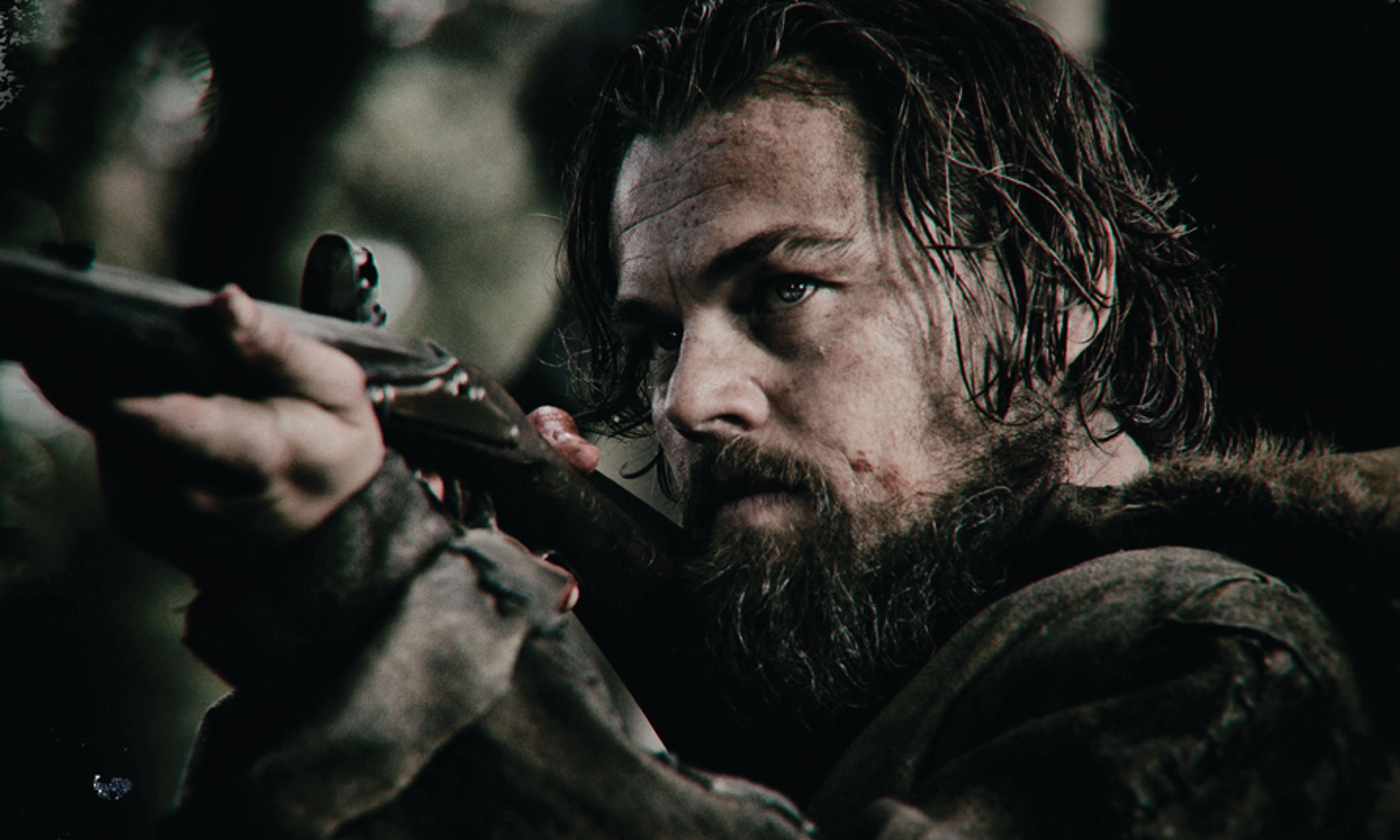
Leonardo DiCaprio is 40. Let that sink in.
No, it’s even worse than that: He’s 41. Yet the cheeks are still smooth, the boyishness still palpable, the eternal youthfulness still a defining feature of his presence on the screen.
And his career remains divided between parts that accept this reality and seek to capitalize on it and parts that bury his Dorian Grayishness under beards or makeup or just a manly scowl — parts in which he tries, in a literal sense, to act his age.
Mostly the first set of parts are better. (To pick the most recent examples, the criminal man-child Jordan Belfort in Scorsese’s The Wolf of Wall Street and the title role in Baz Luhrmann’s Gatsby were both great roles for Leo; his attempt to embody J. Edgar Hoover for Clint Eastwood was not.)
But the attempts at toughness are likely to continue; time’s arrow is in flight, and you can’t keep playing 30-year-olds at 50. And so this winter DiCaprio has taken it to extremes: In The Revenant, Alejandro González Iñárritu’s Old West survival epic, he buries his beauty not only under a beard, a pelt of hair, and a revenger’s grimace, but under the claws and teeth and body of a grizzly bear.
The bear attack catches DiCaprio’s character, Hugh Glass, when he’s trying to guide a team of soldiers and fur traders back from an earlier ambush, at the hands of Ree Indians, in the wintry high plains of 1832. He’s savaged and mauled and seems certain to die, and the party’s commanding officer, Andrew Henry (Domhnall Gleeson), orders three of the men to stay behind with Glass, let him die as peacefully as possible, and then give him a Christian burial.
One of the men is Glass’s son, a half-Indian boy named Hawk; another, unfortunately for all concerned, is the growling, self-interested Fitzgerald (Tom Hardy), who can possibly be forgiven an outsize anxiety about Indians given that he’s missing half his scalp. Soon enough the boy has been knifed, Glass has been tossed, still breathing, into a shallow grave, and Fitzgerald is headed back to what passes for civilization.
But the grave cannot hold our trapper, and neither can the winter bar him from his avenging course.
Visually, The Revenant is a staggering achievement. In his earlier English-language melodramas, 21 Grams and Babel, González Iñárritu tended to over-aestheticize tales of fated tragedy. But here the backdrop more than justifies his attention to detail, his zeal for the perfect frame and touch. The grandeur of the West, the pitiless, blue-cold beauty of ice and fir and snow, has rarely had a better cinematic treatment.
And for a while the story matches the scenery. The opening ambush is a brutal, blistering set piece; the bear attack is basically everything that Werner Herzog’s Grizzly Man couldn’t show given hairy, churning life; and the villain, Fitzgerald, has a twitchy greediness for our attention.
But once Fitzgerald’s schemes give way to Glass’s odyssey, the characters are separated from one another. The man-versus-nature showdown comes to the fore, and the movie becomes something beautiful to look at without a narrative to match. The screenplay has a lot of moving pieces: Along with Glass, Fitzgerald, and the larger party they’re both separated from, it throws in a group of Indians looking for a missing daughter (a kind of mirror-image version of The Searchers) and a gang of sinister French fur traders, as well as a wave of flashbacks, dream sequences, and hallucinations, many of them scored by ghostly murmuring from Glass’s dead Indian wife.
But there’s too much pretentious matter, not enough true art, and the film ends up trapped somewhere between Terrence Malick and Ridley Scott’s Gladiator: Its revenge drama is too weighed down by capital-M Meaningfulness to have the propulsive force it needs, and its meditations on nature, God, and man’s inhumanity to man aren’t interesting enough to justify their recurrence or longueurs.
Which doesn’t make The Revenant a failure; it’s still staggeringly beautiful, still remarkable in patches even if the whole doesn’t quite congeal. And of DiCaprio’s various gritty, grown-up performances I’d say this is the best: His face looks genuinely ragged, snow-encrusted like the landscape, and the bulk of furs and weapons makes you forget the boyish body underneath.
I’m not sure it’s a great performance, and if it wins him his first Oscar, that will be a little silly in the way that first Oscars for famous actors often are. Hardy is better, more vivid, and even Gleeson’s officer has a hint of a more complicated psychology than the single-minded Glass. But this is more the movie’s fault than Leo’s; he’s doing his part, and it’s not his fault that The Revenant has less to show us about the human condition than it does about the terrible beauty of the West.











Comments