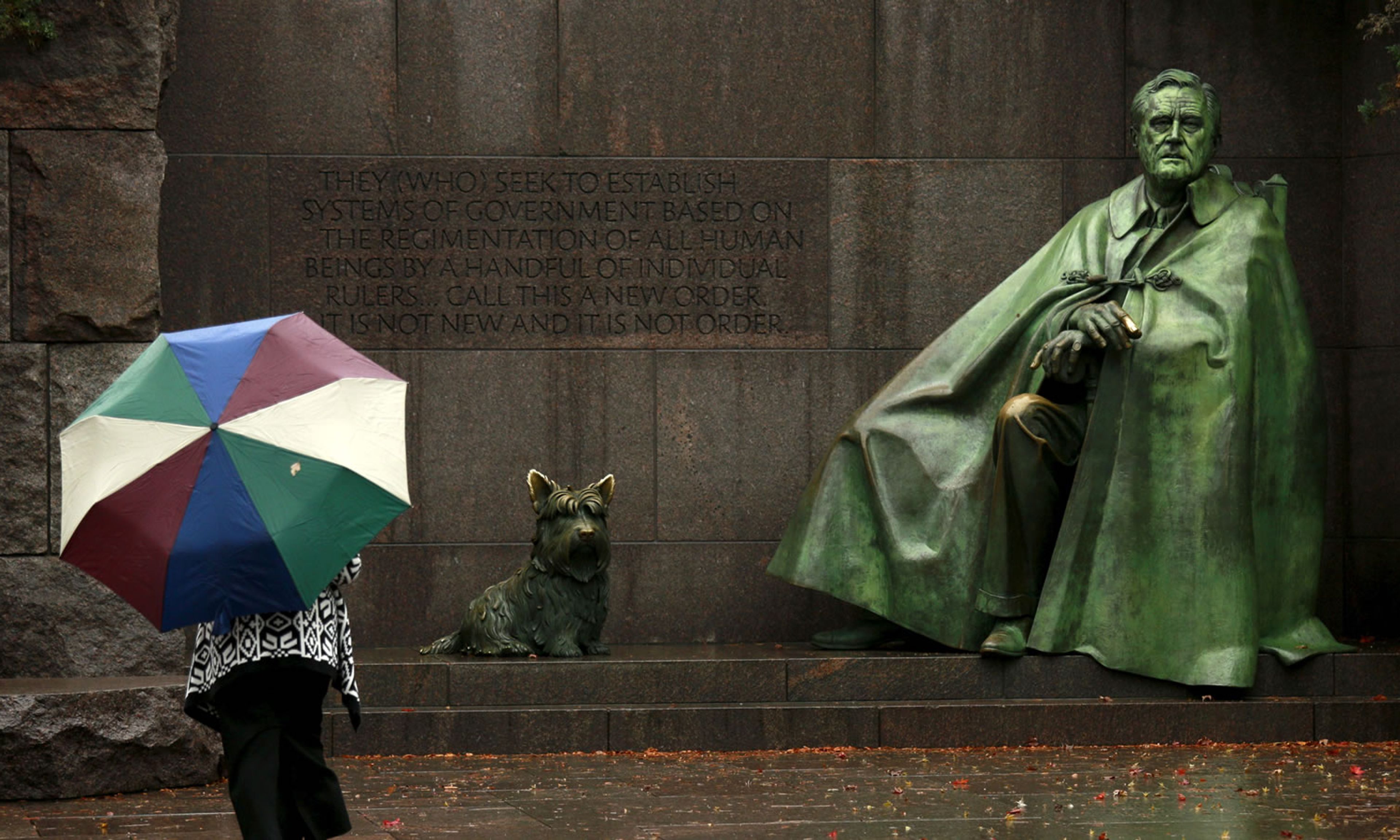
Some seem to believe Barack Obama is the second coming of Franklin Delano Roosevelt. Newspaper columns are rife with Obama-FDR comparisons, few of them skeptical. A recent Paul Krugman column was titled “Franklin Delano Obama?” and Time pictured Obama on its cover as the New Deal icon — cigarette and all — to accompany an article urging a New New Deal. Disgraced New York governor Eliot Spitzer returned from political exile to proclaim that “President-elect Barack Obama will soon face the extraordinary task of saving capitalism from its own excesses, much as Franklin D. Roosevelt had to do 76 years ago.”
There may be some parallels between Obama and FDR. Obama, too, succeeds a big-spending Republican whose fealty to market principles never matched his political rhetoric and inherits an extraordinary economic crisis. Obama defeated a candidate with minimal credibility on economic questions and will enter the White House with a sympathetic congressional majority. So perhaps it is only natural that Obama’s advisers are reading up on FDR’s first 100 days while his media cheerleaders call for an equally revolutionary progressive agenda. Yet before we embrace a “new” New Deal, it’s worth revisiting the alleged success of the old one. Economic historian Burton Folsom Jr.’s New Deal or Raw Deal? is thus a very timely book.
FDR is firmly entrenched in the American presidential pantheon; yet Folsom comes not to praise Roosevelt, but to bury him. Page by page Folsom peels away the parchment wrapping the Roosevelt myth to reveal the flawed figure beneath. Like other recent works, most notably Amity Shlaes’s The Forgotten Man, this enjoyable and eye-opening revisionist account seeks to separate fact from folklore, and correct common misperceptions about the New Deal and its economic legacy. In many respects it is a direct challenge to the “Roosevelt legend” popularized by William Leuchtenburg, Arthur Schlesinger Jr., and other historians.
Roosevelt’s rise was facilitated by the Great Depression and the Hoover administration’s lackluster recovery efforts. After three years of Hooverism, which was nearly a mini–New Deal in its own right, America had had enough. FDR’s ambitions were further advanced by his charisma and ambiguous political message. While he promised progressive spending initiatives, including “aid to agriculture,” public works to combat unemployment, and “bold leadership in distress relief,” he also campaigned on a platform of low taxes, reduced tariffs, and fiscal restraint: He said he would reduce the cost of government by 25 percent and pursue a balanced budget.
Once in office, FDR renounced any pretense of fiscal conservatism, though he still pursued gradual reductions in tariffs. Instead he set about building an array of federal programs to increase public employment and combat “underconsumption.” Among the New Deal’s cornerstones was the National Industrial Recovery Act, a revolutionary law that sought to cartelize industries so as to set prices and wages. Roosevelt labored under the belief that the Great Depression could be cured if workers were paid more: This would stimulate greater consumption and spur the economy, even if fewer people were working. It did not turn out that way. In reality, the new system stifled entrepreneurship, innovation, and competition, while providing little benefit to workers. From 1933 to 1935, nominal wages rose, but real wages actually declined. Companies that sought greater market share through lower prices were targeted by federal officials and often run out of business.
The Supreme Court upended the scheme by a 9–0 vote, but Roosevelt was undaunted, pushing replacement programs and conceiving an audacious (but ultimately unsuccessful) plan to “pack” the Supreme Court with new appointees.
Key parts of the New Deal were sold as temporary crisis measures, but once enacted they remained in place — some to this very day. FDR’s agricultural subsidies are a perfect example. The extensive system of subsidies and production controls generated substantial public employment — 100,000 federal workers were required to monitor farmer compliance — and increased income for some farmers. Yet, Folsom reports, as agricultural production dropped, consumer prices rose, and imports soared. In 1935, largely due to the Agricultural Adjustment Act, America became a major food importer.
FDR is remembered for his economic populism and campaigns against business leaders and “economic royalists.” Less known is how heavily his policies weighed on the poor and the working class. Despite his best efforts to soak the rich and impose near-confiscatory tax rates on high earners, the early New Deal relied upon heavily regressive excise taxes, including taxes on alcohol and the processing of food and clothing. From 1933 through 1936, federal revenues from excise taxes were greater than those from personal and corporate income taxes combined.
Despite the enactment of many new federal programs, there was little positive result. By 1939 Roosevelt’s treasury secretary, Henry Morgenthau, was forced to admit, “We are spending more than we have ever spent before and it does not work.” Morgenthau conceded that after nearly two full terms in office, the Roosevelt administration “never made good on our promises.” While unemployment dropped during Roosevelt’s first term, it crept back up between 1936 and 1939. Stock values plummeted from 1937 to 1939, causing some to call the late 1930s a depression within the Depression. On key economic indicators, including unemployment and industrial production, the United States underperformed other industrialized nations during the 1930s. Even accounting for differences in how economic indicators were calculated in various nations, Folsom notes, “the U.S. economy under Roosevelt did poorly not only in an absolute sense, but in a relative sense as well.” While this is disputed by some (see Conrad Black in NR, Dec. 15), more recent economic research, such as that by economists Lee Ohanian and Harold Cole, confirms Folsom’s claim that the New Deal did more to extend the Depression than to end it.
The dramatic expansion of the federal government came at tremendous cost to the nation, and not just financial. The gross negligence of Roosevelt’s Federal Emergency Relief Administration rivals the worst account of the Federal Emergency Management Agency under George W. Bush. Over 250 veterans working for FERA perished due to inadequate hurricane preparation in the Florida Keys in 1935. Men sent to work on infrastructure projects were left unprotected as hurricanes approached, causing what Time called a “slaughter worse than war.”
The creation of massive federal relief and spending programs encouraged patronage abuses and political manipulation. FDR’s administration doled out positions and federal funds to maximum political advantage. In many respects, Folsom explains, the abuse of federal monies and positions was a greater problem than the make-work nature of many projects: “Roosevelt’s special-interest spending created insatiable demands by almost all groups of voters for special subsidies.” Political patronage was hardly a new phenomenon; what was new was the sheer volume of money and power wielded by the administration.
Not content with documenting the New Deal’s policy failures, Folsom also delves into Roosevelt’s personal foibles, including his economic illiteracy and “poor character.” As Folsom documents, often relying on the contemporary accounts of FDR’s confederates, Roosevelt regularly made promises he did not plan to keep, and would deceive political allies and opponents alike if necessary to advance his agenda. As Harold Ickes, FDR’s interior secretary, confessed, all too often Roosevelt seemed “to regard his word lightly.” More disturbingly, FDR evinced a paranoia and vindictive streak that were positively Nixonesque. “Roosevelt could be a shrewd and smooth politician,” Folsom notes, and quite charismatic. Yet on many occasions “his anger and vindictiveness overrode his political judgment.” He sought to purge allegedly “disloyal” Democrats from Congress, and set the Internal Revenue Service loose on his political opponents.
Folsom argues that Roosevelt’s larger-than-life public persona hid the small and often contemptible man. Yet Folsom wants to go farther, suggesting that after Roosevelt’s conduct “fewer presidents would be bound by public promises, by constitutional restraints, or by providing exemplary conduct in their personal lives.” Even if one were to accept that Roosevelt was the first American president to exhibit such character traits to this degree, Folsom offers little reason to believe that FDR himself is responsible for the poor character and irresponsibility shown by some of his successors.
Folsom does acknowledge the New Deal’s few bright spots, including reasonably sound monetary policy and a gradual reduction in tariffs. With protectionist sentiment on the rise today, this latter policy is certainly one worth emulating. That said, New Deal or Raw Deal? is not a particularly even-handed treatment of its subject, but much the same could be said of most favorable treatments (which is to say, most treatments) of FDR. There is no reason a counterweight should bear any greater burden of balance than conventional historical texts. It’s an indictment — and quite a damning one at that — but not a final judgment.
It is too often said that those who do not learn from history are condemned to repeat it, but sometimes this warning is true and important. If the nation is prepared to embark on another progressive voyage to expand the federal government, it’s worth noting how such treks fared before. Thus we should be thankful for Folsom’s insightful primer on the policy failures of the nation’s last effort to combat economic crisis with government largesse.












Comments