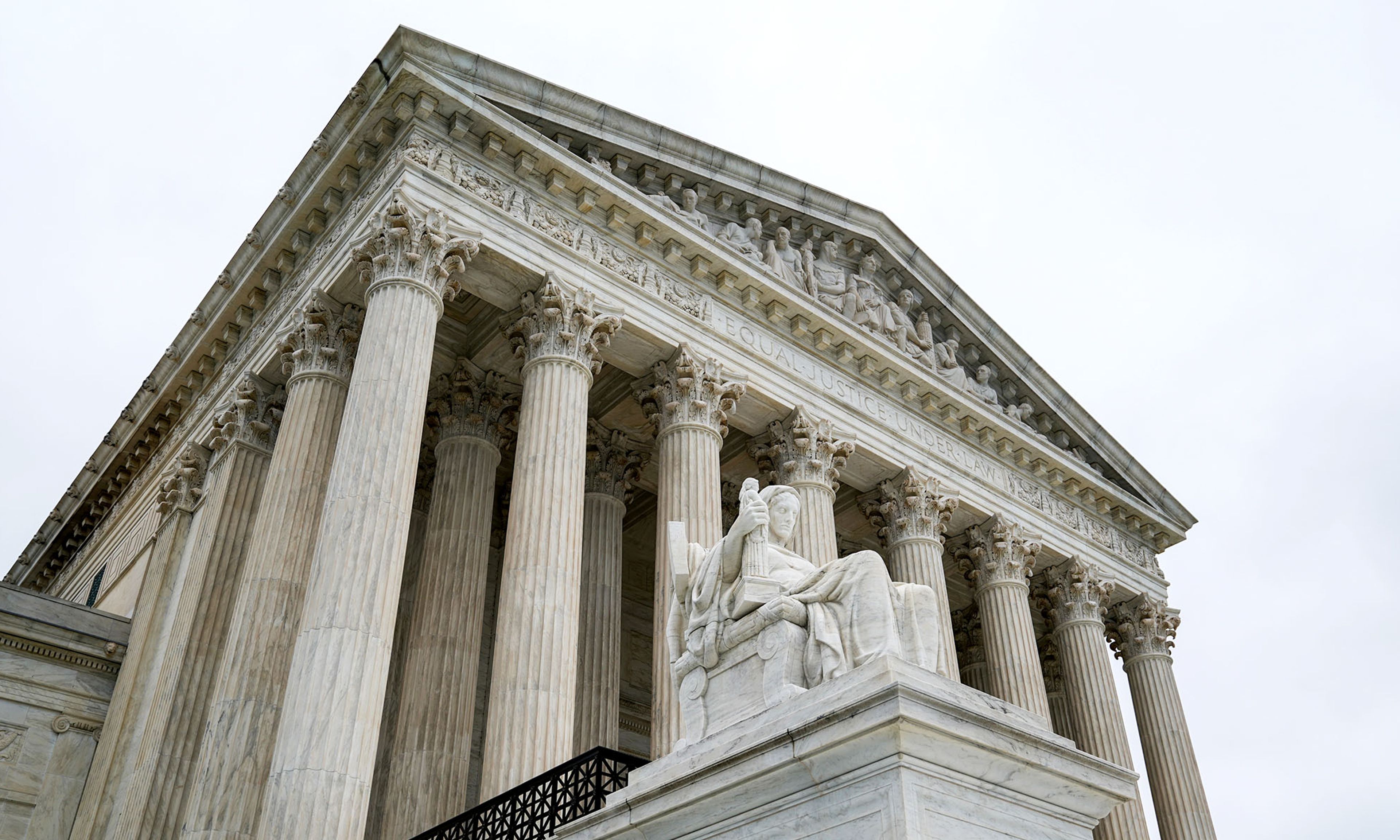
It’s been half a year since the Supreme Court handed down its decision in District of Columbia v. Heller, affirming that the Second Amendment gives individual citizens the right to keep and bear arms. But Reason senior editor Brian Doherty, author of Radicals for Capitalism, has already published a short book, Gun Control on Trial, documenting the history, context, and outcome of the case.
The book is a worthwhile endeavor. Covering lots of ground in fewer than 120 pages of text, it’s a great primer for the unfamiliar, and even those who have followed the gun debate will find plenty of interesting new tidbits. However, the author glosses over a few topics, sometimes offers weak analysis, and gets some minor facts wrong.
Doherty starts at the beginning: He shows how the Founders, building on English tradition, valued gun rights. An armed populace, also called the militia, was useful for repelling outside invaders, replacing government armies to some degree, and keeping said armies from seizing power. These values culminated in the Constitution’s Second Amendment, “A well regulated Militia, being necessary to the security of a free State, the right of the people to keep and bear Arms, shall not be infringed.”
As Doherty winds his way through American history, he presents a series of fascinating anecdotes. For example, he tackles the backstory of the 1939 Supreme Court case U.S. v. Miller: Two criminals transported a sawed-off shotgun across state lines without paying the tax the National Firearms Act levied on such weapons. The judge they faced was a gun-control activist who wanted to verify that the NFA was constitutional by sending a good case (one where the defendants weren’t particularly likable) up through the appeals process. When the criminals pled guilty, he refused to accept the plea — that way he could throw out the indictment, ostensibly on the grounds that the NFA violated the Second Amendment, and the government could appeal the case. The defendants went on the run, and their lawyers didn’t even bother showing up at the Supreme Court to argue.
Even with the deck thus stacked, Doherty notes, Miller was not the defeat for gun rights that many people later thought it was. The Court did uphold the NFA, but did so not because the criminals weren’t members of a militia, but because it had not been proven that a sawed-off shotgun was the type of weapon a militia might use. The decision even noted that the militia included all males capable of fighting, not just government-selected recruits.
When Doherty gets to the Heller case of last year, his reporting really shines. He interviewed all the major players (on the pro-gun side, anyway), and he thoroughly documents the personalities, infighting (the NRA would have preferred to wait for a few more pro-gun Supreme Court nominees, and sabotaged the effort), strategizing, and collaboration that made the case such a success.
One debate Doherty avoids, however, stems from the fact that precursors to the Second Amendment varied greatly in their wording. For example, the Pennsylvania state constitution protected the right of the people to bear arms “for the defence of themselves and the state,” and 21 members of the state’s ratifying convention later suggested the protection of gun ownership even for the “purpose of killing game.” Other states offered a right to bear arms “for the common defence” or “for the defence of the state.” Not surprisingly, some anti-gun activists and scholars have latched on to the latter phrases, claiming these prove that in the founding era, people understood the right to bear arms as limited to militia endeavors. Rather than explore the topic, Doherty dismisses it, claiming that gun ownership “for the common defence” was somehow “mixed” conceptually with gun ownership unrelated to the common defense. He offers no supporting details until several pages later, when he notes the obscure 1833 Tennessee Supreme Court case Simpson v. State. (Simpson interpreted the phrase “to keep and to bear arms for their common defense” in the state constitution to mean that citizens may bear arms generally.)
The issue deserves more discussion, because Second Amendment experts have divergent views. Clayton Cramer has speculated that the phrasing might have been intended to counter a specific argument in favor of disarming the population — the argument that when a standing army exists, the people no longer need to bear arms for the common defense. Don Kates has pointed out that, through the 19th century, no court clearly interpreted “for the common defence” to limit a right-to-bear-arms clause. He argues that “common defence” didn’t distinguish military defense from personal defense, but military and personal defense from gun use “in a private quarrel.”
The Second Amendment’s predecessors perhaps said different things because they meant different things. At least some early Americans thought that “for the common defence” limited the right, and were worried about that fact: In Massachusetts, before the state adopted “for the common defence” language, the locality of Northampton suggested changing the language to “The People have a right to keep and bear arms, as well, for their Own as the Common defence.”
Gun Control on Trial also addresses the merits of gun restrictions, and here Doherty’s worst offense is his distortion of the D.C. murder rate. D.C.’s gun ban, which Heller struck down, took effect in 1976. Doherty repeatedly cites the statistic that in the ensuing years, only once has the murder rate slipped below what it was then. From this he argues that a D.C. with a gun ban “has not been a safer D.C.”
The city is indeed no safer, but the 1976 figure is highly misleading. Between 1970 and 1976 the murder rate fluctuated quite a bit, between a low of 26.8 and a high of 38.3 per 100,000 (before 1970, it was lower but rising consistently, save for a spike in 1969). The 1976 rate was the low, 26.8 — it was not a representative snapshot of murder in a pre-ban D.C. Looking at the 1970–76 range rather than just the 1976 rate, it’s impossible to tell what effect, if any, the ban had. The rate stayed in this range until 1985, the year it dipped below the 1976 rate, and again until 1988, when a severe crime wave gripped the city.
Doherty’s analysis doesn’t fare much better when he compares D.C. with the nation’s other 49 largest cities. It turns out that in the 1990s, crime in D.C. increased more than crime in the other cities, but this may have had nothing to do with gun laws: D.C. is disproportionately poor and black, and the site of a disproportionate share of the drug war. It’s much more fair to compare D.C. with Baltimore, and when researcher Gary Kleck did just that in 1995, it turned out that the two cities’ murder rates had moved in tandem both before and after the ban.
The effects of gun control are incredibly hard to tease out, even with reams of data, and it takes cherry-picking to make a single city’s experience seem to prove otherwise. The most one can learn from D.C.’s murder rate is that gun bans are no cure-all: There was no noticeable drop in murder after 1976, and when the drug wars took off in the late ’80s, the ban didn’t prevent the rate from rising.
To say anything more than that with confidence, one has to turn to large-scale statistical studies. Doherty touches briefly on a few, but he could have done more in explaining the debate and the players in it. Basically, there are three schools of thought. The controversial economist John Lott, who singlehandedly set off a wave of studies with More Guns, Less Crime, leads the pro-gun school. Lott believes that once you consider all the relevant demographic factors, it’s gun rights, not gun-control measures, that decrease crime — gun rights enable self-defense, making criminals afraid to attack.
There are a few scholars on the opposite side, who believe that gun control reduces crime. And there are some studies, in particular extensive literature reviews by the Centers for Disease Control and the National Academy of Sciences, that find no convincing evidence in either direction. (One member of the NAS panel, leading criminologist James Q. Wilson, dissented, saying essentially that he agreed with Lott.) Doherty mentions the CDC and NAS reviews only briefly, and doesn’t mention Lott or his supporters. Like the words “for the common defence,” this is an issue that warrants more space.
Also, there are a few minor errors. For example, Doherty says that D.C. “tried to rely on the fact that D.C. is not technically a state to claim that the Bill of Rights doesn’t apply to them anyway,” that this was “bizarre,” and that the Court “ended up ignoring it.” In fact, D.C. argued that the Second Amendment specifically, not the Bill of Rights as a whole, was meant to protect the states from the federal government, and so would not apply to a federal enclave; whether or not it was “bizarre,” a dissenting judge at the appeals-court level made a similar argument; which the Court addressed (“The phrase ‘security of a free state’ meant ‘security of a free polity,’ not security of each of the several States”).
In another section, Doherty explains that it will take more lawsuits to apply the new Second Amendment doctrine to the states in addition to the District, and some have already been filed. He celebrates these new suits for having already “brought change,” because Chicago suburbs Morton Grove and Wilmette have repealed their handgun bans rather than go to court. But it’s not at all clear that any real “change” occurred, because Chicago itself is fighting one such lawsuit — it’s likely the suburbs repealed so as to wait out the verdict and avoid legal costs, not to respect their residents’ rights. They can always reinstate the bans later.
Still, given that Doherty had so little time and used so few words, Gun Control on Trial is a remarkable accomplishment — well worth reading, and worth keeping as a reference.











Comments