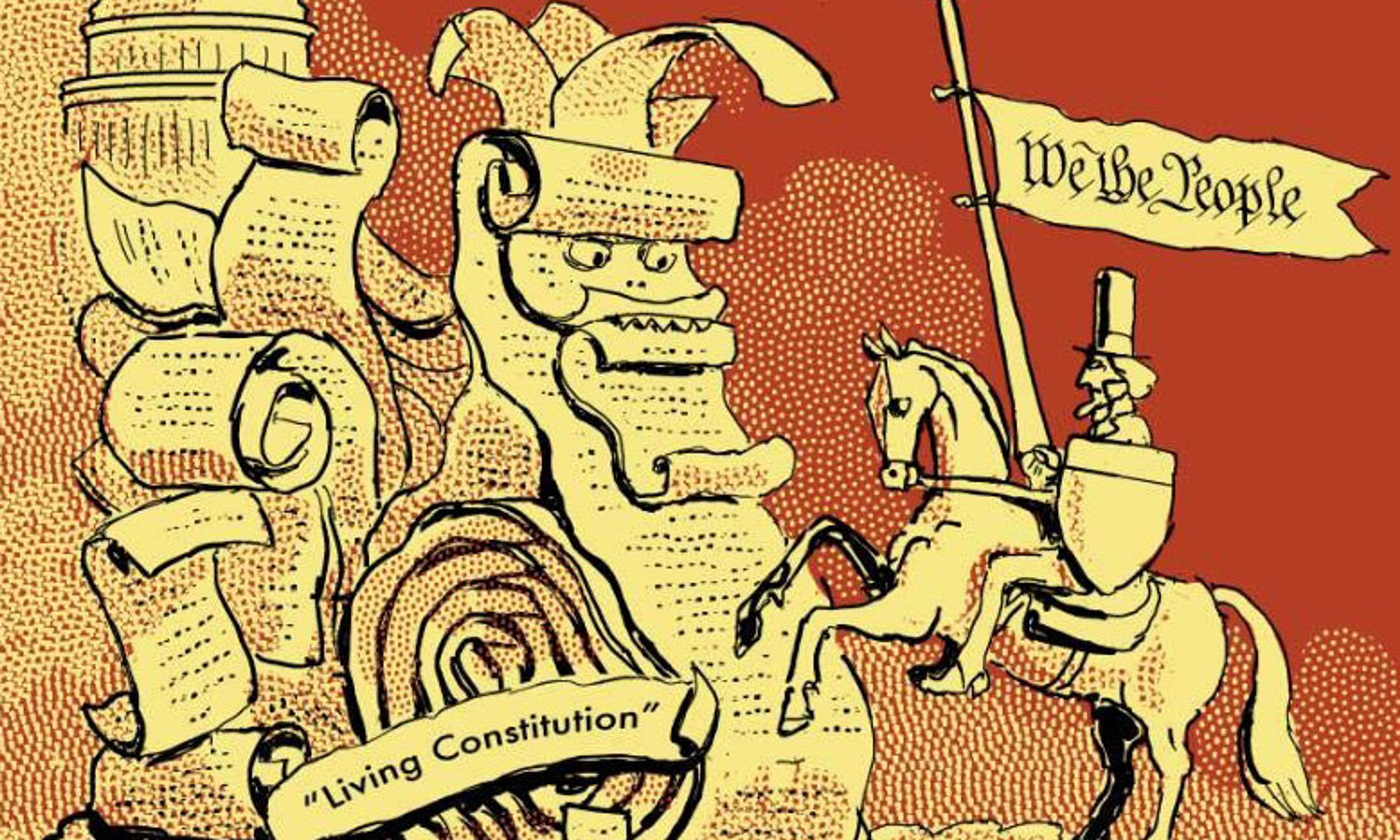
A specter haunts Charles Kesler’s Crisis of the Two Constitutions: the specter of Trumpism. It is right there in the subtitle: “The Rise, Decline, and Recovery of American Greatness.” Even though only two of 18 chapters of the book deal directly with Donald Trump, the reader senses the work building toward an apologia for the former president. Yet, much as he did during the Trump administration, Kesler remains just a touch aloof from Trumpism: clearly for it but writing as a bemused analyst rather than a participant.
In the preface, for example, he reasonably regrets that “our polarization is pervasive and deepening, though it isn’t yet, I hope, at the point of no return.” Yet nearly at the end of the book, he offers a defense of publishing Michael Anton’s “The Flight 93 Election” in the Claremont Review of Books, which Kesler edits. He regards Anton’s flight of fancy as harmless rhetoric, exaggerated as all political appeals are. A cynic might see Anton’s thesis — namely, that the country had boarded a doomed airliner and that its only hope to avoid a fiery death was Donald Trump — as polarizing. There is not much room for compromise between charging the cockpit and crashing the plane. Almost 400 pages separate these reflections. Maybe the reader is supposed to have forgotten by then. But the juxtaposition forces the question: Can Kesler have it both ways?
Again, this is not a book about Trump in any comprehensive sense. Much of its value lies in persuasively charting the steady emergence of a second constitution, that of the administrative state and the social-justice warriors, against the Framers’ original, which was based on prudent republicanism and natural rights — foundations Kesler intriguingly distinguishes from liberal democracy. Liberal democracy, he argues, cannot account for the idea of “founding” in the American sense.
Kesler’s exposition of the Philadelphia Constitution, especially of Federalist No. 10, is admirable. He convincingly shows that the American Founders were not, as is commonly thought even among their admirers, indifferent to virtue. Among other points, he develops the thesis that the American regime is designed not to pacify interests but rather to cultivate citizens and attract statesmen. In an intriguing chapter five, Kesler defends the Framers against the charge that they were inattentive to education: “The founders expected that the cultivation of republican opinions among the people would engender republican manners, and thus restrain and shape the role of passion and interest in the new regime.”
Chapter four’s exposition of George Washington — which includes an enriching analysis of civility that roots it in citizenship rather than mere politeness — and chapter six’s portrait of Abraham Lincoln remind us that excellence in republican statesmanship is both possible and indispensable. Kesler’s Lincoln, who tracks Harry Jaffa’s, brings the reader back to the Declaration of Independence and shows that its basis must be more than Lockean individualism. Kesler’s discussion of the much misunderstood virtue of prudence is illuminating as well.
His takedown of Woodrow Wilson is devastating, establishing that Progressivism proclaimed a new constitution based in transient and ideological progress rather than unchanging nature. This idea of progress without end or object is the first of three waves of liberalism that Kesler identifies. The second is “economic or ‘entitlement’ liberalism,” typified by Franklin Roosevelt’s proclamation of a new Bill of Rights, economic in nature, in 1944. The third wave, of which Kesler is also an astute analyst, is multiculturalism, which he says has proved more radical and “fratricidal” than the others — or, rather, it has developed the radicalism innate in the first two waves.
In this regard, Kesler also offers a deep and engaging assessment of the mania according to which America is systemically and irredeemably unjust, especially as that mania plays out on campuses. The education of citizens, he argues, is insufficient without anchoring moral truths. Kesler is at his best here:
Thus the reading of great books, although necessary, is not sufficient. They must be read with a view to the students’ own good as human beings and citizens; they must be read with an eye for something outside the texts. For the aim of education is not simply the imparting of facts or an appreciation of great books, but wisdom — uniting theory with practice, knowledge with character, ideas with consequences.
But Kesler’s ideas have consequences too. The book deserves to be read for these and other insights, but his thesis is larger than that. It requires a reckoning as well. There is no question that there are two constitutions, or that one has morphed into another while some of us are still clinging to the old. But the thesis is of a crisis. Given that conservatism should be generally disposed to suspect assertions of crises as veiled claims to power, we need to understand why exactly — after more than a century of development — the crisis is now.
In his preface, Kesler offers the suggestion that the nation is moving from the regular give-and-take of “normal politics” to the more fundamental and potentially explosive questions of “regime politics,” much as it did in the 1850s. This echoes the Trumpist claims that 2016 was the most important election since 1860 and that 2020 was the most decisive since 1864. Kesler suggests there are a few ways out: One side could change minds and win, or the two sides could trade power, growing more bitter with one another. Alternatively, the country could change the subject, which seems untenable.
Consequently, Kesler really sees only three exit strategies. “The happiest of these would be a vastly reinvigorated federalism.” Barring that, there is — paging Michael Anton — either secession or civil war. There are excellent reasons for reinvigorating federalism, but the claim that the alternatives beyond that are secession or fighting it out in a shooting war is — to put the matter kindly and gently — a kinder, gentler version of the Flight 93 thesis.
Notwithstanding his excellent prose and often penetrating insights, Kesler seems caught up in the moment. The country may be headed for a breakup and the attendant bloodshed. But it may also be that the Aristotelian middle class of America is somewhere between puzzled by and, more to the point, indifferent to the crisis Kesler posits.
Prudence includes the capacity to see just a little over the horizon, and it is possible that Kesler’s vision of a coming crackup demonstrates a prudence that Pollyannas lack. But it deserves to be treated skeptically. Between the emergence of the Progressive constitution and today’s purported crisis, the nation has fought two world wars and a cold war, vastly expanded civil rights for all Americans, and been engaged in other world-historical events. Not all moments are world-historical, though. Far from it: One suspects an inverse relationship between the claim that events are world-historical and the extent to which they actually are.
A theme develops relatively early in the book that the problem is not just Progressivism but also conservatism, or at least what Kesler regards as the confused varieties of it. American conservatism bloomed late and insufficiently, he writes. Frank Meyer’s fusionism, for example, spurned the One and True Church of the Declaration of Independence — in other words, the Claremont school of thought — thereby avoiding the fundamental questions of politics. A conservative disposition might be inclined to avoid pushing exactly those kinds of questions, in favor of civic peace. But for Kesler, conservatism’s tent has grown large and confused and therefore — its ultimate sin — unable to make a compelling case against the Progressive constitution. This kind of conservatism is, as the former president might say, a loser. Similarly, traditional conservatives such as Russell Kirk were, for Kesler, too enamored of non-American thinkers such as Edmund Burke.
“What is plaguing conservatism, in other words,” Kesler offers, “is that its sense of mission — its devotion to a high, clear, and overarching cause — has deserted it, and recognition of this fact has begun to sink in among conservatives and liberals alike.”
If in fact the whole truth lies in only one strain of conservatism that brooks no compromise, then we do have the conditions for permanent conservative defeat and disgruntlement and, if feelings are as strong as Kesler suggests, a crisis of the regime.
Might Kesler’s rigidity be promoting, not merely describing, the coming crisis? His explanation of the Flight 93 essay’s publication is suggestive. A Never Trumper, Kesler reports, told him the essay was “dangerous” but could not, to Kesler’s ears, identify a danger other than the possibility that Trump might win. “The broader point, of course, is that almost any spirited political appeal involves an element of exaggeration for effect.”
Anton’s jeremiad does not deserve elevation to a causal explanation for all that followed. But the nature and degree of his exaggerations matter. To the extent “The Flight 93 Election” either amplified or created the impression that desperate measures were necessary to save the nation from impending demise, is it surprising that those who believed it reacted in ways from which Kesler wants to remain aloof — such as storming the U.S. Capitol to try to prevent the counting of electoral votes?
Nonetheless, the case for Trump is simple: He wins. He fights. But then — and a book with a 2021 publication date is conspicuously silent on this — he lost. The book seems to have gone to press before Election Day, and certainly before Trump went wild with election conspiracy claims that have induced a majority of Republicans to believe Joe Biden is a Vichy president. It has, for that reason, an occasionally anachronistic feel.
A further analysis of the events since Election Day 2020 might show that the crisis may not be entirely on the side of the Progressive constitution. Part of the crisis may be a rhetorical posture that — elucidated with Kesler’s pen, kindly and gently — sees every dispute in existential terms.
That does not detract from Kesler’s ample insights, all of which make Crisis of the Two Constitutions worth reading. It is simply a wish that he had applied his powers of insight more carefully to the Trump phenomenon as well.












Comments