San Diego — Here on the Southern California side of the U.S.-Mexico border, where workers at a wastewater treatment facility can see into the backyards of their Mexican neighbors, the water running through the Tijuana River Valley is toxic. So toxic, in fact, that U.S. Customs and Border Patrol agents say that one step in the wrong channel is enough to melt their boots off.
At 7 a.m. on a cloudy Earth Day morning in late April, hippie protesters hold Stop the Poop signs at the entrance. The smell of hydrogen sulfide and sewage fills the air, making everyone’s nose crinkle the moment they step out of their cars to start the tour.
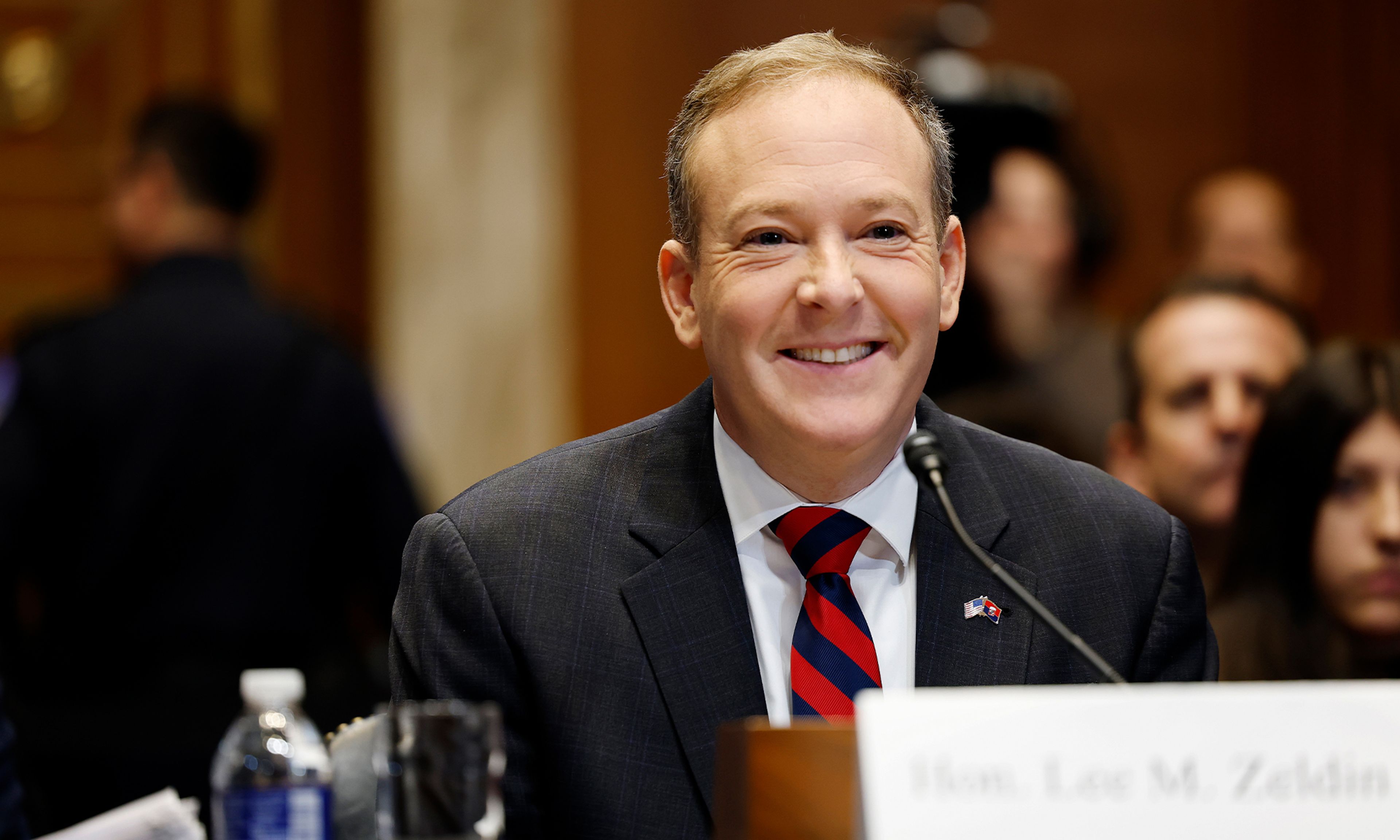
Lee Zeldin, the Trump administration’s Environmental Protection Agency (EPA) administrator and a New York native, is here with a bipartisan delegation of California politicians to tour the South Bay International Wastewater Treatment Plant in San Diego. The plant is on the receiving end of Mexican sewage, sediment, and industrial waste — and its old pipes can’t keep up. Congress has appropriated more than $600 million in recent years to upgrade this facility. But the problem with this massive construction project is operating the plant while upgrading it.
On the second stop of the tour, wastewater treatment facility employee Jacob Schmidt points at a Mexican highway project that he says is wreaking havoc on the plant’s wastewater-collection system, damaging its equipment in the process. “Whenever it rains through here, we get bombarded with tons of sediment, rocks, tires, pipes, all sorts of stuff” from the Mexican hillside.
“If you guys really look here, this is pure sewage coming from this community on this hillside,” he tells the gaggle of hard-hat- and safety-vest-wearing politicians, pointing into neighboring Tijuana. “This hillside has a broken pipe. They say, because of the topography, they can’t fix it in Mexico, but that’s what all this water is coming from.” This prompts some head-scratching from the tour: If the topography is that challenging, why would Mexico build on it?
The wastewater plant looks like the set of Chinatown, Roman Polanski’s 1974 film — though this place reeks, drones hover everywhere, and the treatment facility is encased in border fencing. The sewage problem is so bad that local beaches are closed, and the Naval Special Warfare Command in nearby Coronado, Calif., has seen an uptick in reports of acute gastrointestinal illnesses among Navy SEAL trainees due to waterborne bacteria.
At another stop in the wastewater plant, the Tijuana riverbed is full of tires and sediment. The project managers explain that the flow of liquid is “essentially sewage and industrial waste.”
Zeldin gets right to it: “Give me an idea of what’s the best thing we could do to solve this issue.”
Upgrading the infrastructure, stopping the leaks, and increasing the treatment capability on the south side of the border, a wastewater-facility employee explains. The problem is that the Mexicans “do not collect the full sewage from downtown Tijuana” and other parts of the fast-growing Mexican city. As a result, the U.S. side “has become the solution for sewage, and that should never happen.”
Local officials on the tour — all well aware that journalists are sitting in the same van — complain about the length and purpose of the early-morning tour.
“Where are we? Another photo op?”
“Was that the last stop? I hope?”
“Happy Earth Day, everybody.”
But Zeldin is resolute. The night before the tour, he met for an hour and a half with Mexican officials to pressure them to step up work on the infrastructure front. But he says the U.S. must invest a pretty penny cleaning it up, too.
“The cheapest way of figuring it out is going to come with a price tag of hundreds of millions of dollars,” he says on the tour with Empire State–style bluntness. “But if anyone’s spooked by the price tag, the fact is, if you don’t do that, you’re never going to actually solve it.”
Leading the Trump administration’s diplomatic approach to the Tijuana River Valley crisis is a one of the more challenging problems Zeldin faces in his new role atop the EPA, one that requires him to address a vast range of issues: environmental policy, local politics, public health, and sometimes, foreign policy. “If the response we get from Mexico is that they will do 80 percent of what needs to get done, but not the final 20 percent,” Zeldin tells me during a wide-ranging sit-down interview later that afternoon in his hotel, then “there will be no end of this crisis, and it will continue for years and decades to come.”
* * *
The first Jewish EPA administrator in American history, 45-year-old Zeldin grew up in Suffolk County, N.Y. A lawyer by training, the Iraq veteran and recently retired lieutenant colonel in the U.S. Army Reserve ran unsuccessfully for Congress in 2008 before serving a few years in the state legislature. In 2014 he ran again for New York’s first congressional district on Long Island and won, serving there for four terms. Near the end of his tenure, he battled early-stage chronic myeloid leukemia and is now in remission.
Zeldin is a curious pick to lead the EPA. Myron Ebell, chairman of the American Lands Council, who ran Trump’s first EPA transition team in 2017, tells NR he’s “not surprised that he was chosen for a cabinet position” this go-round because he was told in 2023 by people involved in the Trump operation that Zeldin was very highly regarded and had a future in the next administration. “I was surprised that it was EPA, because he’s a very sharp lawyer . . . but he is not experienced in environmental law.” So, while he was an “outstanding choice,” he was also an “unusual” one.
In person, Zeldin is affable and careful with his words. Unlike other, more controversial members of the president’s cabinet — some of whom scraped through their Senate confirmation votes or whose first few months on the job have been rocked by controversy and bad headlines — Zeldin enjoys high marks among broad factions of Republicans for leading the EPA under Trump, who kicked off his second term by withdrawing once again from the Paris climate agreement, declaring an energy “emergency,” and prioritizing deregulation for the coal industry, oil and natural gas, and offshore drilling.
Zeldin’s own deregulatory moves have endeared him to the president’s inner circle. Those who were around during the first Trump administration say he’s a refreshing change from Trump EPA predecessors such as Scott Pruitt, the former Oklahoma attorney general who resigned in 2018 amid a flurry of ethics investigations.
“Lee is aggressive, and we love it,” a White House official tells NR. “He’s out there every day pushing the president’s policies. Zeldin knows that in order to get press coverage, you need to actually deliver policy wins.”
For Republicans, those wins include nixing DEI and “environmental justice” initiatives and overhauling dozens of rules on vehicle emissions, coal power plants, wastewater, mercury emissions, and air pollution. Many of these regulations got their legal basis in the “Endangerment Finding,” a now-overhauled Obama-era rule labeling greenhouse gases a threat to public health. Citing “waste, fraud, and abuse,” Zeldin also canceled more than $20 billion in congressionally approved clean-energy grants that were awarded to eight progressive climate nonprofits under the Inflation Reduction Act of 2022, inviting legal challenges from the groups in question.
When I ask Zeldin whether there are any EPA regulations or climate laws that he hopes future Republican administrations will not overturn, he cites a few “historic, landmark” laws that give the EPA statutory authority to do its work every day — the Clean Air Act, the Clean Water Act, the Safe Drinking Water Act, the Toxic Substances Control Act, and the Comprehensive Environmental Response, Compensation, and Liability Act (CERCLA). But even these laws shouldn’t be viewed as sacrosanct, he says: “Just because a new rule comes out of an agency like the EPA, it doesn’t automatically get etched in stone as an eleventh commandment.”
Zeldin’s mantra is that there is not a binary choice between protecting the environment and strengthening the economy. In his view, Joe Biden’s biggest mistake was instituting “trillions of dollars’ worth” of regulations and “seeking to get rid of entire industries,” all while showing “an extreme insensitivity to the impacts on Americans who can least afford it.”
The coal industry comes to mind. There are many states, he says, where coal doesn’t create jobs or dominate conversations at the local barbershop. He adds:
And then there are other states where the coal industry is life. It’s power. It’s how you power your home. It’s how you can afford to survive. It’s your job, it’s your local economy. It’s so closely wedded to your state’s future that you do actually talk coal when in conversations with friends and family about life. . . . The decisions made toward the end of the Biden administration were specifically, purposefully targeting industries wholesale to fulfill a left-wing climate agenda. And if gone unchecked, they will cause a tremendous amount of pain that Americans can’t afford, and Americans don’t accept.
A sign of the times: 35 House Democrats joined Republicans this month in repealing California’s requirement that only “zero emission” vehicles be sold in the state by 2035, a ban that several other states have adopted. “We just finished an election where every poll I’m seeing, everybody I talk to, says, ‘You guys need to listen to the working class, the middle-class people,’” Orange County–area Representative Lou Correa (D., Calif.) told the New York Times following his vote to repeal the electric-vehicle mandate. “I’m listening to my constituents who are saying ‘don’t kill us.’”
And yet Zeldin’s deregulatory drive has also unleashed a flood of pushback from many Democratic lawmakers and climate activists. “My gut instinct is that just like a lot of other people who have been appointed to these positions in this administration, his job seems to be to undo everything we’ve worked so hard to accomplish in his particular area,” says Chrissy Houlahan (D., Pa.), co-chairwoman of the bipartisan Climate Solutions Caucus, of which Zeldin was once a member. “We seem to be in the process of destroying the country rather than healing it and destroying the planet rather than healing it.”
This criticism prompts eye rolls from Republicans. “He’s following the will of the administration, who is promising to streamline government, that they would find fraud, waste, and abuse throughout the system,” says Representative Nick Langworthy (R., N.Y.), the former chairman of the New York Republican Party who recruited Zeldin to run for governor in 2022. “There are so many programs in all these agencies that absolutely no one in this body even voted for and that were created just by the administrative state.”
* * *
As one longtime Trump adviser tells it, Zeldin’s relationship with Trump world began during the first impeachment probe, when the then-congressman emerged as a staunch defender of the president in hearings in which he countered the Democratic Party’s narrative that Trump was a Kremlin puppet. And Zeldin voted to overturn 2020 presidential election results in Arizona and Pennsylvania, endearing him even more to the president. Trump was extremely impressed that Zeldin lost by only six points in his gubernatorial challenge to New York Democratic Governor Kathy Hochul in 2022 — in the same deep-blue state that Biden had carried by 23 points two years earlier.
Then, in April 2023, Zeldin endorsed Trump — long before most Republican members of Congress did so. He also joined the America First Policy Institute, fundraised for Republicans in 2024 with his own super PAC, and emerged as a prominent surrogate for the GOP nominee on television and the campaign trail. But as someone close to Zeldin and Trump put it, he held on to his moderate appeal even as he became more conservative over time. “He’s not over the top. . . . Tonally, he speaks in a very measured way that I think appeals to people who might not be chest thumpers themselves.”
He’s brought this brand to the EPA. “He’s definitely pushing the agenda to reform the EPA so that it’s less of a bureaucratic, costly boondoggle that was wasting billions of dollars and overregulating a lot of businesses that probably didn’t do anything to the environment anyway,” says John McLaughlin, a longtime Trump pollster who conducted surveys for Zeldin when he first ran for Congress in 2008. “Who knows what the future holds for Lee in politics, because Lee’s very young, and he’s also been very successful.”
Ebell agrees that it’s hard to predict what the EPA position portends for Zeldin’s future, given that EPA administrator has traditionally been a role ambitious politicos try to snag near the end of their political career. “The obvious thing is he might move up in the cabinet when there’s a reshuffle,” he says.
Others share this prediction, while adding that high-paying private sector gigs are also in the cards. “Everything he’s done has resulted in largely positive headlines for the administration,” says one longtime Trump operative, from canceling left-wing grants and cutting regulations to holding Mexico accountable for Tijuana’s sewage crisis. “When he got EPA, my initial view of it was, this won’t be the last post to the administration that he has. And I think that even more now.”











Comments