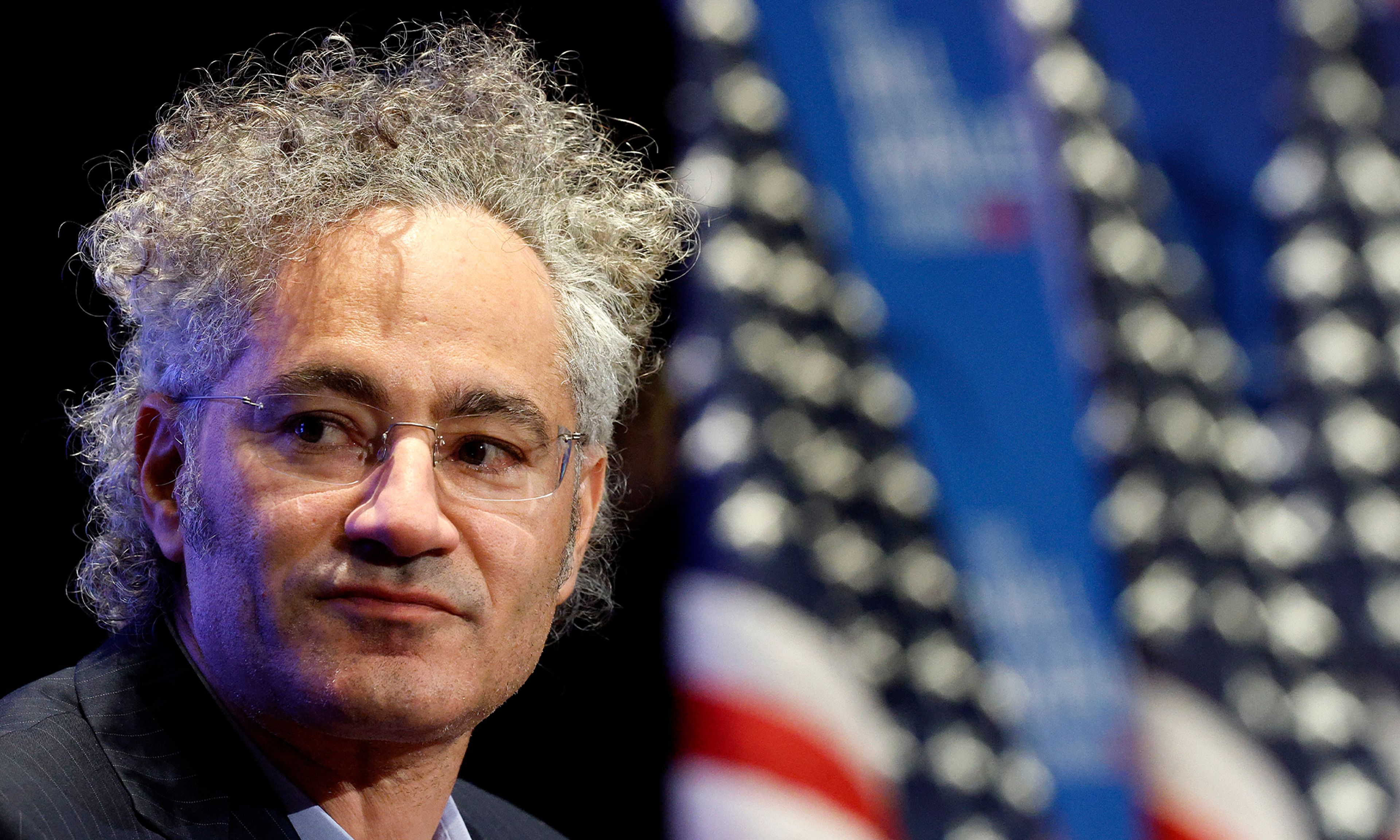
Washington, D.C. — Twenty-two American flags lined the stage at the Capitol Hill auditorium in April, where venture capitalists, tech start-up founders, and government officials traded ideas about how to spark a manufacturing renaissance and upgrade America’s defense-industrial base in anticipation of a potential conflict with China.
They convened to reaffirm their intent to work hand in glove with the U.S. government against America’s foes — perhaps the most definitive repudiation yet of the woeful, unpatriotic mood that had until recently pervaded the tech industry.
The first iteration of the summit, the Hill and Valley Forum, was a dinner in 2023, ahead of TikTok CEO Shou Chew’s testimony before Congress. The conference last year focused in large part on legislation to compel the divestiture of TikTok. This year, unlike during the previous gatherings, the valley has a sympathetic president in the White House, and the broader cultural environment has shifted in the industry’s favor. The proceedings therefore resembled those of any other policy conference. The participants’ project, to reorient the industry in a way that advances America’s interests, has already made great strides. The question now is not whether their movement can drive policy changes but what that program should include. Rather than focus on a narrow policy goal, participants batted around new ideas about maintaining the industry’s alignment with the national interest.
The forum’s organizers tried to pitch a wide tent and even include a few figures who are generally opposed to the administration’s agenda. The ideological range represented at the forum spanned White House Council of Economic Advisers Chairman Stephen Miran and New Hampshire Democratic Senator Jeanne Shaheen. (The latter used the platform to condemn President Donald Trump’s use of tariffs and cuts to foreign aid.) This broad participation might have diluted the conspiratorial nature of the previous iterations of the forum and possibly extended its longevity as an institution.
Jacob Helberg, an adviser to Palantir, which makes bespoke artificial-intelligence-powered software for companies and U.S.-allied governments, said the goal of the forum is to “create a bipartisan, bicoastal alliance of technologists and policymakers to defend the national interest.” Helberg personifies that ethos and the political currents that the industry has tapped into. Last year, he secured a videotaped message from Trump that was played at the forum. Following his election victory, the president nominated Helberg to be the undersecretary for economic growth, energy, and the environment at the State Department. “Ultimately, all the builders here are here to support the U.S. government,” he told National Review in a brief interview about the forum.
Above all, though, this year’s gathering marked the triumph of a sense that tech is no longer in the thrall of activist employees. This is a far cry from the state of the industry seven years ago, when progressive Google employees stymied a government contract that would have seen the tech company — former slogan “Don’t be evil” — collaborate with the Pentagon on an initiative called Project Maven that uses machine learning to identify targets on the battlefield. “We believe that Google should not be in the business of war,” employees in revolt wrote in a missive at the time. In a tacit endorsement of, or a submission to, that perspective, their bosses obliged, declining to renew the contract with the military and citing concerns about negative media coverage.
The reigning message from Silicon Valley’s power players today is the opposite. “The obvious solution to war is to have the West having the strongest, most precise deadly weapons possible so that we can minimize unnecessary, innocent deaths,” is how Alex Karp, the CEO of Palantir, put it during the conference’s first panel. Palantir won a Maven-related contract last year. And consider that an executive from Alphabet, Google’s parent company, spoke on a panel at the forum later in the afternoon.
Karp’s message is certainly good for business, with his company’s valuation surging on expectations that its government and defense contracts will continue to grow. But it’s also the morally right approach. Palantir has never apologized for its work with Washington, and now more of the industry has shifted to Karp’s side of the debate. His new book, The Technological Republic, a patriotic manifesto for the industry, quickly hit the top of the New York Times bestsellers’ list.
Not everyone agrees with Karp’s unapologetic pro-Western stance. During the forum, two anti-Israel hecklers were escorted out after a lengthy back-and-forth with Karp, who called the first one “an unwitting product of an evil force.” Karp then said: “The hierarchy of my book and our company is the West is superior. It’s simply superior because we can have this discussion. She can yell, I can respond.”
The Silicon Valley orthodoxies of the 2010s were indefensible, but, the year after Google’s Project Maven foible, some Google employees, to their credit, also revolted against a project that would have seen the development of a specialized search engine for China, outfitted with special censorship capabilities. That the project, which was scrapped, was considered at all speaks to Big Tech’s moral promiscuity. In 2025, such an idea would almost be a nonstarter and saddle any company that attempts it with an irresponsible degree of regulatory and legal liability.
That doesn’t mean that the tech world has completely abandoned work in China. “I’m hearing about people that are actually making investments in AI, and I think it’s an immoral, irresponsible thing to do,” Josh Wolfe, the founder of Lux Capital, a fund that has invested in numerous defense-tech firms, said in an interview. Wolfe is one of the most visible proponents of the new tech patriotism. He played a large role in the industry’s advocacy against TikTok, and after October 7, 2023, he took a proudly pro-Israel stance. One of his portfolio companies, Clarifai, benefited from the Project Maven controversy when it was tapped for contracts almost immediately after Google’s withdrawal. Another company in which his fund invested is Anduril, the buzzy start-up that makes advanced drones and missiles.
“There were a lot of people that were doing dual-use technologies,” Wolfe said. “There were people that were doing defense things. There were people that were working with the intelligence community, and we funded a lot of those companies over the years, but Anduril was the first pure-play defense company that said we are going to make technologies for the war fighter unapologetically.”
Now, reports say that the Trump administration might bring in Anduril and Palantir, alongside SpaceX, to work on Trump’s signature “Golden Dome” missile-defense project. As the Hill and Valley Forum’s daytime programming took place, the White House held an event at which one of Anduril’s drones was on display. Trump called it a “nasty-looking thing” and thanked CEO Brian Schimpf for opening a new manufacturing plant in Ohio.
During a session at the end of the day, Emil Michael, an alumnus of Uber and Trump’s nominee for undersecretary of defense for research and engineering, explained that it’s surprising to hear about new venture capital investment in China: “Hopefully we’re at the end of the last era,” he said, referring to a time when American companies questioned whether they should support the U.S. military. That era is almost certainly over. We’ll all be better off for it.
Editor’s note: A previous version of this piece incorrectly stated that the Pentagon has already awarded a contract for the Golden Dome project and that Anduril founder Palmer Luckey attended an event at the White House.












Comments