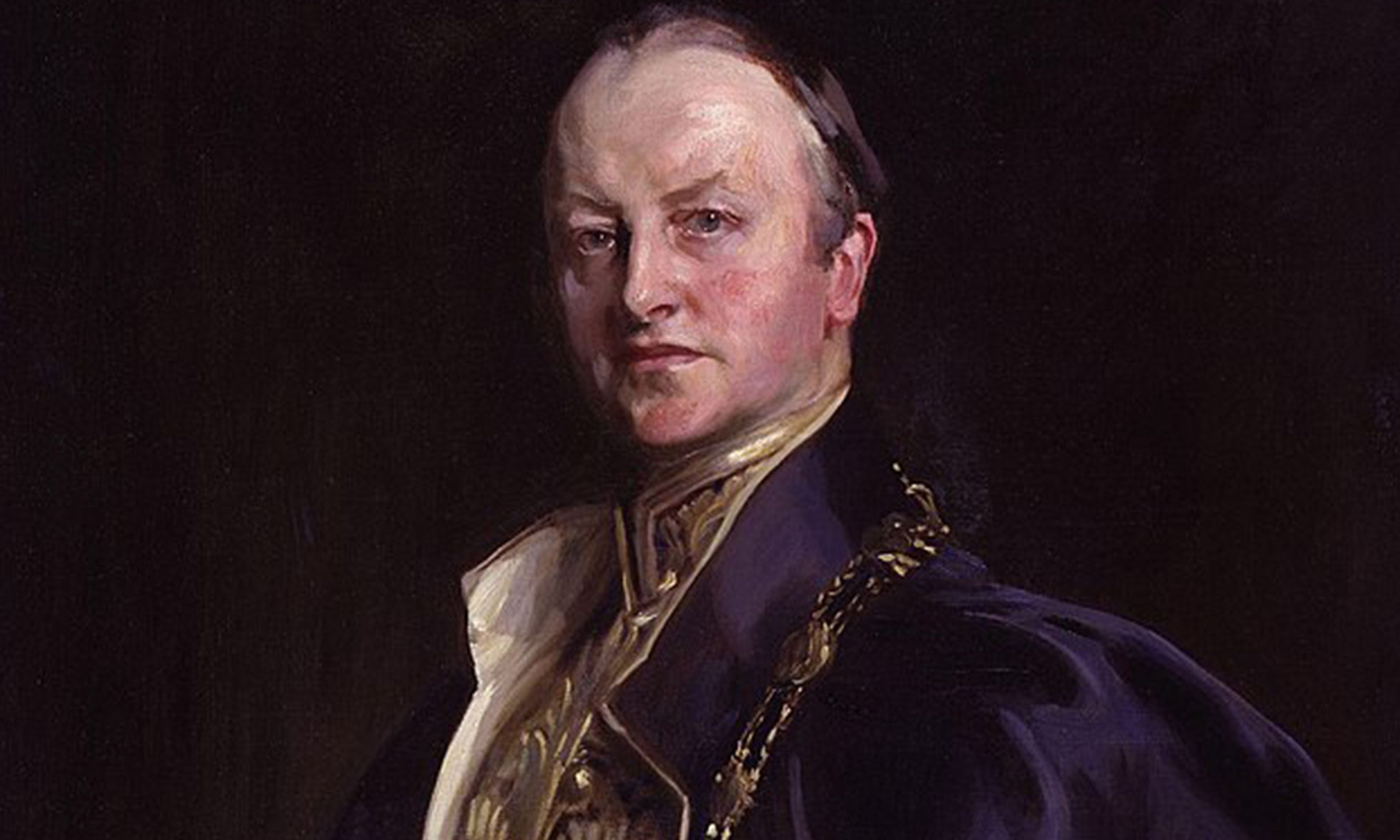
Stretching across four large and stately rooms overlooking the River Thames in London, the House of Lords library houses 80,000 books. In serendipitous moments between debates and divisions one can peruse its volumes, and recently I came across a speech given by George Nathaniel Curzon at a dinner thrown by his Old Etonian friends and contemporaries at the Café Monico in London on Friday, October 28, 1898. They were saying farewell to him as he prepared to set sail to take up his new post as viceroy of India.
Lord Curzon had been a wayward pupil at Eton, but through hard work and high intelligence he had taken more prizes in French, Italian, and history, among other subjects, than anyone had before. The author of three books on the Orient, he was in many ways the brightest and the best that Britain had to offer for the most important job in her empire, which at that time covered between a quarter and a fifth of the world’s land surface.
In his speech that night, Curzon enunciated his vision of “an imperialism exalted but not arrogant, fearless but not rash — an imperialism which is every day becoming less and less the creed of a party and more and more the faith of a nation.” Not yet 40, but about to go out to rule over 300 million Indians, he spoke of “the spirit of courage, but yet of humility, of high aspiration, but still more of duty, in which any man should approach such a task.” He recalled how at Eton the beaks (masters) had “perpetually invited” the schoolboys to “contemplate the pomp and majesty, the law and living influence of the Empire of Rome.” They saw it as the template for the British Empire, which was to dwarf it in size if not in longevity (although the period between John Cabot landing in Newfoundland and Chris Patten leaving Hong Kong was 500 years and six days).
“I love India,” Curzon told his school friends, “its people, its history, its government, the absorbing mysteries of its civilization and its life.” He spoke of “the fascination, and if I may say so, the sacredness of India,” which he had first visited in 1887, and he promised to “devote such energies” as he “might possess to its service.” He contrasted the rapacity of the East India Company in the 18th century with the “spirit of duty,” which, owing to “a Christian ideal,” meant that, in their own time, “we think much of the welfare of India and but little of its wealth; that we endeavor to administer the government of the country in the interest of the governed; that our mission there is one of obligation and not of profit.”
Now, what is going on here? Are we really to suppose, as Black Lives Matter and the Marxist interpretation of history dictate, that Lord Curzon was merely the mouthpiece of British capitalism, the lackey of an exploitative system designed solely to extract profits from the downtrodden masses of the subcontinent? For that simply does not ring true on any level, not least because Curzon, the son of a peer, a former president of the Oxford Union, and a prize fellow of All Souls, saw capitalists as irredeemably middle-class.
According to the Marxist analysis, Curzon must have either been deliberately lying to his school friends about his duties as viceroy or been the victim of an elaborate “false-consciousness syndrome.” For Marxists, the idea that Curzon, and legions of other upstanding public servants like him, might have wanted to dedicate their lives to the betterment of the native races of the empire, seeing in that a noble and profoundly Christian calling, is anathema. Instead, according to the leftist analysis that has been swallowed whole and uncomplainingly by woke schoolteachers and is therefore taught as truth to our children, these imperialists were merely white supremacists whose aim was to extract whatever raw materials and profits they could from the empire, treating the natives as little better than slaves in the process.
Yet this analysis ignores the fact that even as Curzon was speaking, the 500 richest people in India were almost all Indians, either the maharajahs, nizams, and princes of the subcontinent or the great merchants of Calcutta, Bombay, and Delhi. Is it the normal mark of imperialism that it allows the richest people not to be the governors but the governed? Something more subtle, more complicated, more interesting, and much more uplifting was in fact going on in the British Empire than is dreamt of in Marxist philosophy.
The Marxist analysis cannot accept that by harnessing British developmental and industrial know-how to Indian manpower and raw materials, both Britons and Indians could benefit, especially once the rapacious East India Company had been stripped of its governing powers in 1858. Mutually beneficial capitalism can exist without exploitation of one side by the other.
Yet because the Left cannot accept this, it is forced to argue that India’s railways were primarily built to send armies to crush revolts rather than to make travel easier and cheaper for ordinary people and businessmen. So wholly has the British establishment bought into the Marxist/woke analysis of empire that the magnificent Koh-i-Noor diamond, given to Queen Victoria as part of a peace treaty, was not allowed to be used at Charles III’s recent coronation for fear of offending modern-day Indians.
Fortunately, in the face of an avalanche of ahistorical nonsense regarding the British Empire, usually promoted for political purposes rather than in a spirit of genuine intellectual inquiry, there is a small but brave band of revisionist historians willing to point out — even if they might not quite state it so baldly — that for the great majority of its native peoples for the great majority of its post-1858 history, the empire was a boon. Historians such as Zareer Masani, Kartar Lalvani, and Tirthankar Roy infuriate the Left all the more because their backgrounds are not those of the evil British oppressors.
Foremost in the Left’s crosshairs today is Professor Nigel Biggar, who cannot be ignored by them because he is Regius Professor Emeritus of Moral and Pastoral Theology at Oxford University. Yet even he has faced the threat of cancellation, because of his view that the history of the British Empire must be seen objectively and in its correct historical context rather than condemned out of hand, and that there was a great deal of good mixed in with what was also undoubtedly bad. Biggar never tries to whitewash the story of colonialism, but he always explains the situation fairly and never avoids making politically incorrect points simply because they are unfashionable.
The story of the publication of this book is worthy of note. After Biggar delivered the manuscript, he received a fulsome letter of congratulations on its content from his publisher at Bloomsbury in January 2021, saying, “I consider this to be a book of major importance.” Only two months later, once the woker employees at the publisher-turned-moral-policeman had had their say, Biggar was informed that the book’s publication had been delayed indefinitely because “public feeling” was “not currently favorable.” When Biggar politely asked what “public feeling” they were referring to, and what he would have to change in the book to make it publishable, Bloomsbury refused to reply and canceled his contract. So much for freedom of speech at Bloomsbury Ltd.
Fortunately, the redoubtable Arabella Pike at HarperCollins took on the book, which has subsequently become a bestseller. Bloomsbury is not Bud Light, admittedly, but it is yet another example of a corporation putting its woke ideology above its duty to make profits for shareholders.
The reason that the book has sold so well is that it is a superbly balanced and honest assessment of the benefits and drawbacks of colonialism that also has the courage to enter parts of the debate that the more extreme proponents of Black Lives Matter and decolonization of curricula were hoping to close down. The book’s 129 pages of endnotes, many of them highly informative, are an indication of Biggar’s profound scholarship and almost form a book in themselves.
As one might expect from an Oxford regius professor, the book’s argument is taut, logical, and persuasive, but on occasion he also entertainingly eviscerates foaming anti-British polemicists such as Harvard’s Caroline Elkins and the egregious Indian politician Shashi Tharoor, employing both the scalpel and the sledgehammer. Biggar confronts every controversy, such as slavery, the legacy of Cecil Rhodes, the Amritsar Massacre of 1919, the Bengal Famine of 1943, the Mau Mau Uprising in Kenya, and so on, without preconceptions and is willing to weigh the evidence objectively. This is hugely refreshing, as usually these issues are presented by the Left through an ideological lens that precludes genuine investigation in favor of name-calling and insinuation, not least of racism on the part of anyone who does not subscribe to their narrative.
This book was therefore desperately needed, as hardly a day goes by without some absurd, unhistorical accusation being leveled. In early June 2023, for example, a spokesman for Human Rights Watch on the BBC blamed colonialism for Uganda’s new law that institutes the death penalty for some same-sex acts. Uganda became independent in 1962; it has therefore had six decades to pass more-liberal laws if it wished, in a continent where only 22 of Africa’s 54 countries have legalized homosexuality. Far from colonialism being responsible for anti-gay repression, if Uganda were still a colony today, homosexuality would have been legalized over half a century ago, as it was in Britain. In other words, Human Rights Watch could not have been more wrong in every aspect of its argument.
Similarly, it has recently been alleged that British imperialists, in an act of entirely unwarranted brutality, carried out an aerial bombing of the Punjabi town Gujranwala in April 1919, targeting civilians and destroying a school. (It made the news because Rishi Sunak’s grandfather was living there at the time.) In fact, a dangerous riot had taken place in which every building connected to government, as well as the railway station, post office, church, and district court, had been burnt to the ground. Aircraft were sent because no other reinforcements were available, and it was hoped that they would help to prevent Europeans from being murdered. The pilots were ordered not to fire on the town, only to disperse crowds in the open. Although an airman did drop one bomb close to a group of people “near a large red building,” he did not realize it was a school.
What the Left cannot accept is that what motivated a large number of British colonialists of the late 19th and 20th centuries was a sense of idealism not unlike that which inspired the volunteers for President Kennedy’s Peace Corps. Moreover, there were hundreds of thousands of explorers, missionaries, tea-planters, doctors, soldiers, civil servants, irrigation experts, railway engineers, bridge-builders, and so on who decided to dedicate their lives to far-flung parts of the world because it was their professional calling and for whom exploitation and the profit motive, let alone white supremacy, were not factors in their choices.
They might well have been patronizing towards the local people, but, as Biggar points out, “it surely cannot always be patronizing to believe that foreign people need help, guidance or protection.” With the Japanese killing 6 percent of all Filipinos between 1941 and 1945, was it patronizing for Britain to have led the effort to stop them invading India too, where 6 percent of Indians numbered 18 million people?
A new, grown-up, nonideological debate is needed about the pros and cons of colonialism, and the ideal primer for it would be Biggar’s well-researched, well-written, and thought-provoking book. However, as long as wokery still thinks it can win the argument through cancellations and witch hunts, don’t expect such a debate to start anytime soon.












Comments