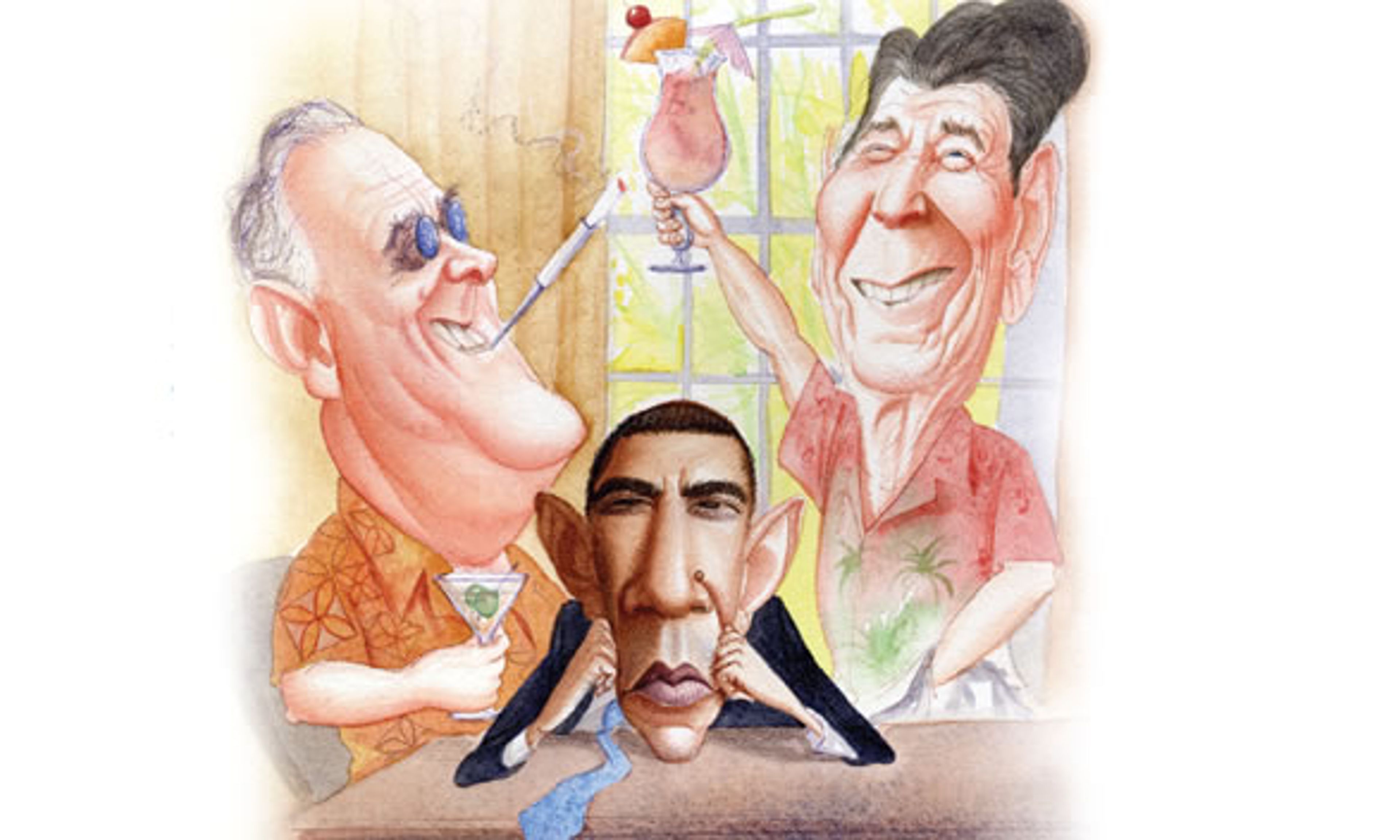
• If that unpaid advisory job is still open, we hear Arlen Specter is available.
• The explosion of BP’s Deepwater Horizon oil rig in the Gulf of Mexico April 20 killed eleven workers and released — how many gallons of oil? Estimates, as of Memorial Day, ranged from 18 to 40 million. The problem has three faces. BP tries to cap the mile-deep well; their latest plan is to lower a dome with a siphon. Relief wells, drilled diagonally, can deliver plugs of heavy liquids and cement, but they will not be finished until August. Meanwhile the state of Louisiana begs for damage control — booms and temporary sand berms to keep oil from its wetlands. Finally, there is the question of public perception. On the first problem, though the administration hectors BP for the disaster, it follows BP’s lead since, as Adm. Mike Mullen, chairman of the Joint Chiefs, said, the firm has the “best technology.” On problems two and three, there has been drift. Louisiana asked for berms in early May, for booms ten days later. They got no response. Obama himself has been remote, an absence. Cajun loyalty caused even James Carville to erupt: “Put somebody in charge of this thing and get this thing moving.” Obama did not cause the deep-sea disaster, but he has to deal with it. Louisiana may wound a second 21st-century presidency.
• Speaking at a fundraiser in San Francisco, President Obama said, “Let’s face it: This has been the toughest year and a half since any year and a half since the 1930s.” As others have pointed out, the period from the ’30s till now includes Pearl Harbor, World War II, the Cold War, the Korean War, the Cuban Missile Crisis, the Vietnam War, race riots, Watergate, “stagflation,” the Iran hostage crisis, 9/11, and much else. Certainly the current period has its challenges, but so have other periods, in fact most of them. If Obama keeps feeling sorry for himself, his next stage will be getting bitter, then clinging to guns and religion.
• Maybe Rahm Emanuel and Bill Clinton aren’t as shrewd as we thought. According to the White House counsel’s version of events, they tried to tempt Joe Sestak out of the Democratic Senate primary in Pennsylvania with an offer of an unpaid position on a presidential advisory board. This doesn’t sound like a very enticing offer for a sitting congressman and former three-star admiral, and doesn’t sound like the high-ranking job Sestak had said back in February he was offered to get out of the race. Presumably the reason the White House took months to produce its version of events, which is sketchy and highly lawyerly, is that this is a ticklish area. If a job offer was made to Sestak in an explicit trade for a decision not to run, it ran afoul of federal law. The White House should have, as a matter of public hygiene, handed the matter off to the Public Integrity Section of the Justice Department, but that’s too much to expect from the most transparent administration ever.
• Chris Christie, New Jersey’s governor, has twice recently shown an ability to speak unvarnished truth to those who would rather not hear it. At a town hall in May, Christie received a by now surely familiar greeting: the ire of a public-school teacher jealously guarding every dollar of her recession-proof pay raises. When the teacher said that she could be making more money as a babysitter, Christie suggested, to audience applause, that perhaps educators, whose lobbyists often speak of teaching as a calling, should put their taxpayer-funded Cadillac benefits packages where their mouths are, or find a new line of work. The event came just a week after Christie vetoed the Democratic-controlled state legislature’s “millionaire’s tax” a mere two minutes after its passage. “We’ll be back, Governor,” said the Democratic senate president, who’d delivered the bill to Christie’s desk. “We’ll see,” replied Christie. What he left unsaid is the sentiment that has underlined every act of his fearless administration to date: This far, no farther.
• Author Joe McGinniss, who is doing a book on Sarah Palin, has rented a house in Wasilla, Alaska, next door to her for the summer. Call it Method writing. Palin should consider herself lucky; McGinniss researched his first book, The Selling of the President 1968, by infiltrating Richard Nixon’s presidential campaign. Palin reacted on Facebook. “Maybe we’ll welcome him with a homemade blueberry pie tomorrow so he’ll know how friendly Alaskans are.” That is Palin’s charm. Then she went off on McGinniss’s “‘journalism’” (note her scare quotes), his “peering,” and his “overlooking Piper’s bedroom.” She should have done what she talked about in the first sentence and let the anger go. Should she become president, she will encounter people a lot worse than Joe McGinniss. John Adams said that George Washington possessed “the gift of silence.” A gift Sarah Palin must acquire.
In the Red
Nothing aligns with the conceits of economists quite so wonderfully as the reliable and heavily reproduced result that economic conditions are the key driver of election results. Witness the provocative title of one of the more recent entries in the literature by economists Jeffrey DeSimone and Courtney LaFountain: “Still the Economy, Stupid: Economic Voting in the 2004 Presidential Election.”
DeSimone and LaFountain extend our understanding of the impact of the economy on elections in an important way. They find that the effect of the economy on elections is asymmetric: A bad economy severely undermines support for incumbents, but a good economy does not necessarily reward them.
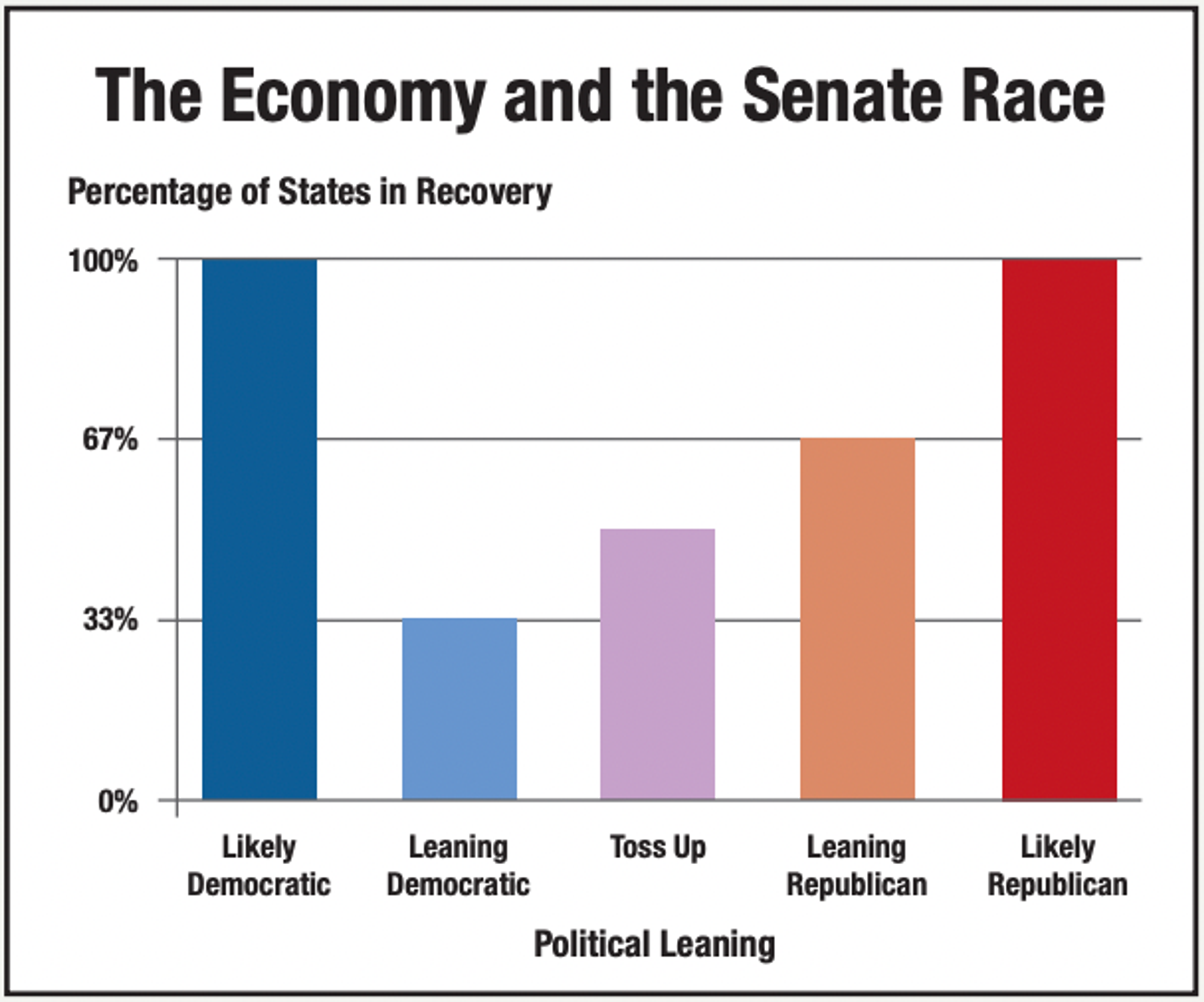
This finding is bad news for Democrats heading into the midterm election. The economy is turning around, but the improving conditions will not necessarily create the voter euphoria Nancy Pelosi and Harry Reid might be hoping for. And the attached chart suggests the news for Democrats may be even worse than that. The recovery has been quite spotty, with some parts of the country storming ahead and others still reeling, and the pockets of continuing misery are strategically placed.
The chart draws on two data sources. First, RealClearPolitics.com assembles polling data for Senate races around the country and ranks seats as either likely Democratic (New York and Oregon), leaning Democratic (California, Connecticut, and Wisconsin), or toss-up (Colorado, Florida, Missouri, Ohio, Pennsylvania, and Washington). In addition, eleven states are either leaning or likely Republican. The second data source is drawn from Dismal Scientist, a website that uses state-level data to determine whether the recovery is fully under way in each state. The chart combines these sources and identifies the fraction of states in each political category that are already in recovery.
The chart tells an interesting story. The “likely” states, both Democratic and Republican, are in recovery. But the states that are leaning Democratic or toss-up — the states that will be most in play — are the pockets of misery where the economy will be a big issue.
The chart likely understates the problem for Democrats, as the Dismal Scientist rankings seem a little generous to these eyes in calling a recovery. Indeed, the only state in the column leaning toward Democrats that is in recovery is California, and the unemployment rate there is still 12.6 percent.
In the spring of 2008, a similar analysis in this space portended calamity for Republicans in that year’s elections. The regional data suggested, I wrote, that “as Republicans enter the fall campaign, they can collectively add a significant economic disadvantage to their list of handicaps.”
This year, the forces are reversed.
— KEVIN A. HASSETT
• “Tea party protesters scream ‘nigger’ at black congressman.” So read the McClatchy News headline, but there is more — and less — to the story. Rep. Emanuel Cleaver (D., Mo.), according to the same report, was spat upon by a protester, who was arrested. The big-hearted Democrat, according to McClatchy, declined to press charges — a lucky thing, since nobody had been arrested. And nobody had been arrested because, as video shows, Representative Cleaver was not being spat upon. McClatchy’s report relies upon a couple of Democratic officeholders and an unnamed “colleague” for its sources. The tea-party protest in question was thick with media and cameras. Not one piece of evidence has been produced that this story is true — even after Andrew Breitbart offered $100,000 for such evidence — and some evidence has shown that aspects of it are false, such as this fictional spitting arrest. McClatchy’s brass has dug in, and its editors have so far refused to acknowledge the problems with their reporting, though they have dispatched self-righteous e-mails to their critics over at the blog Power Line, writing: “Without professional journalists, the citizenry will be forced to rely on partisans like yourself and Powerline for whom facts are a nettlesome inconvenience.” And who are these professional journalists?
• Republicans finally have something to brag about in a special election for the House of Representatives: In Hawaii’s 1st congressional district, where Obama grew up, Charles Djou on May 22 became the first Republican to represent the Aloha State in Congress since 1991. But this contest — triggered by Democrat Neil Abercrombie’s decision to retire mid-session to help his bid for governor — was an outlier. Two Democrats — veteran state senator Colleen Hanabusa and Ed Case, a former congressman from Hawaii’s other district — split their party’s vote, allowing Djou to win with just under 40 percent. Democrats largely shrugged and predicted they would win in November; Hanabusa’s task grew easier when Case announced on May 30 that he would not compete in this fall’s Democratic primary. One trend in Djou’s favor? Hawaiians have never rejected an incumbent member of the House or Senate.
• Pres. Felipe Calderón of Mexico used the occasion of an address to a joint session of Congress to attack Arizona’s immigration law. What is wrong with this picture? Hypocrisy. Mexico’s immigration laws are at least as draconian as Arizona’s — its officials are “required to demand that foreigners prove their legal presence in the country before attending to any issues.” What’s sauce for the oca is sauce for the ganso. Rudeness. A traveling head of state should not abuse the hospitality of his hosts’ legislature by intervening in their politics. Intervention is a sensitive topic with Mexicans, given our long and fraught history; surely Calderón understands. The reaction. Congressional Democrats, eager to use the Arizona law to gin up their base, greeted his remark with applause. Rep. Tom McClintock, a California Republican, instead invited Calderón to “apply for citizenship . . . learn our history and our customs, and become an American. And then he will have every right to participate in [this] debate.”
• Richard Blumenthal, the attorney general of Connecticut and the Democrats’ nominee for the U.S. Senate there, has repeatedly implied, and sometimes said, that he served as a Marine in Vietnam. The principal defense has been that on many other occasions he told the truth, which is that his Vietnam-era service in the Marine Corps Reserve took place stateside. He says he “misspoke” unintentionally. The only people who profess to believe him are those with an interest in doing so, a class that includes nearly the entire Democratic party. That Blumenthal attempted to steal other men’s valor is no indictment of his party; that it has rallied to his defense surely is.
• The $113 billion “extenders” package that the Obama administration and its allies are attempting to pass through Congress contradicts most of what they told us over the last 18 months — about the stimulus, the health-care bill, and the budget deficit. The bill contains yet another extension of unemployment benefits for those whose aid was set to expire, revealing that the stimulus was not to be temporary, but ongoing. It delays certain scheduled cuts in physicians’ Medicare reimbursements, revealing that the health-care bill did not reduce the deficit; promises used to secure its passage are now adding tens of billions to its cost. And the fact that the Democrats decided not to offset the new spending reveals that they are not serious about deficit reduction; they ignore their own pay-as-you-go rules whenever these prove inconvenient. After BP figures out how to plug that leak in the Gulf, maybe it can engineer a way to stop the gusher of borrowed money in Washington.
• Public-employee compensation is a promising issue for conservatives, and not just because the associated pensions threaten to bankrupt several states, as Kevin D. Williamson reports on page 28. Government employees now take home a total compensation package worth 44 percent more than their private-sector colleagues, and enjoy one very important intangible benefit — job security: While millions of private-sector jobs were shed in the recession, and unemployment hovers around 10 percent, governments have made only the smallest reductions to their workforces. Indeed, many government agencies are hiring, the stimulus was directed largely into the pockets of government workers, and the number of federal employees earning six-figure salaries has exploded under the Obama administration. As they campaign, Republicans should remind government workers and the public who works for whom.
• Imam Feisal Abdul Rauf wants to build a 13-story Muslim cultural center and mosque near Ground Zero. How near? He has bought an empty clothing store two blocks north, which was damaged on 9/11 when a landing-gear assembly of one of the hijacked airplanes crashed through its roof. Rauf preaches moderation. “My colleagues and I are the anti-terrorists,” he wrote in the Daily News. “[We want] to interweave America’s Muslim population into the mainstream society.” Sometimes he sounds less moderate: After 9/11 he told 60 Minutes that “United States policies were an accessory to the crime that happened.” The holding company for his project, the Cordoba Institute, had less than $20,000 in assets as of 2008; where will the $100 million he plans to raise come from? In 1993 John Paul II moved a Carmelite convent from the site of Auschwitz. The nuns did not build Auschwitz, and decent Muslims are not terrorists (they were among 9/11’s victims, as Rauf points out). But anyone who is not a provocateur would acknowledge the importance of symbolism and the risk of mixed messages. Imam Rauf should take his mosque elsewhere.
• Hillary Clinton, taking pains to point out that she was speaking for herself and not for the administration (since when do secretaries of state do that?), made some strange observations about taxes and Brazil: “The rich are not paying their fair share in any nation that is facing the kind of employment issues” that the United States is, she said, “whether it’s individual, corporate, or whatever. . . . Brazil has the highest tax-to-GDP rate in the Western hemisphere and guess what — they’re growing like crazy.” Hillary Clinton is always the last to know: Brazil’s aggregate tax burden, at 24 percent of GDP, is slightly lower than the U.S. tax burden. Brazil’s top personal income-tax rate is 27.5 percent; the top U.S. rate is 35 percent, soon to be raised to 39.6 percent. Madam Secretary did not say how she thinks higher taxes on the rich will produce jobs for everybody else. Given her light dusting of education on the subject, that’s probably for the best.
• Mosab Hassan Yousef has told his story in a memoir, Son of Hamas: He is the eldest son of Hamas founder Hassan Yousef. Sickened by what he saw around him, he turned against Hamas and spied for the Israelis — in order to save innocent lives, of which he saved plenty. He converted to Christianity and came to the United States. He went to Homeland Security, saying, effectively, “This is who I am, this is what I’ve done, I wish to seek asylum.” Homeland Security is balking, citing his former terrorist ties. Yousef says that DHS officers are embarrassed: embarrassed that he pointed out “huge gaps” in our security and in our “understanding of terrorism.” He lives in San Diego, working at a grocery store. He is to appear before an immigration judge on June 30. Nobody has a better case for political asylum.
• The story with the highest irony quotient this fortnight concerned Massachusetts state representative Mike Moran, a keen supporter of Gov. Deval Patrick’s “sanctuary state” policies towards illegal immigrants. Representative Moran was waiting in his car at a red light when he was rear-ended at 60 mph by Isaias Naranjo, an illegal immigrant from Mexico. Mr. Naranjo had no license, and his blood alcohol level was three times the limit. Nothing abashed, he laughed at the police when they read these charges to him, and scoffed that nothing would happen to him as he could just go back to “my country.” Not to be outdone in reckless candor, Moran said to a TV reporter after the event: “I have been and will continue to be pro-immigrant and in some cases even pro-illegal-immigrant. It would be politically expedient for me at this point in time to change that. That should . . . tell you that even after being hit by one I will continue to advocate for immigrants and their rights as citizens in this country.” Rear-end him again!
• You don’t have to be a scholar to know that congressional chairmen bring home the pork. But researchers at Harvard Business School, working with decades’ worth of data, put a number on it: Earmarked spending targeted at a specific state increases by about 40 percent when one of that state’s senators becomes chairman of one of the major committees, such as appropriations, and by about 20 percent when one of its representatives heads such a committee in the House. The surprise twist: The economy chokes on all that pork. Rather than thriving on the injections of federal cash, local businesses actually retrench: “The firms significantly cut physical and R&D spending, reduce employment, and experience lower sales,” says Prof. Joshua Coval in an interview with Working Knowledge. “The results show up throughout the past 40 years, in large and small states, in large and small firms, and are most pronounced in geographically concentrated firms and within the industries that are the target of the spending.” The researchers posit that “crowding out” — government projects’ supplanting of private projects — as well as competition for highly skilled labor and other resources explains the paradox. The paper is titled “Do Powerful Politicians Cause Corporate Downsizing?” and should be required reading as we enter yet another debate on stimulus and unemployment. If President Obama won’t heed Hayek, perhaps he’ll heed Harvard.
• Before Obama adviser Kal Penn went to the White House, he went to White Castle. Harold & Kumar Go to White Castle was a comedy, but Barack & Kumar Go to White Castle is a tragedy, at least for White Castle. The victualer specializing in diminutive hamburgers reports that the punitive features of Obamacare will cut its income — in half. Very likely, that lost income will be recouped in part through cutting labor costs, meaning fewer jobs and lower wages for White Castle employees. Mr. Penn has his Hollywood millions to fall back on, Mr. Obama his Ivy League law degree and presidential pension. What about the people who work at White Castle? There’s a high price to pay for supersizing government, and they’ll pay it.
• When an NYPD officer — or a police officer just about anywhere — determines that his life or that of another is in danger, he is authorized by law to use deadly force. Police are taught to aim their weapon at the center of the target and fire until the threat subsides. But New York City assembly members Annette Robinson and Darryl Towns (both Democrats of Brooklyn) want to change this. They have introduced a bill that would require officers to shoot “with the intent to stop, rather than kill.” In an accompanying memo, they explain that “an officer would have to try to shoot a suspect in the arm or the leg,” and that “the number of times an officer shoots a person should not exceed the minimal number necessary to stop the person.” To anyone familiar with the difficulty of shooting anything with a pistol, the requirement to aim for a suspect’s extremities is patently absurd: Even aiming for the central body mass, and even at a distance of six feet or less, officers miss suspects more often than they hit them. Similarly, the requirement that officers reassess the situation after every shot they fire will give suspects more time to shoot back. When aiming at this bill, shoot to kill.
• The latest flare-up of violence off the Gaza coast has been months in the planning. Hamas, the Islamist movement that seized power in Gaza, does everything it can to bring in weapons and gunmen. Naturally there is an Israeli blockade. This time, Hamas got open Turkish backing to prepare and launch a flotilla of ships to enter Gaza. Hundreds of activists from all over the world, united only in hatred of Israel, were recruited to sail and provide civilian cover. Either the ships would dock, in which case the blockade would prove useless, or, more likely, there would be a confrontation, and Israel would be made to look bad. Either way, Hamas was sure to generate immense publicity, and that would be victory enough. As expected, Israeli commandos stormed the lead ship. Activists resisted, and nine or maybe ten people were killed, four of them Turks. The flotilla was then escorted into an Israeli port where the cargoes are being inspected and the activists deported. Provoking rage over this incident for which it is largely responsible, Turkey is advancing the process of breaking with Israel and the West, abandoning its past secular stance for the sake of Islamist solidarity. The world’s disproportionate condemnation of Israel’s efforts to defend itself shows the organizers of this flotilla that hatred pays dividends.
• Israel has never signed the Non-Proliferation Treaty, and neither denies nor confirms that it has a nuclear weapon. Its enemies have long been trying to oblige it to join the NPT as a step in clarifying the situation, and then if necessary enforcing Israel’s disarmament. Hitherto the United States has used its veto power to head off such an outcome. In a conference of the International Atomic Energy Agency, the Muslim countries, including Iran, have passed a resolution that Israel should allow inspection of its atomic sites, join the NPT, and, in effect, lose an important aspect of its defenses. The United Nations Security Council naturally has backed the resolution. Here’s the crunch: The resolution addresses Israel alone, and makes no mention of Iran’s continuous refusal to comply with its obligations to the IAEA and obvious determination to have its nuclear-weapon and -delivery systems. For the first time, the United States has failed to use its veto, instead backing this resolution. Consider it a moral disarmament.
• International investigators have dispelled any doubt that North Korea was responsible for torpedoing a South Korean warship and killing 46 sailors on March 26. The attack is surely Pyongyang’s most spectacular atrocity since the 1987 bombing of Korean Air Flight 858. Secretary of State Clinton is now working to build support for a fresh round of global sanctions on the Communist regime. New sanctions would not topple the dictatorship, nor dramatically alter North Korea’s conduct. Tightening our grip on Pyongyang’s finances, however, would bolster U.S. leverage at a critical moment in Korean history, with 69-year-old Kim Jong Il in deteriorating health and a shaky leadership transition already under way. The U.S. should also re-list North Korea as a state sponsor of terrorism; meanwhile, to demonstrate solidarity with Seoul, Congress should approve the bilateral free-trade deal that was signed in June 2007 and has been held hostage by the United Auto Workers ever since. We fully expect China to continue subsidizing the Hermit Kingdom with food and fuel aid. But the Obama administration should do everything possible to choke Pyongyang’s cash flow and provide incentives for a post-Kim regime to seek rapprochement with its democratic neighbors.
• The deadbeat Greeks put together a deficit-reduction package in advance of the bailout enabled by the International Monetary Fund and the European Union. Economic analysts already are saying that Athens is not on track to meet this year’s deficit-reduction goals. This should surprise nobody: Greece has been lying about its deficits since it entered the European Union and never has made a serious effort to meet its fiscal obligations under the Maastricht Treaty. The United States is providing about $54 billion of the IMF bailout bucks. It’s one thing for Greece’s corrupt and self-dealing government to pillage its own citizens and the European Union; it’s another for it to pillage us. The IMF should insist that Greece hit its deficit-reduction target, and the United States should, if necessary, withhold IMF funds to make that happen. After all, we’re going to want to make sure that there’s something left in the IMF kitty when it’s Washington’s turn.
• Orlando Zapata Tamayo, a Cuban prisoner of conscience, died in February after an 83-day hunger strike. His ordeal and death has galvanized opposition on the island. A Cuban-born artist in New Jersey, Geandy Pavón, had an inspired idea. He is taking Zapata’s picture and projecting it onto the façades of buildings. Just any buildings? No — buildings in the Free World that contain offices of the Cuban dictatorship. Most recently, he did this with the Cuban Interests Section on 16th St. in Washington. The date was May 20, the anniversary of Cuba’s independence from Spain. Pavón says that his Zapata art “imposes the face of the victim upon the assassin, using light as an analogy to truth, reason, and justice.”
• Gun battles, killing dozens, erupted in Tivoli Gardens, a neighborhood of Jamaica’s capital, Kingston, as authorities tried to extradite Christopher “Dudus” Coke to the United States on charges of drug- and gun-running. Coke is also the don, or de facto mayor, of Tivoli Gardens, preserving order of a kind and dispensing largesse. He is not sui generis — Jamaica’s political parties, left and right, have relied on the support of gangsters like Coke for more than 30 years. Political philosophers called such a situation imperium in imperio, the state within a state. It appears, in even more feral forms, in Mexico and Colombia. In all three countries the fertilizer is drug money. Americans shake our heads, but we should recognize that our grotesque appetites for stimulation create problems that weaker governments cannot handle.
• In 1989, Lori Berenson dropped out of MIT “to pursue a passion for social justice.” That’s the way the Associated Press put it in a report the other day. Berenson’s passion eventually led her to Peru, where she joined up with the Túpac Amaru Revolutionary Movement, or MRTA (as it’s known in Latin America). The MRTA was a cousin of the Shining Path, Communist and terrorist. They did their best to overthrow Peru’s democracy, and almost succeeded. They killed and maimed a lot of people. Berenson was arrested in connection with a plot to take over the Peruvian congress. Having served three-quarters of her 20-year sentence, she has been released. She has never turned on the MRTA. But she’s now interested in working as a translator and dessert chef. Let’s hope that in the future she breaks only the literal kind of eggs.
• The Museum of Modern Art off the Champs-Élysées is a Paris showplace. In the small hours, a thief removed one of its windows, avoided most of the closed-circuit-television cameras — perhaps he knew where they were — and cut five pictures out of their frames. For some reason, the security alarm did not go off, so the three guards on duty suspected nothing. Oddest of all, the five pictures are masterworks by Picasso, Matisse, Braque, Modigliani, and Léger, all far too well known to be offered for sale. A mad collector wanted them? Some obscure blackmail or swap in the underworld? Revenge by some disappointed museum insider? The value of the stolen pictures is estimated at $123 million, making this one of the biggest art heists ever. They weren’t insured either. All that’s required for a gripping movie is a director with imagination to make sense of it all.
• When Elton John appeared on the program of an eight-day arts festival in Morocco, Islamists protested. Mustapha Ramid, a spokesman of the Justice and Development party, said the gay artist would corrupt the young, and refused even to call him a man: “Sorry, I should say this person.” The festival, which operates under the aegis of the Moroccan government, would not back down. “Elton John is one of the best artists in the world,” said festival director Aziz Daki. He is a woeful artist, who has been peddling carbonated treacle for decades. But de gustibus non est disputandum. Thousands of Moroccans turned out to hear him when he performed in the capital city of Rabat. Congratulations to them, and to their government for not wanting to turn the country into a fundamentalist madrassah.
• Public-school test scores in Washington, D.C., are still far below national averages, while per-pupil expenditures are among the nation’s highest, as are student obesity rates. In one respect at least, though, D.C. schools are a model for the nation. The quality of the free condoms issued to high-school and college students could not be better, following a recent upgrade to Trojan brand in attractive gold wrappers. This followed complaints from students that the condoms formerly issued were of poor quality and too small. “We thought making condoms available was a good thing, but we never asked the kids what they wanted,” confessed the chairman of the District’s health committee. Isn’t that the whole aim of education, to give students what they want? If you thought it was something to do with imparting knowledge, building character, and transmitting culture, go to the back of the class . . . and don’t forget to pick up your free prophylactics as you pass the teacher’s desk.
• Thanks to a change in federal law sponsored by Sen. Tom Coburn (R., Okla.), licensed gun owners may now carry their weapons in national parks, subject to the laws of the states they are in. This is good news for hikers but bad news for aggressive grizzlies, as one such found out in Alaska’s Denali National Park. The bear emerged from trailside brush and charged a backpacker. Fortunately, the hiker’s companion was packing heat — a .45 caliber semiautomatic pistol. It took nine rounds to stop the bear, which staggered off into the woods, collapsing and dying 100 feet away. The incident has become a test case of the new law, which does not permit the actual firing of a weapon. Other federal laws forbid killing wildlife in the parks, with a separate law against the killing of bears. We hope the Denali hikers will emerge as unscathed from these legal tangles as they did from their grizzly encounter. Should things turn out otherwise, they will have for consolation the old gun-rights adage that it is better to be tried by twelve than carried by six.
• Suppose you were picking a mascot for the 2012 Olympics in London. What would best represent the host nation? A lion or bulldog? Way too pugnacious for today’s caring Britain. John Bull? Entirely too plump for these health-conscious times. Instead, the organizing committee has settled on a pair of elaborate and baffling single-eyed creatures — festooned with lights, cameras, bracelets, and indecipherable symbols — that resemble Teletubbies turned inside out, except not quite as handsome as that makes them sound. The dismal duo are guaranteed not to offend any racial, ethnic, gender, or religious group, mainly because nobody knows what the hell they are. Do marketers expect the public to fall in love with what looks like the product of an illicit liaison between Gumby and your cell phone? Surely the nation that produced Thomas Gainsborough and Mary Quant can come up with something better to personify today’s Britain — although, considering the pair of nondescript hybrids that British voters have just chosen to run their country, perhaps not.
• Debuting after 9/11 (though in production before it), the TV cliffhanger series 24 could not help becoming a cultural barometer. Critics hated it for reducing war on terrorism to a matter of willpower, skill, and patriotism properly applied. Jack Bauer, the protagonist for all eight seasons of the show, would stop at nothing to do what he needed to defend the nation from all enemies, foreign and domestic — including torture. Critics had a point there, but their complaints fell on deaf ears to millions of viewers who simply rejoiced in an unapologetically entertaining TV romp. While fighting terrorism is far more complicated in real life, we salute the show for acknowledging that the fight is doomed without, yes, willpower, skill, and patriotism properly applied.
• Martin Gardner was one of a kind. Though best known for his books and columns on math and science, his interests ranged far wider. The Annotated Alice — Lewis Carroll’s “Alice” books with Gardner’s commentary in the margins — is still in print after 50 years. His 1996 essay collection The Night Is Large includes sections on the arts, philosophy, and religion. He chronicled his own journey through the last of those zones, from fundamentalist Protestantism to abstract theism, in an autobiographical novel, The Flight of Peter Fromm. His 1957 classic Fads and Fallacies in the Name of Science ruthlessly debunked such pseudosciences as Dianetics and Orgone Therapy, which he saw not only as insults to real science, but also as cheap demystification of the ineffable. Gardner was by upbringing and temperament an American gentleman of the old school. His personal kindnesses endeared him to thousands, while his indefatigable productivity — more than 70 books and innumerable magazine columns — made him known to millions. A great American, Martin Gardner died May 22, aged 95. R.I.P.
• Art Linkletter said the darnedest things. The popular host of long-running television programs could have spent his final years in a comfortable Hollywood dotage. Instead, he crusaded for Social Security reform, becoming active in organizations such as the United Seniors Association and Team Grandparent. “I was one of the first people to ever pay Social Security,” he told the Wall Street Journal last year. “But now the program has become a rip-off, just like the guy [Bernard Madoff] who did the Ponzi scheme. We need to stop the congressional raid on the trust fund and turn this tax money back over to individuals so they can own it and control it.” On May 26, Linkletter died at the age of 97. R.I.P.
The Republican Retreat
Every week brings fresh bad news about Obamacare. Many companies are considering dropping their health coverage as a result of the incentives the law creates. Small businesses are reporting that the law’s tax credits are encouraging them not to make new hires. People with preexisting conditions, who were supposed to be the chief beneficiaries of the law, will mostly be left out of its high-risk pools: There are perhaps 4 million of them, but only enough funding for 200,000. The Department of Health and Human Services is already behind schedule in implementing the law. And the director of the Congressional Budget Office, appointed by Democrats, denies that the law will reduce the pressure of health spending on the budget.
Republicans ought to be seizing on each revelation to press the case for repealing Obamacare. It is, after all, the worst law the Democrats have enacted on Obama’s watch; and it is also the GOP’s best issue in this year’s elections. Instead Republicans have largely allowed the Democrats to switch the subject from their unpopular health-care legislation to financial regulation, oil spills, and immigration. They have been reacting to the news instead of trying to make it.
The most important step Republicans could take to promote repeal would be to launch a campaign to pressure House Democrats who voted against Obamacare to co-sponsor legislation to repeal it. On this crucial issue, though, House Republicans have whiffed. Some Republican congressmen are worried about being seen as having no health-care solutions of their own, and so the leadership has gotten behind a bill that both repeals Obamacare and replaces it with various conservative reforms.
We would, of course, be delighted to see such a bill enacted. But the principal effect of including conservative alternatives will be to make it easier for Democrats not to sign on to the bill. It thus sets back the biggest conservative health-care reform of all: the repeal of Obamacare. And it does so for no good reason. For one thing, all the House Republicans are already on record supporting conservative health solutions; there is no need for this piece of legislation to include them. For another, the number of incumbent Republican congressmen at risk of losing to a Democratic challenger this year is vanishingly small. The number of Republican congressmen at risk of losing their seats because they are not sufficiently vocal about their favored health reforms is zero. Is it really beyond the wit of House Republicans to say that they favor first repealing Obamacare and then enacting constructive legislation?
What is most worrisome about the party’s tactical mistake is the loss of nerve that explains it. That loss of nerve is apparent in the party’s other silences.
Most Americans believe that government should not fund abortion, and liberals’ insistence to the contrary nearly sank Obamacare. Republican congressman Roy Blunt, running for the Senate in Missouri, says he will fight to apply the Hyde amendment’s restrictions on abortion funding to Obamacare. Where are the rest of the Republicans?
Elena Kagan, Obama’s Supreme Court nominee, was solicitor general during the legislative debate over Obamacare. Her office may have been consulted about the legal issues it poses. Shouldn’t Republicans be asking about her role, if only to begin making the case that a Justice Kagan would have to recuse herself?
Obama has nominated Donald Berwick, a man who describes his attachment to the British single-payer model of rationing health care in nearly erotic terms, to head the Centers for Medicare and Medicaid Services. A few Republicans have, to their credit, objected — but not enough. A White House spokesman says that the opponents see the nomination as an “excuse to re-fight health care.” Who needs an excuse? Excessive government control of health care, the basic issue in the Obamacare fight, is the basic issue in this fight as well — if, that is, Republicans are prepared to put up a fight.
Failing to put advocates of Obamacare on the defensive arguably contributed to the Republicans’ loss of a special election in Pennsylvania. If their lassitude continues, Republicans will blow many more opportunities in the months to come.












Comments