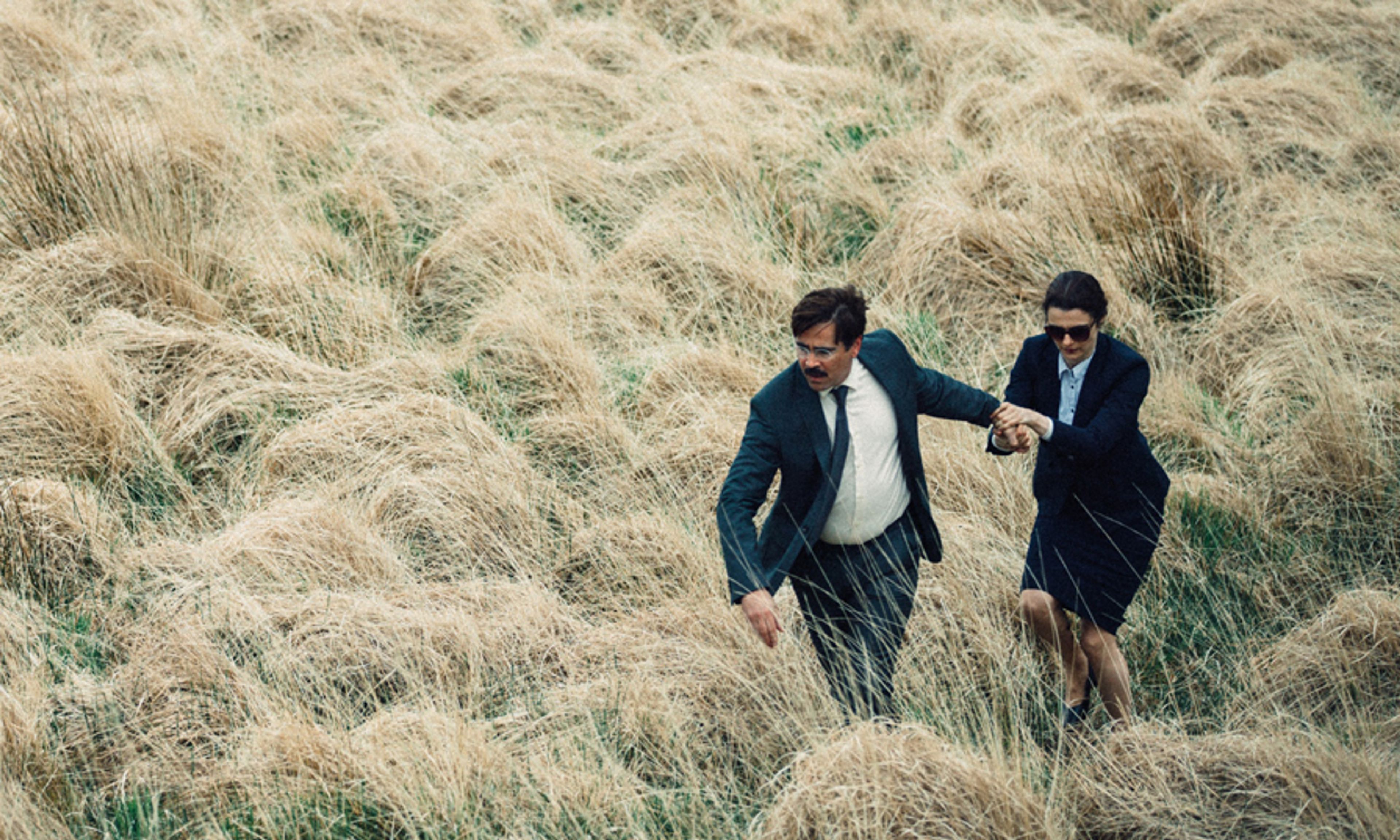
There is no way to summarize the plot of The Lobster, in which Colin Farrell stars as a sad-sack divorcé and Rachel Weisz plays his love interest, without making it sound like a parody of an artsy foreign-language film. But here goes: Farrell’s character, the lumpen, mustachioed David, lives in a society that requires single people to decamp for a seaside hotel if they haven’t found (or if they manage to lose) their romantic partner.
That might sound pleasant enough, even if the “requires” part is slightly creepy, but hang on — once ensconced in the hotel, surrounded by fellow singletons, they have 45 days to find a mate. And should Cupid’s arrow fail to land before their time expires, they will be transformed into an animal of their choosing.
And I do mean transformed. When David arrives at the hotel he brings his dog, who used to be his brother, and after asking him whether he prefers men or women (“Is there a bisexual option?” he asks, but there isn’t), the hoteliers make him make his bestial choice. Most people are like his brother and choose dogs, the Hotel Manager (Olivia Colman) tells him — that’s why there are so many canines in the world. But David has a more eccentric pick, a creature that “can live for over a hundred years, is blue-blooded like aristocrats, and stays fertile all its life.”
“A lobster is an excellent choice,” the Hotel Manager says.
This line, like every line in the movie, is delivered deadpan. In the world of The Lobster, pairing off is supposed to be everything, but strong emotion has been banished. The hotel stages crude propaganda about the joys of coupledom — mini-skits showing single men choking on their food and single women being raped — and enforces a ban on self-abuse by sticking the offending hand into a toaster. Successful couples don’t exactly fall in love; instead, they establish themselves on the basis of some shared feature, as though they were following a Match.com algorithm designed by a toddler — shared nosebleeds, shared cruelty, shared nearsightedness.
Or “shared,” I should say, since the pressure is strong enough that people fake things. One hotel guest (Ben Whishaw) has a limp and keeps hoping to meet a fellow limper, but instead he ends up faking nosebleeds so as to pair off with a girl with that affliction. David himself pretends to be a sociopath in order to woo the hotel’s most heartless guest (Angeliki Papoulia); she tests him by pretending to choke on an olive, and when he doesn’t budge to save her she decides he might just suit her. (He doesn’t.)
There is an alternative to all this: Beyond the hotel grounds, in the woods, live the Loners, Weisz’s character among them. The hotel guests hunt the Loners with tranquilizer guns, and every one captured wins you a day added to your own stay. (The captives themselves are presumably transmogrified, though the movie doesn’t specify their fate.)
But sometimes hotel guests also escape to join them. What they find, though, isn’t freedom but a different sort of regimentation: enforced individualism, under the watchful eye of a flame-haired guerrilla leader (Léa Seydoux), in which new arrivals dig their own grave and are told to expect to die alone, all displays of affection are forbidden on pain of mutilation, and the only music is electronic music played on headphones, to ensure that all the Loners will dance by themselves.
The creator of this strange world is Yorgos Lanthimos, a Greek filmmaker with a cluster of strange European films under his belt, the best known of which is Dogtooth, in which three children are raised to adulthood (and beyond) on a sealed compound by their parents and told they may not leave until their “dogtooth” falls out.
I confess that I haven’t seen it, but a glance at the trailer suggests a similar exercise in high-concept unsettlement. And unsettling the audience is really what The Lobster is all about. You can interpret it as satire or dystopia or social critique, but I don’t know that the movie is really trying to say something specific and timely about The Way We Love Now. Instead The Lobster goes out of its way to make its setting feel more like a dream state than some plausible near future: The technology, the clothes, the vaguely Anglo-French geography all seem selected for their insinuating semi-familiarity, as though the characters were on a set conjured up by someone’s (David’s?) subconscious, an imperfect and therefore uncanny imitation of reality.
The plot, too, runs on dream logic, from the bizarre rules that everyone just accepts to the sudden spasms of violence that no one seems to find strange to the very Jungian ease of man-to-beast transformation. And that logic justifies what would otherwise be kind of a cop-out of an ending, in which the movie refuses to tell us how its forbidden love story actually ends. Because isn’t that how it always is with dreams? You’re in love and you’re about to commit an act of awful violence so that you don’t have to turn into a crustacean, and then — if you’re lucky — you wake up.












Comments