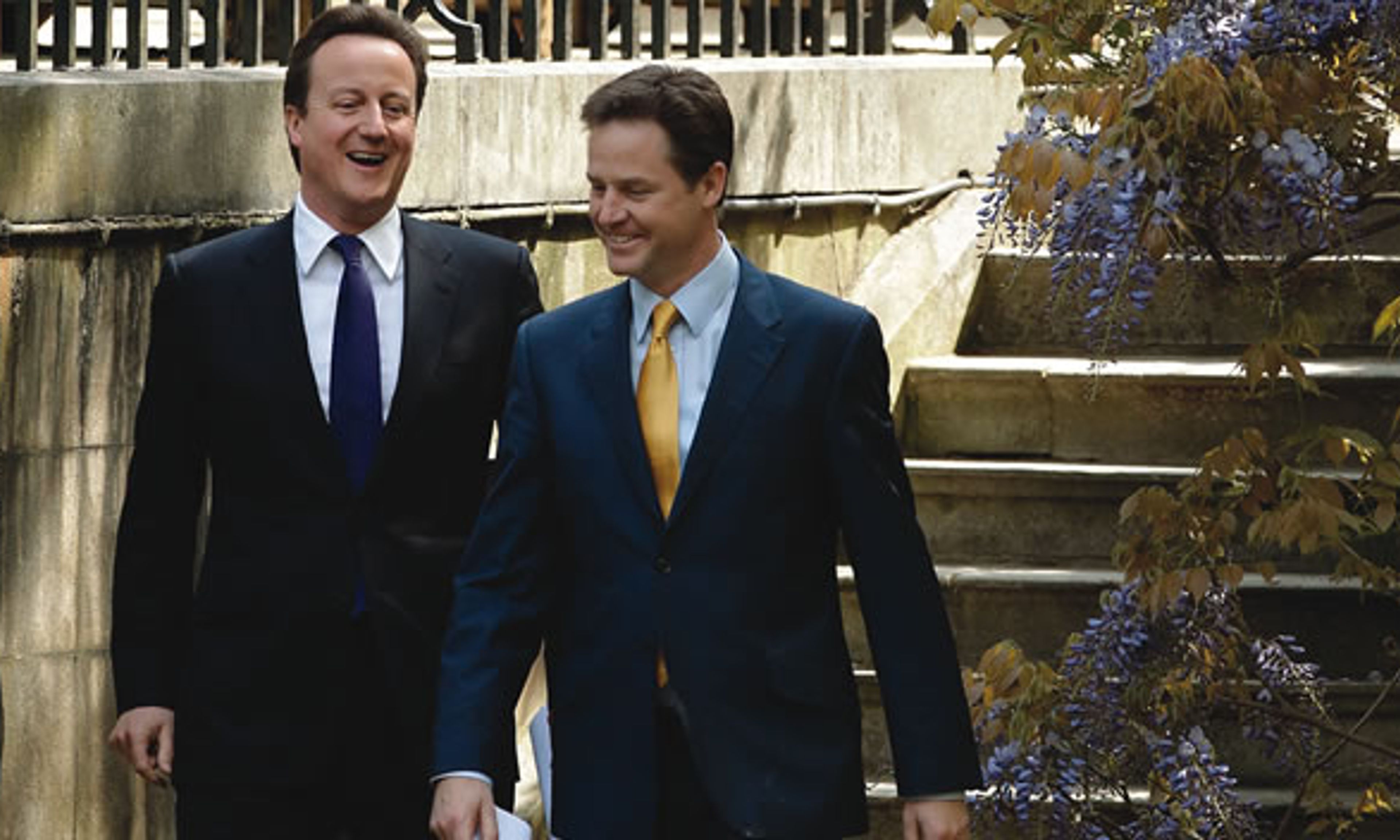
Politics is the art of the plausible. Only two weeks after the British electorate ushered in the apparent uncertainty of a hung parliament, the Lib-Dem-Con coalition cobbled together from the disappointed Tories and the third-place Liberal Democrats has already acquired an aura of inevitability. This aura has been created in part by the leaders of the two parties. Though politically at odds (at least until the polls closed), Tory David Cameron and Lib-Dem Nick Clegg are socially almost identical: both rich, both well-connected, both graduates of famous public (i.e., private) schools and Oxbridge, both married to stylish, successful career women, and both career politicians who, as the saying goes, “never had a real job.”
Their ideological overlap is similarly large: Cameron long ago described himself as a “liberal conservative” and Clegg, briefly a Tory at college, wrote essays for the market-friendly wing of his own otherwise “progressive” party. Neither is “tribal” — the current media term for genuinely holding the views you and your party officially espouse. Their joint press conference in the Downing Street garden announcing the new coalition was accordingly smooth, seamless, and eerily harmonious. It reminded me of a soft-shoe-shuffle duo, each of whom knows the other’s routine so perfectly that he can play either part.
The smoothness of this joint performance was reflected in the ease with which both parties agreed on a program. Later press reports even alleged that Tory negotiators had invited the Lib-Dems to strike out manifesto items that were too embarrassingly conservative. Cameron’s near-exclusive wooing of Lib-Dem voters before the election began to look like a shrewd preparation for an alliance with their party after it. In fact, it was a failed electoral calculation beforehand that nonetheless facilitated a quick adaptation to an unexpected alliance afterwards.
But if Cameron’s farsightedness wasn’t the explanation, then maybe a Tory-Lib-Dem coming together was, well, sort of inevitable in the light of, you know, historical developments like, er, Britain now being a social-democratic country, basically that is. Naturally the infamous Tory Right is both unhappy with this and powerless to do much about it — it’s being marginalized by history at long last! Liberal Tories are more realistic.
So the world — or at least the metropolitan media — increasingly sees the coalition as the product less of electoral accident than of converging ideologies, the gravitational pull of the center, and “the cunning of history.” From this standpoint, the coalition looks like a natural and permanent feature of British politics because it is an inevitable one.
As always, however, inevitability has to be carried along by a stretcher party of supporting arguments.
The first such argument is that the Cameron strategy — i.e., dissing the conservative base to show centrists that the “nasty” Tory party had changed — did pretty well in the election itself. This is important because if Cameronism did badly, then the coalition is a gimcrack alliance of losers rather than the carrier of inevitable progress. Yet since the Tories improved their share of the national vote by a mere 3.8 percent — to 36.1 percent — against a failed, discredited, and unpopular government, that is a hard case to prove. Its advocates have to dig deep for statistical measures that seem to justify it. They fixed on two: the Labour-to-Tory electoral swing and the rise in the raw number of Tory voters.
Cameron’s favorable swing, they initially pointed out, was higher than the swing enjoyed in a similar election by Margaret Thatcher in 1979. In fact, this seems not to be the case: Thatcher’s Labour-to-Tory swing in 1979 was 5.3 percent, versus a swing this year of 5.0 percent at the end of the night. But why quibble about a secondary matter? A swing is a statistical artifact that measures not the level of support of one party but the change in relative support between two parties. If party A loses 10 percent of its voters between elections while rival party B gets exactly the same level of support as before, then the statisticians will register an A-to-B swing of 5 percent.
Something like that happened in 2010. Labour lost 6.2 percent of its national vote in comparison with the 2005 election; the Tories gained 3.8 percent; and the total of those numbers divided by two was a swing of 5.0 percent. So Gordon Brown’s retreat contributed almost two-thirds of the Labour-to-Tory swing, the Tories’ advance a feeble one-third. Not very impressive. If you want a truer indicator of electoral support, look instead at the percentage of the national vote won by a party. Cameron’s Conservatives won 36.1 percent this year; Margaret Thatcher’s winning percentage in 1979 was 43.9. Case closed.
What, then, of the rise in the raw numbers of votes for the Tories this year? This was indeed impressive — an increase of almost 2 million votes on 2005 to reach a total of 10,706,647. Indeed, that raw number is higher than the Tory vote totals in both the 2001 and 1997 elections. On the other hand it’s between 2.5 and 3.5 million votes lower than John Major’s total in the 1992 election and than the Tory total in all three of Thatcher’s elections. Am I “nostalgic,” as David Frum has suggested, for those victories? You betcha! But I am also curious about these dramatic variations between then and now. Is there some third factor, some hidden clue, that might help us to account for them? As it happens, there is such a clue: turnout.
At 65.1 percent of the electorate, amounting to 29,653,638 voters, turnout in 2010 was sharply higher than in the two previous elections. It rose by 3.7 percent and roughly 2.5 million votes above the figures in 2005 and by 6 percent and more than 3 million votes above 2001. Since Cameron attained a 3.8 percent increased share of this rising total, he saw his raw vote figures rise by the 2 million cited above. At the same time, Gordon Brown saw his percentage vote fall by a massive 6.2 percent but, because of the higher turnout, his voting numbers fell by less than 1 million.
Why did turnout rise? Well, the election campaign was exciting, the outcome was in doubt, and the two previous elections had seen exceptionally low turnout. If we go back to the elections fought by Major and Thatcher, moreover, the turnouts varied between 73 and 78 percent. Hence their high percentages produced even higher raw vote numbers. So neither the medium turnout in 2010 nor the factors that produced it suggest a strong Tory revival — though they can be misused to mask a weak one.
A more reasonable defense of the Cameron strategy is that it was broadly correct but blown off course by the foolish decision to include Liberal Democrat Nick Clegg in the party leaders’ debates. There is something in this argument but not as much as most pundits think. It is true that Clegg grabbed the limelight, seized the “change” mandate, and made himself the equal of Brown and Cameron. This undoubtedly disrupted both the Tory and Labour campaigns, but the Clegg effect faded and in the end had little impact on the Tory vote. Cameron was scoring roughly 35–38 percent in opinion polls prior to the leaders’ first debate; he fell to 30–33 percent in the weeks following it; but he recovered to hit almost the exact midpoint of his earlier 35–38 percent range on Election Day.
So what has to be explained is why Cameron was struggling to stay afloat in the mid-30s when the campaign began. Tim Montgomerie of the influential website www.conservativehome.com has published a wonderfully synoptic account of the Cameron caper that points out serious structural weaknesses in Cameronism. It never integrated his policy innovations — deep-green politics, etc. — into a coherent conservative narrative and thus sounded inauthentic. It endorsed Labour’s economic and budgetary qualities for too long, was thus unable to profit from their dramatic collapse in late 2008, and failed to advance an agreed and consistent set of solutions thereafter. It shrank from “hot button” issues, such as immigration, even when polling research showed them to be matters of overwhelming concern to the voters. In general, Montgomerie confirms my own argument that the Cameroons progressed heedlessly from realizing that the base was insufficient for victory to believing that it was an actual obstacle to victory. In their pursuit of centrists they were carelessly content to alienate voters to their right.
The broad sweep of Montgomerie’s narrative is amply confirmed by the graph of polling data from 2005 to the present on the independent website UK Polling Report. The Tories rise slowly in the polls, reaching a 45–48 percent plateau for a few months in 2008, until the financial crisis breaks, when they start a long downward trend. They stage occasional upsurges against the trend in 2009 and look like entering election year with a 38–42 percent range of support. But in November Cameron withdraws his “cast iron” pledge to hold a referendum on the Lisbon Treaty advancing European political unification — a matter of both trust and importance to the conservative base. His numbers now begin a slow and erratic fall until he enters the campaign itself with numbers generally in the range of 35–38 percent. Which is also where he ended up on Election Day.
Some of the voters who defected in the final six months went to the two “fringe parties” of the Right — the Euroskeptic UKIP party, which gained 3.1 percent of the popular vote, and the neo-fascist British National party, which received 1.9 percent. If only half of the combined UKIP-BNP vote had gone to the Tories, they would have had a popular vote total of 38.6 percent and a small overall majority in the House of Commons. Estimates of the Tory seats lost as a result of the defections range from 21 to 41 — say, about 30 — which would have given the Tories a majority of around 20. But that calculation understates the loss of conservative voters suffered by the Cameroons because of their (and their predecessors’) neglect and even disdain of natural conservative voters. Some of the disillusioned Tory voters can be assumed simply not to have voted at all. The turnout figures above show that, compared with 1997, between 12 and 18 percent more of the electorate has simply stayed at home on Election Day. It would not be surprising if right-wing voters — either Tories discontented over the Lisbon Treaty or ex-Labour voters angry at uncontrolled immigration who would once have crossed over — amounted to a disproportionate number of these stay-at-homes.
In the face of these facts, some supporters of the Cameron project argue that there are fewer votes on the right than in the center; Cameron simply went duck-hunting where the ducks were. That argument fails on two grounds. In the first place, there is more competition for votes in the center — from Labour, the Lib-Dems, and the Greens (now represented in parliament) as well as the Tories. Indeed, in this election the Lib-Dems actually gained an additional 1 percent of the popular vote (though they lost a handful of seats). Second, the votes on the right were until recently part of the conservative base. They should in principle be easier to recruit than those who have never been attracted by conservative politics. But Cameroons, while accusing their critics of advocating a strategy of simply holding on to the base, actually carried out one of replacing it.
In an editorial, National Review forecast the likely result: “The nightmare scenario is for the Tory vote to rise but for the insurgent UKIP to win enough votes from discontented toxic Tories to put Labour or the Lib-Dems in power.” It turned out to be uncannily accurate.
So unless nightmares are daydreams, the Cameron strategy plainly failed and the Tories plainly lost. Any other conclusion is self-deception. And on the day after, everyone knew it. That was why Cameron had to get into government at any cost. As NR points out in “The Week” in the current issue, if he had not done so, he would have faced a major rebellion of resentful and unrestrained Tories and almost certainly lost office. Or if he had been able to form a minority single-party Tory government — which was a second-order possibility — he would have rested uneasily on the daily chance of defeat (and on support from no-less-resentful backbenchers). He therefore sought the one coalition that would give him a strong majority in parliament, the possibility of an administration that could last five years and survive the travails of economic retrenchment, and protection from his own party.
Cameronism is a foolish political strategy that was always likely to fail. But Cameron is a bold, daring, and imaginative politician — an opportunist in the good sense as well as the bad — and he stitched up the coalition and his internal enemies simultaneously by offering the Lib-Dem leader anything it took. It took quite a lot. The Tories are now committed to constitutional reforms that, in addition to offending their sense of constitutional continuity, threaten to prevent their forming a single-party majority government ever again. Most of them don’t like it.
For the moment, however, the coalition is in power and as the lawyers say, possession is nine points of the law. It has a majority large enough to last for the five years of a full parliament — if it stays together. It has the approval of the establishment (even of the liberal establishment) since it is seen as a Lib-Dem government supported by Tories rather than the reverse. It is enjoying some modest popularity with everyone else — but hardly excessively: Two recent polls show the Tories have gained 1 percent approval and the Lib-Dems have lost 3 percent. And it floats along on the hope that governments can shape events to suit their interests. That is true enough, but governments are also hostage to events over which they have little control. The event that is fast approaching this coalition is a budgetary statement on June 22 that will inevitably inflict heavy costs on the voters in some combination of tax rises and public-spending cuts. How will a coalition that is riven by serious ideological divisions under all the polite optimism survive the prolonged unpopularity that economic distress will bring? Will Lib-Dems retreat from bold retrenchment when the going gets tough? Will Tories stay loyal when UKIP starts winning special elections?
Maybe the most ominous sign for the coalition is the cheerful spirit of Labour MPs. They feel they dodged a bullet when Clegg went with Cameron rather than Brown. They know that if a Lib-Lab government were today preparing a list of spending cuts for June 22, they would be facing Armageddon in what would have been a much-too-soon election. They suffered no meltdown and have a solid base of 258 seats in parliament. Rid of Brown, they are electing a new leader in a contest that will help give them a new image. And they are already beginning to work out how to exploit the coalition’s weaknesses on immigration, on the EU, and above all on the economic crisis for which they will shortly shrug off all responsibility.
One distinguished Cameroon recently justified forming the coalition with the argument that the Tories could never fully detoxify themselves in opposition. All an opposition can do is promise. Cameron needed to be in government, he said, in order to take the actions that would decisively change the image of the Tory party in a way no promise could do.
Exactly, said a Labour MP, thinking of June 22.












Comments