The engineer tried to enter the open-shop construction site, slipping through a gap between a stone wall and a chain-link fence. But the union members rushed him, ramming the fence against his body and trapping him. Screaming, the engineer tried to free himself, and then to shelter his body. When it was over, he collapsed and passed out, cut and bruised.
In Philadelphia, such acts of union violence are nothing new. Organized labor dominates the city’s construction sector, using fear and force to cow contractors and developers. By some estimates, Philadelphia’s unions have perpetrated, on average, nearly 45 annual acts of violence or vandalism for almost four decades.
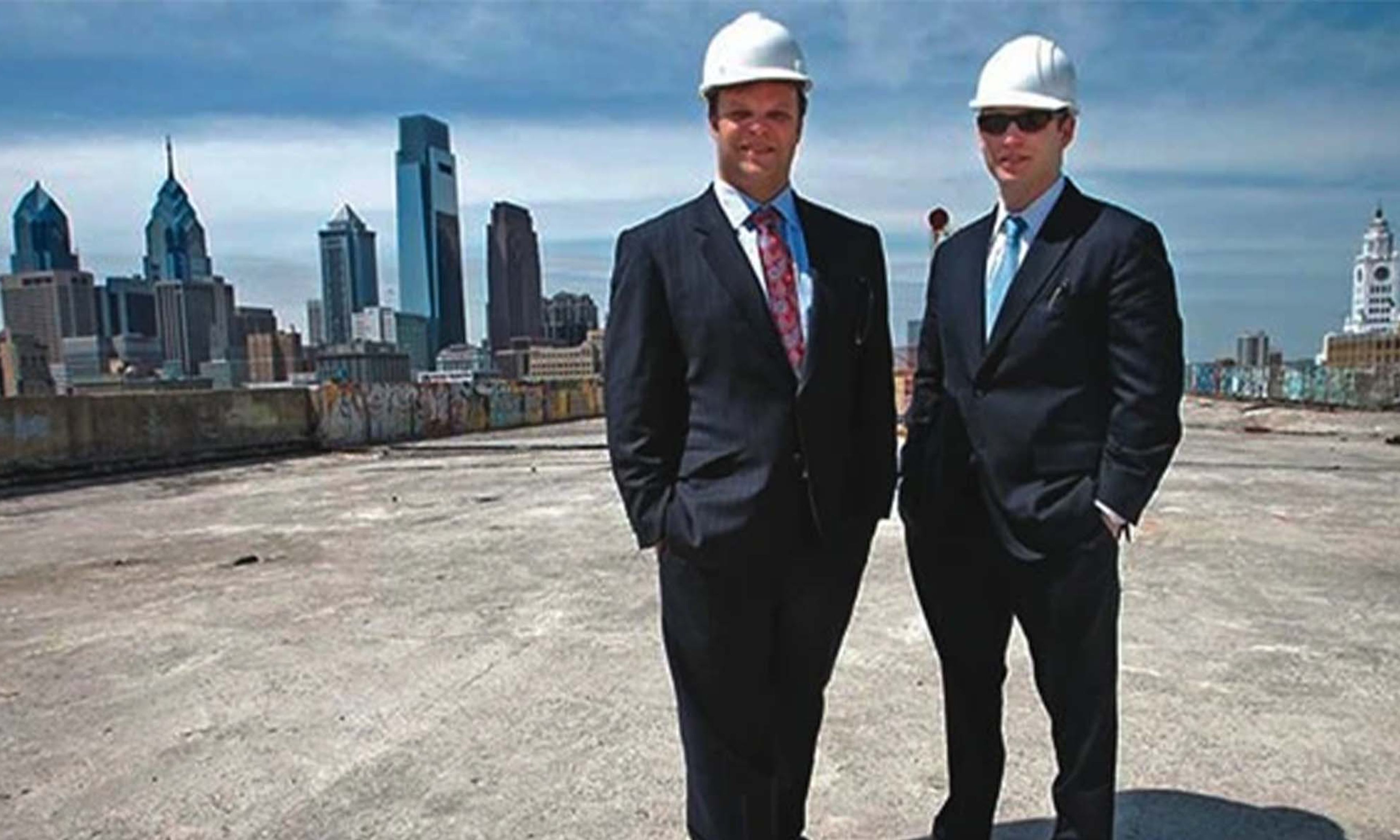
So unions probably expected to get their way when they approached Matthew and Michael Pestronk, two young developers building a luxury-apartment complex in downtown Philadelphia. Initially, the Pestronk brothers offered to hire union subcontractors for nearly half of the project. But the labor leaders demanded the project go union-only, which would have added about $15 million to the overall cost, according to the Pestronks, and forbade their members to work on the site until the brothers yielded. Instead, the Pestronks hired non-union workers, triggering one of the most rancorous labor conflicts in Philadelphia’s recent history.
“They’re f***ing organized criminals,” Matthew tells me. “They’re repulsive, they’re disgusting, and their tactics are intolerable.” Michael agrees: “It’s a shame they’re calling it unions. It has nothing to do with labor unions or the fair treatment of workers. . . . It’s just an organized-crime ring that’s racketeering and controlling the market.”
The Pestronks have spent $1 million on security and lawyers. Consequently, many incidents of violence have been documented. The engineer’s assault was recorded by at least three cameras. Michael says his workers have been attacked with crowbars; security guards have been hit in the face and pushed; entrances have been blocked; tires have been punctured by ice picks, knives, and nails; oil has been dumped near entrances; equipment has been vandalized; workers have been subjected to racist and sexist remarks; and flyers have been distributed featuring a photo of Matthew’s wife, male genitalia, and the caption “Carrie Pestronk likes to get hard with it!”
A former college wrestler who once owned a 158-pound English mastiff, Matthew isn’t easily intimidated, as the unions are discovering. “They just picked a fight with the wrong people,” he says. “They grossly underestimated us.” Matthew says he doesn’t want to pick a fight, just to end one: “If they escalate it, we’re going to destroy them. . . . They’re going to lose, and they’re going to lose bad. We have substantial resources, just as they do, and we also have a major advantage: We’re in the right. And that’s worth a lot, when you’re actually in the right.”
The Pestronks are being compared to J. Leon Altemose, a Philadelphia contractor who stood up to unions in the 1970s. Finding the unions’ demands excessive, he hired non-union for a major building project near Valley Forge.
On June 5, 1972, the unions carried out what Harper’s Magazine later called “virtually a military assault” against Altemose. Men arrived at his construction site in union-chartered buses. They charged, igniting firebombs and vandalizing vehicles and other equipment, wreaking around $400,000 in destruction. Though around 1,000 participated in the attack, only 16 were convicted of a crime, and only eleven imprisoned.
Later that summer, union members beat up Altemose. The contractor appeared on 60 Minutes and became a hero of the national open-shop movement. Altemose, who died in 2008, is remembered in Philly as the only guy who stood up to unions and won.
Generally, Philadelphia’s developers and contractors are reticent about union violence, vandalism, and intimidation. They’re afraid to speak because bloodshed is recent history.
In 2010, Toys“R”Us used mixed-shop labor for a building project in the Philadelphia suburbs. One summer morning, members of the ironworkers’ union showed up with baseball bats. They shattered the rear windows of the workers’ trucks and then chased the fleeing men, hitting them with bats and punching them. One worker had to be taken to the hospital for injuries to his head, back, legs, and torso.
Two ironworkers were arrested and pled guilty to simple assault. James Godby, the detective who investigated the incident, says two other ironworkers likely participated in the assault but went free for lack of evidence. “We made a couple of calls [to the ironworkers’ union],” Godby says, “and we didn’t get a lot of cooperation.”
Violence, vandalism, and intimidation have become a part of the institution of organized labor in Philadelphia. The Pestronks’ cameras show a white male, unprovoked, hitting a security guard. Michael, as well as an eyewitness, identified the assailant as Fred Cosenza — a business representative who earned $102,213 in 2011 for his work with the Building Trades Council, a construction-trades labor organization. Cosenza is mentioned in at least two cases that businesses filed with the National Labor Relations Board; in one, an office employee called the police after Cosenza and six other labor leaders visited her workplace. She testified, according to the decision of the administrative-law judge, that they “gave the impression they would not leave ‘until they got what they came for,’ that matters became tense, and that she was ‘freaked out’ and ‘scared.’” I tried to ask Cosenza about these claims, but he referred me to the Building Trades Council and hung up.
Pat Gillespie, business manager of the Building Trades Council, tells me that “if someone breaks the law, it’s not the responsibility of the unions.” He says that “one person’s harassment is another person’s free-speech exercise,” adding that “life is tough in Philadelphia, as it is in any urban area. Someone shot me from a car one time. . . . To say that we’re more expressive than any other area — maybe we do it a little louder, but the point’s the same. You have to protect what’s yours and preserve the standards that have been established for our area.”
The conflict between unions and the Pestronks “doesn’t amount to anything more than pushing and shoving matches,” Gillespie says. “[The Pestronks] don’t like to be called out for what they are: a couple of bottom-feeders who are trying to profiteer at the expense of people who work for their money.” (The Pestronks pay their workers between $35 and $45 an hour.) Gillespie also tells me that tensions are not “anywhere near as high as they could be.” He claims the Pestronks have hired people to intimidate him, “guys with a lot of tattoos and stuff,” adding that they post “only convenient video” on their website, PhillyBully.com.
Federal law makes it nearly impossible to investigate a union as an organizational entity. If another group were using similar tactics, it could be investigated under the Federal Anti-Racketeering Act of 1934 or the Hobbs Act, which prohibits “the obtaining of property from another, with his consent, induced by wrongful use of actual or threatened force, violence, or fear, or under color of official right.”
However, in 1973, the Supreme Court ruled in United States v. Enmons that union officials may not be investigated, much less prosecuted, for violence or intimidation under the Hobbs Act if they are carrying out “legitimate union objectives,” such as campaigning for a pay raise or more union hires. Individual members may be prosecuted, but Enmons keeps federal authorities from investigating the union as an organizational entity.
“You can’t prosecute the union-writ-large for extortion,” says James Sherk, a labor expert at the Heritage Foundation. “The challenge is proving who’s done it. Everyone pretty much knows when the union has done it, but identifying which member is pretty difficult.” If it weren’t for Enmons, Sherk says, “you’d be able to go after the union institutionally and take records and go in after who’s ordering it.”
In Philadelphia, this contributes to a culture of impunity. The National Right to Work Committee examined newspaper accounts of 143 incidents of union-related violence or vandalism in Philadelphia; arrests were mentioned only 38 times; convictions, eight times. Police and open-shop businesses report that unions often get away with crime.
Philadelphia’s politics are also suspect. Members of the city council have an informal agreement: Each gets the final say over projects or land usage in his or her district. And in 2011 alone, the Philly Post found, unions had donated at least $327,600 to city-council members. Open-shop employers fear that the city council will veto their projects if they don’t cave to union demands.
All these problems long ago escalated to the point that basic personal and property rights in Philadelphia are routinely threatened and violated. Law and politics have failed to check unions’ Mafia-like behavior, so it has fallen to courageous individuals to take a stand.












Comments