‘I want to dedicate this next song,” the Israeli pop megastar Eden Ben Zaken is telling a crowd of hundreds of survivors of Hamas’s barbaric attack, “to the mothers among you, the true heroes.” Ben Zaken then caps off her unique concert — presented, gratis, on the fifth night of Hanukkah in Eilat, a city to which thousands of Israelis living on the border of Gaza have been evacuated — with her power ballad “Chayim Sheli,” a term of endearment that means “my life.”
The song and its dedication represent both the tragedy and the resilience of Israeli society in the wake of the murderous October 7 invasion: an assault on humanity, a reaction of heroism, a response of determination, and a reaffirmation of life.
On that accursed day, thousands of terrorists punctured the border wall and rampaged through kibbutzim, towns, and small cities, raping, pillaging, murdering, decapitating, and mutilating more than 1,200 Israelis — the overwhelming majority of them women, children, and the elderly — wounding thousands, and abducting more than 240. It was the most vicious attack on Jews since the Holocaust.
We have spent the past months visiting and speaking with dozens of Israelis directly affected by Hamas’s onslaught, witnessing firsthand the physical remains of the terrorists’ depredations, and recording the testimonies of the survivors, the heroes, the hostages, their families, and those determined to rebuild their homes, their communities, and their country bigger, stronger, and better than before. Rather than interview government or military officials, we met with ordinary Israelis experiencing extraordinary events. Hope springs eternal, especially in a country whose national anthem translates to “The Hope.” Even in the wake of the most brutal attack in Israel’s history, its people, against all odds, remain optimistic. We are humbled to present their stories.
The Heroes
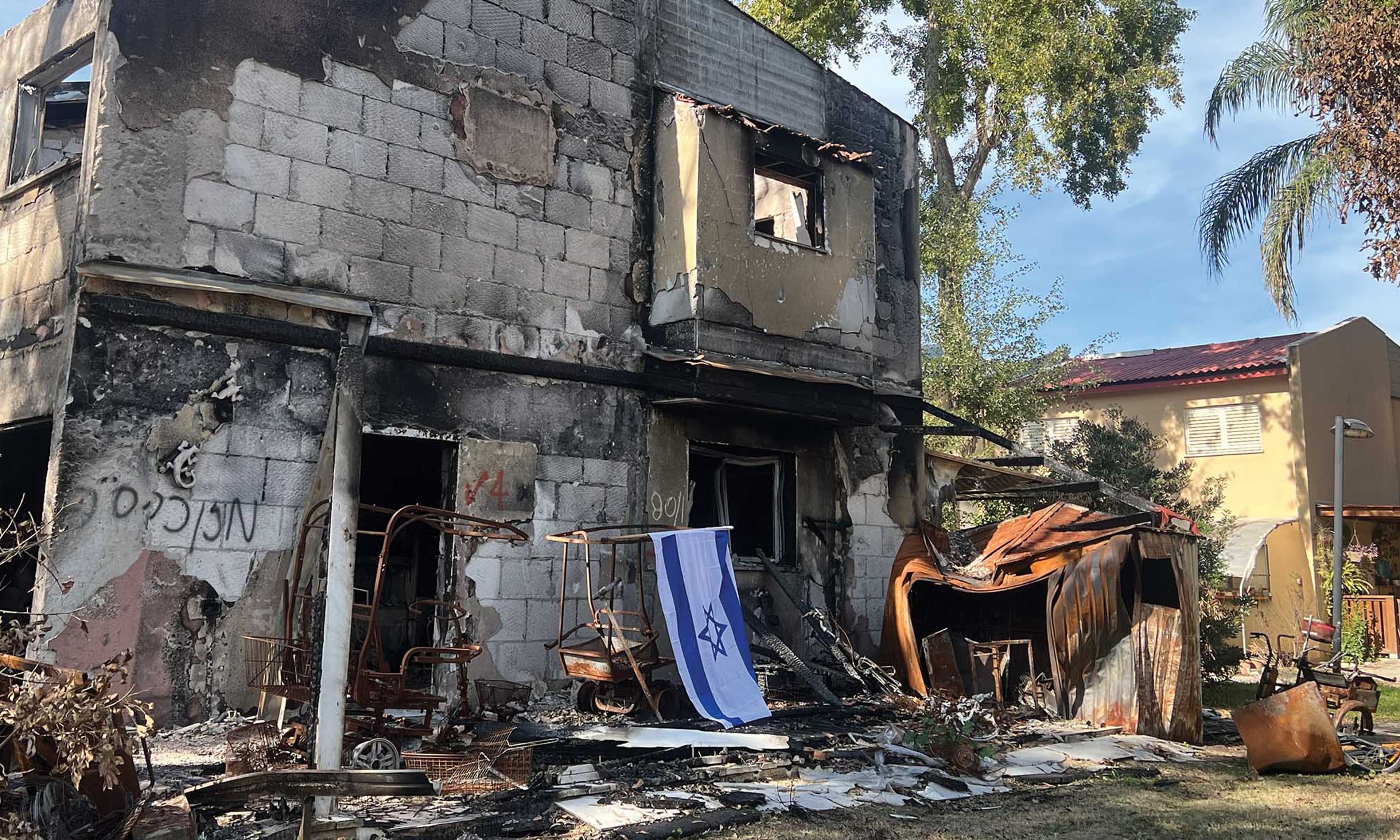
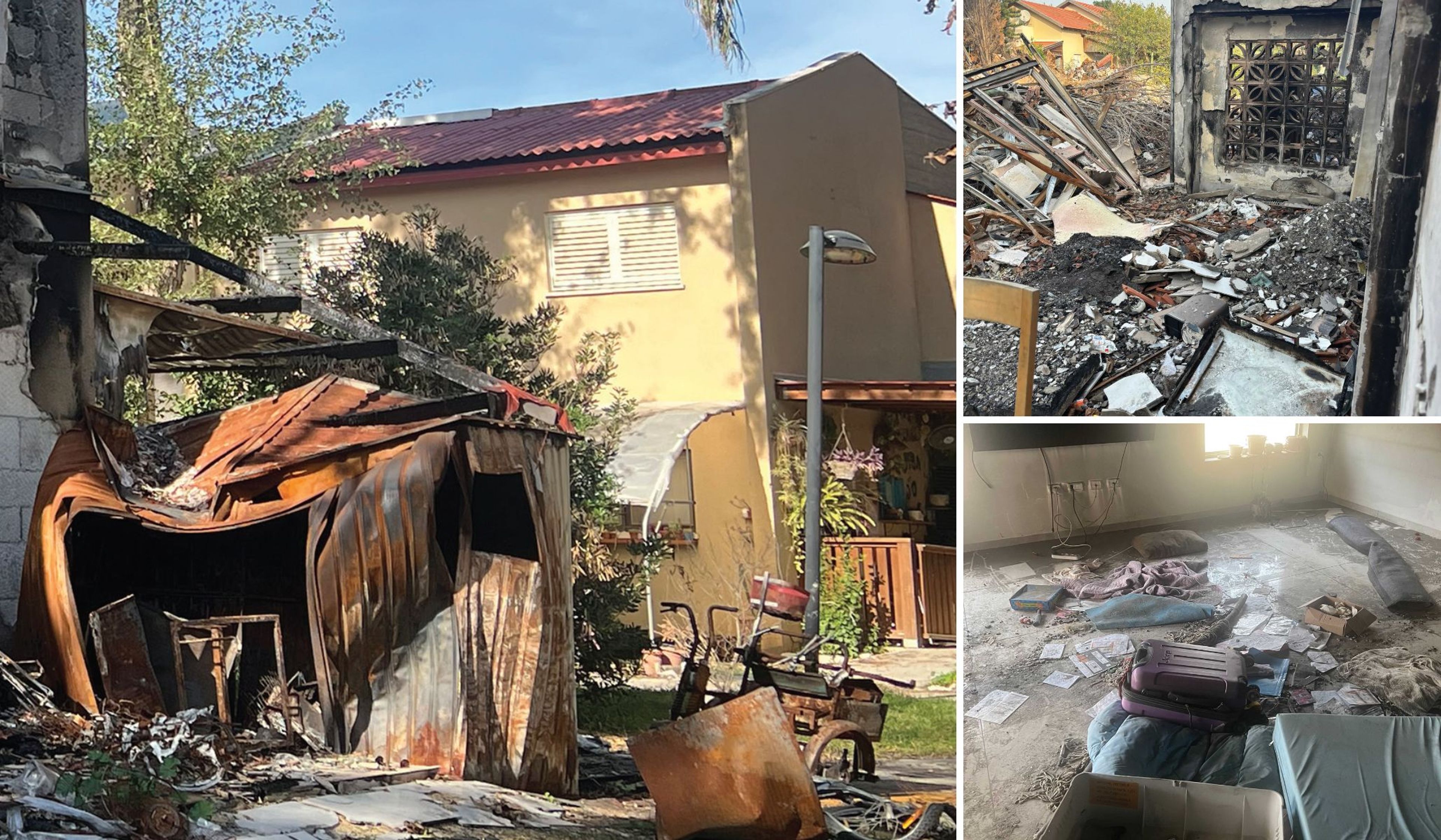
It is difficult to describe the devastation suffered by Kibbutz Be’eri, a community of 1,150 inhabitants, where, on October 7, nearly 100 Israelis perished, 29 were abducted, and 200 (out of a total of 380) homes were destroyed. Terrorists penetrated the gates of the kibbutz, which sits two miles outside of Gaza, and systematically breached home after home, butchering residents in their sleep. When some kibbutzniks sought shelter in their reinforced safe rooms, the assailants rolled tires into their homes, ignited their gas stoves, set their houses ablaze, and smoked them out, forcing the suffocating residents to open their safe-room windows, into which the terrorists tossed grenades. Some corpses were burnt so badly that the ashes had to be sent to laboratories abroad for DNA identification.
During our visit, exactly 75 days after the attack, the scents were as powerful as the sights. We smelled burnt rubber, wood, and ash, and the blackened remains of houses, golf carts, and tricycles left little to the imagination. If the burning — of homes, of cars, of people — represented a Holocaust in miniature, then Be’eri in its current state resembled nothing so much as a living Holocaust memorial.
Yet despite the widespread destruction, Be’eri and other communities like it also witnessed astounding acts of heroism by everyday Israelis thrust into the arena. Or Yellin is one of them, but he was reluctant to discuss his actions, or the 14 hours he spent protecting others in his safe room. Instead, he was eager to focus on the stories of those he helped save. “This is [an IDF] cannon, don’t worry,” he said, as he led us on a tour of the extensive damage, punctuated as it was by Israeli artillery fired from just outside the kibbutz at Hamas strongholds just a few miles away. “My nervous system has collapsed, so I don’t feel anything.”
Just a few minutes away from Be’eri sits Kibbutz Alumim, where Ayal Young, 37 and a father of four, demonstrated incredible heroism. During the early hours of the morning, after leaving his wife and kids in the safe room, Ayal and fellow members of the kibbutz’s readiness squad heard gunshots near the fields. They knew they were too late when they came upon the bodies of foreign agricultural workers, who had been on their morning break. “When we arrived at the scene, to our dismay we found mostly casualties and a few injured,” Ayal told us. “We did what we could to save the injured workers and realized there were more to come.”
The group’s members patrolled the kibbutz and steeled themselves for further incursions. “We heard a huge blast coming from the surrounding fence and spotted terrorists flooding into the kibbutz,” Ayal said. “We decided to shoot in their direction to lure them away from the residents and toward us.” Ayal and his partner then came face-to-face with a terrorist who shot at them, wounding his partner in the leg and grazing Ayal’s face. Ayal shot and killed the attacker, not noticing a second gunman behind him. “We didn’t get a chance to clear the area, and suddenly I felt a very sharp pain in my back,” Ayal recalled. “I fell, not able to move my body, barely able to breathe.” When he was later taken to the hospital, doctors discovered he had been shot four times: twice in the back, once in the lungs, and once in the face. Ayal has been in intensive rehab since the injury.
When we spoke to him, Ayal deflected the praise cast in his direction. “The true heroes,” he insisted to us, “are the families who remained quietly in their safe rooms.” He singled out his wife, Reut, who kept their four children safe, fed, and undetected for 26 hours. Some families spent hours physically holding shut their safe-room doors, which could not lock from the inside, while the terrorists on the other side sought to pry them open.
We also spoke with Gal (he asked us not to use his last name), 21, who was enjoying himself at the Nova Desert Music Festival when Hamas descended upon them. “We kept dancing even after the rockets were fired,” he told us, “until we heard gunshots.” Gal, his brother, and his friend leapt into their car and came to a fork in the road. “Everyone who turned left died,” he recalled. “Some of us who turned right survived.” Their car escaped only because Gal pushed the driver’s head down to avoid being hit by the intense cross fire. “With my dad on the phone,” he said, “I navigated us out of the killing zone.”
The Survivors
Carmel Be’eri, 18, survived the October 7 massacre inside her safe room in Kibbutz Alumim only through what she sees as divine intervention. “It was a miracle,” the 18-year-old student told us. “The terrorists attacked the ‘easier’ targets first, so by the time they got to us, our kibbutz’s readiness squad was prepared for them.” The squad fought off the rampaging terrorists valiantly. She would later learn that her father was fighting alongside Ayal Young, her neighbor.
Carmel considers herself fortunate that she was left physically unscathed. “I was literally spared from death,” she said. “We had an internet problem and lost connectivity for about six or seven hours, which caused panic. Only later, when I saw photos of the [other] kibbutzim, did I appreciate how much worse it could have been at Alumim.”
Along with her family, Carmel was evacuated to a hotel in Netanya, about 100 miles north. “People on the streets welcomed us in, waving Israeli flags,” she recalled. Life as an evacuee has been hard. “In the beginning it was a huge crisis,” she said. “The hotel was packed with people, there was always noise.”
Ayal Young agreed, noting that while he and his family will be eternally grateful for the hospitality they’ve received, they have “virtually no privacy, or sense of family, living in a hotel, with four children sharing a tiny room.” To provide some sense of routine and structure, they’ve enrolled their children in a local school and have kept them busy with extracurricular activities.
While things have settled down, Carmel is anxious — in both senses of the term — to return home. “I really hope we go back,” she insisted. “I want to.” But her parents are wary. “They won’t go back until they see how the war ends, to make sure it’s really over,” she said.
Jonathan Dekel-Chen, 60, a resident of Kibbutz Nir Oz, whose son, Sagui, was taken hostage on October 7 after courageously defending his community from hundreds of invading terrorists, sounded a similar note of caution. “It strains the imagination,” he told us, “that anyone who experienced [the attack] would agree to go live there.”
Herein lies the big question: Will the kibbutzim ringing the border with Gaza — the area known as the Otef Azza (the Gaza envelope) — return in all their glory? The stakes are high: Jonathan characterized the region as “Israel’s breadbasket,” and the truth of his statement was evident during our time in the south, where verdant fields and orchards line every road. If residents cannot safely and confidently return home, he said, the entire country will suffer.
“There’s a future for the Otef,” Carmel stated plainly. “It’s my home, and home to some of the most beautiful sunsets in Israel.” When asked what she sees as the fate of the afflicted kibbutzim, she gives a hopeful response: “After the war, the rest of the country will realize just how important the Otef is for Israel, and I can’t wait to see it grow even bigger and grander than before.”
Ayal Young also was warily optimistic. “Our aspiration is to return home,” he said. “But it depends on when and how the war finishes. If Hamas remains on the other side of the fence, we won’t have accomplished anything.” But he too is hopeful that Alumim will be rebuilt even larger and stronger.
We asked Carmel what gives her strength. “My family,” she said. “Knowing that they’re always by my side grounds me.” Likewise, Ayal pointed to his wife and children as his inspiration, proclaiming “What really bolsters us is Israel’s spirit of unity.”
In the first few weeks after the war broke out, one of us (Danya) helped establish and taught at a makeshift school for children from the stricken southern city of Sderot whose families had been evacuated to Jerusalem. At first, the kids, unsurprisingly, were still in shock and reluctant to open up to any of the staff. “I want to go home!” we overheard a young girl exclaim one day. “You don’t have a home,” her friend responded.
But once Danya and her colleagues created a safe space and structure for the kids, they were gradually able to share their feelings. One day, a seven-year-old, Noam, was peering out of a classroom window at passing policemen on horseback. After being asked why he was so interested in the horses, he answered, “My father rides horses too. He’s in Yamam” — an elite counterterrorist unit — “and one day I want to serve there too.” He didn’t know where his dad was at that moment: “I’m not sure, but I hope he comes home soon.”
The Returnees
“Why do I get to be here, and they don’t?” Ofir Engel, 17, asked us in Kibbutz Be’eri. “They all have to come back home now.” Ofir had returned for the first time to the house from which Hamas terrorists kidnapped him on October 7.
“Two men with guns, one with an RPG,” Ofir recalled. “First thing, they shoot the door. Then they took me into a black car. The last thing I remember is being carried away and my girlfriend say[ing], ‘I love you.’ ” His weeks in captivity were worse than a nightmare. “They abused us mentally,” he said. “They told us that our families don’t want us to come back and that we are going to stay in Gaza for more than a year.”
Unlikely as it may seem, Ofir is one of the lucky ones. He came home in November as part of a deal in which Israel returned hundreds of Palestinians, including convicted terrorists, in exchange for 105 women and children. The Associated Press reported that at least ten of the returned female hostages had suffered sexual abuse. Hamas circulated videos that showed everyday Gazans jeering at, beating, and throwing rocks at the captive children, women, and elderly.
Clara Marman and her sister, Gabriela Leimberg, and Gabriela’s daughter Mia, all dual nationals of Israel and Argentina, endured an experience similar to Ofir’s. Clara and Gabriela, their brother Fernando, Mia, and Clara’s partner, Louis Har, were taken from Kibbutz Nir Yitzchak, less than two miles from the Gaza border, after sheltering in their safe room all morning. Clara’s daughter, Gefen Sigal Ilan, was in touch with her mother until she and the other hostages were taken through the fence surrounding the kibbutz. “Hamas seized them violently and then used psychological abuse against them,” Gefen said. “My mother didn’t receive the medication she needed, let alone enough food.”
After weeks in captivity, Clara, Gabriela, and Mia returned home as part of the November exchange. Gefen told us that, even in the dark dungeons where they were kept, the women dreamt of freedom. “While being held hostage, they sat together and started planning their future,” she said. “What they were going to do when they were released, that was what gave them a lot of strength.”
But Fernando and Louis remain in Hamas’s hands. Gefen has traveled throughout South America to advocate for them, even meeting with Javier Milei, the newly elected Argentine president. “My uncle is due to celebrate his 61st birthday,” Gefen says, “and I refuse to believe that he won’t be here.”
The Hostages’ Families
“I’m standing here now in these clothes, barefoot,” said Ella Ben-Ami, 22, clad only in shorts and a T-shirt on a crisp December morning, “because my dad was kidnapped from our home, barefoot in his underwear. I don’t care if I’m cold,” she continued, “because my dad is colder.”
Ohad and Raz Ben-Ami, Ella’s parents, both 57, were savagely kidnapped on October 7 and separated in captivity. Ella escaped her parents’ fate only by sleeping elsewhere in the kibbutz that night. Her father texted her that morning while in hiding to tell her he was writing a will on the computer in his safe room and to provide her with the password. Ella didn’t believe him — until she received a final text, reading “They’re here” and then “Shema Yisrael,” the most central of Jewish prayers. Raz, blessedly, was returned to Israel in November as part of the exchange, but Ohad remains in Hamas’s grasp. “My mom came back from the lowest point in her life, as a hostage in captivity in Gaza, to be a wife of a hostage in captivity in Gaza,” Ella said.
Nira Sharabi’s husband, Yossi, and brother-in-law, Eli, were also seized from Be’eri; her daughter, Yuval, is Ofir Engel’s girlfriend. Eli’s wife and two teenage daughters were slaughtered in front of him. “One hundred and twenty-nine abductees still in Gaza,” she said, “and the whole country is a hostage of Hamas.” Kibbutz Be’eri reported on January 16 that Yossi Sharabi was murdered by Hamas while in captivity.
A few miles away, in Nir Oz, Sagui Dekel-Chen, 35, an American citizen, found terrorists roaming on October 7 and leapt into action to defend his family and community. But after valiantly fighting off Hamas militants, he was taken captive and remains in Gaza months later; one-fifth of the kibbutz residents were seized. (Sagui’s mother, who was also abducted by Hamas, managed to escape miraculously after an Israeli helicopter shot at the vehicle taking her away.)
Sagui, like many residents of the Otef, had worked for peace and coexistence between Jews and Arabs. The father of three daughters, including one born while he has been in captivity, Sagui “is exactly the son any father would want to have,” Jonathan, his dad, told us. “The world is a much better place with him in it, and Palestinian Arabs are better off with Sagui doing what he’s meant to do in the world.”
Indeed, Jonathan has worked tirelessly since the attack and made multiple visits to the United States to secure the release of his son and the other hostages. “I’ve found wall-to-wall support for the fate of the hostages,” he told us, “having met with nearly 100 elected officials,” from the most conservative members of Congress to Democratic Socialists. “For me as an American,” he said, “it’s been affirming that America has been a light on the hill of justice and liberty.” In November, Jonathan walked with his wife at the head of a miles-long march in Sarasota, Fla., in solidarity with the hostages.
Jonathan said the attack could serve as a jolt to young progressives, a forceful reminder of “a basic truth” that is “so evident that it can no longer be avoided or ignored”: “Israel has been faced during its entire existence with enemies that are committed entirely to killing Jews and annihilating the state, period.” He’s hopeful that, worldwide, we can battle “blind hatred, whether it’s racial, ethnic, or national.”
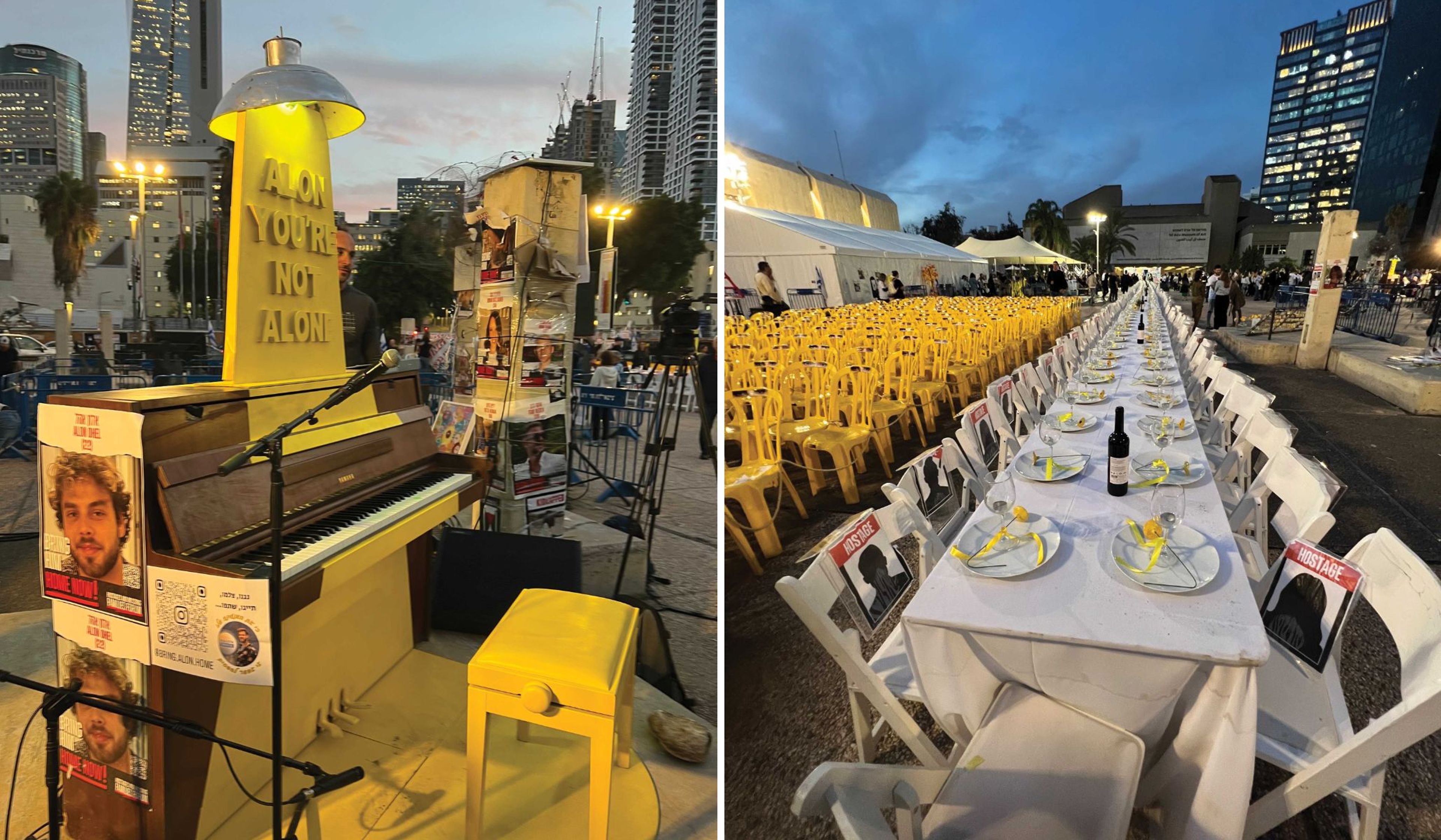
Finally, our cousin Alon Ohel, 22, a promising young pianist, was seized on October 7 at the Nova Festival. “He hid with many others in a roadside shelter,” his mother, Idit Rosen Ohel, told us, “until Hamas began throwing grenades inside.” The terrorists then extracted four survivors — including another American, Hersh Goldberg-Polin, a family friend (Israel is a small country indeed), part of whose arm the grenades had blown off — loaded them onto the back of a Toyota Hilux, and carted them off into Gaza. They haven’t been heard from since.
“Wherever Alon goes,” Idit related, “he’s like a magnet, raising people up.” Before the attack, Alon was beginning to earn acclaim as a musician and had just returned from a lengthy trip to Southeast Asia. “When he moves, he moves with music,” Idit said. After the abduction, his parents placed a piano in the center of the renamed Hostages Square in Tel Aviv, where families have gathered for support and to raise awareness. Every day, different musicians, from well-known Israeli artists to well-meaning amateurs, take turns playing on the piano, on which sits a block-letter sculpture reading alon — you are not alone.
In general, the families of the hostages have found hope in one another, striving to envision a happier future. “My mother has been suffering from a serious illness for 15 years,” Ella Ben-Ami told us. “Whenever you would ask her how she’s doing, she would always answer, ‘Everything’s fine.’ Even if she was in pain or had just come out of surgery, everything was ‘fine.’ I learned optimism from her.” While Raz, Ella’s mother, still cannot bring herself to return to Be’eri, she’s improving day by day. Ella draws strength from Ohad even while he is in captivity. “From my father,” Ella said, “I learned to smile and to always be sure to act sensibly. My dad inspired a sense of self-confidence, and it completely gives me hope.”
Gefen Sigal Ilan also credited her mother, thankfully freed from captivity, for her resilience, even as Fernando and Louis remain in Hamas’s hands. “I think it’s the glass-half-full ideology that my mother raised me with,” Gefen said. “What gives me hope is thinking of the hug that I’ll give them when they return, and the feast we’ll have as a reunited family at last.”
And Idit Rosen Ohel emphasized the importance of asking for help and taking ownership. “We think we don’t have control, but we do,” she said. We may not be able to control our fate or how others treat us, but we can own our thoughts and emotions. “I don’t know when Alon’s going to come home, or how he’s going to come home,” she confided. “But I have control over what family, what house he’s going to come home to, and I can make sure it’s a strong, healthy, positive one.”
The resilience and hopefulness we observed over the past months appears to be reflected in the data, not just the anecdotes. A recent survey conducted by the Israel Democracy Institute found that optimism about Israel’s future rose by more than ten percentage points immediately after the war began, with 80 percent of respondents praising the army’s execution of the campaign. In addition, 83 percent of those surveyed assessed their fellow Israelis’ level of resilience as “quite high” or “very high.” When you’re fighting for your lives, or for your captive relatives, or for your very way of life, you have no choice but to be strong.
“We love death like our enemies love life,” Hamas leader Ismail Haniyeh is fond of proclaiming. While this crystallization of the jihadist philosophy is meant to denigrate the Israeli mind-set, it actually flatters it. As the heroes, the survivors, the returned hostages, and their families have shown the world, we do indeed love life, we affirm it, and we fight for it with every fiber of our being, no matter the cost. It’s the only option.
— Michael M. Rosen is an attorney and writer in Israel and a nonresident senior fellow at the American Enterprise Institute. Danya Rosen studies at an Israeli premilitary academy 15 miles from the Gaza border.











Comments