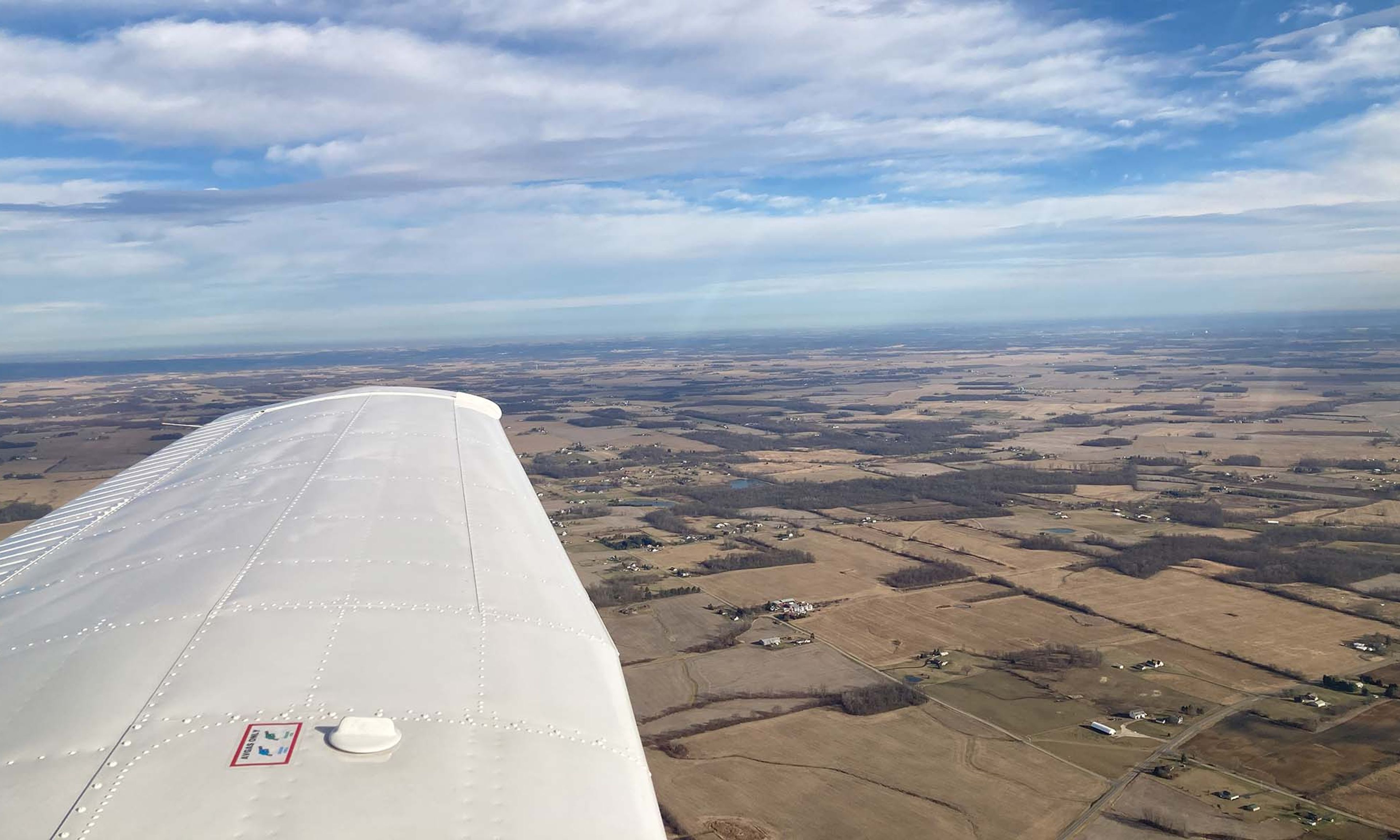
All three wheels hit the runway so hard, my teeth rattled. Determined not to cry, I taxied the Cessna back to the ramp in stony silence punctuated only by a calm, loaded question from my instructor in the right seat: “Why’d you do that?”
What could I say? I’d been trying and failing miserably at short-field landings for weeks, my primary instructor was leaving for the major airlines after this lesson, I was overwhelmed with ground-school material, and my self-confidence was almost nil. One year, hundreds of hours, and thousands of dollars into flight training, was I about to trip before the finish line?
What exactly planted in my head the idea of flying a plane is a mystery. It could’ve been all the plane rides I took between New York City and Ohio when I was living in the Big Apple. It could’ve been getting to know the two Air Force pilots-to-be who joined our Dayton community while studying for their master’s degrees. Or maybe it was just growing up in Dayton, breathing the same air as the Wright Brothers. Whether it was one of these or all three, it was compounded by a strange, sudden need for a challenge, and I signed up for a discovery flight in June 2022.
I had researched the idea of becoming a pilot in only a few cursory Google queries and some general-info calls to my local flight school. Perhaps this was for the best, because if I’d known the extent (and eventual cost) of the endeavor, I might’ve balked. As it was, a mixture of stubbornness and curiosity drove me on, and despite feeling terribly nauseated during that initial flight, I decided to pursue the training in earnest.
There are two main components of flight training: ground school and flight instruction. Ground school consists of, well, everything. Aerodynamics, mechanics, weather, flight-planning, charts, weight and balance, emergency procedures, human factors, electronic systems, regulations, airport schematics — these topics and many others filled my mind, whether I was waking or asleep (yes, I’d dream about them). Flight instruction also follows a curriculum, wherein you learn how to preflight (fun), taxi (a struggle), take off (thrilling), and land (yikes) while also mastering a set list of maneuvers over the practice area. In true Karate Kid fashion, I was baffled for a while about why we’d want to practice stalling out a plane — until I realized it was preparing me to correct for, or just not make, critical errors while taking off or landing. This was just one revelation among many I had, circling high (well, at 3,500 feet MSL) over southwest Ohio.
Ground-school and flight-training milestones are critical, and each one passed gives you a new sense of accomplishment. My first major milestone was the initial solo flight. November 10, 2022, was a gorgeous day, and there’s nothing quite like the feeling of your instructor endorsing your logbook and getting out of the plane so that you can taxi out and shoot up into the sky by your lonesome.
Flight training slowed down after my solo because of bad winter weather, but ground school picked up. The next milestone was my written exam, and I couldn’t make any cross-country solos until I’d passed it. (These “cross-countries” aren’t to be taken literally — I didn’t fly to California, but as an overawed student pilot, I rather felt like I had.) This FAA-regulated written test consists of 60 questions, all multiple choice, on which you have 150 minutes (120 minutes since April 2023) to score 70 percent or higher. In a rare moment of bravado, I told my instructor I planned to get a 93. He simply smiled and said nothing.
With this test scheduled for the beginning of February 2023, I spent January submerged in practice exams. But no matter how hard I studied, I couldn’t crack that 70. I quit all my usual choral activities that month and studied harder. My scores improved, but low 80s still wasn’t going to satisfy me.
If you ever hear a pilot joke that, to get her license, she had to become a doctor, a lawyer, a mechanic, an engineer, and a meteorologist, know that she’s only half kidding. I walked into that testing center full of trepidation and random weather facts. Who knew a thunderstorm has three stages? And that so many types of fog exist? Just under an hour later, I emerged, shaking a bit, and walked to the front desk for my results. The test proctor kindly tried to put me at ease and then glanced at her computer — her eyes widened.
I’d scored a 93.
One of the instructors from my school walked by right in time to see me crumple onto the counter in shock — it was all I could do not to shout with joy.
After this thrilling moment, my flight training progressed steadily and uneventfully. There’s a long, detailed set of requirements that must be met in order to take that exam of all exams: the check ride. These included night flights with my instructor, multiple dual and solo cross-countries, solo landings, at towered airport, and more. Aviation spilled over into my leisure time. I attended local air shows; became a member of EAA (the Experimental Aviation Association), AOPA (Aircraft Owners and Pilots Association), and WAI (Women in Aviation International); and devoured each issue of Flight Training magazine. I listened to aviation podcasts, watched hours of aviation content on YouTube, and dreamed of going to EAA’s AirVenture (an aviator’s mecca in Wisconsin).
And then I hit my training wall.
There are three types of landings you must demonstrate during your check ride: normal, soft-field, and short-field. Normal had taken me a little while, but soft- and short-field were proving impossible. Nothing I did went right, and making matters worse, my home airport has a short, narrow runway sitting in the bend of a river and requires you to come in over a levy to land.
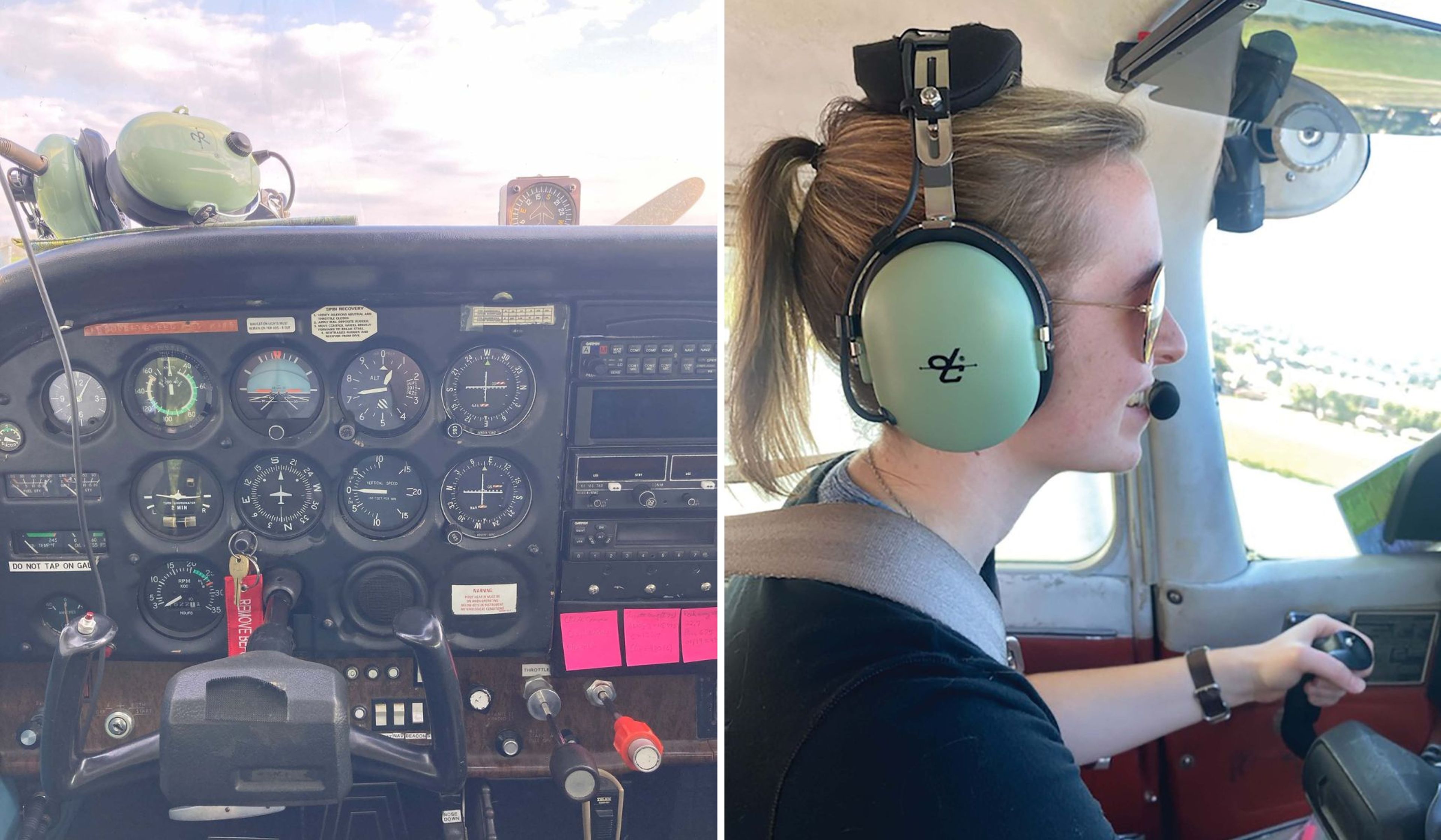
Which brings us back to that horrible landing. It’d been an awful flight all around, and it was all I could do to put on a smile and thank my instructor for all his help — he really had done so much! He was the reason I could fly in the first place. Off he went to the major airlines, and off I went to another teacher (recommended by my old one), hopeful that we could work out a plan.
Work out a plan we did, and by the grace of God, and Bill’s patience, I began nailing my landings — every type. It took 48 laps around the pattern, but by golly, I could do it. My confidence inched up.
Then he tested my ground-school knowledge, because, as nothing is simple in aviation, the check ride has two portions: oral and practical. Though I’d been studying for the first part, Bill found my prep sadly lacking and sent me home with a better study guide. I took notes, answered quiz questions, and verbalized responses until I was blue in the face. And then I went and tabbed sections of the FAR/AIM (Federal Aviation Regulations/Aeronautical Information Manual) and highlighted portions of the PHAK (Pilot’s Handbook of Aeronautical Knowledge) until I was cross-eyed.
Check rides, no matter how prepared you are or how nice the examiner is, are exhausting. The designated pilot-examiner (DPE) follows the Airman Certification Standard (ACS) and grills you on every aspect of flying contained therein. And even though you have your reference materials close at hand, it’s very much a closed-book test. Once you’re good and tired from explaining flight-plan details, restrictions on flight after scuba diving, and your hydraulic braking system, you go fly the plane. But you won’t turn back now, because you’re determined to prove yourself a safe pilot.
Despite a few minor slipups, I passed the oral portion strongly; and even though I blanked for a terrifying moment on how to perform an emergency descent on the flight portion, I eventually worked my way to it and satisfied the DPE.
Now, heading back to the airport, there was only one box left to check: the short-field landing.
I made my approach calls.
Parallel to the runway, I called the downwind leg.
The base and final turns went smoothly.
Then, as I was lined up and on a stable final approach, I saw the other plane.
I’d seen him during my earlier legs, but he’d had plenty of time to move. Or so I thought. Alas, the radio-less Cub puttered along the runway, seemingly oblivious to the Cessna fast approaching his rear. So I did the most sensible thing I could do: I went around.
The second approach was not as lovely, nor was my landing where I wanted it, but it was within standards — cue a massive sigh of relief. Moments later, I’d taxied off the runway and parked the plane, and the DPE shook my hand, a knowing smile on his face.
Four hundred eighty-seven days, no blood, a lot of sweat, and not too many tears later, I’d done it. All the late-night studying, freezing-cold preflights, frustrating mechanical issues, and irritating schedule conflicts had not beaten me. I still don’t know why God opened this door. If He wanted me to gain confidence, it was an expensive — albeit effective — manner of achieving it. Maybe I won’t know for many years, but I do know I’ve discovered an incredible world in aviation. Yes, it has plenty of dangers, but what activity doesn’t?
So if you’ll excuse me, I must go. I’m off to the airfield where, God willing, I’ll find a trusty Cessna 172 or a zippy Piper Pilot. Exactly what I need to turn some liquid fuel into noise, up there in the wild blue yonder.











Comments