In the early light we heard three sounds. First was hammering, hard and regular. Raising a barn? Shutting a coffin? Releasing the Balrog? Seven or eight knocks, then a pause, then it resumed. Next came a high steady whine. No fantasies possible about this; unquestionably it was a power sander. Listening fingertips contracted automatically in a gesture of safety. Last was a rapid, baritone pounding, slower than a drumroll, faster than a dribble — the song of a big drill, of the kind you usually hear chewing up a street, but what was it doing in midair?
These were the sounds of façade work. Our apartment building occupies almost the entire end of a city block. It is 19 stories tall (nominally 20, but there is no 13th floor). The vogue in the Kennedy administration when it went up was for white brick. Dull once, it has now acquired the patina of age, like the Beetle cars that were ubiquitous. Plain or retro-hip, it wears a lot of bricks. The city has elaborate regulations governing their maintenance.
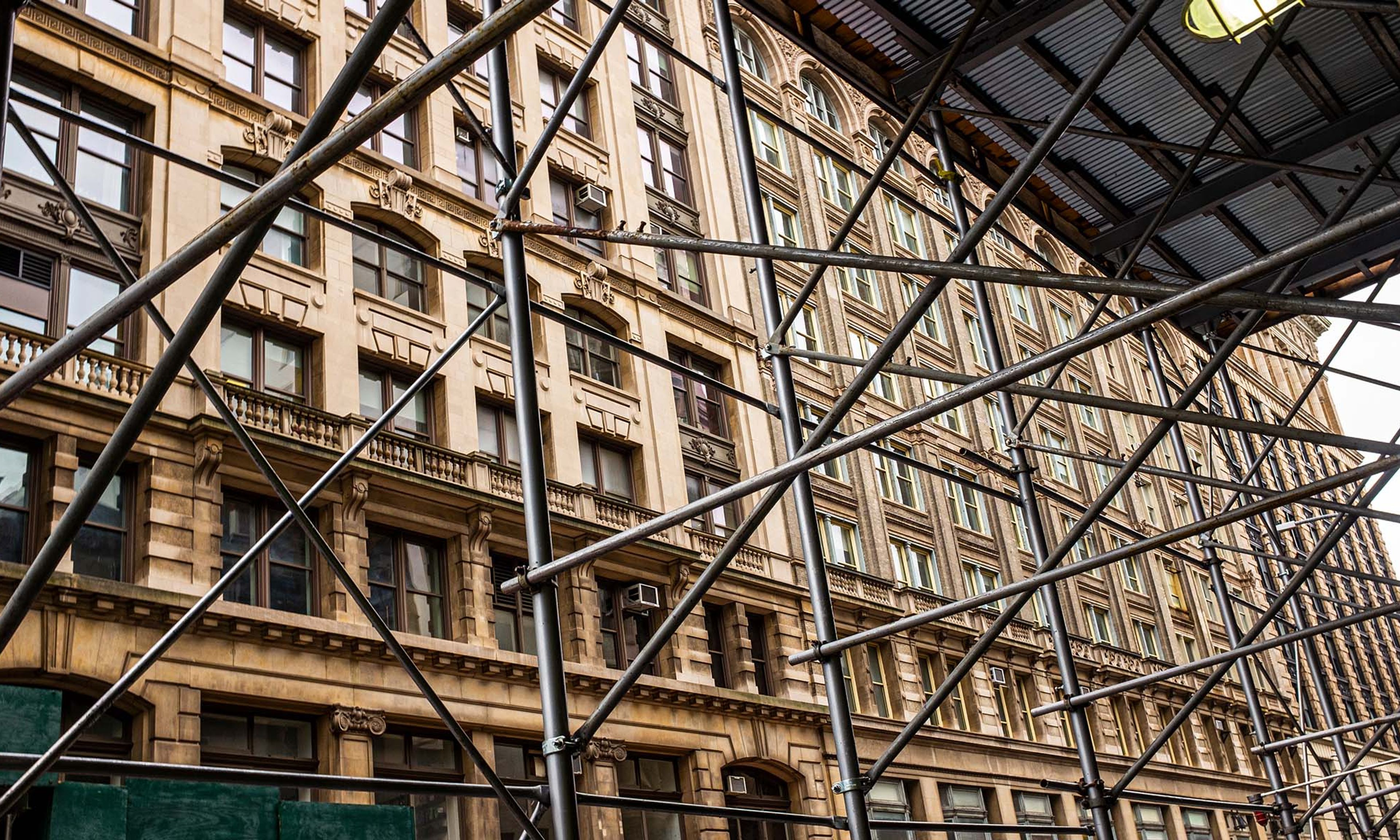
For months we have been girdled at ground level by scaffolding — a web of metal posts supporting a blue-walled deck one story up. In the rain it sheltered pedestrians. In the night it watched over sleeping bums. Deliverymen chained their bicycles, topped by handlebar mitts, to the crosspieces, when they were not roaring up and down the avenue. Nothing else seemed to be happening, though. If it was someone’s idea of new millennium architecture, it was a bad one. Or was it a landlord’s scheme to keep it up forever and so avoid liability for falling detritus?
Then, only a few weeks ago, there began to be activity. In the daytime a stepladder appeared, rising from the street, giving access to the scaffold’s deck (at night, it was taken down and slung horizontally, just above head level). When you walked outside and looked up, a suspended platform might show, here or there, clinging to the building’s flank. Work had begun.
I noticed cables hanging outside the window by the dinner table. Then, that morning, the loud one, there was a man out there. Better him than me. The temperature was below freezing, one of the coldest days of the winter so far. The wind a hundred-plus feet up must have been delightful. How long would he be there?
The racket he made was deafening. My wife, as she informed me, not that I didn’t already know, sees patients in the apartment; how could she with that going on? The doorman could not say when the noise might stop. The work is done by contractors, not by the building itself. I’m a journalist, do an interview.
I rapped on the window. The man in the cold looked my way. “How long?” I shouted. Feenish? he said. I slapped my watch. Foro cluck. I told my wife. She wanted confirmation. Every working man, I said, knows when he is to stop.
In 1979 a young woman, a college student, was killed by falling terra-cotta. In response Local Law 10 was enacted, mandating inspections every five years of the façades of buildings taller than six stories. In 1997 four separate showers of debris, all in one month — bricks, stone, concrete, and an entire façade — prompted Local Law 11, requiring that inspections be hands-on. (Law 10 had allowed inspections to be done via binoculars from the street.) An official website shows how safe the city’s 16,000 six-story-or-higher buildings are. If I am reading the bar graph correctly, it looks like about 9,000 are safe, or safe enough for the next five years. That leaves about 7,000 that are unsafe, that have filed no reports, or (my favorite category) that were deemed safe enough for the next five years, but that was longer than five years ago. Stay alert, I guess.
One point, unrelated to façades: the increasing size of Latin America. The man on the suspended platform was Hispanic, the super and most of the doormen are Hispanic. I recently saw that, by some measures, the United States has the second-largest population of Spanish-speakers in the world, behind only Mexico. Now most of them are not monoglots, so we still lead the world in English-speakers (more than in India, and more than twice as many as in Nigeria). But the prudent man takes note. Lincoln, Jefferson, Huck and Jim: translators out there?












Comments