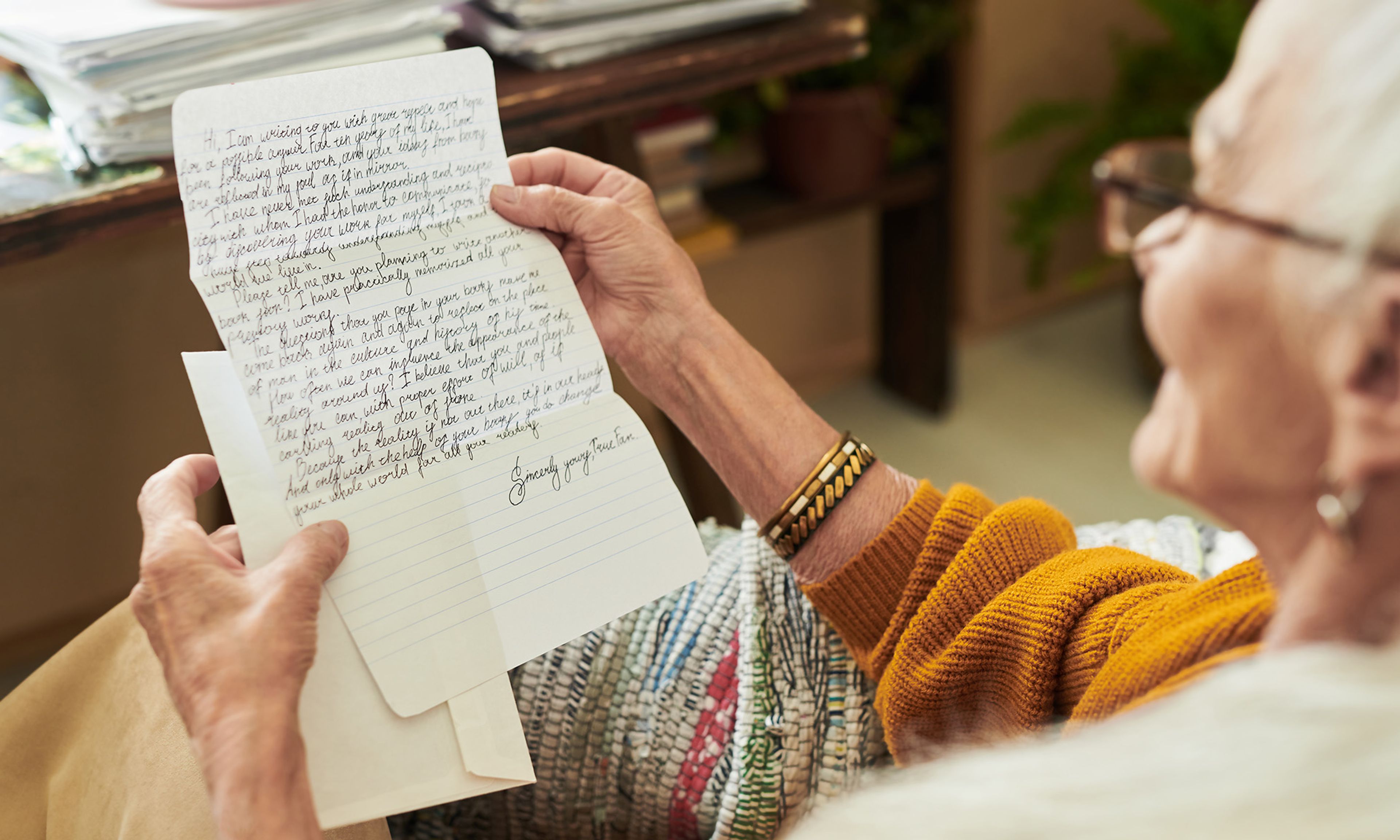
Historians have a problem. Many old documents are written in an archaic hand the practice of which has fallen out of use, and they are appealing for help deciphering its peculiar symbols. It’s called . . . cursive.
“Reading cursive is a superpower,” said Suzanne Isaacs, a community manager with the National Archives Catalog in Washington, D.C.
Perhaps, but it’s a rather underwhelming one. You can’t imagine Cursiveman standing on a rooftop arms akimbo, cape fluttering, ready to fly off and transcribe something in an elegant fashion. It’s about as much of a superpower as knowing how to set a table.
Is cursive really dead? No. Almost half the states have mandated its instruction, something that makes some Boomers say, “Good! There’s nothing like hours of pointless, hand-cramping penmanship practice to instill discipline and respect for tradition.” You wonder how a generation used to thumbing out “y u go fr fam” will cope with actually spelling out entire words, on something as bizarre as paper, with a stick that makes marks. Can’t AI do that? Can’t AI read the old documents?
Not very well, it turns out. And that’s odd. There’s something about cursive that makes AI confused and unhappy. Mind you, AI has been peering through the carbonized remains of scrolls incinerated by the Vesuvius eruption that buried Pompeii, and it can make out some words. (Just a few. Like “oww” and “hot” and “RUN.”) But you feed AI a letter from a housewife in 1952 and it starts to smoke, as if Captain Kirk had forced it into an illogical corner.
I was taught cursive in grade school, and no one questioned why. It was the writing equivalent of creased pants and an ironed shirt — a better form, a smarter look. It was simply what proper people did. The simpletons who struggled to write “CAT” without sticking out their tongue would be doomed to a life of block letters, although at least they could look down on the people who signed their name with an X.
With painstaking precision we crafted our letters, driving out all individual quirks to produce the exact replica of the perfect forms in the book. We’d get pretty good at it, too. Until we came across the most dreaded cursive capital of them all . . . Q.
It didn’t even look like a Q. It looked like a 2. Maybe Q didn’t show up for work one day and they stuck 2 in the job, and he just hung around because Q never came back. Z was weird, but what were the chances of starting a sentence with that capital letter? Zero. Whereas Q was obviously important, because we spent forever mastering it. Oh for the day when we’d show off our mastery! First job interview, the guy pushes a piece of paper across the table, hands you a pencil, and says, “Write ‘QUITE A QUEER QUORUM OF QUALITY QUOITS,’ QUOTH QUENTIN,” and you smile: My whole life has been leading up to this.
“Quoits,” by the way, was always the word used as an example of Q. I’m sure they have something different today, but the American educational system had been deeply penetrated by a pro-quoit lobby, and they were intent on making schoolchildren know about it. It’s a ring toss game. Wikipedia has an odd note that reminds me of the deficiencies of my classical know-how: “Quoits is supposedly the game the ancient Greek deity Apollo was playing with his lover Hyacinth which ultimately resulted in his death.”
Earliest known lawn-dart fatality, basically. Anyway, I do not recall using cursive at any point after it was no longer required. We were free spirits and would not be held back by this archaic means of communication. I’d argue that this was not a bad thing. Many idiosyncratic, individualistic handwriting styles arose, making a letter from a friend distinctive and delightful.
I remember looking at a letter my wife was reading, many years ago, and for a moment wondering why my mother was writing to her. The handwriting, absolutely identical to my mother’s, was my mother-in-law’s: perfect cursive, and hence interchangeable with letters from millions of other moms to their kids. The uniqueness of an entire generation had been subsumed by the Cursive Imperative.
To be honest, I’m less concerned by how they write what they are learning than what they are learning in the first place. Kids today, you ask them what killed Hyacinth, and they spell “kwoit.” Hopeless.










Comments