Appleton, Wis.
The world falls in love with curling every four years. A handful of American dudes, who often look like they’ve just been turned out of the Wooden Nickel on College Avenue, compete against teams of similarly constructed men to decide which country will earn a gold medal for accurately launching rocks and massaging them into position with brooms. Men on couches everywhere appreciate that their body type is represented on the screen, and the women beside them swoon at the spectacle of men voluntarily sweeping and communicating. Then the ceremonies conclude, the mustached faces disappear from our minds, and life returns to normal. But curling continues, existing every winter between the Olympics in aluminum-sided buildings. And not only does it exist, it’s thriving, with clubs popping up where men and women play every weeknight.
The sport began, as many do, to settle some beef between bored men. In the 16th century, it was recorded in Latin by a clerk that a monk and an abbot’s representative took to throwing stones on a frozen lake to settle a challenge. Several years later, the Flemish artist Pieter Bruegel the Elder depicted men playing a game thought to be curling in his Winter Landscape with a Bird Trap. But the move to organization and export waited until the 19th century, when the Grand Caledonian Curling Club was formed in Edinburgh. A visit from Queen Victoria, who was enchanted by the game, allowed the club to replace “Grand” with “Royal.” With Scottish travel to English holdings the world over, the colder climates of North America were ripe for a winter pastime that took advantage of resources they had in abundance: time, ice, and boulders.
An appreciator of words, I’d had curling on my mind for some time as a sport with a lexicon that is entirely foreign to the average American, whose sports references are dominated by basketball, football, and baseball. Slam dunk, any given Sunday, eye on the ball — who doesn’t know these expressions? But curling, with its Canadian and Scottish influences, comes with mouthfuls of Maple-Gaelic exoticism.
To learn more about this peculiar sport, its practitioners, and its patois, I made several trips to the Appleton Curling Club. I hoped to return with at least one expression that might be used to exhaustion in future projects.
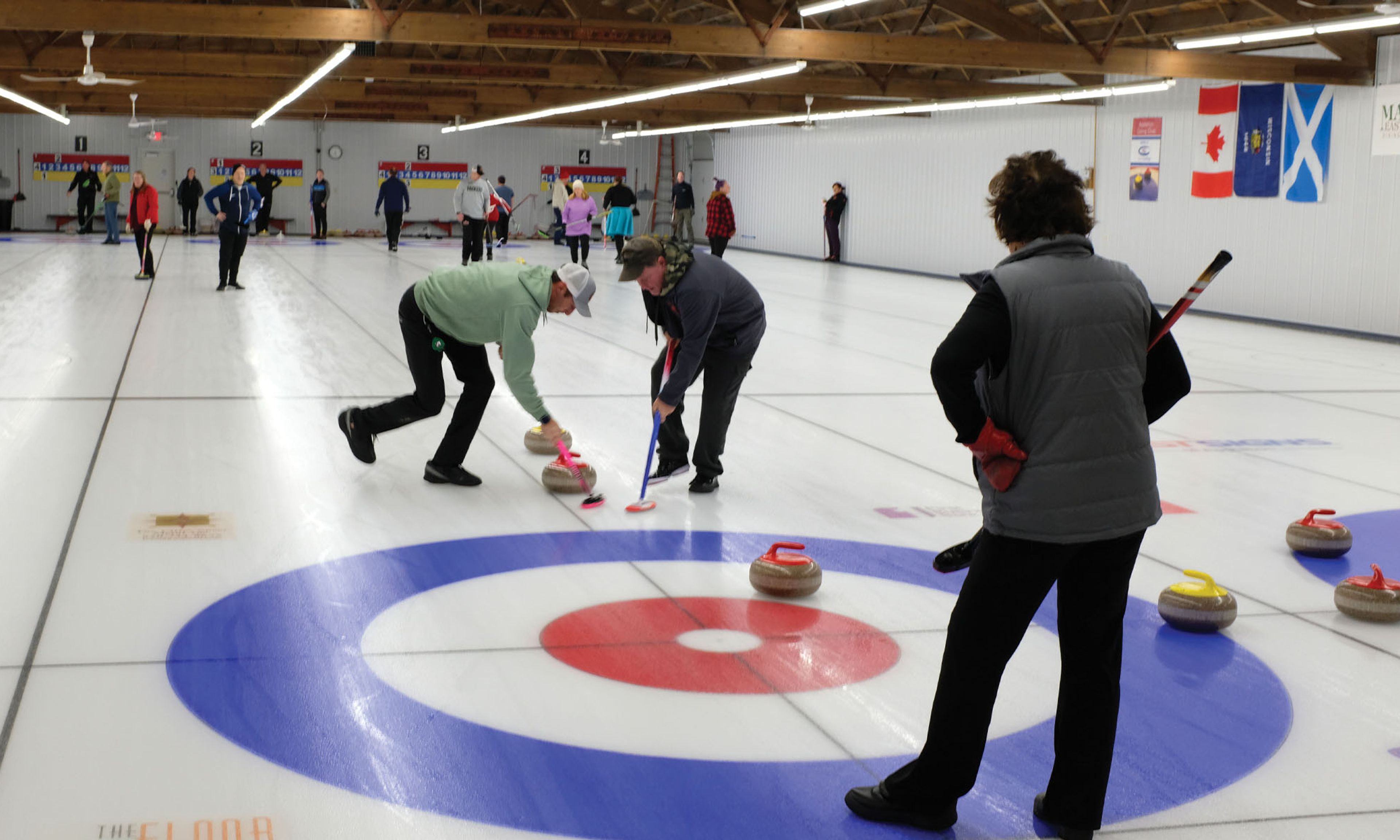
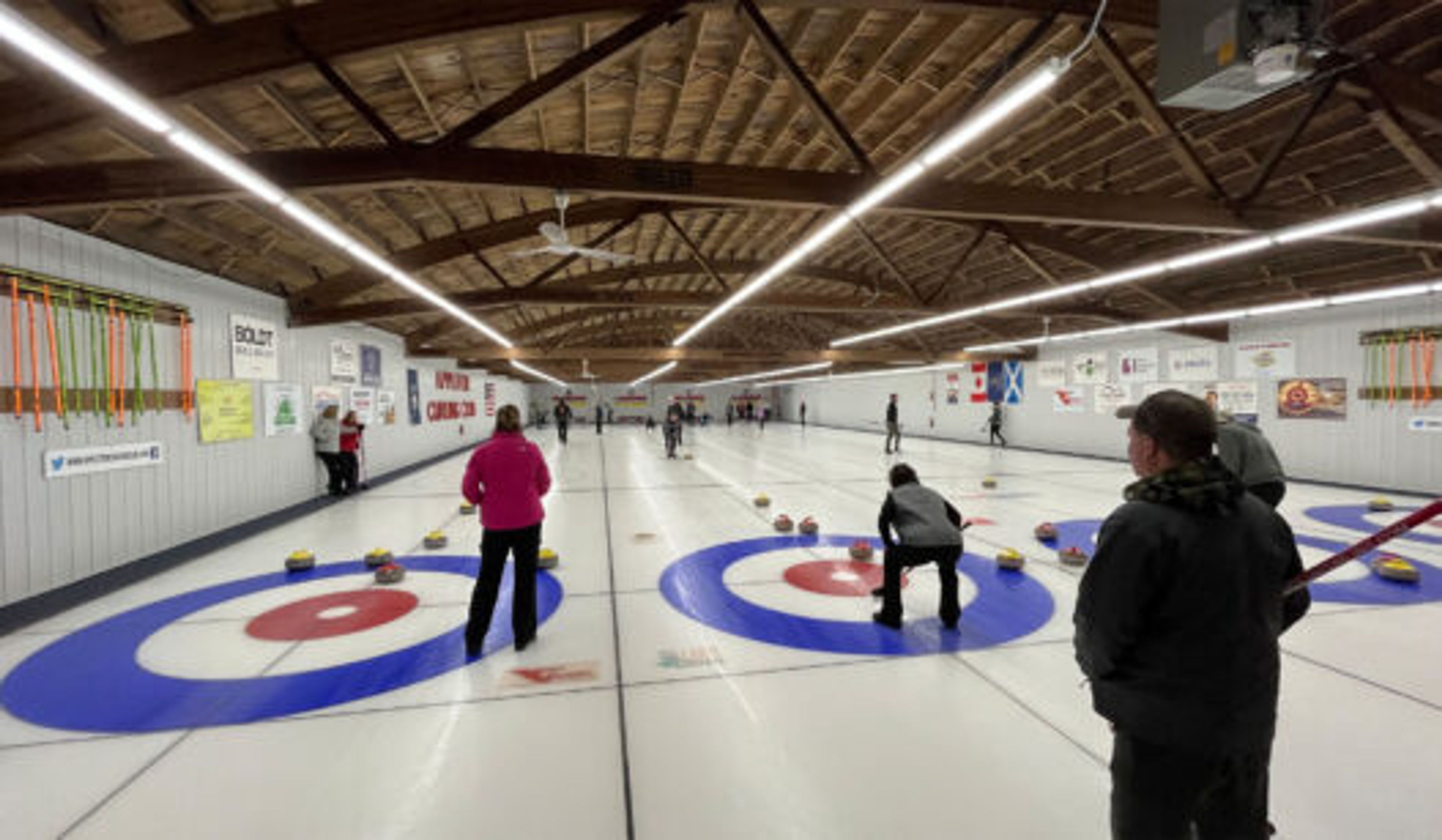
The club is a humble building flanked by a La Quinta, a theater, and a burger joint. But the self-effacing exterior belies the tranquil splendor of its interior. When one is seated in the gallery on the club’s second level, which looks out over the ice field, the curling sheets (lanes) look like a firing range made for giants that was then installed horizontally. The house (the target) is composed of a twelve-foot blue circle, and within that an eight-foot white circle containing a four-foot red serving of pi, and within that, like the innermost figure in a nesting doll, the coveted foot-wide button (center circle), which decides which team scores. These bull’s-eyes, arrayed 125 feet apart and painted before the season begins, live under three-quarters of an inch of ice like arctic fossils from Flatland. Behind and above them are the hacks, from which the curlers launch, releasing the 42-pound stones wrought from granite harvested from the Scottish coast (the point of origin for this game). The stones are impossibly sturdy, dare I say Atlantean, with a rigid columnar insert suited for gliding down the pebbled ice (perfectly smooth ice would create suction), while the outer granite is ideal for absorbing blows that would grenade most any other granite.
Above the house is the hog line, the point at which one must make the delivery (release the stone). While doing so, a curler (let’s say he’s right-handed, for simplicity’s sake) makes an in-turn (spins the stone clockwise) or out-turn (spins it counterclockwise). To release the stone without any spin — a straight handle — practically guarantees that the stone will decide, in a thundering conspiracy between it and the pebbled surface, to begin spinning in the opposite direction you intend. The out- or in-turns are lightly applied, rotating the stone no more than 45 degrees on release. Small inputs produce significant effects when allowed 30 seconds and 40 yards to play out.
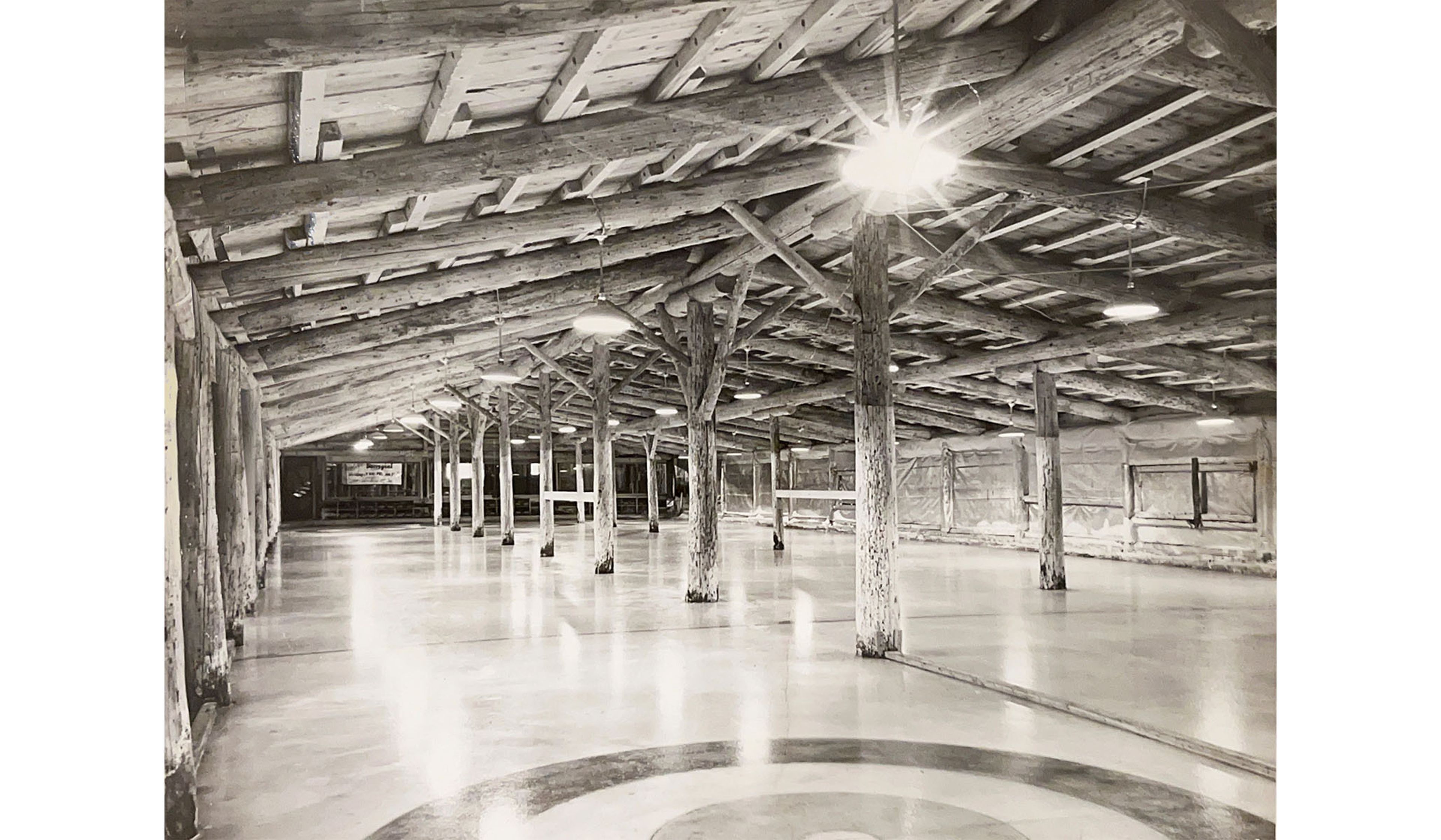
The Appleton Curling Club, founded in 1939 (current building, 1959), has four sheets, more than most. When matches aren’t going, the illumined ice house holds much the same languorous expectation as an Olympic swimming pool . . . or the Overlook Hotel’s ballroom. It is, for anyone with Moe, Larry, and Curly coordination, a hazardous expanse, 60 feet across and 150 feet long. It is a world of its own, with the space-time helices of the analog clock on the far end the only thing confirming that time has not come to rest. The ice, composed of deionized water (harder than mineralized when frozen) that’s cooled by a Baldor-motor-powered pump system, is immaculate. The ice’s pebbling wears throughout each match; this, along with condensation, makes for a suboptimal playing surface. So before matches, a one-ton electric razor scrapes the ice down to a plane. From there, water is splattered on the fresh ice to create the pebbling, from which the nipper then snips the tallest peaks. The “ice maker” is a position of prestige in any curling club, for he is the alchemist who produces the perfect ice throughout the season and ensures that it stays that way. He then deputizes trusted members to do the pebbling and nipping.
The 250 current members come from all walks of life. White and blue collars pass through the door, as do those with no collar at all who scrape together the dues to play. It is, as Denny, a longtime club member, explains to me, a place where, when someone enters, all one is or should be is a curler. Well over a dozen such clubs exist in eastern Wisconsin, with Appleton and Green Bay finding ready competition in Clintonville, Stevens Point, and Waupaca. Columbia County, so close to the progressive Madison nucleus that even its ice has a blue tint, boasts five clubs and has a reputation for hyper-competitiveness.
It’s the people that make the curling club what it is. There are no PGA pros, salaried greenskeepers, or desk clerks here. Everything, from the ice production and maintenance to the meals and bathroom cleaning, is done by members. Denny has been with the club for 30 years. Reflecting on what it means to him, he shared how, when he was a young man and newer member, his wife had their twins and was then diagnosed with cancer. The curling club delivered meals three times a week for nine months, keeping the young family fed while they juggled that terrible disease and raised their babies. She recovered, and all are well and actively curling. Since then, Denny has gone on to help install miles of new piping throughout the facility, tend to the ice, and participate in dozens of tournaments and events. He’s competed with, and beaten, Olympians.
I wondered aloud whether there is any other sport where the weekend warrior can face off against world-class players on equal footing (i.e., not as a promotion or out of pity). Denny didn’t have to think about it more than 0.42 seconds: “No, no other sport.” The organic, club-based nature of curling means that professional play remains at the community level rather than in an insular, detached league. With high schoolers and college kids also using the clubs, all competitions remain within reach for all players, and even a middling curler can occasionally get the better of a pro in a given end (inning; typically eight to a game), and sometimes even steal an entire game. Furthermore, it’s a gentleman’s game. How many men and women are tempted to play and act nasty to make it one more rung up another sport’s ladder? The doping, cheating, and sponsorship scandals that plague many sports have minimal purchase in one where the privilege to play at reciprocal and finite venues and events depends on one’s good standing.
The lack of oversight or a governing authority appeared to have its first test in 2015 (almost 500 years after the sport’s inception), when a sport-wide controversy arose: The brooms (brushes) got too good. Traditionally corn husk or hog hair, they began to be made from space-age materials that would melt the ice and keep it melted well past a single delivery. Furthermore, teams figured out that one sweeper was better than two, but there had always been two sweepers sweeping. What to do? Well, the curlers came together — call it the Council of Icea — to hash out the rules. No commissioner. No owners. No Barstool (though barstools were used). Just men and women — curlers — who cared deeply about maintaining parity across the sport. There in Kemptville, Ontario (pop.: 4,051), they debated materials and techniques and settled things to the satisfaction of a supermajority. Curling, a triad of two quasi-socialist states and the U.S. of A., produced an event that’s the closest any sport has ever come to the Constitutional Convention of 1787. Elbridge Gerry would doubtless have made a fine skip (captain).
[aniview video=”1774533″ /]
Play is simple enough. A team has a skip, a vice, a second, and a lead, each with an assigned cupholder next to the sheet. The lead is usually the most inexperienced member because his slack can be picked up later by the others. That said, if a rink (team) wishes to play offensively, the lead needs to situate, with finesse, the guard (first stone) in position above the house. This placement forces the opposing team to go around him until the fifth stone, at which point the opposing team may attempt a takeout, knocking that blocking stone from play and opening the middle for attack by the hammer (the final stone). Teams track the speed of the ice sheet by timing the stones to the hog line. Denny explained that the ice is slower at first, speeds up toward the middle of play, and then marginally slows near the end. All of this must be accounted for in one’s hip flexors, extensors, and glutes when launching and releasing.
Attempting to throw a stone myself was hilariously fun. You wear clean sneakers and place a slider (plastic oversole) on your nondominant foot. Putting one’s strong foot in the hack, you take a sprinter’s pose, with the stone in your dominant hand rotated 45 degrees. The other hand grips a plastic stabilizer that will slide with you. As you push out of the hack, the stabilizer and stone immediately threaten divorce, demanding to part ways — the stabilizer weighs a pound and the stone 42 times more. You are now a one-legged danseur pulled by Babe the Blue Ox; your launch leg drags behind you in a dramatic tendu derrière. You’re then reminded to release the stone and, while doing so, to keep your weight off it — the one solid thing holding your face from frenching Jack Frost. You do as you’re told and off the stone goes, nearly in the intended direction. The euphoria of survival and high-level mediocrity wash over you just in time for a brush to be placed in your hand, and you learn that chasing a stone with Reeboks while trying to heat the ice disappearing beneath the stone’s prow is no simple task. In the interstitial moments not consumed with the upkeep of your shambling slide and gulps of 25-degree air, you reminisce about how easy throwing stones was after all.
Once arrived on the other end of the sheet, you get together with your team for thinking time (conferencing). It’s here that your skip will indicate to your teammates and you what he wants. Tony, a high school curling coach, explained that beginners need focus only on a smooth delivery. That builds confidence. He’d wanted to get into curling for a few years before becoming a member, pushing past an initial impression that you had to know a guy to get in. Part of his school outreach is an effort to make sure that everyone who wants to curl has an in.
Should you succeed in an end, that’s called a draw. Should you break even, that’s a blank end. Should you fail often enough, that’s an ignominious trip to the club bar to dissect what happened. From the Appleton club’s barroom, you can look out the ice-level windows at the sliders and Reeboks of the other curlers. It’s from misery perched atop these rounded bar chairs that championships are watered and friendships strengthened.
On the first weekend of the new year, the Appleton Curling Club hosted its 80th annual men’s bonspiel (tournament). With curling’s emphasis on good manners and generosity, a team pays to register, and then all food and drinks (including alcohol) are covered for the weekend. At $80/man, it’s a deal like none other. Burke’s little platoons are alive and well in the Midwest. It’s just that around here they call them rinks.











Comments