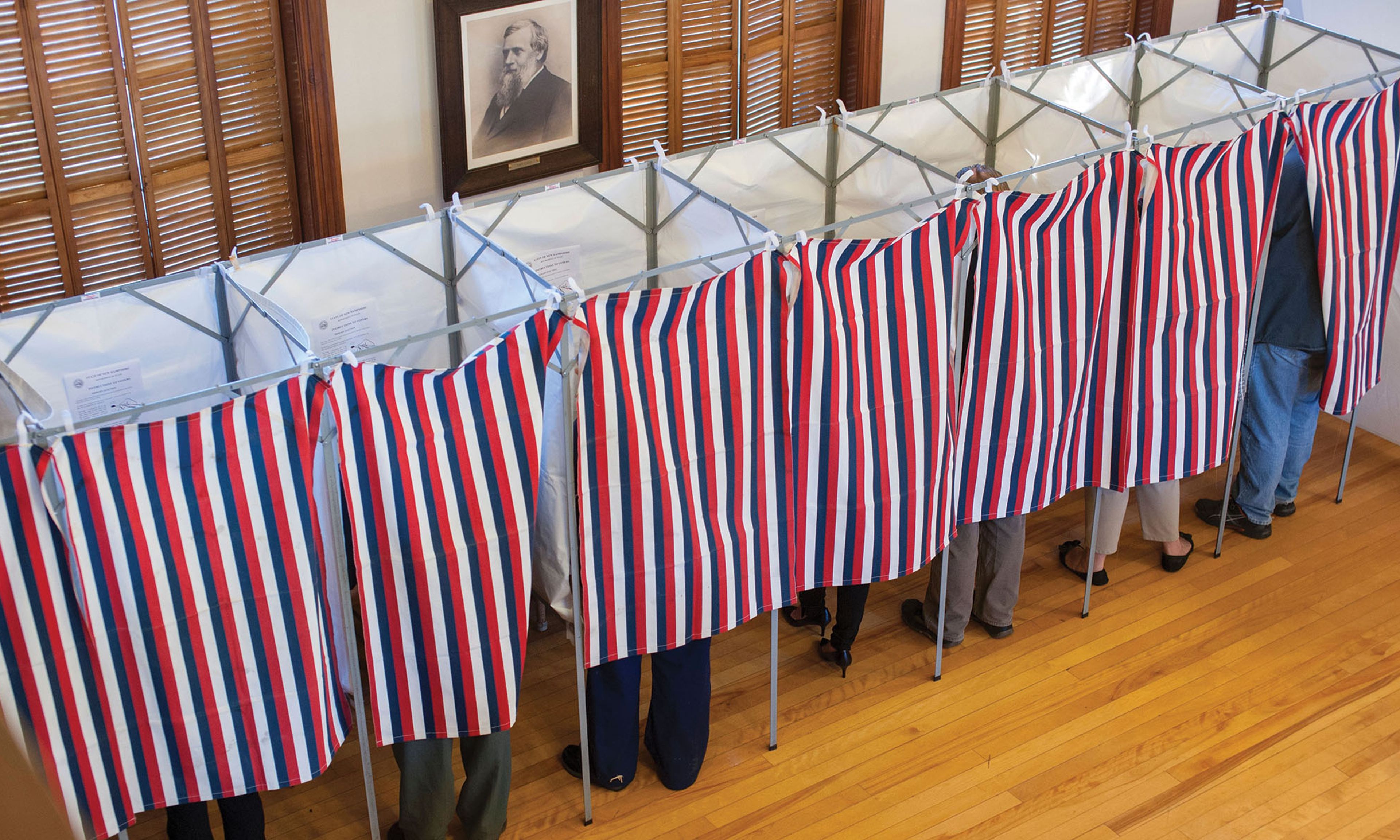
Americans like to brag about our democracy, but these days, nobody is happy with how American elections work. That is ironic, because voting is easier, fairer, and more secure than at almost any time in our history. Still, we should not be complacent. Two decades of losing candidates’ attacking the legitimacy of elections have taken their toll. Gallup and Morning Consult polls show that around 40 percent of Americans no longer have confidence in the fairness of our elections, an all-time high. After the 2016 election, YouGov polls found that as many as two-thirds of Democrats believed that Russian hackers had actually changed the vote totals. A recent R Street poll shows that only 23 percent of GOP voters believe that we had a free and fair election in 2020.
The Capitol riot ought to be a wake-up call. So should the fact that many urban downtowns were bracing for riots in the event of a Trump victory. Bad actors at home and abroad sow mistrust in our system, and they are succeeding. These threats are not just to public perception; in very close elections, it is crucial that each vote be counted fairly, equally, and without dilution by fraud. To that end, Republicans should aim to shore up faith in the system — and seek reasonable Democrats to join them.
Not so long ago, even after the 2000 recount, bipartisan common ground was possible. The 2005 Commission on Federal Election Reform, co-chaired by Jimmy Carter and James Baker, recommended voter identification, and a 6–3 Supreme Court ruling upheld it in an opinion by liberal justice John Paul Stevens. Both the Clinton-era “motor voter” law and the 2002 Help America Vote Act required states to periodically purge inactive registrations from their voter lists. HAVA also curbed a notorious abuse — state judges’ ordering that polling places stay open late in selected precincts — by limiting any late-arriving voters to provisional ballots. HAVA passed the Senate 92–2, and was backed by all but eleven House Democrats, including the current leadership.
Those days are gone. To stoke the fears of their voting base, today’s Democrats persistently cast advocacy of accurate voter lists and identification as racist voter suppression. “Voter suppression” conjures images of Bull Connor turning fire hoses on black Americans registering to vote. Iowa Republicans passed a bill allowing 20 days of early voting; because the state previously allowed 29 days, Democrats branded the move as “voter suppression.” Literally anything that imposes any sort of rule or safeguard, or that requires even the tiniest bit of effort to register and vote, earns the same label. This narrative is impervious to the reality of massive turnout in 2018 and 2020, an enormous multi-year rise in black turnout, and studies showing that most election-security measures have little effect on turnout.
Meanwhile, Republicans obsess about voter fraud, without evidence that large-scale frauds still happen. A handful of American elections have been thrown out because of fraud in recent decades — more often in primary than in general elections — but all of them had been decided by fewer than a thousand votes. The introduction of computer analysis with the FBI investigation of the 1982 Illinois governor’s race (in which some 100,000 fraudulent votes were cast for Democrats in Chicago, resulting in 63 convictions) has made it vastly harder to commit large-scale voter fraud without being detected.
We can have better voting systems without suppressing votes or descending into paranoia. Many practical ideas are on offer. The best of these have already been adopted by states such as Florida and Texas, which made it through 2020 with minimal controversy and resolved nearly all of their contests by midnight on Election Night. Three areas can be reformed. We should (1) maintain accurate voter rolls; (2) make in-person voting the gold standard; and (3) ensure speed and transparency in counting the votes.
Democrats and progressives, for their part, have a few legitimate grievances, and Republicans should be willing to address them. We should (1) allow pre-canvassing of absentee ballots; (2) expand polling places, especially in African-American neighborhoods, to reduce waiting times; and (3) spend more money on elections administration.
Finally, two areas call for less dramatic changes: We should maintain security from hackers and limit reliance on early voting.
Maintain accurate voter rolls. There are two possible ways to run a voting system. One is the honor system: Everybody who wants to vote can do so as often as they want, whether or not they are eligible. The other, however, is the long-standing system in most democracies: Register people who are eligible to vote in a particular place, and limit voters to one vote in the place where they register.
A current, accurate list of registered, eligible voters is the foundation of a one-man, one-vote system. Adding names as people register is only the start. States also need to determine which registrations belong to living, eligible voters, and then they need to keep the lists up to date. As anyone who has tried to maintain a mailing list can attest, this is a constant struggle. People move, and people die. Even the left-wing Brennan Center for Justice admits on its website, “Voter list maintenance ensures accurate rolls and efficient election administration.”
Best practices require three steps. First, verify a voter’s identity and eligibility when he first registers. Online registration should be limited to voters who already have a driver’s license or other strong form of state identity, so that they are pre-verified in the system. Democratic proposals for automatic registration would undermine the reliability of lists, both by removing the voter’s self-verification from the process and by raising the number of voters who don’t even know they are registered in multiple jurisdictions. Getting voters into the habit of civic engagement by having them register themselves is good citizenship as well as good security.
Second, states must continuously update their voter lists. Democrats cast this process as “purges” of “voters,” but it is really about eliminating the names of former voters who have either died or moved away. Congress should let states remove former voters more quickly; states should use more-pinpointed methods to identify them. States could upgrade in two ways: more-regular interstate communication to identify voters who move, die, or are convicted of felonies; and the use of commercial databases that often have better information than the Postal Service’s National Change of Address system. Services that track people for marketing, credit scoring, or debt collection are often a step ahead of the government. They can help cull the lists without crossing off the names of active voters.
Third, names must be checked against the rolls when people vote. In-person voters can present identification, as is the law in many states. Democrats bitterly resist voter ID, but it is a modest proposal that’s extremely popular across party lines, and lawsuits to stop it have persistently failed to present evidence that voters were unable to have their votes counted. The best states offer free IDs to people without driver’s licenses.
Identification works only if the precincts have accurate voter lists. These takes time to finalize. Late or same-day registration of voters thwarts processes such as checking registrations in other states. States with the best voting protocol require all registrations to be received a month or so ahead of the start of voting. Extended early voting complicates this: Why should a person still be eligible to register in one state after he may already have voted in another? Again, even the Brennan Center advises states to “conduct voter list maintenance programs well before an election,” but that is impossible if the list remains a moving target.
Make in-person voting the gold standard. So long as there are accurate lists and voters present valid identification, in-person voting is secure. It was once a commonplace among liberals that voter ID distracted from the real security problem: absentee ballots. The New York Times published a long article in 2012, quoting various “elections experts,” on this theme. But even before the dramatic rise in mail-in ballots in 2020 amid the COVID-19 lockdowns, Democrats abruptly changed their tune. Marc Elias (the Democratic Party’s chief elections lawyer) launched scores of lawsuits, in swing states and elsewhere, to promote “four pillars” of easier mail-in voting: free postage, counting late-arriving ballots, watering down signature requirements, and ballot harvesting. This is precisely the wrong direction if the goal is shoring up election integrity and trust in our electoral process.
There are multiple advantages to in-person voting. Not only does the voter typically present a photo identification that can be compared to the voter’s appearance, but the law prevents electioneering around the polling place, and the secrecy of the voting booth is sacrosanct. None of this is true of absentee voting.
There are two ways to level the playing field. One is to restore pre-lockdown limits to absentee voting, so that mail-in balloting does not become the norm and voters can return to presenting ID and casting secret ballots far from electioneers. This would include requiring voters to have a reason for voting absentee each election and ending the emergency pandemic practice of mass-mailing ballots to people who do not request one.
We should also improve how vote-by-mail works. For example, ballots are currently verified by checking the signatures on the envelope containing the ballot. But signature comparisons can be a subjective exercise that generates controversy. One improvement would be to require voters to also write on the envelope their driver’s license number (if they have one) — information usually accessible to the license holder but few others. Some states are also considering requiring the signature to be notarized. Notarization would be unduly burdensome to require for every mailed ballot, but it could be considered as either an alternative to a license number or as conclusive proof of the signature. Polls show that requiring more-rigorous identification for absentee balloting is hugely popular; one Atlanta Journal-Constitution poll found 74 percent support, including majorities in every demographic group.
Ballot harvesting should be restricted. This is the process by which some states let a third party — even a paid party activist — observe a voter filling out his ballot and then let that third party deliver it, out of the voter’s hands, to the polling place. It is a far cry from the secrecy of the voting booth. Limiting ballot harvesters to a voter’s immediate family would be a positive step, if one that still provides less secrecy than voting in person. Some states allow full-time caregivers to handle ballots, although this can be a source of error and fraud when the staffs of nursing homes and other facilities are handling the ballots of large numbers of residents.
Ballot drop boxes have been a target for some Republican reformers who want to limit or abolish them, out of worry that the boxes are not tamper-proof. The better proposal than banning them is to keep drop boxes under closer supervision whenever they are open to receive ballots and also when they are being transported. The convenience of drop boxes, however, is an asset; they strengthen the case for enforcing hard deadlines for the return of absentee ballots. Voters who fear that the Post Office will not deliver their vote on time can always use a drop box instead.
Ensure speed and transparency in counting the votes. Getting only registered voters to cast ballots is only half the battle. The election of 2020 shone a light on how votes are counted, and some states blinked. California and New York took weeks to count millions of votes, an inexcusable display of incompetence. Democrats have a legitimate complaint about the counting of absentee ballots: Republican legislatures, mainly in the Midwest, blocked efforts to process absentee ballots before Election Day, thereby guaranteeing that those votes would not be counted until late on Election Night. That created the “red mirage” that allowed Donald Trump to take an early lead and then claim that exclusively or heavily pro-Biden “vote dumps” were suspicious, when in fact they were the result of Republican choices and Biden supporters were always expected to be more likely to vote by mail.
Allow pre-canvassing of absentee ballots. This is already in place in multiple Republican-run states. As ballots arrive, workers verify the voter’s identity and tally up how many ballots await counting, so that all that remains on Election Day is to count the actual votes. Pre-canvassing does not mean counting mailed-in votes before Election Day, as this presents its own problems if word of early-arriving vote tallies leaks out. Every voter should vote in equal ignorance of how the vote is actually going. There’s a similar problem with allowing votes to arrive after Election Day, when voters already know the results. In addition, if votes continue landing after Election Day, the state does not know how many are outstanding.
One reform proposed in Florida to limit surprise late-night vote dumps from the bluest precincts is to require all precincts to report in real time how many votes are outstanding. However, some states with notoriously dysfunctional large cities may find that it is easier said than done to tell localities what to report. Another proposal is to strengthen the right of bipartisan observers to watch the signature-verification process.
Expand polling places. Democrats often complain about long waits to vote. The best answer is to offer more polling locations. It remains the case in many states that some precincts have unreasonably long lines, and studies regularly show that these tend disproportionately to be African-American areas. The location of voting places is typically the responsibility of local elections officials, and in black communities, those are usually Democrats. But statewide Republican-run governments can do more to pressure them and to bankroll more polling locations. That means putting aside Republicans’ natural disincentive to make it easier to vote in overwhelmingly Democratic precincts. Long lines are not just unfair; they also help feed the sense of black voters that Republicans are trying to suppress their vote, and that, in turn, makes it hard for Republicans to gain more black support. Increasing the number and size of polling locations costs money, but it costs nothing in ballot security. Some states solve this problem by placing a maximum limit on the number of voters a precinct may serve.
Spend more money. Another legitimate bipartisan grievance is that state and local elections administration is often underfunded, and this exacerbates Democratic concerns about polling locations and overbroad voter-roll purges as well as Republican concerns about inadequate security. More money can help overcrowded polling stations provide enough voting machines and ensure that they are adequately serviced.
Maintain security from hackers. There are things that do not need much fixing. Public panics about voting machines and hackers play on fears about the opaque nature of technology. The 2004 Democratic freak-out about Diebold voting machines and the 2020 Republican meltdown over Dominion voting machines were cut from identical cloth. Georgia’s hand recount showed the misguided nature of the Dominion panic, but it also illustrated how essential it is to keep a paper trail of all ballots to audit.
Russian hackers actually did try to penetrate some of our voter-registration systems in 2016, but there is no evidence that they accomplished anything. In reality, state and local voting and counting systems are typically not connected to the Internet at election time, and the very fact that we have 50 different state systems makes it much harder for a technology-based attack to succeed. That said, the one elections area that is potentially vulnerable — registered-voter lists — should be a continuing subject of scrutiny to ensure that security measures remain current.
Limit reliance on early voting. This is often proposed as an alternative to relieve lines and make voting more convenient. But studies tend to show that early voting does nothing to increase turnout; it just brings the most motivated voters out first. It also drives up the cost of elections, requires more work from volunteers, complicates the process of finalizing voter lists, and risks votes being cast before late-breaking news. Early voting can help voters who cannot leave work on Election Day, but that alone is no reason for it to extend more than a week. As with polling places, however, access to early voting should be evenhanded. That counsels against efforts to bar Sunday voting in states where black churches commonly drive “souls to the polls” after services.
Republicans should not reflexively oppose all efforts to make voting easier. Not only does that feed narratives that deepen mistrust of the GOP, it is also increasingly self-defeating. It is no longer true that Republicans necessarily benefit more from low-turnout than high-turnout elections. The highest-turnout voters, traditionally, are settled adults with permanent addresses, while the lowest-turnout voters tend to be young people and those at the margins of society. But as more suburban voters have shifted to the Democrats, while more working-class voters have shifted to the Republicans, the link between high-turnout voters and support for the GOP has weakened.
Republican proposals need to be crafted with an eye to defending them not only in public but also in court as reasonable, pragmatic, and fair. Democrats filed more than 300 lawsuits in the 2020 election cycle seeking to block state election laws. After reviewing proposed state reforms, Elias tweeted, “Looks like I am going to have a very busy year fighting Republican voter suppression in court.”
The timing of court challenges and changes to voting laws and practices presents another area ripe for reform. Eleventh-hour rules changes by non-legislators, alongside lawsuits that leave the rules in doubt even after the election, corrode faith in the system. Federal courts often invoke the Purcell doctrine, which says that federal judges should not order changes to a state’s practices late in the game, and the Supreme Court has been noticeably gun-shy about repeating its Bush v. Gore experience. But federal judicial restraint often just emboldens state courts and state executive officials to disregard the work of state legislatures.
In federal elections, that conflicts with Articles I and II of the Constitution, which mandate that state legislatures set election rules. The Supreme Court has yet to firmly resolve how far nonlegislative bodies can get away with usurping this power and rewriting state rules, and Democrats eagerly exploited this lack in 2020.
Democrats have their own complaint: the “preclearance” process under the Voting Rights Act used to limit some southern states from changing any voting rules or procedures without the advance approval of the Civil Rights Division of the Justice Department, before the Supreme Court, in Shelby County v. Holder (2013), struck down the antiquated formula for deciding which states require preclearance. The preclearance process, designed in the context of the massive resistance of Jim Crow states in the 1960s, is problematic for two reasons: It delegates too much hard-to-review power to politically unaccountable Democratic partisans inside the federal executive branch, and it is expressly designed to apply only to part of the country.
Rather than revive preclearance or leave everything to the discretion of courts, Congress should adopt a stricter system of deadlines and procedures to resolve election-rules challenges in court far enough before Election Day to allow states to follow the rulings and limit post-election challenges to how those rulings were applied. There is no reason why voters and election officials should enter October not knowing the rules of the road. Legal challenges should be resolved in courts of law, not by federal bureaucrats, and legal review should not be evaded by settlements or consent decrees in which state executive-branch officials volunteer to rewrite their own state’s laws.
Unfortunately, the solutions currently on offer from congressional Democrats are so chock-full of poison pills that Republicans have no option but to resist them until they can regain a foothold from which to offer their own alternatives. H.R. 1, Democrats’ “For the People Act,” would, in a radical departure, federalize vast amounts of the state election system. Among the proposals are a voter-ID ban, automatic voter registration, same-day registration, online registration, early voting, at-will absentee balloting, and felon voting. It is also a massive omnibus bill that piles burdens on political speech and donations, restructures the Federal Election Commission into a partisan agency, and abolishes the power that state legislatures have had since the Founding to draw congressional districts. The John Lewis Voting Rights Advancement Act would restore executive-branch preclearance, putting states under supervision for a full decade for determinations made by the attorney general and holding them responsible for the actions of localities the state cannot control.
The federal government has done nothing to earn such a sweeping power grab. States have it in their power, with modest federal assistance, to improve state voting systems and gain the cooperation of recalcitrant, incompetent, or corrupt localities. If they are guided by common sense and experience rather than rage and demagoguery, they can begin the process of rebuilding trust in our democracy.











Comments