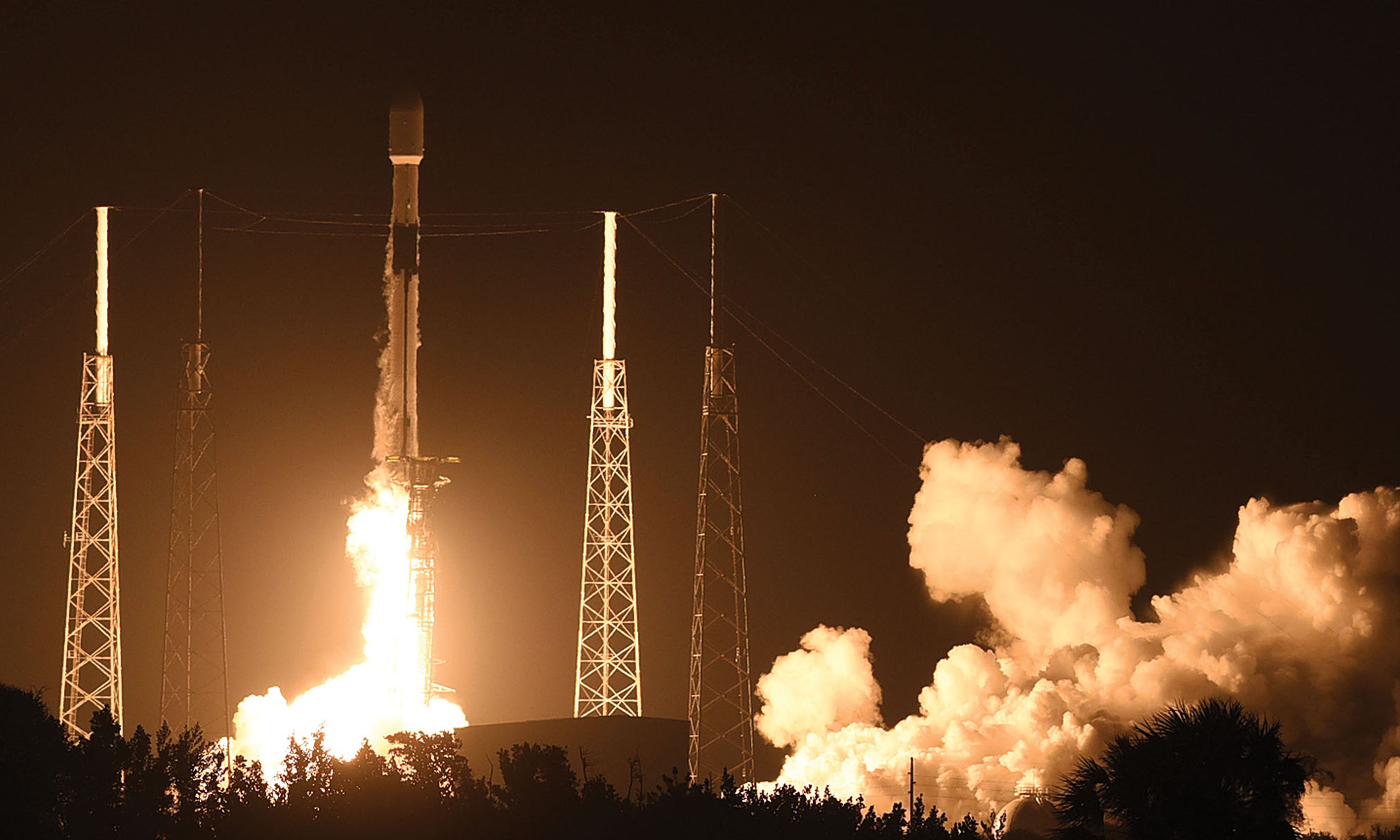
Wherever profit leads us, to every sea and shore For love of gain the wide world’s harbors we explore. — Dutch poet Joost van den Vondel (1587–1679)
Once Westerners were explorers — daredevils driven by greed, faith, and curiosity to (as they used to say on the original Star Trek) “seek out new life and new civilizations.” In what the historian J. H. Parry called the “Age of Reconnaissance,” Europeans and their descendants were animated with a “fierce competitive pugnacity” out of which the modern world emerged.
Today’s “innovators” in social-media firms, with their cult of surveillance, may seem pale in comparison, but we see the outlines of a new, more breathtaking technological future beyond the cyberspace mind swamp and out to the solar system and beyond. The builders of this new era — egotists and inveterate schemers such as Elon Musk, Jeff Bezos, and Richard Branson — are creating something more than better ways to silence dissent or post cat videos. They are creating a new world that, if we do not get to experience it, may shape the reality of our children and grandchildren.
This new Age of Reconnaissance involves more than just a handful of over-rich moguls. They are part of a vast entrepreneurial surge that includes more than 50 players engaged in everything from launch facilities and launch-service provision to reusable-rocket production and moon and Mars landers and vehicles. This is no minor niche market. Boosted by a huge surge of investment, space-industry global revenues are up more than twofold since the early 2000s, from $175 billion in 2005 to almost $424 billion in 2019. By 2040, Morgan Stanley projects, space-industry annual revenues globally should reach $1.2 trillion.
The first Age of Reconnaissance started in the 1300s, ultimately redrawing the map of the world and creating the first global economy. Its buccaneers were often flawed, with motivations that were complex and even contradictory. As Bernal Díaz, a soldier with Cortés, explained, they came “to serve God and His Majesty, to give light to those who were in darkness, and to grow rich, as all men desire to do.”
The great outward push began with the Italian city-states of the Renaissance and spread to other parts of Europe. Many were poor but resource-rich city-states such as Venice, and, later, nations such as Portugal that had few resources and were dependent on trade. Between 1000 and 1800 the greatest success was generally secured by those who perfected maritime technology, starting with the Vikings, the Venetians, and the Genoese, then spreading north to the Baltic Hansa, and then to the Netherlands and England. Many of these earlier explorers were privately financed, and some, such as Sir Francis Drake, were openly piratical. The great ocean adventures also led to great technological advances, such as extremely precise clocks that were used to calculate longitude.
Other early exploration missions were largely government-funded, and the rewards from those missions were owned by sovereign governments. With Christopher Columbus’s success in landing in the Americas (1492) and Vasco da Gama’s navigation around the Cape of Good Hope to India (1497), interest in fielding missions of exploration grew dramatically in the 1490s and early 1500s. While no one knew the precise nature of the treasure awaiting them, the anticipation of untold new wealth was a hot topic of conversation in royal courts and merchant houses throughout Europe.
As is true today, there were many skeptics of the whole enterprise. As one 16th-century Italian historian suggested: “What need have we of what is found everywhere in Europe?” Indeed, the cost of exploration was very high, as were the risks associated with success; crews suffered from disease and many ships were lost. Governments also needed money to fund other initiatives, such as wars based on religion or for territorial domination. The solution to this problem — in monarchies as well as the Dutch Republic — was to establish the “joint-stock company,” a new form of enterprise in which risks and rewards were spread across a large base of investors.
Henry IV chartered the first joint-stock company, the Company of Merchant Adventurers, in 1407. Initially it was an association of English cloth traders who funded their trading expeditions by selling shares of their company to wealthy landowners. This corporate form proved well suited for funding expeditions to the Americas, Asia, and Africa. In the early 17th century, similar groups of investors, also referred to as “adventurers,” were formed to develop overseas trade and colonies in the New World, such as the Virginia Company of Adventurers of 1609 (which later split into the London Company, settling Jamestown and the Chesapeake Bay area, and the Plymouth Company, which settled New England).
In the mid 1600s, similar joint-stock companies were formed in other countries. The Dutch East India Company, the French East India Company, and the (British) South Sea Company were pivotal in providing the capital to explore and exploit the new frontiers of commercial interest. Working with what Parry calls “enterprising poachers,” these companies controlled Indonesia, parts of the Indies, and the Cape of Good Hope. In some places, such as Indonesia, the Dutch East India Company, despite a record of malfeasance and even fraud, remained essentially the face of Dutch rule until the 1940s.
In what the historian F. R. H. Du Boulay called an “age of ambition,” lower-ranking nobles and commoners, seeking a better life, took on the role of entrepreneurs, pirates, and financiers. Their energies accelerated the development of the first truly global economy, as well as the development of mathematics and study of the stars. Even Asia’s great rise, the economic mega-story of our times, has its roots in cities developed by these entrepreneurs, such as Mumbai, Singapore, Shanghai, and Hong Kong.
Today these explorers, like much of our Western tradition, are the subjects of scorn and derision, creators of what the radical philosopher Frantz Fanon called the “European game,” which was leading the West “into the abyss.” The explorers have been vilified for their cruelty to purportedly superior cultures that some believe possessed more humane values and hewed closer to nature. Yet despite their manifest flaws, we can still appreciate the explorers’ spirit, their ambitions, and their willingness to take risks as inspiration for the future.
In the 1950s and 1960s, the modern space race was conducted almost entirely between governments, with the USSR’s space program and NASA being the unquestioned leaders. But now it is entrepreneurs, most of them American, who are on the cutting edge, leapfrogging government-backed enterprises in China, Russia, the EU, and India. In particular, Europe, where modern rocketry was born during World War II, lags in the development of new space companies and still focuses on government-directed funding and development to meet the challenge posed by SpaceX and its buccaneering brethren. Bureaucratic giants such as Boeing have also fallen behind.
There are those who believe that the main competitors for space hegemony will be China and the U.S., and that we will need to fend off a challenge by the Chinese state. (See, for example, Brandon Weichert’s Winning Space: How America Remains a Superpower.) But at least in the West, suggests longtime space analyst Rand Simberg, government-led exploration is no longer competitive. One reason for this is that Congress is essentially forced to award contracts by zip code, he says, noting that the industry has not had a strong advocate in the White House since Reagan. We do not know a lot about what is happening in China, where operations are famously opaque, but in America, the government sector is not really in the lead. The big drops in payload costs and advances in rocket building are now being driven by the private sector, not NASA’s hobbled bureaucracy. “Today’s NASA,” Simberg says, “could not pull off Apollo 8.”
That the action is now very much controlled by entrepreneurial enterprises, mostly across the Anglosphere, has much to do with a tradition and a legal structure that favor private property more than other cultures do. “It’s based on the age of expansion, the legacy of the British East India Company,” observes Australia-based analyst and KPMG partner Michael Kalms. “The culture of the new space industry is being driven by commercial enterprise and risk-taking,” not on government reliance.
As in the past, innovation is driven by intense competition among these players. The new awards of contracts for moon landers, for example, included Blue Origin, SpaceX, and Dynetics (a small Huntsville, Ala., start-up), as well as several established aerospace companies, including Lockheed Martin and Northrop Grumman. The moon rover is also being developed by another small firm, Pittsburgh-based Astrobotic, founded in 2007 as a spinoff from Carnegie Mellon University.
But the most radical ventures are those being taken by unique new companies that have seized on specific niches and new technologies. Spin Launch, which is based in Long Beach, Calif., and New Mexico, uses a unique technology that employs a centrifuge 100 yards in diameter to launch rockets at speeds up to 5,000 miles per hour, shooting up to 200 pounds of satellite in the air without traditional rocket boosters.
Also located in the thriving Douglas Park complex near Long Beach’s Art Deco airfield, Relativity Space is innovating not in how to shoot rockets, but in how to build them. The company specializes in using artificial intelligence and 3-D printing. It secured $500 million of new equity funding in November and has won significant new contracts with NASA, the large services firm Trisept, and the communications firm Iridium, as well as Lockheed Martin. Although it works with current players, Relativity seeks to disrupt the long-established aerospace supply chain by internalizing 95 percent of all components through its 3-D-printing software. “We are seeking to change this industry from the ground up by doing our own manufacturing for almost everything,” says Marc Seidel, the company’s director of finance. He predicts that the company, which now employs 260 people full time, will grow to 1,500 in five years.



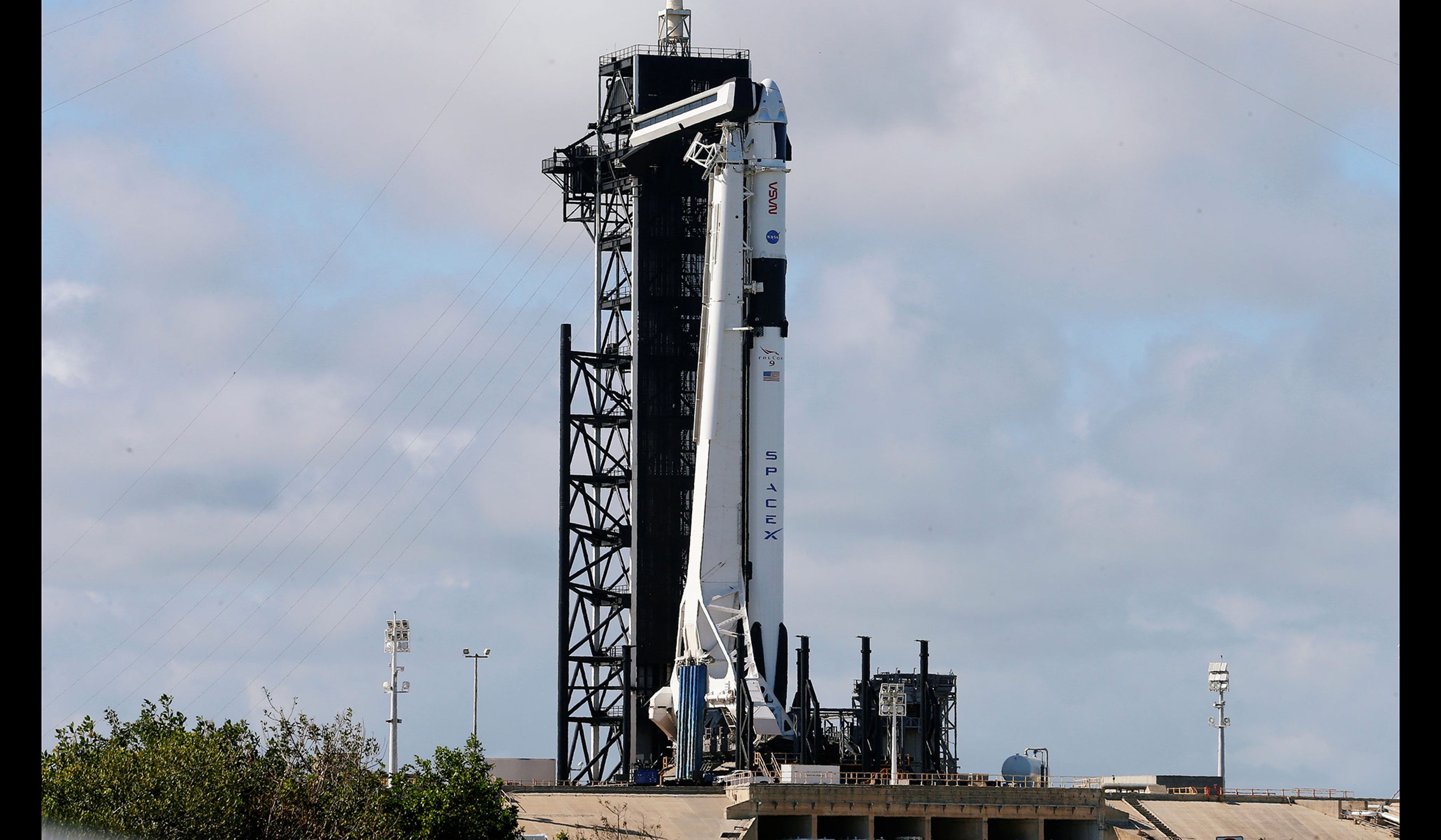






NASA astronauts Robert Behnken and Douglas Hurley aboard SpaceX’s Dragon Endeavour spacecraft, August 2, 2020.
NASA/Handout via Reuters
The main competition in the space industry today is focused on putting small satellites into orbit. SpaceX generates most of its space-industry revenue from commercial and national-security satellite launches, as well as two NASA contracts, one a multibillion-dollar deal to deliver cargo to the International Space Station and the other up to $2.6 billion to develop a capsule that will deliver astronauts to the space station.
But these activities certainly do not reflect the final ambition of Musk and other would-be lords of outer space. At a time when NASA speaks of spending $30 billion to return to the moon, people such as Elon Musk and Jeff Bezos can raise their own capital to get to the far more alluring destination of Mars, which has many characteristics, including water and critical minerals, that make it a far better object for settlement and even permanent colonies than Luna. It is, relatively speaking, Australia rather than Greenland.
Four areas in particular seem to be on the horizon for growth: space tourism (with companies such as Virgin Galactic), natural-resource extraction from planets and asteroids (with companies such as Asteroid Mining Corporation), in-space manufacturing (with companies such as Thales and Made in Space), all of which are being funded by venture capital, and the provision of communications services, such as high-speed Internet, directly to earthbound customers. The potential in these fields is enormous — for example, for advanced manufacturing that can take place best in zero gravity.
Perhaps the richest potential lies in resource extraction, which may allow future Earthers to shift mining operations away from our tired planet and become green without impoverishing humanity. The promise for extraterrestrial mining is large. Texas senator Ted Cruz noted in 2017, “I’ll make a prediction right now. The first trillionaire will be made in space.”
But the most consequential move — equivalent to the mass colonization of the Americas and Oceania — will be the long-awaited settlement of space, the ultimate way to extend urban sprawl without all the complications. This is the human future popularized by visionaries such as Arthur C. Clarke, Isaac Asimov, and Star Trek producer Gene Roddenberry. This movement promises humanity — not just the West — a bold future that cannot easily be erased by government, as occurred when China’s Ming dynasty ceased its ambitious explorations in the 15th century. Ultimately, government cannot lead because of its other commitments and its need to appeal to the population. No president would be able to obtain massive spending to, for example, colonize Mars or fund a lithium plant there, but private firms might do so, understanding the risks as well as the huge potential rewards.
Of course, eventually the new lords of space — like their Age of Reconnaissance forebears — will need to be restrained by national and even supranational government. Someone will need to determine the critical legal and economic issues of who owns what, who has the right to explore where, and what should be considered shared resources — just as the famous Papal Line of Demarcation of 1494, laid out in the Treaty of Tordesillas between Spain and Portugal, attempted to settle conflicts over lands newly discovered or explored by Christopher Columbus and other late-15th-century voyagers. But for now, at this critical juncture, America’s best hope to retain primacy in space lies in stimulating and embracing the appetite for risk by our entrepreneurs and investors. Our future in the new era of reconnaissance depends on tapping this part of Western, and particularly American, culture. As was true with the bold pioneers of the Age of Reconnaissance, progress will be made fastest by people who risk everything, even their lives, to get rich. It is these entrepreneurs, the descendants of the great explorers, who will bring the greatest rewards for America, and the world, in the emerging space era.
—Mr. Kotkin is the presidential fellow in urban futures at Chapman University in Orange, Calif., and the executive director of the Urban Reform Institute. His new book is The Coming of Neo-Feudalism. Mr. Toplansky is a clinical assistant professor of management science at Chapman University and a co-founder of KPMG’s National Center of Excellence in Advanced Data and Analytics.













Comments