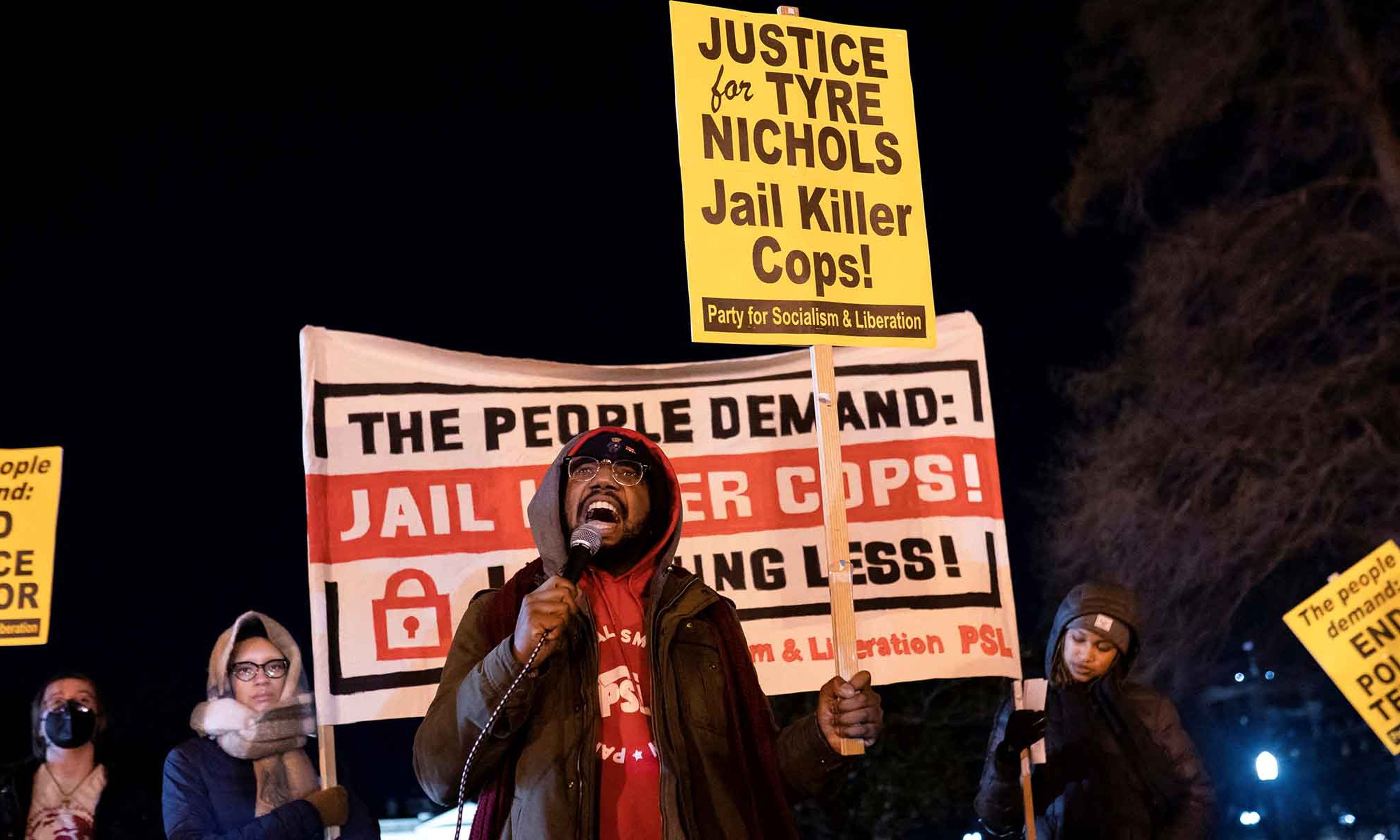
When a life is lost in a controversial police encounter, there is a mourning ritual favored by activists. The name of the deceased is added to a grim litany and recited together with the familiar names of other people: Trayvon Martin, Michael Brown, Eric Garner, Philando Castile, Tamir Rice, Breonna Taylor, George Floyd, and Daunte Wright. For reasons that will soon be clear, I dislike this ritual. But after watching the savage beating of Tyre Nichols, I found myself meditating in a similar way on another list of people: Tadarrius Bean, Demetrius Haley, Desmond Mills Jr., Emmitt Martin III, and Justin Smith.
These are the officers who killed Nichols, and to someone in a lugubrious mood, a list such as this can feel symbolic of some deeper, cosmic tragedy. Pictured clean-cut and smiling, they have appeared on every news channel, seeming to symbolize the withered hopes of so many people who once believed that black police officers would make a transformative difference in America’s least fortunate neighborhoods.
James Forman Jr. has documented some of this history in his riveting book Locking Up Our Own. He explains the significance of the “Atlanta eight,” inaugurated in 1948 as the city’s first black officers, and of Burtell Jefferson, the nation’s first black police chief, inaugurated in 1978 in Washington, D.C. They were hailed as heroes, and the label seemed to fit. In a racist age, that initial set of black officers formed secret study groups, working assiduously to excel in every aspect of their job, so that no excuse could be found to deny them well-deserved promotions. They knew that their communities were stacking high hopes on their shoulders. It seemed reasonable, in that optimistic hour, to hope that a more representative police force might, at least over the long run, forge smoother relations between the police and black neighborhoods and pave the way to better lives for black citizens generally: better policing, fairer courts, and a more perfect union. Looking at those five smiling faces, one wonders: Was that naïve?
Of course, it was very good indeed for police departments to abandon racist hiring and promotion practices. Doors opened for many good cops who deserved the opportunity to protect and serve. It turns out, however, that transformative improvements in crime control do not necessarily flow from broader cultural advancements in social justice. Breakthroughs in policing certainly are possible; the past few decades have seen more than one. Generally, these are the results of some combination of better discipline, better information, and better tactics adopted by police departments. When, in the ’80s, New York’s police focused on maintaining neighborhood order by policing petty crime, the city became safer and more livable. And the analytics revolution of the ’90s greatly improved the efficiency of police departments, enabling them to lower crime rates by directing resources where they were most needed.
But no such claims can be made for diversity seminars, disparate-impact studies, or awareness-raising efforts. Sometimes there are reasons to want those things, but they don’t make streets safer, and American citizens living in unsafe neighborhoods deserve better. It would be good if Memphis’s shocking incident inspired more Americans to look for effective solutions instead of performing symbolic rituals.
The mourning ritual would at least be understandable if the people commemorated by activists really had lost their lives in racially motivated killings. That’s not the case. Indeed, a hyperbolic concern about racist policing has been one of the greatest obstacles to understanding what happened to Brown, Garner, Castile, Rice, Taylor, Floyd, Wright, and many others. Without this understanding, it is impossible to take reasonable steps to avert such tragedies.
All of these fatal encounters are different, but certain themes emerge if one scrutinizes many of them. Very occasionally, it does happen that an officer loses his temper and kills or attacks a person in rage. That appears to have happened to Nichols. Laquan McDonald was another such victim, and the Chicago cop who killed him, Jason Van Dyke, was appropriately convicted of homicide in the second degree. Though it’s possible that some such instances are animated by racism, they are rare. Far more often, officers are assigned some blame for a death — not because they fired a weapon unreasonably, for example, but because their sloppy tactics created an unnecessarily dangerous situation. This explains how Tamir Rice, a twelve-year-old boy, was shot in a park while playing alone with a realistic-looking toy pistol. The officer who killed him may have plausibly felt threatened when the boy’s hand moved for a split second towards his midsection, but, given that there were no bystanders, it was unnecessary for the officers to drive directly up to the boy and leap out of their squad car. Had they approached the situation slowly, allowing themselves a few more seconds of observation, an innocent life could have been spared.
Tamir’s tragic death revealed dysfunction on other levels of the Cleveland Police Department as well. For example, the neighbors who originally called the police had mentioned that the child’s “pistol” might well be a toy, but the dispatcher neglected to pass on that crucial information to the officers. And Timothy Loehmann, the officer who shot Tamir, had previously been deemed unfit for duty by another police department. The incident serves as a grim reminder of how officer-created jeopardy can be avoided through adequate training and a careful screening of candidates. Better screening might also have saved victims such as Castile and Wright. Castile was shot during a routine traffic stop after honestly informing the officer that he had a legally owned firearm in the car. He did nothing wrong, but no one who watched the footage of his death could seriously believe that the officer was motivated by hatred or rage. He was inexperienced, and he panicked. A person of that temperament should never have become a cop in the first place, of course, which highlights the need for rigorous candidate-screening.
Activists tend to turn a very bright spotlight on fatal police encounters, but sometimes bright light can blind us. In Ferguson, Mo., police relations with citizens were already damaged by the immense pressure city government had placed on officers to issue tickets and fines. A few commentators took note of this, but the consideration was largely lost in the wind as activists gathered after Michael Brown’s death to “say his name.”
Then there are unique cases whose noteworthy features are largely overlooked simply because the loudest commentators are comfortable with the familiar scripts. As a resident of the Twin Cities, and having watched many tapes of fatal police encounters, I was deeply perplexed by the death of George Floyd. Usually, a fatal encounter takes place in a matter of seconds. It is typically obvious what has happened, though questions of moral responsibility might be hard to answer. But the conduct of Derek Chauvin, the officer who killed Floyd, was utterly bizarre. If he was seething with racist rage, his face did not betray it. He acted calmly, deliberately, and authoritatively, in ways that made absolutely no sense in the circumstances. Even now, after endless commentary and a highly publicized trial, I have no clear sense of what Chauvin thought he was doing. Isn’t it important for activists to understand why such an extraordinary incident occurred before they decide to turn a gas station into a smoldering pile of rubble? Why are they so curiously incurious? If as an affected citizen (I used to get coffee at the gas station) I find this maddening, it’s easy for me to grasp why police officers across the nation are quitting their jobs. They can see that good intentions count for little once activists have written their narratives.
There are some hard choices to be made at this juncture. In particular, Nichols’s savage beating in Memphis raised serious questions about the image police should cultivate in society at large. Bean, Haley, Mills, Martin, and Smith were members of a relatively new elite squadron known as “Scorpion.” That unit has already been disbanded, but many other cities are weighing the question of what to do with their own elite crime-fighting units. Critics have been quick to complain that these units tend to adopt militaristic attitudes towards policing. Abuses are more likely when cops are encouraged to think of themselves as head-knocking tough guys, and it’s certainly true that American citizens must not be viewed as enemy combatants. Building rapport with communities is genuinely important, especially in neighborhoods that harbor long-standing suspicions of the police, often because they were chronically under-policed right up until they attracted the sustained interest of the Drug Enforcement Agency. That history does matter and may sometimes justify a gentler touch in policing.
Defusing the “warrior ethos,” however, may backfire if it renders police impotent in the face of violent crime. A balanced approach to policing should incorporate street-strolling community cops and wonky analysts, but, in the end, the police exist to stop crime. They are the thin blue line, holding back the chaos that perpetually threatens to make life a misery. The job requires courage and self-sacrifice, and few decent people will do it unless they are properly honored as crime-fighters. If politicians, media, and police departments themselves try to rebrand police officers as cheerful public servants helping cats down from trees, recruitment across the nation will likely continue to slump. Even that, however, would be much better than allowing the badge to stand as a symbol of racist oppression.
American policing is indeed in crisis, but racism is not the central problem. Crime control, already difficult in a discontented society, will become impossible if policemen are made into scapegoats for everything Americans dislike about their history and culture. Unless the police are exonerated from the symbolic burden of corporate guilt, our cities will be overwhelmed by violent crime. Recite the names of Bean, Haley, Mills, Martin, and Smith — if that’s what it takes to break the spell. Then forget about symbolic victories and losses and think about what might help.












Comments