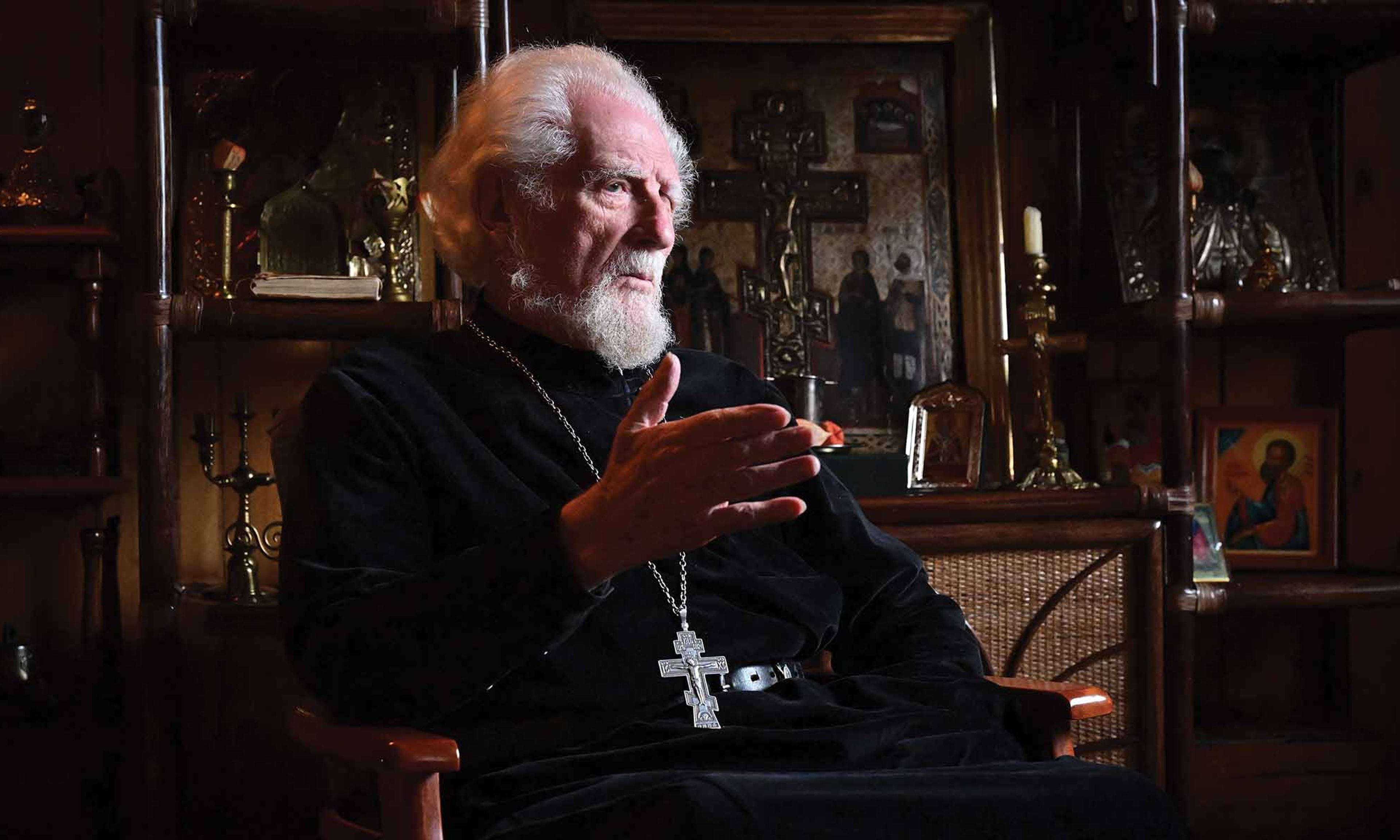
On February 1, an audience gathered at the Reagan Institute in Washington, D.C., to see a new documentary. Its subject: Father Georgy Edelstein, a brave and truth-telling priest in Russia. The film was made by Vladimir Kara-Murza, another brave and truth-telling Russian. He has been a political prisoner since April 2022.
The event in Washington was co-hosted by the Reagan Institute and the National Endowment for Democracy. A featured speaker was Evgenia Kara-Murza, wife of the prisoner, and filmmaker.
From prison, he was able to transmit a message, which was read at the event by Evgenia. He began by speaking of Kommersant, the Russian newspaper, where he once worked. On its front page, the paper explains that it was founded in 1909 but had to cease publication between 1917 and 1990, “for reasons beyond editorial control.” Kara-Murza remarked that, for reasons beyond his own control, he was unable to appear in Washington.
He has the same graceful touch he always had, even in straitened circumstances.
Kara-Murza also quoted Father Georgy, on the need to speak out: “If we stay silent, we participate in the evil that is happening in our world.”
Father Georgy was born Yuri Edelstein in 1932. His father was Jewish, his mother Christian. They lived in Kyiv. In the film, he says, “I think that of the ten or eleven boys and girls with whom I played before 1941, only two or three survived.” He goes on to say, “I can never answer the question of why I am here and they are all buried at Babi Yar.”
On February 28 last year — four days after the Kremlin launched its all-out assault on Ukraine — Father Georgy issued a statement. “Brothers and sisters!” he began. Christians should not “stand aside” when atrocities are being carried out.
Father Georgy continued, “We will not repeat the crimes of those who hailed Hitler’s actions on September 1, 1939. We cannot shyly close our eyes and call black white, evil good, and say that Abel was probably wrong and provoked his older brother.”
He concluded by saying, “The blood of the people of Ukraine will remain on the hands of not only the rulers, and soldiers who carry out orders. Their blood is on the hands of each of us who approved of this military operation or simply remained silent.”
Vladimir Kara-Murza was born in 1981. For 15 years, he worked alongside Boris Nemtsov, the leader of the Russian opposition. Nemtsov was murdered on February 27, 2015, within sight of the Kremlin. Three months later, Kara-Murza himself was nearly murdered: poisoned. It happened again in 2017.
Many of his friends implored Kara-Murza to leave Russia, once and for all, but he refused. He said that he had a duty to oppose the Russian government on Russian soil — especially if he was going to ask others to do so.
The film about Father Georgy is Kara-Murza’s third film. The first, he made in 2005: They Chose Freedom. It is about political dissent in the Soviet Union. The second, made in 2016, is titled, simply, “Nemtsov.”
In his first film, he chronicled the seven men and women who went to Red Square in 1968 to protest the Soviet Union’s invasion of Czechoslovakia. These men and women held Czechoslovakian flags. They also held placards, bearing such messages as “Shame to the Occupiers!” and “For Your Freedom and Ours!”
The protest lasted only a few minutes. KGB agents pounced on the protesters, without mercy. They knocked out the teeth of Viktor Fainberg. He would be locked up in a psychiatric prison — subjected to horrifying things — for five years. He died on January 2 of this year, having received honors from the Czech and Slovak governments.
A Prague newspaper, back in 1968, editorialized, “Now there are at least seven reasons for which we will never be able to hate the Russian people.”
In Red Square that day, as noted above, the seven Russians carried Czechoslovakian flags. Today, many people, around the world, display the Ukrainian flag. There are some who scorn this: “Are you signaling your virtue? Don’t you have loyalty to your own country and its flag?” Whatever the scorners say, it is natural, for some — for many — to express solidarity with a people under siege and fighting for its life.
Vladimir Kara-Murza admires Father Georgy Edelstein a great deal, and, in the new film, it is easy to see why. Father Georgy is gentle, thoughtful, humble, kind. He is also firm, like granite.
“Were you baptized in Leningrad?” asks Kara-Murza. Hesitating, Father Georgy says, “I don’t like to say that word. I don’t like to say the name of that demon.” Kara-Murza says, “In St. Petersburg.” This, Father Georgy is comfortable with.
For years, Father Georgy was hounded and harassed by government officials — and not only government officials. “The Soviet regime was bad,” he says. “Very bad. But our bishops were worse, because they tried to run ahead of the authorities and be more zealously Soviet than government officials.”
A great many priests doubled as KGB agents. Father Georgy, in those Soviet years, did not shrink from saying so, and decrying this treachery.
In the first week of February, a few days after the screening of the film in Washington, news came from Switzerland: According to declassified Swiss records, Patriarch Kirill, the current head of the Russian Orthodox Church, worked for the KGB in the 1970s. He is a close ally of Putin and has blessed the assault on Ukraine as godly work.
Says Father Georgy in the film, “I think that every person who collaborated with the KGB — a bishop, a priest, a layman, it doesn’t matter — must repent, and we as Christians, following Christ’s call, must forgive them.” If he criticizes collaborators, it’s only “because they have not repented.”
In 1987, Father Georgy was suspended from his priestly duties, for “politically motivated dissent.” He lost his village parish. The next year, President Reagan traveled to Moscow and met with a variety of dissidents at Spaso House, the home of the U.S. ambassador. Among them was Father Georgy.
Said Reagan to the group,
I thought it might be appropriate for me to begin by letting you know why I so wanted this meeting to take place. You see, I wanted to convey to you that you have the prayers and support of the American people, indeed of people throughout the world. I wanted to convey this support to you that you might in turn convey it to others, so that all those working for human rights throughout this vast land — from the Urals to Kamchatka, from the Laptev Sea to the Caspian — might be encouraged and take heart.
Soon after, the Soviet authorities saw fit to give Father Georgy back his parish. “Let him have his trifle!” was the word. Father Georgy tells Vladimir Kara-Murza, “Reagan really did restore me to the priesthood, and I am grateful for it.”
Father Georgy’s eldest son is Yuli Edelstein, a prominent politician in Israel. Three times, he has been a government minister, and from 2013 to 2020 he was speaker of the Knesset. In the Soviet Union, he was a refusenik, and a political prisoner. Yuli Edelstein is a story unto himself.
Yuri Edelstein — who would become “Father Georgy” — never liked to be told, “Shh.” “Ever since kindergarten, I have been told, ‘Shh. Don’t say anything.’”
One day, during naptime, the kindergarten teacher removed the portrait of Pavel Postyshev from the wall. He was a Communist bigwig, a brutalizer of Ukraine. He fell from favor in the Great Purge, and was executed in 1939.
“Why did you remove Comrade Postyshev?” asked Yuri of his teacher. She said, “Shh.” He went home and asked his mother to explain. She, too, said, “Shh.”
Needing someone to talk to, he went to his cat, who was under the bed. Yuri crawled under there too. “I promised him that I would never lie and would never tell anyone, ‘Shh.’”
In conversation with Kara-Murza, Father Georgy states, “If you know something, you must say it. Gregory the Theologian, a great teacher of the church, said that ‘by silence God is betrayed.’”
Vladimir Kara-Murza has been in prison for almost a year. (He and Evgenia have three children, incidentally.) He faces 20 more years in prison. One of the charges against him is that he was involved with the Sakharov Center in Moscow. On January 24, the Kremlin banned the center as an “undesirable organization.”
(Andrei Sakharov was the great scientist and dissident who won the Nobel Peace Prize in 1975. The Sakharov Center was created in 1990, a year after his death, by his widow, Yelena Bonner, and others.)
Kara-Murza is also charged with high treason — no less than high treason. This stems from three speeches he gave: before the NATO Parliamentary Assembly in Lisbon; before the U.S. Congress; and before the Norwegian Helsinki Committee.
Last September, the journalist Ivan Safronov — who, like Kara-Murza, once worked for Kommersant — was convicted of high treason. He was sentenced to 22 years. The authorities pressured him to confess guilt, offering him only twelve years if he would do so. He refused.
At his sentencing, he said to his supporters, from the glass cage in which defendants are kept, “I’ll write to everyone. Keep writing to me. I love you!” His fiancée told court officials, “You can all go burn” (in hell, that is).
Safronov’s father — Ivan Sr. — was also a journalist. He died in 2007, from falling out a window, as irritants to the Kremlin so often do.
In 2018, Vladimir Kara-Murza spoke at the Oslo Freedom Forum. Dissidents, he said, are often “the true voices, and the true faces, of their nations and their societies.” Throughout history, “autocrats have usurped the sole right to speak on behalf of their nations, from Louis XIV with his ‘I am the state’ to the current regime in the Kremlin, which has said, through the mouth of Vyacheslav Volodin, one of the closest political aides to Vladimir Putin, ‘There is no Russia without Putin.’”
This statement by Volodin, Kara-Murza called “probably the most insulting thing I have ever heard said about my country.”
In August 1968, seven Russians went to Red Square to protest the invasion of Czechoslovakia. Since February 24 last year, more than 20,000 Russians have been detained for protesting the invasion of Ukraine. It is well to remember: They are Russian, too.











Comments