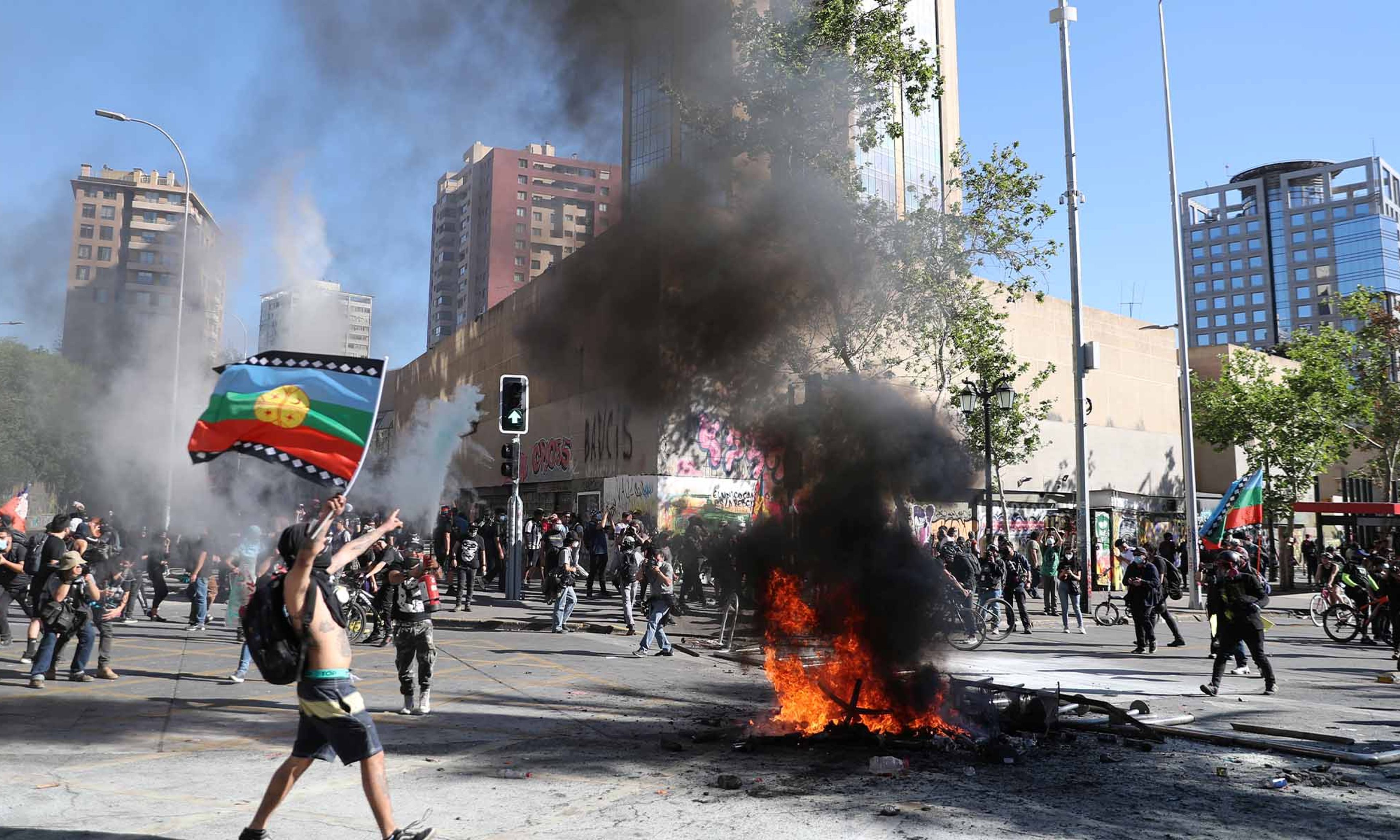
On October 18, 2019, young Chilean leftists took to the streets of Santiago by the tens of thousands, burning churches and stores, looting supermarkets, erecting barricades, and torching buses. The proximate cause of the violent unrest was a modest increase in public-transit fares, but its ultimate origin lay in a deep dissatisfaction with Chile’s long-lived market-oriented economy.
The Chile Project, Sebastian Edwards’s absorbing, mystifying tale of how neoliberal economics took root in the Southern Hemisphere only to be uprooted, contains twin paradoxes. First, the enigma of how a group of University of Chicago economists, nicknamed the “Chicago Boys,” gained purchase on Chilean soil when the terrain seemed at its most slippery: The junta that had initially welcomed the neoliberal approach and the reemergence of a democratic order ostensibly hostile to it was removed from power in 1990 after President Augusto Pinochet lost his bid for reelection. And second, the puzzle of how the same Chicago caravan subsequently slid off the trail decades later after driving Chile to soaring economic heights.
Edwards himself forms part of the riveting story he tells. Born in Chile, he studied economics in Santiago, served as a student activist in Salvador Allende’s Socialist Party, collaborated with a key member of the Chicago delegation, fled the dictatorship in 1977, and returned in 2019 in time for the mass protests. He defines neoliberalism as “a set of beliefs and policy recommendations that emphasize the use of market mechanisms to solve most of society’s problems and needs, including the provision and allocation of social services such as education, old-age pensions, health, support for the arts, and public transportation.”
Launched in 1955 as “an integral part of the US strategy to contain the spread of communism in Latin America,” the Chile Project dispatched leading economists of the University of Chicago, including Milton Friedman, Arnold Harberger, and Theodore Schultz, thousands of miles southward to implant their market-based solutions in hitherto inhospitable ground.
The policies the Chicago Boys championed included liberalizing trade, eliminating tariffs, abolishing the minimum wage, and curtailing regulation. They spent the 1950s and ’60s training protégés primarily at Pontificia Universidad Católica de Chile in Santiago, where they sparred with leftists at the rival Universidad de Chile and enjoyed modest success in reforming the country’s hidebound economic structure.
Edwards stints on some of the early details, but the story picks up steam in 1970, when Allende won a narrow electoral victory on an expressly Marxist platform to “replace the current economic structure, putting an end to the power of national and international monopolistic capital and latifundia, and to initiate the construction of socialism,” all “implemented through a system of national economic planning and control.” The Chicago Boys fell out of favor, Allende nationalized entire industries, and, predictably, three years later, the Chilean economy collapsed, with runaway inflation devastating real wages and undermining all efforts at income redistribution.
In marched Augusto Pinochet and his junta, ushering in two decades of political repression and economic growth, as the generals reengaged the neoliberals who’d been banished by the socialists. Friedman was summoned to La Moneda, the presidential palace, to meet with the dictator himself, and he unceremoniously prescribed “shock treatment” that slashed budgets and curbed foreign-currency outlays. Over the next several years, Friedman’s treatment largely cured the patient, converting a massive budget deficit into a modest surplus, opening the market to international trade, and liberating both prices and interest rates. The major side effect: massive unemployment, which rocketed as high as 22 percent.
At the same time, Friedman’s Chilean disciples committed a cardinal sin of which their patron saint vigorously disapproved: They linked the Chilean peso to the dollar in a “crawling peg system” that wound up spiking inflation and interest rates. (Friedman himself favored either a free-floating exchange rate or an irrevocably fixed rate. “I conclude that the only way to refrain from using inflation as a method of taxation is to avoid having a central bank,” he had said years earlier during a lecture in Israel.) By 1982, Chilean banks had foundered, the price of the dollar had doubled, and real GDP per capita had shriveled by 20 percent.
But Pinochet gave the Chicago Boys a second chance, and in the mid 1980s they implemented a massive corporate-tax cut, which mushroomed private investment; dramatically increased infrastructure spending; and encouraged foreign direct investment in Chile though debt-to-equity swaps that revived distressed local industries, including the mining sector. Average GDP growth swelled by 6.4 percent per annum, while unemployment finally buckled to a manageable 6.8 percent by 1989. Since the junta had taken power, illiteracy had fallen by nearly half, exports had more than doubled, and poverty had dropped by a third.
Along the way, Edwards also carefully considers the fraught issue of collaboration. What degree of moral responsibility should the Chicago Boys bear for the junta’s manifest human-rights violations? Friedman himself once intervened in behalf of an imprisoned Chilean economist, Fernando Flores. “Freedom is indivisible,” Friedman wrote to Pinochet. “Greater economic freedom promotes and facilitates greater political freedom. But equally, greater political freedom promotes economic freedom.” Harberger, too, interceded with authorities in Santiago, to secure the release of another economist.
And so it perhaps wasn’t overly surprising that, when Pinochet finally stepped aside in 1990 and the democratic restoration ushered in a more progressive government, Alejandro Foxley, the newly appointed finance minister who had previously expressed deep skepticism about the Chicago Boys, declined to scrap their successful reforms. In an interview with Newsweek, Foxley emphasized the importance of “avoiding at all costs the typical cycle of populist economic policies in Latin America.” The new government proceeded accordingly, and Chile was rewarded in the 1990s with surging productivity, yearly GDP growth approaching 8 percent, and burgeoning outside investment; the country’s per capita income grew to become the highest in Latin America by 2002, surpassing even that of archrival Argentina.
Political freedom flourished alongside economic liberty. In 2019, Freedom House bestowed on Chile its highest grades among Latin American countries for freedom and press freedom — higher even than for Greece, Italy, and Spain. The Economist in 2020 classified Chile as one of only three Latin American nations qualifying as full democracies. Center-left Chilean governments had good reason to ratify the neoliberal consensus that their predecessors had introduced.
And yet trouble was brewing, with a United Nations Development Programme report cautioning that malestar, or economic and social malaise, had set in. Edwards observes that “while every traditional indicator showed that Chile was a major success and was steadily moving toward the ranks of the advanced nations, substantial portions of the society were deeply unhappy and demanded major changes.”
But why?
Edwards fingers inequality as a key suspect. Even though, by 2018, Chile’s Gini coefficient (economists’ classic measure of inequality) was right at the average for Latin American countries, and even though it had declined dramatically since the junta, social (what Edwards calls “horizontal”) inequality had ballooned. Chile lagged other Latin nations in certain metrics for civic engagement, environmental commitment, and health care.
Another cause of the malaise lay in secondary education. The Chicago Boys had bolstered for-profit universities that proved largely unsuccessful and saddled young Chileans with substantial debts. “People who come out of that kind of inferior education can’t get jobs,” Harberger surmised, “and they have every good reason to feel they have been put upon.”
Underfunded pensions represented yet another cause of the Chilean ferment. Under the junta, economic reformers promoted individual savings accounts instead of the American pay-as-you-go system of Social Security, which itself is nearing insolvency. Suggested savings rates were set at a low 10 percent, mandatory employer contributions were likewise pegged too skimpily, and the relatively young retirement age (60 for women, 65 for men) didn’t increase with life expectancy. The privatized pension-management companies hampered efforts at pension reform, and the system wobbled for decades.
Popular discontent erupted with the October 2019 riots. In elections in 2021, the center-right government of President Sebastian Piñera gave way to Gabriel Boric, a 35-year-old leftist firebrand and former student activist. “If Chile was once the cradle of neoliberalism,” he intoned, “then it will also be its grave.” He spearheaded a dramatic overhaul of the entire Chilean constitution, seeking to unravel nearly all of the Chicago Boys’ policies by restraining property rights, nationalizing pensions and health care, empowering labor unions, and boosting government spending. For good measure, Boric also proposed adding radical new provisions favoring indigenous autonomy, gender equality, and environmental preservation.
But on September 4, 2022, voters rejected Boric’s ambitious constitutional rewrite, by a 62–38 margin. Disillusioned mostly with the Left’s efforts to redefine Chile as a multinational state, they soured on its most extreme economic revisions too.
Yet, in the wake of the defeat, Boric and others immediately set about composing a new draft constitution, which isn’t likely to be much more congenial to neoliberalism than the one that voters overwhelmingly rejected. Alas, Edwards reckons, “most of the economic system built by the Chicago Boys will be replaced by a social democratic system like the one that prevails in the European and, especially, Nordic nations.” Market economics in Chile was born as a foreign import, grew up as a maidservant to a military regime, matured as a nonpartisan consensus, but faltered in old age. The serpentine course of its life has proved bewildering, and it’s not over yet, as Edwards sagely reminds us.












Comments