
• Float around and find out.
• At press time, the U.S. military had shot down three unidentified flying objects in three days — one over Alaska on a Friday, one over Canada on a Saturday, and one over Michigan near Lake Huron on Super Bowl Sunday. This comes about a week after a U.S. fighter jet shot down a Chinese spy balloon off the coast of South Carolina, after it had crossed the entire continent. General Glen VanHerck, the commander of North American Aerospace Defense Command and U.S. Northern Command, said the shot-down balloon wasn’t the first: “Those balloons, so every day as a NORAD commander it’s my responsibility to detect threats to North America. I will tell you that we did not detect those threats. And that’s a domain awareness gap that we have to figure out. But I don’t want to go in further detail.” No doubt. Americans are not used to having their airspace invaded by anyone, and the new shoot-them-as-we-spot-them approach makes the administration’s previous spin that the Chinese spy balloons were no serious threat less persuasive. No doubt some details about the invading spy craft need to be withheld, but so far, the administration isn’t saying much of anything. Watch the skies.
• Last year, Senator Rick Scott (R., Fla.) proposed sunsetting all federal programs after five years. Democrats promptly pointed out that Social Security and Medicare would be included, meaning that in theory the programs could disappear. Naturally, they decided to portray Scott’s proposal as a serious project of the Republican Party. It was, after all, midterm-election season. Even now they’re keeping at it, with President Biden returning to the theme multiple times during and after the State of the Union address. The new twist is the idea, conjured from thin air by Biden, that Republicans are holding up a debt-ceiling increase because of their commitment to sunsetting the entitlements. This is what prompted Republicans to call Biden a liar during the speech. These programs badly need reform. Scott’s ill-considered half-idea is not the way to go about it — although kudos to him for uncovering that Biden in the 1970s made the same sunsetting-everything proposal, something the president has doubtless forgotten. In his ninth decade, Biden is obviously not inclined to have a mature conversation about our fastest-growing federal programs.
• Donald Trump is growing visibly frustrated that insults and provocations have neither damaged Ron DeSantis nor, thus far, baited him into responding. With Trump trailing the Florida governor in early presidential polls in New Hampshire and in hypothetical head-to-head national matchups, the former president faces the unaccustomed possibility that he may have to run from behind. He has reportedly been running new nicknames such as “Meatball Ron” by Maggie Haberman of the New York Times after “Ron DeSanctimonious” failed to take. DeSantis is not a declared candidate yet, so for now, he can plausibly use the Florida spring legislative session as an excuse to avoid engaging. Trump’s latest swipe, borrowed from media attacks last fall, is a photo of DeSantis from his time as a high-school teacher drinking at a party with girls who had recently graduated. This was not the best judgment by DeSantis, but without more, it is no great scandal on the part of an unmarried 23-year-old fresh out of college. The Trumpian touch is to call this “grooming” of underage girls. DeSantis brushed it off by saying he was focusing on his job and “fighting against Joe Biden.” How long DeSantis sticks to that line may depend upon his poll standing and how he handles Trump’s jabs at close range on a debate stage.
• Once again, DeSantis has had the temerity to interfere with the government of the state that he runs. Having noticed that an AP African-American-history course contained all manner of material that violated state law or that “lacks educational value” — including segments on “Black queer theory,” the “reparations movement,” Black Lives Matter, and the scholars behind critical race theory — DeSantis removed it from the curriculum until changes were made. At first it seemed as though the College Board, which compiled the course, was going to accede to Florida’s request. After a period of intense criticism from progressives, the College Board then came out swinging against DeSantis, prompting him to up the ante and threaten to drop its material completely from Florida’s curricula. “This College Board,” DeSantis noted, “nobody elected them to anything. They’re just kind of there.” Whether America’s elected officials continue to tolerate radicalized institutions that are “just kind of there” promises to be one of the key political questions going forward.
• Nikki Haley is the first declared 2024 presidential candidate since Trump. She enters the race as a long shot — well behind both Trump and the presumed candidacy of DeSantis. As a former governor and ambassador to the United Nations, Haley has a mix of executive and foreign-policy experience that makes her a plausible presidential candidate with a respectably conservative record. Haley will have questions to answer on her shifting stances on Trump, some blemishes on her policy record (especially on spending), and what foreign-policy direction she foresees for the party. Those are debates worth having. More worrisome, in a party that needs to move beyond Trump, is the possibility that she will divide the field and allow Trump to win renomination over the objections of a majority of Republican voters. At the same time, no one has a right to the nomination, and Haley deserves a chance to make her case.
• Last year, as the Senate race in Pennsylvania got into full swing, many of America’s most prestigious media outlets jumped to protect the Democratic candidate, John Fetterman, from the suggestion that his debilitating stroke had rendered him unfit for office. At times, the coverage grew farcical. Journalists who discussed Fetterman’s struggle to process language were berated for having noticed — including by the candidate’s wife, Gisele. References to Fetterman’s patently obvious struggles were cast as “ableist.” It was insisted that no permanent damage would come from Fetterman’s decision to run for office when he should have been recovering at home. Now — with the election won and a six-year-term secured — the truth is trickling out. Per the New York Times, Fetterman’s condition is not mild; rather, he finds it so hard to process language that he often feels as if he’s hearing “the muffled voice of the teacher in the ‘Peanuts’ cartoon, whose words could never be deciphered.” He has, the Times notes, “had to come to terms with the fact that he may have set himself back permanently by not taking the recommended amount of rest during the campaign.” If only someone had said something at the time.
• We are glad to hear that the FBI has retracted its now-notorious leaked memo on the threat of Catholics who worship at the traditional Latin Mass. That memo described “Radical Traditionalist Catholics” as a potential recruiting ground for ethnically motivated right-wing extremism and violence. Based on research from Salon articles and the Southern Poverty Law Center, the memo accuses such Catholics of “adherence to anti-Semitic, anti-immigrant, anti-LGBTQ and white supremacist ideology.” The authors show little ability to distinguish between heated populist rhetoric — which is common in democracies — and conspiratorial intention, which is rare. Careful research is supposed to narrow the focus of law enforcement to the tiny numbers of groups and individuals that are a danger. By targeting beliefs that are obliged in a religious communion of 1 billion people worldwide, and shared by billions of other humans worldwide, the report was little more than a poisonous slander.
• In testimony to the House Ways and Means Committee, Department of Labor inspector general Larry Turner estimated that at least $191 billion of pandemic-era unemployment benefits were improperly paid, with “a significant portion” of that amount attributable to fraud. His conservative estimate of the rate of improper payments was just above 20 percent, and he said the actual rate was likely higher still. Even the lowest estimate is nearly double the total amount spent each year on the welfare programs that the Ways and Means Committee oversees, such as Supplemental Security Income and Temporary Assistance for Needy Families. Turner told Congress that his office had warned lawmakers about the potential for fraud right from the beginning of the CARES Act in 2020. He requested that Congress extend the statute of limitations to allow prosecutors more time to catch fraudsters. Extending the statute of limitations would be a good idea in the short run. In the long run, Congress needs to ensure that any future programs have better fraud protections so that law enforcement doesn’t have to go on a yearslong, hundred-billion-dollar scavenger hunt after the fact.
• The sad fate of Netscape reminds us that it is not easy to remain on the commanding heights of the internet economy for very long. Google’s 84 percent share of the U.S. search-engine market (the figure is even higher globally) is therefore a remarkable achievement. Microsoft’s Bing lags far behind with around 9 percent. This may be about to change. Microsoft has already invested substantial amounts in OpenAI, the developer of ChatGPT, and is going to invest a total of $10 billion more. Next up: integrating ChatGPT to mount a new challenge to Google’s search engine. Will this gambit succeed? Too early to say. But Google’s response — a planned launch of its Bard as a competitor to ChatGPT and adding more AI features to other products — indicates that it is taking Microsoft’s challenge seriously. Unbeatable monopolies tend not to stay that way.
• Journalist Seymour Hersh published a blockbuster accusation: that in September 2022 a secret U.S. military operation destroyed the Nord Stream pipelines that run natural gas from Russia to Germany. Even if you put aside Hersh’s checkered history of exposés that haven’t panned out, there are reasons to doubt this latest story, which relies heavily on the account of one anonymous source. Hersh describes NATO secretary general Jens Stoltenberg as “a hardliner on all things Putin and Russia who had cooperated with the American intelligence community since the Vietnam War.” Stoltenberg was 16 when the Vietnam War ended. Hersh describes a mission hidden from Congress but launched with the full cooperation of the Norwegian, Danish, and Swedish governments. Norwegian ships and planes that Hersh describes as being involved in the sabotage operation were nowhere near that location at that time. This operation would have involved hundreds of people in the military and intelligence communities, but the only person who leaked chose to reveal it all — without any corroborating documents or hard evidence — to Hersh. Finally, keep in mind, this high-risk, super-secret operation would have been overseen and carefully concealed by . . . Joe Biden.
• Biden called on Congress to impose a price ceiling of $35 per month on insulin for all Americans. The Inflation Reduction Act, that great health-care-and-climate bill, capped prices at $35 for Medicare recipients. About 20 percent of diabetics with private insurance pay more than $35 per month for insulin right now, according to the Kaiser Family Foundation. By capping the price, Biden is essentially promising to make the market for insulin more like the market for baby formula. Markets with price ceilings are more prone to shortages and misallocation of resources. There’s nothing magic about the number 35, either: A cap once set can be expected to tighten. Another red flag about this proposal is that Eli Lilly and Sanofi, two of the largest insulin makers, support it. They already provide insulin at $35 a month or less through their own company-run programs. Making the company policies of two of the largest incumbent firms into a government mandate will hardly spark competition. A better alternative would be for the government to reduce regulations on the production of biosimilars, which are the equivalent to generic drugs for biologics such as insulin. Then diabetics could see what price competition from generic drugs has brought to numerous other markets: increased choices and decreased costs.
• Taxpayers often find it difficult to understand the tax code. It seems that, on occasion, the IRS finds itself in the same boat. Unable to decide whether certain state stimulus payments were taxable or not, the IRS asked taxpayers in those states to hold off filing a return until the agency had worked out the answer for itself. It has now done just that, which is good news for taxpayers in some states, not so good for taxpayers in others. If the tax system is so complicated that the agency that runs it finds it difficult to understand how a significant provision should work, it’s time to have a simpler tax code.
• The Fed’s interest-rate hikes have not kept the unemployment rate from continuing to decline, hitting 3.4 percent in January. If the past few decades didn’t make it clear already, the Fed should wake up to the fact that the supposedly automatic inverse relationship between inflation and unemployment does not exist. The Fed overdid its expansionary monetary policy during the pandemic, likely because it believed loose money would promote employment. But maintaining historically low unemployment, which is partly explained by a lower labor-force-participation rate rather than anything to do with monetary policy, isn’t impressive if it means the Fed loses the handle on inflation. Inflation remains unacceptably high, and the Fed remains ambiguous about its strategy to get inflation back to 2 percent and keep it there. That may help explain why there is so little sign that it is going back to 2 percent.
• The latest state to bring sanity to transgender medicine is Utah. It has banned transition surgeries for minors and stopped the prescription of transition drugs to new patients whose histories of gender dysphoria are too recent. The law also allows individuals to “bring a medical malpractice action for treatment provided to the individual as a minor if the individual later disaffirms consent.” These are important steps in reintroducing clinical accountability. The statute is moderate in tone and in reach, making it harder for transgender activists to attack it. Its focus is to protect patients, not punish providers. This law marks a shift in Governor Spencer Cox’s thinking on the issue. Either he has come to appreciate, as did South Dakota’s Kristi Noem, that Republican voters are alarmed by the growth of transgender medical interventions on children, or he has come to appreciate — perhaps by watching the debate unfold in Europe — that the case for such interventions is not as credible, nor as compassionate, as he might have once supposed.
• On February 3, 50 cars of a Norfolk Southern train derailed near East Palestine, Ohio. An egregious but at least recognizable misfortune was this time a disaster in the making, as ten of these cars contained extremely hazardous — and highly flammable — chemicals. Indeed, a fierce fire quickly began that blanketed the nearby town in apocalyptic smoke. With fears of a potentially catastrophic explosion looming, at-risk residents in Ohio and Pennsylvania were ordered evacuated, and a controlled release of the most potentially explosive chemicals began. This was understandable when the unenviable choice was between targeted chemical distribution and a possibly cataclysmic eruption. But even after environmental indicators suggested it would be safe for residents to go home, there have been reports of lingering problems: pungent smells in the air, spontaneous burning sensations in the eyes of locals, sick and dying animals. Let all reasonable expense and efforts be directed to investigate the damage caused, to repair it, to assign blame, to make those affected whole — and to ensure that such an event never occurs again.
• A revolution is afoot. Nearly 70 years after Milton Friedman published “The Role of Government in Education,” in which he presented a compelling argument for introducing free-market principles to education, several GOP-led states are poised to enact school-choice legislation, marking the biggest expansion of the policy since its debut in the early 1990s. Giving parents the freedom to choose the pedagogical environment that suits their child best should produce better outcomes for students. And when schools are forced to compete, the quality of the education system improves for every child, regardless of zip code. Why is this happening now? The pandemic brought the inadequacies of the American education system to light, and parents no longer want their children’s education to be at the mercy of big government. It has taken too many decades, but the politicians are finally learning.
• As the one-year anniversary of Russia’s most recent invasion of Ukraine approaches, the most noteworthy fact is that Ukraine survives. Ukrainians have done it with significant NATO, especially American, help. But they have shown the skill and the national resolve to make the best use of everything they have. The second most noteworthy fact is Vladimir Putin’s willingness to grind on. The quick victory he anticipated as his legacy project has become a win-at-all-cost battle of attrition. Conquering all of Ukraine must strike even him as now hopeless, but he seems determined to ingest everything east of the Dnipro, to hold Crimea, and to kidnap, rape, and kill as many Ukrainians, fighters and civilians alike, as possible. According to Ukrainian sources (rated credible by the U.K.), Russian casualties incurred in assaults on the city of Bakhmut have been colossal. Yet on they come, driven by Putin and by the ambitions of Yevgeny Prigozhin, his one-time caterer, now the impresario of the Wagner Group, the private army that does his and Putin’s bidding. Biden’s strategy has been to escalate by stages, denying every Ukrainian request for advanced weapons, then supplying them as the war on the ground grows dire. Indecisive folly, or prudent caution, lest a maddened Putin go nuclear? History will judge. Now Ukrainians bleed.

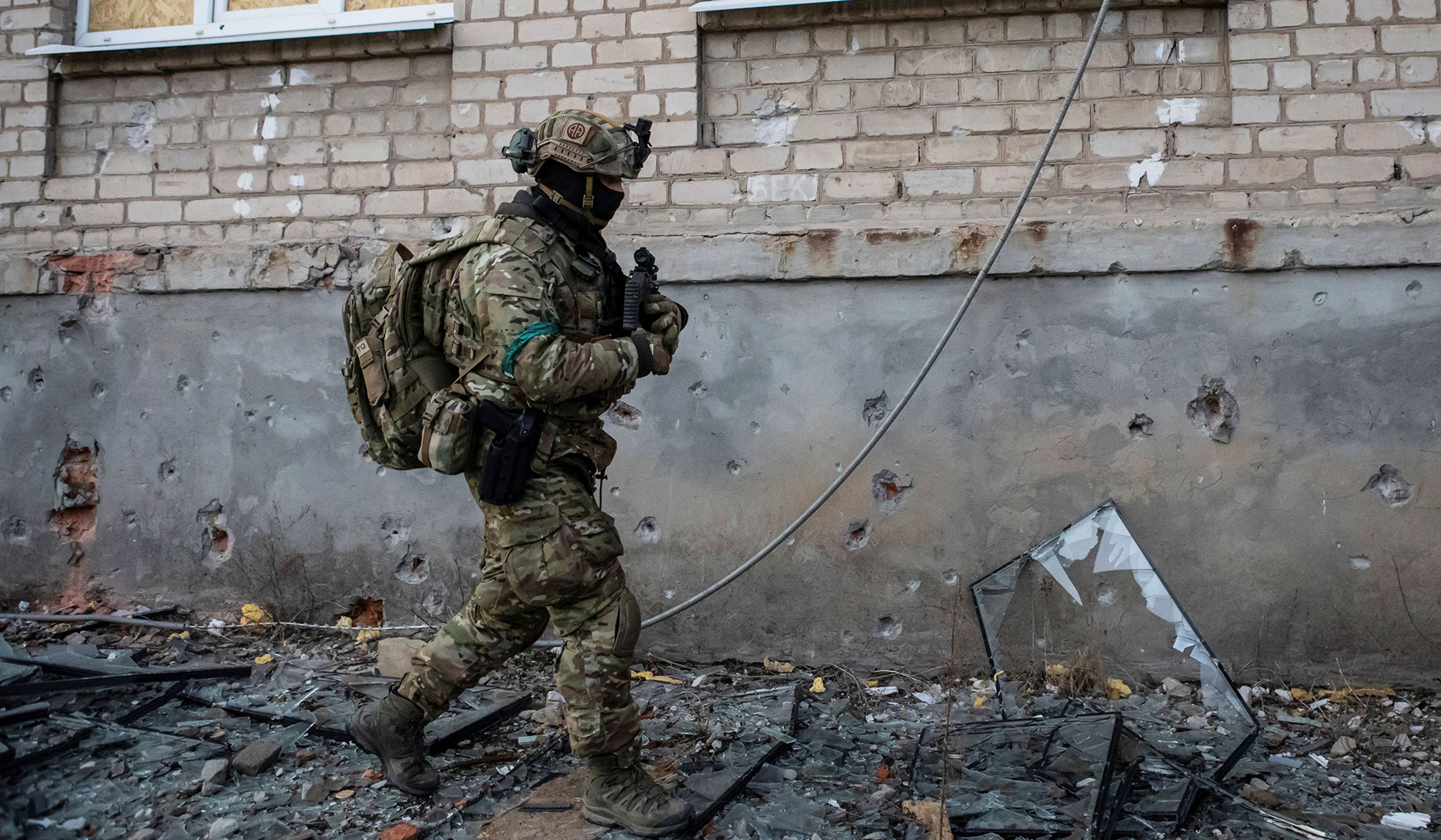


































Ukrainian servicemen exit an armored personnel carrier in the frontline town of Bakhmut, Donetsk Region, Ukraine, February 9, 2023.
Yevhenii Zavhorodnii/Reuters
• In a joint announcement, the U.S. and the Philippines have agreed to open four additional military bases to American forces. Situated across the Luzon Strait from Taiwan and facing China across the South China Sea, the Philippine archipelago is located at one of the world’s most important geopolitical crossroads. Therefore it is no small thing, and a very welcome one, that Beijing’s belligerence has pushed the Filipinos back toward the U.S.
• In Nicaragua, the dictatorship of Daniel Ortega released more than 200 political prisoners, sending them on a plane to the United States. The dictatorship has felt the squeeze of U.S. sanctions and other punitive measures. Among the prisoners released were Félix Maradiaga and Juan Sebastián Chamorro, both of whom had dared try to run for president in 2021. Monsignor Rolando Álvarez, the bishop of Matagalpa, had been under house arrest. The regime demanded that he get on the plane that was taking the political prisoners into exile. He refused, saying he wanted to consult with his fellow bishops first. In an act of fury, the regime then sentenced him to 26 years in prison. The Ortega regime is grotesquely cruel; its opponents are incredibly brave; and the U.S. government should keep applying pressure.
• The show trial of 47 Hong Kong pro-democracy figures kicked off, close to two years after they were initially charged under the Beijing-imposed National Security Law in February 2021. The list of pro-democracy leaders facing trial as part of this group is long, and its members are illustrious. They include longtime activists and politicians Joshua Wong and Benny Tai. Many of them are municipal legislators and other elected officials. The Chinese Communist Party has stripped away the autonomy that made Hong Kong different from normal cities on the mainland. Although it still maintains a façade of that previous status, as it attempts to court foreign tourism and investment, Hong Kong’s government is an arm of the Party. And Hong Kong has essentially become a regular Chinese city. The U.S. and its allies must use what little leverage they have to punish Hong Kongers who collaborate with Beijing and to shun the city.
• The Saudis increased the egregious prison sentence of a U.S. citizen convicted of sending tweets critical of Saudi leaders. Saad Almadi, a naturalized U.S. citizen of Saudi origin, was arrested in 2021 as he visited relatives in the kingdom. He was subsequently treated to the sort of barbarism that the world has come to expect from the Saudis: The court handed down a 16-year prison sentence, with a further 16-year ban on leaving Saudi Arabia. While awaiting trial, he initially held out on asking the U.S. embassy for assistance, for fear of torture; when he did eventually request help, the Saudi jailers indeed tortured him. Almadi’s family is upset at the Biden administration for declining to label his case as one of “wrongful detention” — a designation that devotes more resources to the situation. It’s Almadi’s son, Ibrahim, who brought the lengthening of the prison sentence — to 19 years — to public attention in an interview with the New York Post this week. “I want to see [Biden] give some recognition to my father,” he told the paper. We have an interest in maintaining ties with Riyadh, but we can do that and stand up for an unjustly jailed American.
• In a revealing report, the Afghan Analytics Network interviewed five former Taliban mujahideen relegated to the common drudgery of bureaucratic life after the U.S. withdrawal. It turns out that life in the Islamic Emirate of Afghanistan is more The Office than Rambo III. “I sometimes miss the jihad life for all the good things it had,” Abdul Nafi whined. “In our ministry, there’s little work for me to do. Therefore, I spend most of my time on Twitter.” Omar Mansur lamented that, during the jihad, “we had a great degree of freedom about where to go, where to stay, and whether to participate in the war.” But “these days, you have to go to the office before 8 a.m. and stay there till 4 p.m. If you don’t go, you’re considered absent, and [the wage for] that day is cut from your salary.” The men moaned about the allures of women and wealth in the big city, and, yes, Kabul’s rush-hour traffic. Huzaifa, a former sniper, complained that “the Taliban used to be free of restrictions, but now we sit in one place, behind a desk and a computer 24 hours a day, seven days a week. Life’s become so wearisome; you do the same things every day.” If the U.S. didn’t beat them, maybe ennui will.
• “The only solution is pretty clear,” Yusuke Narita said on a news program in December 2021, referring to the rapid aging of Japanese society. “Isn’t it mass suicide and mass seppuku of the elderly?” A junior economist at Yale, Narita, 37, may be a journeyman in American academe, but in Japanese media he’s found a large receptive audience. Young Japanese who resent the hold that their elders have on positions of power often complain as well that too much wealth, in the form of pensions and social welfare, is transferred from rising generations to retirees. Narita dances around his suggestion that people a few decades older than he should die faster. Predicting that involuntary euthanasia will be “more broadly discussed,” he insists that he doesn’t advocate it. Hiroyuki Nishimura, outspoken amoralist and the owner of 4chan, has joined Narita in public appearances. Like the platform’s most insidious users, Narita introduces offensive ideas only to disavow them when taken to task. He says that he speaks of “mass suicide” only as “an abstract metaphor.” It is a kind of thinking that has long been with us; we wish it would just die already.
• Salman Rushdie’s literary technique is what might be called fabulism: bending the laws of physics and the march of time at will in the course of large, otherwise real-seeming narratives. It can make for both striking effects and lazy writing. In 1989, some passages in The Satanic Verses altering the life of Mohammed made for a death sentence levied by Ayatollah Khomeini, the Iranian despot. Rushdie had to live years incognito; Hitoshi Igarashi, his Japanese translator, was killed. Rushdie himself gradually returned to a normal public life — until last August, when a jihadist fanatic attacked him before a talk in Chautauqua, N.Y. Rushdie suffered multiple stab wounds and lost his right eye. Now he is back once more, with a new novel, Victory City. The heroine, witnessing the suttee or ritual suicide of her mother, resolves to “laugh at death and turn her face toward light.” So does her gallant creator, defying ignorance and murder. Well done.
• LeBron James broke the NBA scoring record in the third quarter of a game his Los Angeles Lakers played against the Oklahoma City Thunder on February 7. The previous career record of 38,387 points was held by Kareem Abdul-Jabbar. James ended the game with 38,390, but play was stopped when the record fell for an on-court celebration. Abdul-Jabbar and James graciously acknowledged each other as living sports legends. A third legend hovered over the event, since James writes on his sneakers every game “In the Arena,” a phrase taken from Teddy Roosevelt’s 1910 oration, “Citizenship in a Republic”: “The credit belongs to the man who is actually in the arena, whose face is marred by dust and sweat and blood; who strives valiantly; . . . who at the best knows in the end the triumph of high achievement, and who at the worst, if he fails, at least fails while daring greatly, so that his place shall never be with those cold and timid souls who neither know victory nor defeat.” TR, who had a lifelong interest in sports — college football, in his case — would say, “Bully!”
• The 1619 Project has reared its ahistoric head like the mythological hydra, this time regrowing in the form of a Hulu television series. The pseudo-journalistic endeavor created by New York Times writer Nikole Hannah-Jones in the summer of 2019 has caused controversy in academic circles since its inception. But that hasn’t stopped the deluge of book deals, journalistic and literary prizes, and admiration from elites that have made the 1619 Project a bonanza. So it’s unsurprising that Hulu has just released a docudrama based on Hannah-Jones’s work. Ultimately, however, the accolades received by the 1619 Project and the visceral reaction of its creators to any criticism don’t change the fact that the central premise of the entire venture — that America’s true founding should be seen as the arrival of the first enslaved Africans in Virginia in 1619 — is based on shoddy history, sometimes contrived associations, and flawed methodology. Duplicitous fiction remains fiction, no matter its form.
• Ben Sasse, until recently a Republican senator representing Nebraska, has written about how American culture does a poor job of forming young adults. More evidence for Sasse’s thesis emerged on his first day as president of the University of Florida. A hundred protesters showed up at the door of his office, pounding on it and presenting a list of “demands.” The behavior of this rabble is not surprising, rather all too typical. This isn’t the first time students have protested him. Last year, during visits to campus to finalize his hiring, sessions open to student questioning were repeatedly disrupted. The protesters’ anger seems to derive largely from the fact that he has dared to voice conservative opinions on matters such as abortion and same-sex marriage. Never mind that Sasse has repeatedly said that he poses no threat to those who disagree with his views. Sasse served as president of Midland University in Nebraska before entering the U.S. Senate, and has thought and written extensively about how to improve colleges and universities. Sasse’s critics should give him a chance to enact his vision for reform, lest they continue to prove him right about their level of maturity.
• Burt Bacharach had the gift of being able to write songs that seem composerless. Songs that seem simply to exist, as part of the atmosphere. “Walk On By,” “Close to You,” “I’ll Never Fall in Love Again,” “Alfie,” “Raindrops Keep Fallin’ on My Head.” And on and on. Bacharach was a composer of popular music who had studied with some big classical composers: Darius Milhaud (his greatest influence), Henry Cowell, Bohuslav Martinů. He lived a Hollywood life, regularly appearing in the entertainment pages, marrying four times. (No. 2 was Angie Dickinson. No. 3 was Carole Bayer Sager.) Burt Bacharach has figured in the soundtrack of many of our lives. He has died at 94. R.I.P.
• Pete Reed was the founder of Global Response Medicine. A onetime U.S. Marine, he set up the only field hospital on the front lines of the Battle of Mosul. (In this battle, which went on from 2016 to 2017, Iraqi forces retook the city of Mosul from ISIS.) More recently, Reed went to Ukraine, to help evacuate people under siege and treat the wounded. He was killed in Bakhmut: targeted by a Russian anti-tank missile. Also killed was the injured woman he was helping. Writing in the Times of London, Oliver Marsden said, “Reed, 33, died attempting to save others. Every day, heroic volunteer medics like him from across the world risk their lives to help the vulnerable in Ukraine. Choosing to tempt death far from home in a frozen city, in the throes of a savage foreign war, is an act of bravery most people can’t even begin to fathom. Why do they do it?” Reed’s widow, Alex, had an answer, at least for her husband: “Pete wanted to help in the biggest, most tangible way possible, and he was just really, really good at it.” R.I.P.
• Pervez Musharraf was the president of Pakistan from 1999 to 2008. This was a very, very difficult job. In 2001 came 9/11 and America’s War on Terror. Musharraf was an ally in this war. Many, many Pakistanis did not want him to be an ally. This was the source of endless tension. Musharraf has died in exile — Dubai — at 79. A flawed but worthy figure in a convulsive time. R.I.P.
Biden’s Fantasyland
President Biden brought his Walter Mitty fantasies to a joint session of Congress. The State of the Union address was given by the same mythical hero who attended law school on a full academic scholarship and went to jail to protest apartheid. His fabled accomplishments this time included ending the Covid pandemic, reducing inflation and the deficit, and bringing the country together. He pledged heroically to block cuts to Medicare and Social Security and a national ban on abortion — none of which has a remote prospect of reaching his desk, as he tacitly conceded in the case of the entitlement programs. No Republican has proposed to condition an increase in the debt ceiling on sunsetting those programs; Biden stood up to their nonexistent plans.
Some of the posturing was, however, politically shrewd. He did a balancing act on the police, praising most of them while also calling for reform. The social causes the administration has spent much of its energy pursuing were relegated to a few sentences tucked more than an hour into the speech. Instead, he concentrated on a doubtless poll-tested economic agenda.
Price controls on medicine, airfare, and lodging are probably doomed thanks to the Republican House — and rightly so, given the baleful effects they would likely have on innovation and supplies. But price controls often sound appealing when those effects are ignored. Biden’s economic nationalism was also likely a vote-winner: Every president says he favors “buy American” procurement policies, even though they mean less bang for taxpayers’ buck. Nobody wants to see seniors’ benefits slashed; never mind that politicians who stop the discussion there are guaranteeing a crisis nobody wants either.
In the real world, these programs need reform more than they need to be protected from cuts; gun control is not the answer to violent crime; and resort fees, however annoying, are not among the top challenges the U.S. government ought to be tackling. What our politics lacks most is a sober insistence on reality.











Comments