• New York City mayor Eric Adams says he’s a vegan, but he eats fish. We hope he’ll take the same attitude toward the Democratic Party.
• Russiagate special counsel John Durham caused a stir in a court filing attendant to his prosecution of Democratic Party lawyer Michael Sussmann. Durham alleges that a Clinton-campaign operative — Rodney Joffe, who had a contract to help the government combat hacking — exploited his privileged access to Internet-traffic data in order to monitor Donald Trump, even at the White House after Trump took office. Sussmann’s defense claims Durham is distorting the evidence. As we observe this jousting, it is worth keeping in mind that Durham has charged Sussmann merely with lying to the FBI about the identity of his clients, Joffe and the Clinton campaign, when he proffered the data. Durham has not alleged fraud on the government, and has charged neither Joffe nor other Clinton operatives. Durham must complete his probe and file a final report, even as he prosecutes Sussmann and Igor Danchenko, whom he has separately charged with lying to the FBI (about his sources for the Steele dossier). It is fair to note how indifferent, even hostile, the press has been to Durham’s probe compared with Mueller’s. It is also fair to note that, like Mueller’s probe, Durham’s so far features little fire under the smoke.
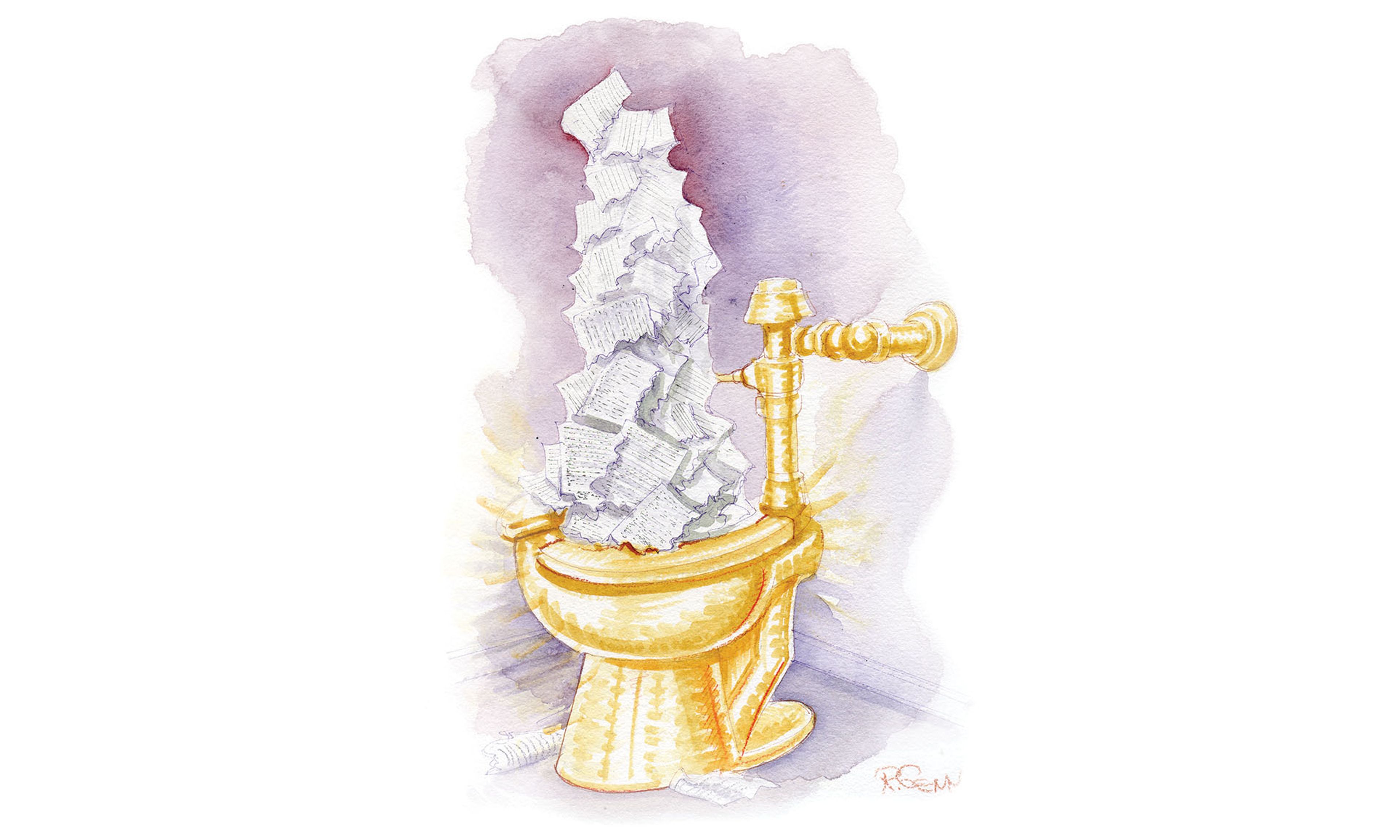
• Trump rampantly flouted legal requirements for preserving records of his presidency. The House January 6 Committee, which is homing in on Trump’s activities during the riot, knows from other witnesses that the then-president made serial phone calls as it ensued. Yet White House records do not account for those calls. The committee also learned that, when he made his quietus, Trump spirited many boxes of documents out of the White House. The national archivist has been struggling to get them back. Many appear to be covered by the Presidential Records Act (PRA), and some are reportedly classified. Other papers were reportedly eliminated during the Trump years via commode. The PRA has no enforcement mechanism (it relies on the presumed good faith of former presidents), but mishandling classified information (which Trump is no longer empowered to declassify) is a criminal offense, as is obstructing a congressional investigation. The committee is asking questions. So, reportedly, is the Justice Department. Among the many costs of the department’s laxity toward Hillary Clinton in 2016 is that any enforcement of the law against Trump now will be seen, with some justification, as partiality.
• The Washington Post reports that two U.S. military analyses conducted last fall, after the American evacuation of Afghanistan, faulted the White House and the State Department for failing to prepare for a rapid Taliban advance or for the possibility that Americans might need to be evacuated from Kabul. Drawing on more than 2,000 pages of documents, the report highlights that senior military commanders repeatedly warned the White House that withdrawal could lead to a catastrophic deterioration of the American position. One senior officer responsible for coordinating the evacuation, Navy rear admiral Peter Vasely, told investigators that U.S. forces would have been “much better prepared to conduct a more orderly” withdrawal “if policymakers had paid attention to the indicators of what was happening on the ground.” The report is sobering — but not for President Biden. “That’s not what I was told,” he said to NBC News. When asked whether he was rejecting the reports, Biden said, “Yes, I am. I am rejecting them.” Biden seems determined to be consistent about rejecting alarms, both beforehand and after they have been proven true.
• Stacey Abrams, the Georgia crackpot and election-denier, put herself into the soup by appearing in photos unmasked amid schoolchildren who were obliged to cover their faces in her presence. Because Democrats have made masking a test of one’s good character, Abrams opened herself up to allegations of hypocrisy and unseriousness, allegations that were quickly and rightly supplied by Republican critics such as Governor Brian Kemp and former senator David Perdue. Abrams at first tried to brazen her way through the controversy, characterizing Republicans’ criticism as a “false political attack” and racist to boot. Lying about being lied about comes naturally to Abrams. Alas for her, the pictures spoke for themselves.
• When he ran for president in 2019, Beto O’Rourke made a splash by promising to confiscate the most commonly owned rifles in the United States. Asked by debate moderator David Muir whether his “buyback” idea meant that he was “proposing taking away [Americans’] guns,” O’Rourke took the opportunity to create a meme. “Hell, yes, we’re going to take your AR-15, your AK-47,” he said. The candidate was pleased with the effect that this promise had, for, within a few hours, his campaign was tweeting out the video and selling merchandise emblazoned with the line. Invited to reconsider a few days later, O’Rourke declined. Now, however, O’Rourke is running to be governor of Texas, where this vow is a political liability. And so, like so many Internet tough guys, he’s simply pretending that he never said what he said. On the campaign trail in East Texas in early February, he told a crowd of supporters, “I’m not interested in taking anything from anyone. What I want to make sure that we do is defend the Second Amendment.” Audacity, thy name is “O’Rourke.”
• Progressives are getting what they deserve in Illinois. They put everything they had into backing Marie Newman in the Democratic primary for the third congressional district. The incumbent there was Dan Lipinski, a conventional Democrat except in one respect: He’s pro-life. Being pro-union, pro–gun control, anti–Tax Cuts and Jobs Act, and anti-Trump simply isn’t enough for progressives. You must support abortion, or else they’re coming for you. Lipinski defeated Newman in 2018, but progressives succeeded in 2020, with Newman squeaking by Lipinski 47–45 in the primary. Now the Office of Congressional Ethics (OCE) has unanimously recommended that she be investigated “because there is substantial reason to believe that Rep. Newman may have promised federal employment to a primary opponent for the purpose of procuring political support.” The documentary evidence is damning. Newman signed a contract with a potential primary challenger in 2018 that said she would hire him as a foreign-policy adviser if she won election to Congress. The OCE has emails that contradict Newman’s testimony and seem to indicate that she knew exactly what she was doing when she signed this contract. Promising federal employment in exchange for political support is not just unethical — it’s against federal law. Progressives said they wanted to replace Lipinski with a more typical Illinois Democrat, and they certainly did.
• Democrats have returned to an outdated theory to find their newest excuse for high inflation. Nancy Pelosi told George Stephanopoulos: “The fact that people have jobs always contributes to increase in inflation.” No, it doesn’t. The theory of a trade-off between low unemployment and high inflation was once part of the conventional wisdom but has been destroyed by observation. The unemployment rate was lower than now for much of 2000 and 2018–19, and the labor-force-participation rate was much higher, but inflation was much lower. The proximate causes of today’s inflation are supply shortages and an excessively loose monetary policy. Neither is a beneficial trend that happens to have an unfortunate side effect, and both require policy responses that the Democratic Party cannot stomach or, perhaps, fathom.
• The House passed the “America COMPETES Act,” a 2,900-page, $250 billion industrial-policy bill that the Biden administration and its congressional allies are pitching as necessary for the United States to compete with China. The bulk of the bill is, however, a partisan spending package, with billions going to scientific research that has little to do with national security and to projects such as the U.N.’s unaccountable Green Climate Fund. Senate Republicans may try to edit the bill into better shape. But the House Democratic negotiating position is so radical that Congress looks incapable of producing a final text that helps us counter the Chinese Communist Party. Lawmakers should scrap this attempt and start from scratch.
• The Democrats’ push for universal pre-K — a major component of the now-stalled Build Back Better legislation — takes it for granted that, costs aside, such programs are good for children. The problem is that we have plenty of reasons to doubt that. A new study of a state-funded preschool program in Tennessee found not only that the program failed to produce lasting gains, but that by sixth grade, participants were doing worse on several academic and behavioral measures than their peers who did not attend the program. (The study compared students who were admitted through a lottery with those who didn’t make it in.) The kids aren’t learning anything. Are adults?
• Manhattan DA Alvin Bragg has been furiously clarifying his soft-on-crime “Day One memo.” The progressive prosecutor campaigned on a promise that his office would not seek jail time for most criminal conduct, including robbery, assault, and gun possession, unless there was a “genuine risk of physical harm.” But since taking office on January 1, Bragg has come under intense pressure from police officers, politicians, business owners, and the public in the face of a rising tide of crime, including the January murder of two NYPD officers, Jason Rivera and Wilbert Mora, in Harlem. Now, Bragg has declared that his original guidance was “a source of confusion” and that prosecutors should apply their “judgment — and experience — in every case.” Democrats are learning that even in deep-blue Manhattan, the public still cares about law and order.
• Blue-state governors in Connecticut, New Jersey, Delaware, Illinois, and elsewhere have announced that their statewide mask mandates are ending. Even the District of Columbia, whose Covid restrictions have been among the strictest in the country throughout the pandemic, announced an end to its mandate. The shift has been most stunning in Virginia, where Republican governor Glenn Youngkin’s executive order to make masks optional in public schools was initially greeted with derision and scorn by Democrats — only to have ten Democrats in the Virginia Senate join all the Republicans in voting to amend education legislation to give parents the choice. It’s hard not to notice that this sudden shift coincides with terrible polling numbers for President Biden and many elected Democrats nationwide. Unfortunately, there seem to be two holdouts: public schools and the CDC. Virginia aside, some states are letting mask mandates lapse for everyone except schoolchildren, even though the evidence is weak that the masks are helping and strong that children are not very susceptible to severe forms of the illness. CDC director Rochelle Walensky said her agency is not going to change its masking guidance yet (it still encourages masking indoors). At this rate, Covid guidance will join the pantheon of CDC advice that everyone already ignores, such as eating steak only well done and not eating raw cookie dough.
• The Texas Heartbeat Act is having its intended effect. In September 2020, 5,400 abortions were performed in the state. In recently released abortion data for September 2021, the state’s department of health and human services found that 2,197 abortions were performed that month — a 51 percent decrease from the previous year. The Texas Heartbeat Act places the law’s enforcement mechanism in the hands of private citizens rather than state officials, allowing citizens to sue anyone found helping a woman obtain an abortion after a fetal heartbeat is detected. September 2021 was the first full month after the act took effect, and while reports suggest that some women traveled out of state to obtain abortions, Texas pregnancy-resource centers reported helping an increased number of women. The law’s legality is still being challenged, but for the time being, it seems to be saving lives.
• The school system of Montgomery County, Md., is reviewing its social-studies curriculum for all of its students, pre-K through twelfth grade. Administrators promise to come up with a curriculum that “strengthens students’ sense of racial, ethnic, and tribal identities.” This is maybe the last thing that needs strengthening in America. It could even use some weakening, and the national motto — E pluribus unum, or “Out of many, one” — could use greater attention. In 1991, Arthur M. Schlesinger Jr., that patriotic liberal, published a book called “The Disuniting of America.” He warned against such a disunion — against American balkanization. “Our task,” he said, “is to combine due appreciation of the splendid diversity of the nation with due emphasis on the great unifying Western ideas of individual freedom, political democracy, and human rights. These are the ideas that define the American nationality — and that today empower people of all continents, creeds, and colors.”
• Writing in City Journal, Abigail Shrier tells a horror story of how transgender ideology has infiltrated family law, resulting in terrible injustice and the undermining of parental rights. The soon-to-be-divorced Ted Hudacko was stripped of all parental and custody rights by California Superior Court judge Joni Hiramoto after he refused to consent to his 16-year-old son’s medical transition. The real shock in his wife’s leaving him was her announcement that their eldest son, Drew (not his real name), was a girl. Drew had shown no signs of gender dysphoria, and Hudacko was concerned about the permanent harm that transition would bring, including infertility and a lifetime as a medical patient. Judge Hiramoto appointed a minor’s counsel, who concluded that Hudacko was insufficiently supportive of his son’s new identity. Later, it was learned that Hiramoto’s own son identified as transgender and that she had publicly supported his transition. If transgender ideology is not resisted now, it will rapidly become deeply entrenched in our medical and legal systems.
• As we go to press, Russia is on the verge of a further and extensive assault on Ukraine. Some 130,000 Russian troops are massed on the Ukrainian border. Ordinary Ukrainians, including grandmothers, are training for a civilian defense force. Russia’s state media are equating Ukrainians with Nazis. The United States has ordered all of its diplomatic personnel to leave the country, except for a handful, who will relocate from the embassy in the capital, Kyiv, to the city of Lviv, in the far west. The crisis has been caused by one man and one government: Vladimir Putin and his dictatorship. It has not been caused by Ukraine, the United States, NATO, or the West. At issue, fundamentally, is Ukraine’s right to exist: its right to exist as an independent and sovereign nation. The United States and every other democracy should affirm this right, even, and especially, if Moscow once more subjugates this country.















Russian T-72B3 main battle tanks drive during drills in Rostov Region, Russia, January 27, 2022.
Sergey Pivovarov/Reuters
• When you hold the Olympics in a dictatorship, what do you get? In 1936 Nazi Germany wrote the script for the answer to that question, which communist China has been following in Beijing this winter. China consigns its Uyghur subjects to prison, slave labor, and forced sinification. So a prop Uyghur was allowed to light the Olympic torch. Chinese tennis star Peng Shuai accused a former vice premier of sexually assaulting her. So she gave an interview to French journalists in which she said it was all a “huge misunderstanding,” while a Communist Party apparatchik stood in the room watching her. (He was visible in a mirror. Mistake? Or a demonstration of the state’s power?) Chinese tech spies on Chinese citizens in myriad ways, from the Internet to street-corner sensors. So American athletes were warned by our Olympic committee not to bring any personal devices, which would surely be hacked. Chinese nationalism, albeit whipped up by the regime, is also spontaneous. So two skaters, Nathan Chen and Zhu Yi, both American-born children of immigrants, were closely watched. Chen competed for the U.S. and won a gold medal; Zhu competed for China and fell in her event; both were heaped with online abuse. There are no events for mendacity, oppression, or rudeness. Communist China would win going away.
• C’est officiel. France’s populist presidential candidates, of the Left (Jean-Luc Mélenchon) and the Right (Marine Le Pen, Éric Zemmour), back Russia’s threatened Anschluss of Ukraine. “Who wouldn’t do the same, with a neighbor like that?” (Mélenchon). “Ukraine belongs to the Russian sphere of influence” (Le Pen). “The Russian point of view is legitimate” (Zemmour). All three, relatedly, want France to leave NATO. There is an element of go-it-alone gloire in all this, recalling the moment in 1967 when Charles de Gaulle left NATO’s integrated military-command structure. There is also plain old anti-Americanism, which has a long French history going back to Citizen Genêt and Napoleon. The French Left views us as false revolutionaries, the French Right as geopolitical and cultural rivals. There are always, bien sûr, French pro-Americans, from Lafayette to Tocqueville to the donors of the Statue of Liberty. Plus they like Jerry Lewis. But the anti-Americans are croaking a very old song.
• Hugo Torres was a Sandinista general, a hero of the revolution. In 1974, he led a daring and successful guerrilla raid to free Daniel Ortega and other Sandinistas from prison. Last summer, the one-time hero was arrested and imprisoned by his old comrade, Ortega. Anticipating arrest, Torres made a video, saying, “I am 73. At this stage of my life, I never thought I would be fighting against another dictatorship now more brutal, more unscrupulous, more irrational, and more autocratic than the Somoza dictatorship.” Torres has died, almost certainly from abuse. The Sandinistas’ political prisoners are kept in wretched conditions. Someday Nicaragua will be free of Ortega and his gang, but that day seems very slow in coming.
• Amnesty International, a nongovernmental organization, has published a 280-page report that takes the side of the Palestinians against the Israelis, whose “oppression and domination,” the report says, “amounts to apartheid.” This is a fine example of what is named by the Roman legal term suppressio veri, or suppression of the truth. Members of the United Arab Party are in the governing coalition. There are no pass laws or restrictions on freedom of association. Israeli Arabs are in the Israeli diplomatic service, the armed forces, and the bar. The report omits all mention of the oppression that Palestinians inflict upon themselves. Mahmoud Abbas, nominally president, is now in the 17th year of a five-year mandate and has canceled elections he was sure to lose. Anyone selling land to an Israeli risks getting shot as a traitor. A current scandal centers on Nizar Banat, a campaigner against corruption; security forces beat him to death in his own house in front of his family. So much one-sided criticism inescapably raises the question of motive.
• The blockade of the Ambassador Bridge, which connects Detroit, Mich., and Windsor, Ontario, was brought to an end after nearly a week. Most protesters left of their own accord when police arrived; only a few dozen arrests were made. That portion of the “Freedom Convoy” protests was harming American workers, who were having their shifts canceled because parts were stuck on the wrong side of the bridge. Now comes the harder part, which is internal to Canada: Protesters are still massed in Ottawa. Prime Minister Justin Trudeau has invoked wide-ranging emergency powers to clear the protesters and seize the money donated to them. He seems to be treating all of them as enemies of the state, which they are not, and regarding them as such is poor practice in a liberal democracy. Canada should never have reached this point. Conservatives had a chance to unseat Trudeau’s Liberal government in elections in September, but under the leadership of Erin O’Toole, the Conservatives ran as Liberals-lite and lost. O’Toole is now out, and the party is under interim leadership. The lack of credible Conservative opposition is the root cause of these disturbances.
• Nikole Hannah-Jones took to Twitter to respond to our issue on American slavery and the 1619 Project. Those familiar with how she typically responds to engagement with her work — usually on Twitter — were unsurprised to find much ad hominem sneering and no substance. She opened by complaining that we “couldn’t find any women, apparently, and only one Black person, apparently, to write about a slavery project created by a Black woman.” This sort of identity-group essentialism — in which the race and gender of the writer are more important than the writer’s reasoning and evidence — has been endemic to efforts by Hannah-Jones to dismiss critiques by the nation’s leading historians in areas of their own, but not her, expertise. In 2019, she dismissed the eminent James McPherson with “LOL. Right, because white historians have produced truly objective history.” Ignoring the substance of four of our five essays, she saved most of her ire for Wilfred Reilly’s contribution but managed to completely miss his point. She confused his argument that slavery was not, in a macroeconomic sense, good for the American South with the entirely distinct contention that it did not profit individual slave-traders and slave-owners. Hannah-Jones wants to be taken seriously as a public intellectual who deserves her Pulitzer Prize and her university professorship and whose historical writings are taught in schools. She has behind her the mighty institutional power of the New York Times. With the privilege of those positions come responsibilities: to defend one’s work and engage with one’s critics in the way that scholars such as McPherson and Gordon Wood have done for decades. Readers can, and should, consider her refusal to do so as a mark against the credibility of the work to which she has devoted the past three years.
• Jason Kilborn, a law professor, is filing a First Amendment suit against the University of Illinois after being suspended and investigated last year. Students triggered a woke panic when Kilborn, who was offering a hypothetical example of workplace discrimination, included slurs in redacted form on an exam. George Will wrote about the episode, noting his lack of surprise that “a sludge of ignorance and cowardice” continues to infect progressive campuses. The university’s Office for Access and Equity concluded that Kilborn had “created a racially hostile environment” for black students and committed “harassing conduct.” Despite apologizing to students (and this despite having done nothing wrong), Kilborn was subjected to 20 hours of coursework, the writing of “self-reflection” papers, sensitivity training, and meetings with diversity officers. It turns out that Kilborn didn’t need to give his students an example of intolerance in the first place. They had already mastered the concept.
• A recent NPR story considered the knotty question of what color one’s emojis should be when one is texting. For most of us, the answer is yellow, because that’s the default color they come in. But, as the story explains, “choosing a skin-tone emoji can open a complex conversation about race and identity.” Of course, for NPR, buying a jelly doughnut can open a complex conversation about race and identity, but just see if your empathy can withstand these predicaments: A part-Asian man frets over which color is closest to his actual skin tone; a brown-skinned woman wonders what it means when a light-skinned friend texts her with a dark-skinned emoji; another listener uses brown for personal and yellow for business (“I just don’t have the emotional capacity to unpack race relations in the professional setting”); while some whites “stick with the yellow emoji because they don’t want to assert their privilege by adding a light-skinned emoji to a text.” Still others contest the assumption that yellow emojis are neutral, saying they “signal a kind of a lack of awareness of your white privilege in many ways.” The bad news, then, is that everything is racist; the good news is that none of it actually matters.
• The eight regional winners of Minnesota’s Name a Snowplow contest have been announced as “Betty Whiteout,” “Ctrl Salt Delete,” “The Big Leplowski,” “Plowasaurus Rex,” “Scoop Dogg,” “Blizzard of Oz,” “No More Mr. Ice Guy,” and “Edward Blizzardhands.”
• Queen Elizabeth II has sat upon the British throne for 70 years now. In documented history, only three monarchs, anywhere, have reigned longer. During her reign, she has had 14 prime ministers, starting with Churchill. Incidentally, there have also been 14 U.S. presidents, starting with Truman. “She never puts a foot wrong,” goes a line about her. Everyone puts a foot wrong now and then. But Queen Elizabeth has been splendid in her job. Marking the 70th anniversary, Justin Welby, the archbishop of Canterbury, had a nice line about her: “She takes her duties seriously, but she doesn’t take herself very seriously.” We Yanks are by no means unpatriotic to salute her.
• In 2000, Tom Brady, of the University of Michigan, was drafted in the sixth round, and 199th overall. He became the greatest football player of all time, according to many. Quarterbacking two teams, he appeared in ten Super Bowls, winning seven of them. In this past season, his 22nd, he was 44 years old. How did he do? Did he stumble through the season respectably, keeping his dignity? More than that: He led the NFL in passing yardage. And in passing touchdowns. He also set an NFL record for completions in a single season (485). Brady has now retired, at or near the top of his game. Prudent people avoid saying, “We will never see his like again.” There are always new stars, new wonders. But perhaps this is a moment for imprudence: We will never see the likes of Tom Brady again.
• P. J. O’Rourke was not a Russell Kirk conservative — his leisure activities included firing a machine gun, while high as a kite, off Hunter S. Thompson’s porch. He had an antic libertarian voice, and when he chose, real journalistic chops. His book Vacations in Hell includes searing vignettes of societies in collapse worldwide (including some collapsing under the weight of right-wing tyranny). After learning his craft on underground papers and National Lampoon, he moved on to Rolling Stone, the American Spectator, and the Weekly Standard. In person he was genial, amusing and amused — as willing to laugh as to bring laughter to others. The literary founders of the modern American Right passed long ago. Now too soon we begin to bid farewell to their successors. Dead at 74, R.I.P.
• Early in his career as an editor, Jason Epstein launched Anchor Books, a division of Doubleday that published paperback editions of serious books that his peers, many of them veterans attending college on the G.I. Bill, could not otherwise have afforded: a boost to literacy in mid-century America. Later in his career he helped found the Library of America, a handsome uniform edition of American classics akin to France’s Bibliothèque de la Pléiade. In between, he and his wife, Barbara, plus poet Robert Lowell and critic Elizabeth Hardwick, started the New York Review of Books during a newspaper strike when the New York Times Book Review was on hiatus. NYRB has been lifelong left-wing, once printing a recipe for Molotov cocktails on its cover. Yet it also published Soviet and Eastern European dissidents, and even at its worst runs at least one interesting piece per issue. A useful life in the book trade. Dead at 93, R.I.P.
• “Cant comforts,” Todd Gitlin wrote. It “makes for efficient simplifications, but only at the price of rigidity.” He meant the rhetoric of identity politics at both ends of the political spectrum. The president of Students for a Democratic Society in the 1960s, he remained politically engaged throughout an academic and journalistic career that spanned six decades and the North American continent from Cambridge to Berkeley, with a couple of detours in Europe. Ever loyal to his side, the Left, he criticized it for “marching on the English department” and neglecting the hard work of staking out common ground with people who don’t live in college towns or on the Upper West Side. At Columbia he taught in the Core, the great-books curriculum, as well as in the journalism school and the sociology department. In 2020 he signed a widely publicized open letter warning against illiberalism and intolerance on both the left and the right. Last year he helped organize the publication of a bipartisan open letter in defense of liberal democracy. He wrote countless articles and 17 books, on the Sixties, the media, the culture wars, and much else. Dead at 79. R.I.P.
A Foolish Censure
The Republican National Committee voted to censure Representatives Liz Cheney and Adam Kinzinger for “actions in their positions as members of the January 6th Select Committee not befitting Republican members of Congress.” This was both morally repellent and politically self-destructive.
Republicans who did nothing to encourage the mob — of which there are many — need not wear a hair shirt over the disgrace of January 6, but when they choose to talk about it, they should tell the unsparing truth. Fair-minded people can, of course, criticize the Democrats’ norm-breaking partisanship on the January 6 committee. But there is no conceivable political benefit to the Republican Party or its members — other than Donald Trump — in defending or minimizing January 6. The American people are neither itching to hear a defense of rioters nor joining Democrats in regarding it as a reason to repudiate the Republican Party and all its works.
The RNC’s statement denounced “a Democrat-led persecution of ordinary citizens engaged in legitimate political discourse” and a “Democrat abuse of prosecutorial power for partisan purposes.” This was, predictably, read as an argument that the action of the mob was nothing but “legitimate political discourse” and that nobody should be prosecuted. To the extent that the party did not intend this meaning — and RNC chairwoman Ronna McDaniel, doing damage control, had to come out in interviews and op-eds to explain that it was not meant that way — its wording was political malpractice of the highest order coming from people whose entire job is politics.
To the extent that the censurers were frustrated by Cheney and Kinzinger’s politically unhelpful focus on January 6, their resolution was self-defeating. Elected Republicans who were not consulted in drafting the censure and do not endorse its sentiment were compelled to take a stand on it. Mitch McConnell was one of several to push back: “It was a violent insurrection with the purpose of trying to prevent a peaceful transfer of power after a legitimately certified election. . . . The issue is whether or not the RNC should be sort of singling out members of our party who may have different views from the majority. That’s not the job of the RNC.”
Such censures have become all too common from political-party operatives attempting to vent their spleens at popularly elected public officials. In Arizona, the Republican Party issued a bizarre censure last year of sitting governor Doug Ducey and former senator Jeff Flake. Not to be outdone in self-destructiveness, Arizona Democrats censured sitting senator Kyrsten Sinema. The first rule of party operatives should be “do no harm.” Attacking a party’s own elected officials, through channels that reflect neither the voters nor the people they elect, violates every rule of political sense.
Cheney and Kinzinger are of course open to criticism. Kinzinger’s endorsement of a primary challenger against Senator Mike Lee, for example, seems myopic. But singling them out for censure, in a party that also includes the likes of Marjorie Taylor Greene and Paul Gosar, was a serious misjudgment. The RNC bought the entire party a bounty of bad headlines, and for no good purpose. Its action will only encourage those who see riots as legitimate political discourse. A mistake, and worse, a shame.











Comments