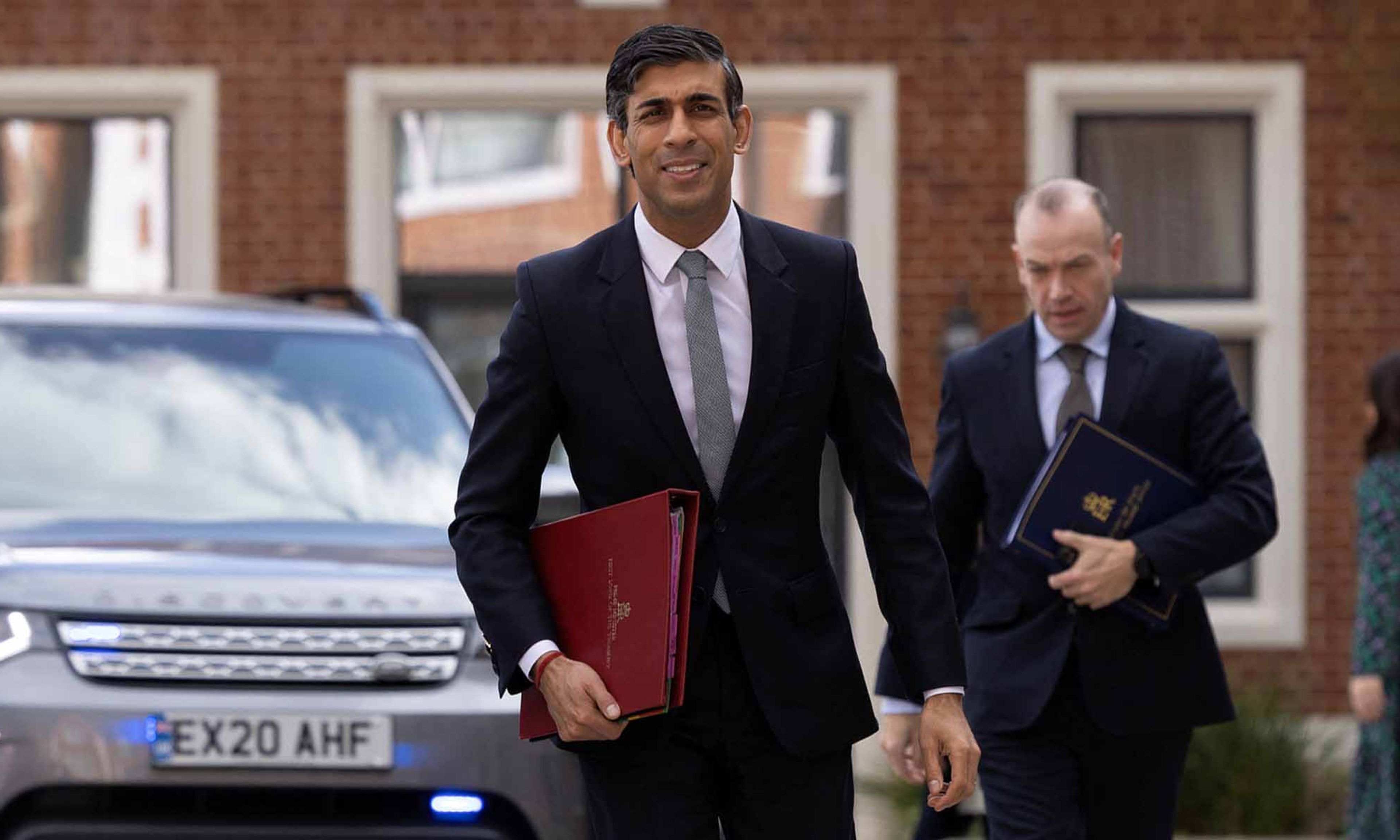
After an exciting period of confusion, policy contradiction, and bold ambition that sometimes went nowhere under the premierships of Boris Johnson and Liz Truss, British statecraft is starting to settle down around modest and realistic attempts to craft a post-Brexit national identity as Global Britain. There’s more continuity of policy between the new Tory prime minister, Rishi Sunak, and his two predecessors than any of them will admit. (The same is true of Presidents Trump and Biden, but the background music there is more easy-listening than Elgar.)
All three PMs have wanted to finalize the U.K.’s post-Brexit relationship with the European Union; to patch substantial policies onto the rhetorical framework of Global Britain; to strike a reasonable balance between the two approaches; and to unify a restive Tory Party around them between now and an election in late 2024. In the last two months Sunak has taken two long steps towards these goals: signing the Windsor Framework to wrap up the post-Brexit Trade and Cooperation Agreement (TCA) between the U.K. and the EU, and persuading eleven Asian and Latin American countries to admit Britain into their Comprehensive and Progressive Agreement for Trans-Pacific Partnership (CPTPP).
Both these deals are important because they settle outstanding problems and set clear directions for U.K. trade and foreign policies. Unfortunately, they differ too. The CPTPP is an unqualified gain for Britain and Sunak — the only question is how valuable it’s likely to prove. But the Windsor Framework has left important “stakeholders” unhappy and sent serious and stubborn disputes with them into cold storage rather than settling them for good.
It was designed to solve a problem that Prime Minister Theresa May handed on to Boris Johnson by oddly conceding that it was Britain’s responsibility to ensure that Brexit would not entail a “hard border” (i.e., customs barriers) between Northern Ireland and the Republic. London didn’t want a hard border, nor did Dublin under the Irish government then in power. It was Brussels that demanded customs barriers between the EU and the U.K., allegedly to ensure the integrity of the single market from violation by the tiny percentage of EU–U.K. trade that crossed the Irish border. A new Irish prime minister, Leo Varadkar, seeing the potential of “weaponizing” the issue to obstruct Brexit and perhaps to advance Irish unity, hinted that a hard border in Ireland might invite a renewal of IRA violence. Shock and horror all round. And if there couldn’t be a hard border in Ireland, where could it be?
Geographically, the only alternative was a border in the Irish Sea, dividing the United Kingdom in two and subjecting Northern Ireland to EU laws and regulations. May had handed Boris the choice between a Brexit that didn’t include Northern Ireland and no Brexit at all. That being no choice at all, Boris accepted the Northern Ireland Protocol, got Brexit for most of the U.K., and determined to solve the Protocol problem later. But Boris was gone and “the adults were in the room” (to quote an almost official government slogan) when the Protocol was replaced by the Windsor Framework, and Sunak’s priority was to placate the EU rather than the Unionists in Northern Ireland. The result is a document that removes significant obstacles to trade between Britain and Northern Ireland but leaves the U.K.–EU border in the Irish Sea, alienates the Unionists, and makes many Tories fearful that Sunak has given Brussels more diplomatic leeway to obstruct attempts by the whole U.K. to diverge from EU regulations.
Much of this is highly controversial. But ministers escaped detailed investigation of the Framework by allowing only 90 minutes of parliamentary debate, and because it was backed by the Labour opposition, they easily overrode a small rebellion of Brexiteers and Unionists.
Sunak’s main political objective of soothing Europe has thus been achieved, but the controversy over the Framework is unlikely to be over. Lawyers differ about what it will mean in practice; we’ll discover the reality when bureaucracies and the courts apply it. It could well be that, as often when the adults in the room have rammed through a measure in the dark, serious public controversies over it erupt, indeed multiply, only as its provisions become known. Sunak apparently hopes that if this happens, Unionist fears will diminish as the people of Northern Ireland realize that they benefit from being in two trade jurisdictions — the EU and the U.K. — at the same time. Perhaps so. That’s a very Sunak argument: economics über alles. But it may prove tone-deaf to a community that defended its national identity and constitutional rights against a terrorist campaign lasting 30 years and that believes the Windsor Framework is an existential threat to them.
In short, the Windsor agreement is securely in place until the next election, but politics between now and then is likely to be roiled by angry Unionists and anxious Tories mounting politically inconvenient criticisms of a deal that has failed to end the Brexit debate. Sunak will be helped in navigating these stormy waters, however, by his success in joining the CPTPP, which is seen by its critics as well as its supporters as a very big deal and a beneficial one for Britain. I agree and offer four reasons for thinking so:
First, the CPTPP is a very big deal that will undoubtedly benefit Britain economically. It is one of the world’s largest free-trade agreements, with a combined GDP of some $13.5 trillion and currently a total market of 500 million people (and growing). The accession of the U.K. will make it approximately equal in size to the post-Brexit EU, but unlike the mature EU, its members are among the fastest-growing economies in the world. And as Britain’s Department for Business and Trade (quoted by a CSIS study) estimates, Britain will be eligible for tariff-free access for over 99 percent of its goods exports plus the liberalization of financial and digital services, which, for the Brits, is a significant gain.
Second, the CPTPP is a straightforward free-trade agreement with none of the political superstructures that made the EU such an uncomfortable place for the Brits, as Daniel Hannan pointed out when joining it was first suggested. It has no CPTPP parliament, no free movement of labor, no budgetary contributions, no common currency, no foreign supreme court, no flag and anthem — in short, no intrusions upon U.K. sovereignty that would lead eventually to its abolition. Economically, its regulatory system rests on the mutual recognition of each member state’s standards rather than the EU’s bureaucratic “harmonization” of them, which grants Brussels de facto power to intervene in every industry in the EU. And, finally, the CPTPP is not a jealously exclusive relationship like the EU; it allows its members to join other free-trade agreements. All in all, it suits the classical-liberal, free-trading, independent Brits. That’s not the only tradition of political economy in the U.K., but it’s the central and intellectually strongest one.
Third, the CPTPP is the nearest thing in economics to the post-Brexit concept of Global Britain and, as such, a natural partner to the AUKUS deal on submarine production and defense technology between the U.S., the U.K., and Australia. They both help to cement Britain’s contribution to the American system of alliances throughout Asia and — though this is rarely discussed in polite company — to strengthen the real trade, diplomatic, and military links of the Anglosphere (thought to be a mythical beast until recently).
Fourth, and perhaps most important in the context of this article, Britain in the CPTPP is a Britain that would find it much harder to rejoin the EU or even to accept “dynamic alignment” with the EU’s ever-growing regulations. Reentering either the customs union or the single market would be impossible for a CPTPP member. Either would require resignation from it — which, as Global Britain skeptic William Atkinson notes hopefully on the Conservative Home website, takes only a simple notice of less than a year. But if the CPTPP delivers any of the beneficial effects it plausibly promises, it’s hard to see the U.K. jumping out of the hammock into the torture chamber again.
For that very reason it invites those in the U.K. who despise and want to reverse Brexit — the BBC, the Guardian, woke civil servants, Oxbridge dons, etc., etc., etc. — to undermine the case for the CPTPP too, and, if possible, to block accession while there is still time. Hence the immediate spread across the media and internet of alarmist myths about the consequences of CPTPP entry, from the collapse of labor protections to bad non-British food.
One statistical comparison in particular has excited the anti-Brexit claque: namely, that the U.K. has taken a 4 percent hit in GDP from Brexit for a miserly gain of 0.08 percent from joining the CPTPP. An easy statistical hit rooted in error goes halfway round the internet before the WTO has got its boots on, and in this case, Catherine McBride of the online publication Briefings for Britain tracks the “4 percent loss of GDP” estimate to a document that cites it as what Britain would lose if the country left the EU under WTO rules without a U.K.–EU free-trade deal. As she then points out, the U.K. has a free-trade deal with the EU — namely, the TCA — and that deal has “successfully preserved our goods exports to the EU in 2022 at approximately 2019 levels. This is fine because exports to the EU weren’t growing pre-2019 anyway.” (And trade between the EU and U.K. in both directions had been falling since 2006.)
So the U.K. has not exchanged the EU for the CPTPP but added the CPTPP to the TCA and is therefore getting the best of both worlds.
The figure of 0.08 percent improvement in Britain’s GDP from CPTPP is, of course, highly speculative guesswork about a fast-moving target, as five other countries have applied to join the group, including Taiwan and China. As a member, the U.K. will have a voice on and a veto over newer members. How the Brits might use that veto to advance their other diplomatic interests invites speculation. Would the U.K. work with Japan to keep China out and entice the U.S. in? Or would the Brits try to draw Beijing out of its alliance with Putin with the seduction of commerce — a very English tactic. Who knows? But in the long term, Britain’s inclusion in the agreement, as the CSIS study observes, is likely to exert a gravitational pull on the U.S. as hostility to free trade in Washington runs up against its natural limits.
If joining the CPTPP has even some of these benefits, it will increase Britain’s diplomatic influence across the geopolitical board — not excluding those disputes frozen in the cold storage of the Windsor Framework. It would improve Sunak’s prospects in the 2024 election too. By enough? Well, it’s a long shot. And if not, the CPTPP would greatly complicate any plans Labour’s Keir Starmer might cherish for rejoining the EU.
Checkmate, perhaps. Check, certainly.











Comments