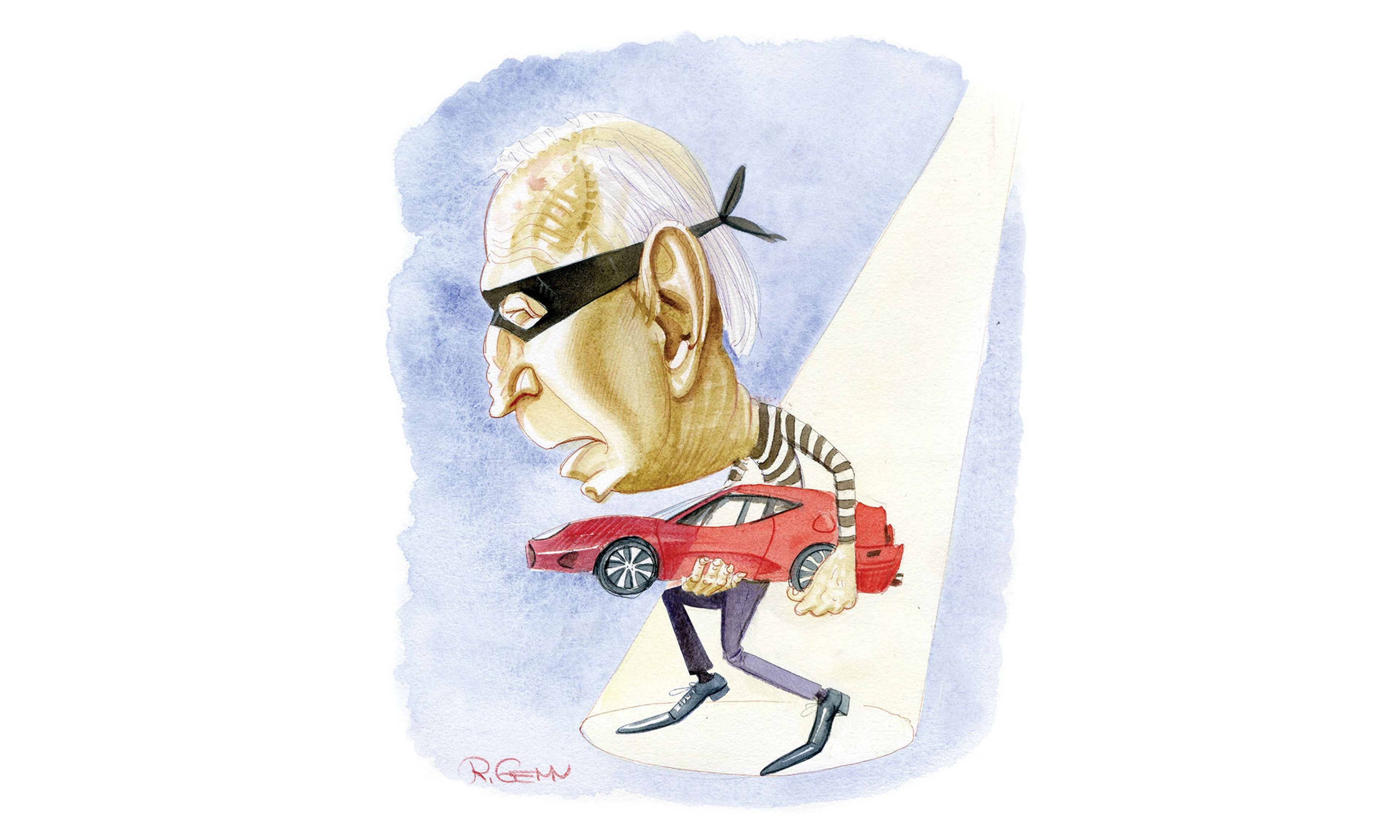
• Biden just put $6 billion of student debt from 78,000 public employees on the shoulders of taxpayers. Lay off the 78,000 public employees, and we’ll call it even.
• President Joe Biden and former president Donald Trump secured the presidential nominations of their parties, setting up the first rematch between presidents since Benjamin Harrison vs. Grover Cleveland in 1892. Among the differences between that race and this: Former president Cleveland did not claim to have won the contest in which he had been defeated. Neither he nor the incumbent Harrison served regular helpings of word salad in their public statements. Harrison was not a shuffling oldster, and Cleveland was not a ranting one. The two sets of contestants have one thing in common, however. Harrison was hobbled by disaffection in normally GOP states, and Cleveland had bad relations with the Democratic stalwarts of Tammany Hall. Similarly, Joe Biden is scrambling to hold onto Muslim voters in Michigan and Minnesota who view him as too pro-Israel, while Trump has consistently lost a significant share of Republican primary voters even after his opponents dropped out. Even factoring out party-switchers, that is not great for an acknowledged party leader. This year democracy, to amend Mencken, is giving the people what they don’t want, good and hard.
• On January 6, 2021, Mike Pence defied Donald Trump. This was critical. Pence now says he cannot endorse Trump for another term as president “in good conscience.” It is startling that, in a general election, a former vice president has declined to endorse the president alongside whom he served. Whatever one may think of the choices Pence made between 2016 and 2020, he has behaved with a bold independence in the years since. Last summer, when he was running for the GOP presidential nomination, Pence traveled to Ukraine, to express his solidarity with that people under siege — this despite the fact that he must have known it would do him no good with the GOP electorate. He continues to remind Republicans who do not wish to hear it that the national debt is rising dangerously and that entitlement programs need reforming because of it. He is also standing firm on the right to life at a time when many Republicans are blaming that cause for the party’s political travails. On all these issues, he differs with Trump in a way that speaks well of him — and of a brand of conservatism that deserves renewal.
• An era is ending in the United States Senate. Mitch McConnell announced that he is stepping aside as Republican leader, bringing to a close an extraordinary run as the longest-serving GOP leader. He will be remembered as one of the most skilled Senate leaders ever. He was a lonely but farsighted advocate of robustly free political speech and an opponent of the execrable McCain-Feingold campaign-finance legislation. He slowed and blocked as much of the Obama agenda as possible. He kept open the Antonin Scalia Supreme Court seat, despite intense pressure to buckle. He then famously pushed the accelerator on judicial confirmations during Trump’s presidency, leading to a historic raft of new constitutionalist judges on the bench. In addition, he preserved the Senate filibuster, and he has been a mentor to countless conservative legislators and jurists in Kentucky and around the country. Lately, he’s been a vocal proponent of Ukraine funding and of our traditional alliances, pushing back against the isolationist tendency on the right. Whoever comes next will have the burden of filling the shoes of a man who deserves to be considered one of the lions of the Senate.
• In early March, Arizona senator Kyrsten Sinema dropped her bid for reelection as an independent, which she had been since leaving the Democratic Party in December 2022. Though Sinema voted with President Biden 94 percent of the time, she had her limits. She opposed Biden’s signature $3.5 trillion Build Back Better plan and rejected left-wing proposals to pack the Supreme Court and to blow up the Senate filibuster. The latter stance, in particular, enraged the Left; activists even swarmed Sinema in a bathroom. But her bipartisan inclinations made her toxic among Democrats without endearing her to enough Republicans, leaving her unviable in the forthcoming Senate election. Her exit, following the announced retirement of Senator Joe Manchin and the decision of Senator McConnell to step down as Republican leader, means that yet another defender of the filibuster is leaving the Senate. Though the filibuster does not explicitly appear in the Constitution, it is one of the few remaining ways of ensuring that significant changes have overwhelming and geographically broad support, something that concerned the Founders. Most of the Left and even parts of the Right now oppose the filibuster for this very reason. The prospect of its disappearance should worry all those who still care about limited government. Which is reason enough to lament Sinema’s imminent departure from the Senate, whatever our disagreements with her.
• Senator Bernie Sanders (I., Vt.) wants everyone to get paid the same for doing less work. Many entrepreneurs throughout human history have wanted this same goal. In fact, they set their sights higher, wanting everyone to get paid more for doing less work. So they invented various labor-saving devices that allow humans to get more done in less time. What is Sanders’s plan to contribute to the great human endeavor of becoming wealthier while working less? Does he have an idea for the next automobile, a better management strategy, or the power loom for the 22nd century? No, Sanders wants to write words on a page and have a couple of hundred people vote for it. He has introduced a bill to mandate a 32-hour workweek “with no loss in pay.” It would amend the Fair Labor Standards Act to reduce the definition of full-time work from 40 hours per week to 32 hours. Pay wouldn’t go down, because the bill says employers “may not reduce the total workweek compensation rate.” Working hard is a core part of being human. Maybe if you’re an 82-year-old socialist who has worked only in politics your entire life, you lose touch with what it means to be a productive member of society. The rest of us wouldn’t eliminate work even if we could.
• The House Republican caucus is in danger of giving away a majority it doesn’t appear to like using. Kevin McCarthy resigned after being deposed as speaker, and his seat won’t be filled until May. Marjorie Taylor Greene is now trying to do the same to Mike Johnson, bringing another motion to vacate the speaker’s chair after Johnson averted a government shutdown by striking a budget deal opposed by more than half of House Republicans. Johnson’s caucus is down to 218 members and drops to 217 when Mike Gallagher’s resignation becomes effective April 19. George Santos was expelled and replaced in a special election by a Democrat; he now says he’s leaving the GOP. Bill Johnson resigned in January to run a university, and his seat won’t be filled until June. Ken Buck, like Gallagher, resigned in disillusion with the state of the House. Buck’s seat will be open until June; Gallagher’s won’t be filled before November. Kay Granger, retiring at the end of the session, is stepping down early from running the Appropriations Committee, a post that members once clung to for dear life. Gallagher’s will be the fifth Republican resignation this session, and the sixth departure if Santos is counted. Twenty other retirements include veterans such as Patrick McHenry, Cathy McMorris Rodgers, Jeff Duncan, and Doug Lamborn. Who would want these jobs?
• President Biden has been getting increasingly hostile in his rhetoric toward Israel in recent weeks, particularly when it comes to Israeli plans to finish the job against Hamas by invading Rafah, a town in southern Gaza. Vice President Kamala Harris chastised the planned Israeli offensive, claiming, laughably, that she had “studied the maps” and decided that Israel’s plan to evacuate civilians from the area wasn’t feasible. Then the administration betrayed Israel at the United Nations by allowing the Security Council to pass a resolution demanding an “immediate ceasefire” in Gaza while Hamas remains in power and still holds 130 hostages. The text of the resolution “demands an immediate ceasefire for the month of Ramadan respected by all parties leading to a lasting sustainable ceasefire,” which in effect would mean leaving Hamas in power and allowing it to rebuild so it can carry out more attacks against Israel. The resolution makes no mention of the October 7 massacres, and while it “also demands the immediate and unconditional release of all hostages,” it does not make the cease-fire conditional on their release. Unsurprisingly, Hamas rejected the current “ceasefire” proposal hours after the resolution passed. Why accept any concessions knowing that the U.S. is pressuring Israel to give up its fight anyway?
• Senate Majority Leader Chuck Schumer likes to portray himself as an unwavering supporter of Israel, but a recent speech seems to prioritize protecting his own position in a Democratic Party that is increasingly hostile toward the Jewish state. Schumer, in a speech on the Senate floor, lumped together Prime Minister Benjamin Netanyahu and Hamas as two of the four biggest obstacles to peace in the region (the others being “radical right-wing Israelis” and Palestinian Authority president Mahmoud Abbas). He then argued that “the Netanyahu coalition no longer fits the needs of Israel after October 7” and said that there should be a new election to replace him. The reality is that whatever their reservations about Netanyahu, Israelis overwhelmingly support the ongoing war effort. Instead of butting into Israeli domestic politics, Schumer would do well to confront the anti-Israeli radicals within his own party.
• It was always a forlorn hope that courts would boot Donald Trump from the ballot on the ground that he had “engaged in insurrection,” as Section 3 of the 14th Amendment puts it. With almost no judicial precedent to guide it on that constitutional provision, the Supreme Court ruled unanimously that state courts cannot disqualify candidates from federal office — at least, not unless Congress authorizes them to do so, which it has not. Given the shoddy handiwork of the Colorado supreme court and the Maine secretary of state, the U.S. Supreme Court balked at letting state courts enforce Section 3, which could have triggered a retaliatory cycle. It allowed state courts to enforce Section 3 against candidates for state office but not federal office — a distinction found nowhere in the text and one not significantly debated during the drafting and ratification of Section 3. It is left unclear whether other qualifications for federal office are unenforceable by states. The Court would have been on sounder legal footing to rule that Trump simply didn’t engage in insurrection within the terms of the provision. Instead, there may be another round of divisive controversy if it comes time to certify a Trump victory. No court will now decide whether Trump is an insurrectionist. None of the dozens of criminal charges against him accuses him of being one. The decision will be made by the voters.
• New York judge Juan Merchan set April 15 for jury selection in the first-ever criminal trial of a former American president — one who happens to be the presumptive Republican presidential nominee. It’s the case brought by Alvin Bragg. Ostensibly, it centers on the dubious 2017 recording in Trump’s books of $130,000 in “hush money,” paid prior to the 2016 election, to a porn star who claims to have had a tryst with Trump in 2006. At most, that should be a misdemeanor and non-prosecutable since the two-year statute of limitations lapsed long ago. Bragg, however, inflates it to 34 felonies (separately charging each invoice, check, and book entry) by claiming Trump did it to hide a second crime: nondisclosure of campaign expenses. That’s a federal crime that Bragg has no authority to prosecute and that the responsible federal agencies declined to pursue — because the payment was technically not a campaign expense and, even if it had been, no disclosure would have been required until after the election (though Bragg insists Trump stole the election by withholding this information from voters). It’s New York, so the case’s absurdity hardly assures an acquittal for Trump.
• A New York appellate court slashed by two-thirds, down to $175 million, the amount that Trump must post to bond to block the state from enforcing an astronomical $454 million judgment. Judge Arthur Engoron, an elected progressive Democrat, set that judgment at a recent civil-fraud trial in which Attorney General Letitia James proved no fraud victims. The reduction was a setback for James, another progressive Democrat who campaigned vowing to use state power against Trump and who has been chirping about the still-mounting judgment (on which interest accrues at more than $112,000 per diem) while publicly coveting Trump’s New York properties. The appellate court’s ruling means James will not be able to force Trump to sell some of his real estate (likely at fire-sale rates) or to watch the state seize his properties to auction them off. The court’s intervention was appropriate. There is substantial evidence that Trump exaggerated the value of his assets, but the wildly disproportionate “disgorgement” penalty for this wrong is grist for a constitutional claim of excessive fine.
• It was a Pyrrhic victory for Fulton County district attorney Fani Willis. Georgia judge Scott McAfee declined to disqualify her from further participation in the state RICO prosecution of Donald Trump and 18 others. He opined that an “odor of mendacity” enwraps the case, arising out of her hiring of special prosecutor Nathan Wade, with whom she had a romantic affair, benefiting from the high salary she paid him by accompanying him on luxury vacations. Worse, although McAfee could not bring himself to make a conclusive finding, he noted the considerable evidence that Willis and Wade gave false testimony to conceal their relationship. The ruling makes no logical sense: McAfee held that Wade had to be disqualified but that Willis could remain, even though it was their joint conduct that created the appearance of impropriety that undermined the integrity of the proceedings. Trump and his co-defendants are seeking to appeal the decision allowing her and her office to continue leading the prosecution. Legally, that makes sense. Practically, Trump should spring for a limo to make sure Willis gets to work every day — she’s his best hope for acquittal.
• Following his primary victories, Donald Trump replaced the merely Trump-backed leadership of the Republican National Committee with members of his family and campaign. North Carolina GOP chairman Michael Whatley and Trump’s daughter-in-law Lara Trump were voted in as RNC co-chairs. Trump-campaign senior adviser Chris LaCivita took over as the RNC’s chief operating officer. On their first business day in charge, the new team sacked more than 60 RNC staffers, telling our Audrey Fahlberg, “This is one team. There will not be redundancies.” Meanwhile, the RNC could not agree to vote on a proposal to bar its funds from being redirected to pay Trump’s legal bills. For now, Trump fundraisers are directing donations first to max out money to Trump’s campaign, then to give to his legal defense, and only then to give what’s left to the party. Accountability is good: Trump has played a double game of backing Ronna McDaniel while his allies blame her for the party’s financial woes and election setbacks. There will be no question now where the buck stops. But the party is supposed to serve more than the interests of one man. In an election year when Democrats are likely to outspend Republicans by a wide margin, the RNC may regret making Trump’s legal defense a priority.
• It is a testament to the upside-down nature of our political moment that after his State of the Union address, Biden let himself be pressured into issuing an apology to an alleged murderer. The suspect, illegal immigrant Jose Antonio Ibarra, crossed the border into Texas in 2022. Exploiting the loopholes in our immigration system, he managed to stay here even after multiple arrests. Then he allegedly murdered Laken Riley. Confronted during the State of the Union with jeers from Representative Marjorie Taylor Greene, Biden said that Riley had been murdered by “an illegal.” Within days Biden sat for an interview and backtracked on this moment of relatable passion in the speech. “I shouldn’t have used ‘illegal’; it’s ‘undocumented,’” Biden said. Trying to distinguish himself from Donald Trump, Biden averred, “What I won’t do. I’m not going to treat any, any, any of these people with disrespect.” Referring to Ibarra as an “illegal” was telling the truth about his immigration status; calling him “undocumented” is using a political euphemism. Why in the world does the president of the United States feel compelled to apologize to him?
• Trump rallies now feature a particular ceremony. It was played out recently in Ohio. An announcer said, “Ladies and gentlemen, please rise for the horribly and unfairly treated January 6 hostages.” Then a recording of the “J6 Choir” played. The recording has the choir singing the national anthem, interspersed with the voice of Trump, who is reciting the Pledge of Allegiance. Trump saluted all the way through. When he took the microphone, he said, “Well, thank you very much, and you see the spirit from the hostages, and that’s what they are, is hostages.” He twice described the convicted rioters as “unbelievable patriots.” Real patriots uphold the Constitution.
• At the same rally, Trump said, “If I don’t get elected, it’s going to be . . . a bloodbath for the country,” prompting Biden to tweet, “This guy wants another January 6.” Predicting a bloodbath is pretty incendiary stuff, but no more than accusing one’s opponents of wanting to reintroduce slavery, which Joe Biden, then Barack Obama’s veep, told a black audience in Danville, Va., in 2012 was the desire of Mitt Romney and the GOP: “They’re going to put y’all back in chains!” When the Romney campaign complained, an Obama spox primly replied that Biden “was using a metaphor” to describe what would happen if banks were “unchain[ed]” or deregulated. Trump as it happens was using a metaphor too, predicting disaster for the American auto industry if a reelected Biden mandates a shift to EVs. Politics is a contact sport, and there have been rougher metaphors than Biden’s chains or Trump’s bloodbath. On the other hand, Trump did sit on his hands while all of those “unbelievable patriots” swarmed the Capitol, some of them violently. Boxers who fight dirty look bad when they cry foul.
• The House of Representatives voted overwhelmingly (352 yeas, with 50 Democrats and 15 Republicans opposed) to pass H.R. 7521, informally known as the “TikTok bill.” It would force platforms controlled by hostile countries, currently defined elsewhere in law as China, Russia, North Korea, and Iran, to divest from their operations in the United States. TikTok’s Chinese controllers — functionally speaking, the Chinese Communist Party — would have to transfer it to new owners not hostile to America. Otherwise it would face a ban in our markets. The bill is narrowly drawn to accomplish its goals without the potential for later government abuse, implicates no First Amendment speech concerns (ownership and control by a hostile government being the legislatively stipulated issue to be corrected), and addresses a grave national-security crisis: the vast stockpile of personal information that a hostile government has compiled about U.S. citizens over years of concerted effort. Trump and Elon Musk have expressed opposition unblemished by any familiarity with the legislation. Chuck Schumer should bring the bill to a vote in the Senate, and senators should pass it. China should be forced to disgorge TikTok to prevent future attempts to “phish” the nation. It’s an urgent priority, senators: Tick tock.
• The mandate that the EPA has granted itself to remake the U.S. auto industry is a step too far legally, and many steps beyond what the government should be doing as a matter of principle. While it does not, strictly speaking, ban the sale of “traditional” cars (that’s surely on the drawing board for another day), it will make it increasingly difficult for Americans to buy the types of cars that they like and that have served them well. It takes little account of consumer choice or of economic, technological, logistical, or geopolitical reality, an exercise in arrogance that will have highly destructive consequences. Adding pointlessness to injury, the mandate will do little or nothing for the climate. China’s automakers, however, will be grateful.
• The Supreme Court heard two lawsuits challenging Food and Drug Administration approvals of the mifepristone-based chemical-abortion pill known as RU-486. Breathless press coverage notwithstanding, the suit threatens no ban on the pill. It challenges 2016 and 2021 decisions stripping the safety precautions for do-it-yourself, at-home chemical abortion, which not infrequently sends women to the hospital or requires further medical treatment. The FDA, under the past three Democratic administrations, has strained to expand the pill’s availability, insulate the FDA from judicial scrutiny, and time its actions to limit political accountability. Thus, the pill was approved in 2000 by the Clinton administration under a fast-track process meant for AIDS drugs. A legal challenge filed against the FDA in 2002 was left unresolved for nearly 14 years, thwarting judicial review while the pill’s market share expanded. Then the Obama and Biden administrations loosened regulatory restrictions in 2016 and 2021, first scaling back reporting requirements for health complications, and then eliminating rules for in-person medical consultations. The lawsuits may fail if the justices believe that doctor groups don’t have standing to sue. That may even be the right legal call. But it will remain true that the pill-pushers have acted without regard for the law or ethics.
• The Alabama supreme court set off a national furor by . . . siding with several couples who were trying to have children via in vitro fertilization. The couples said that the clinic had been negligent in letting a patient destroy embryos in which they had invested their hopes. They sued under the state’s wrongful-death law, and the court agreed that the law covers embryos even when they are outside the womb. Some fertility clinics said they could not operate facing such liability. Democrats, including President Biden, said that the Supreme Court’s Dobbs decision had enabled Republicans to wage war on IVF. The truth is that the court’s decision had almost nothing to do with Dobbs: Nobody, including the dissenting justice in Alabama, doubted that the wrongful-death statute applied to embryos within the womb even when Roe v. Wade was in effect. The further truth is that Republicans have no intention of waging war on IVF: They have differing views, the issue is complex, and the practice is entrenched. Some Republicans have, however, endorsed vaguely written “personhood” bills that can be read to entail opposition to IVF — even though those bills have no chance of passage and would have no legal effect even if enacted. Panicked Alabama Republicans quickly passed a law immunizing the clinics for any misconduct. Republicans in Washington, D.C., have so far shown a little more spine. The right course, under the circumstances, is for Republicans to clarify that stopping IVF is not on their agenda, but also to block sweeping immunity laws for an industry that should face at least as much scrutiny as those that do not create and destroy human lives.
• Sure, sure, free trade for most things, but steel is different, some say. Steel is needed for defense production, the argument goes, so protectionism is justified. Never mind that the top proponent of that view in the Trump administration, trade representative Robert Lighthizer, was previously a highly compensated steel-industry lobbyist. The protectionists also want you to ignore a recent article from William Greenwalt, who was deputy undersecretary of defense for industrial policy — not the sort of job doctrinaire libertarians hold — from 2006 to 2009. He points out that the Pentagon usually buys less than 1 percent of U.S. steel output in a given year, so blanket protectionism doesn’t seem wise. More crucially, he argues that steel protectionism weakens national security. Complying with the various bureaucratic hurdles to source steel drives up costs for the Pentagon and slows the speed at which equipment can be produced. For the MRAP (Mine-Resistant Ambush Protected) program — it was, he wrote, likely the largest defense-related steel order since the Liberty ships — Greenwalt ended up sourcing a lot of the steel from Sweden, Germany, Israel, and Australia. “When DoD urgently needed more steel, the US industry basically told Uncle Sam to pound sand,” Greenwalt writes. Any time the steel industry comes knocking for more privileges, Uncle Sam should return the favor.
• Social media were set ablaze by the news that Wendy’s was going to start “surge pricing.” But that wasn’t really what happened. The company never used the term “surge pricing,” which commonly describes charging more at times of high demand and less at times of low demand to better allocate scarce resources. Wendy’s wouldn’t really have to do that, since, like all restaurants, it has predictable peak times of demand at mealtimes and can plan around them. Scaring away customers at mealtimes is a pretty bad way to run a restaurant, and Wendy’s is pretty good at running restaurants. All the company really planned was digital screens to display prices, which would make it easier for individual locations to change their prices. That would mean they could offer promotions or try new pricing strategies without having to make new menu boards. A sensible modernization, rather than a nefarious plot.
• Back in 2022, free-market advocates were shouting to anyone who would listen that baby-formula shortages were happening because the government had screwed up the market. Now, the Federal Trade Commission — no friend of free markets in recent years — has put out a report in large part agreeing with that argument. It found that because of the WIC (Women, Infants, and Children) program, the U.S. essentially has 50 separate baby-formula markets, each dominated by one producer facing negligible competition. WIC is supposed to subsidize formula for families in poverty, but it has expanded to cover a majority of formula purchases in the U.S. Individual states sign single-supplier contracts to earn steep discounts on formula, and unsubsidized customers pay higher prices to compensate. The supplier that wins the WIC contract ends up with nearly all formula sales in the state. The FTC pointed to an example from California in which winning a contract took one supplier from 5 to 95 percent market share in about a quarter. Similar trends have been recorded in 29 other states. Would anyone tolerate this kind of government failure in the market for food for grown-ups? The market for baby formula, like any other, needs reliable price signals, and it needs them now.
• Terrorists attacking rock fans at a concert hall outside Moscow killed 137 and set the building ablaze. It was the worst terrorist strike on Russian soil since the Beslan school siege in 2004. Credit was claimed by ISIS, most likely its Khorasan affiliate, active in central Asia (the first four alleged perps the Russians arrested are Tajiks). The folly of trusting the Taliban to combat terrorists on its turf was demonstrated in blood. The United States warned Russia in early March of ISIS chatter indicating a possible concert attack; Emmanuel Macron confirmed that French intelligence has also fingered ISIS. Vladimir Putin admitted that “radical Islamists” had carried out the slaughter, though he suggested, as have lesser Kremlin spokesmen, that Ukraine was somehow involved. Russian media claimed early on that the terrorists used a van bearing Ukrainian license plates (photos of said van actually showed Belarusian plates). Was the Russian regime itself involved? One should not underestimate, either, the force of mere neglect. But Moscow is one of the most heavily surveilled cities on earth, and false flags have been a Putin MO since the apartment bombings of 1999 that propelled him into the presidency. Meanwhile the hearts of all decent people go out to the afflicted.
• Putin has “won” another “presidential” “election.” He will “serve” a sixth “term.” Boris Nemtsov was once his main opponent. Nemtsov was killed in February 2015. Then Alexei Navalny was his main opponent. Navalny was killed in February 2024. Another opponent, Vladimir Kara-Murza, is now in a Siberian isolation cell. (He was a lieutenant to Nemtsov.) When Putin “won” in 2018, President Trump congratulated him. This year, the United States did no such thing. Xi of China congratulated Putin, however. Modi of India offered “warm congratulations.” In Italy, the deputy prime minister, Matteo Salvini, said that “when people vote, they are always right.” (Salvini is a long-standing and unblushing admirer of Putin.) Most touching were the Russians who took their ballots and laid them on the grave of Navalny.
• Thousands of Russians gathered at Navalny’s funeral in Moscow. This was a brave thing to do, especially considering that hundreds had already been arrested for laying flowers at Navalny memorials all across the country. One man at the funeral said, “I’m afraid, of course, but despite the fear, a man died in prison and we are here.” A woman compared Navalny and Putin: “One sacrificed himself to save the country, the other one sacrificed the country to save himself.” Plenty of police agents were on hand. They and their cameras did their work. After the funeral, more people were arrested, having been filmed or photographed. (A precise number is hard to get a fix on.) One expert said that Moscow’s facial-recognition system allowed the authorities to “trace the path of every individual right up to his door.” At the funeral, the crowd had chanted such slogans as “Russia will be free” and “Russia without Putin.” Bold statements, from brave souls.
• In a strike on Odesa, Russian forces killed at least 20 people and wounded at least 70. They did this in a “double tap.” Russian forces have been “double tapping” in Syria for many years. They strike once, killing some and injuring others. The injured may be trapped in rubble. Then the rescuers come — and Russian forces strike again, killing and injuring them, too. Thus, the “double tap” is complete. This is an outstanding evil from a regime outstanding for its evil.















Kyiv Mayor Vitali Klitschko visits the site of a building damaged by a Russian missile strike in Kyiv, Ukraine, March 25, 2024.
Gleb Garanich/Reuters
• Ireland’s project of excising hints of Catholic social teaching from its constitution and replacing them with progressive alternatives came to a surprising halt in two referendums. A proposal to include “durable relationships” other than marriage in the constitutional definition of the family was rejected 67.7 percent to 32.3 percent. Another proposal sought to excise the following statement from the constitution: “The State recognises that by her life within the home, woman gives to the State a support without which the common good cannot be achieved. The State shall, therefore, endeavour to ensure that mothers shall not be obliged by economic necessity to engage in labour to the neglect of their duties in the home.” The proposed replacement erased all reference to women, noted that “members of a family” care for one another, and promised that the state “shall strive to support” this care. Voters rejected this change by a margin of 73.9 percent to 26.1 percent. While these proposed changes did not promise legal transformations similar to those from recent referendums legalizing gay marriage and abortion, the depth of the rejections was seen as a rebuke to progressive Ireland. Politico’s headline blamed “confused Irish voters.” The results have put fear in elected politicians. The Taoiseach, Leo Varadkar, resigned as leader of his party. And the largest opposition party, Sinn Féin, has reversed itself and now opposes the draconian hate-crimes legislation it supported unanimously eleven months ago. Just as the Irish seemed to be settling into a role as obedient subjects of a progressive overclass, they demonstrated their famed propensity for sudden and surprising rebellion.
• Princess Catherine, Britain’s potential future queen, became the subject of speculation and conspiracy theories after she disappeared from public life following abdominal surgery in January. Kensington Palace made matters worse on March 10 (U.K. Mother’s Day), releasing a manipulated photograph of the princess meant to reassure the public. Kate herself made an apology on social media for causing “any confusion.” The rumor mill continued to churn. On his show, Stephen Colbert gleefully peddled rumors of Prince William’s alleged infidelity as an explanation for her absence. Three staff members at the hospital where she was treated allegedly attempted to access her medical records. Finally, the 42-year-old mother of three addressed the media frenzy in a short video, revealing that tests after her “major abdominal surgery” revealed that “cancer had been present.” She graciously thanked the public for their “wonderful support and understanding,” expressed gratitude for having William “by my side,” and explained that the desire for privacy came out of concern to protect her children (ages ten, eight, and five). Unwanted publicity may be a price tag of royalty. But it takes a cold heart to fault someone with cancer for mishandling public relations.
• On March 22, the Daily Wire, co-founded by conservative commentator Ben Shapiro, announced that its relationship with Candace Owens had ended. Although Owens had “staked [her] entire professional reputation” (her own words) only the week before on her claim that the wife of French president Emmanuel Macron was in fact a male-to-female transsexual, most believe that her history of increasingly obvious antisemitism to be the primary cause of the break. One suspects more was going on underneath the surface; for well over a year now, Owens has behaved like someone seeking to get fired. Her escalating rhetoric was a means of forcing the Daily Wire to give her a “martyrdom” story that will springboard her into a new career. We can be sure she will find the audience she deserves.
• Humanity’s irrepressible desire to explore will take us only so far into space if we rely on governments to get us there. The private sector is, especially with the success of SpaceX’s Falcon rockets, beginning to normalize space travel in our immediate neighborhood. The impressive launch-by-launch progress of SpaceX’s Starship promises something far grander to come. In late February, Intuitive Machines’ Odysseus became the first American spacecraft since Apollo 17 to manage a soft landing on the lunar surface. A giant if clumsy leap for free enterprise (it landed on its side), it was also the first privately owned vessel to touch down on the moon. However inconveniently positioned, Odysseus was still able to fulfill some of its duties before shutting down for good. Odysseus’s mission was part of a program in which NASA is using low-cost contracts with private companies to deliver equipment to help prepare the way for a lunar base. Let us endeavor to boldly go where government, by itself, can’t.
• Standing outside the gates of the Israeli embassy in Washington, Aaron Bushnell, a 25-year-old U.S. airman, set himself on fire while dressed in his uniform and live-streamed it. “I will no longer be complicit in genocide,” Bushnell declared. “I am about to engage in an extreme act of protest. But compared to what people have been experiencing in Palestine at the hands of their colonizers, it’s not extreme at all.” Bushnell then doused himself in a flammable liquid and self-immolated. “Free Palestine!” were his last words. He died hours later. Bushnell’s actions were deranged and tragic, as some of the reactions have also been. Cornel West praised Bushnell’s courage, and activist Aya Hijazi lauded Bushnell as “a hero and a martyr.” Jill Stein heralded Bushnell’s “extraordinary sacrifice.” But his actions weren’t heroic. They were an embrace of nihilism and a demonstration of mental illness’s ravages. May Aaron Bushnell find the peace he could not in life.
• Shohei Ohtani is arguably the best baseball player of all time, and he still has plenty of time left in his career, which makes recent allegations about sports betting by his translator so troubling. Initially, his translator, Ippei Mizuhara, claimed that Ohtani helped him to pay off $4.5 million in gambling debt that Mizuhara had accumulated with an illegal California bookie. Then the story changed so that Ohtani did not know anything about Mizuhara’s debts and the money was stolen from Ohtani without his knowledge. Mizuhara maintains that he did not bet on baseball, and Ohtani that he did not bet on sports at all. It’s hard to see how this will shake out, but it would be on the level of the Black Sox scandal if Ohtani were somehow culpable.
• Philippe de Gaulle was the son of the French general and president. He fought bravely in World War II. He became an admiral. Then a senator. It was not easy being de Gaulle’s son. Philippe was amazingly gracious about this. Interviewed on his 100th birthday, he said, “I would have preferred to give some of my longevity to my father.’” Admiral de Gaulle has died at 102. R.I.P.
• “Martin Greenfield, Tailor to Sinatra, Obama, Trump and Shaq, Dies at 95.” You would expect an amusing obituary about a celebrity tailor — or a tailor to celebrities. (Actually, Mr. Greenfield was a bit of a celebrity himself.) And it was. But the New York Times, in that obit, told us much more than that. Greenfield learned to sew at Auschwitz — and it enabled him to survive. They are now going, the survivors. Soon they will all be gone. Their stories will live, one can hope: to amaze, to inspire — and, of course, to caution. R.I.P.
• Of the nearly 250 people taken into captivity by Hamas on October 7, 2023, some 130 are still held in Gaza; at least 34 are dead. Most of the hostages are Israeli, and some are dual U.S.-Israeli citizens. The names of the five American hostages believed to be alive deserve to be better known. Edan Alexander, 19, grew up in Tenafly, N.J., and volunteered for the Israeli army after graduating from high school. He was serving near Gaza when kidnapped. Omer Neutra, 22, from Long Island, N.Y., volunteered for the Israeli army after a gap year in Israel and was planning to return to attend Binghamton University. He was serving as a tank commander near Gaza when kidnapped. Hersh Goldberg-Polin, 23, born in California, immigrated with his family to Israel. He was wounded by a grenade at the Nova music festival. Video of his capture shows him missing his left arm below the elbow. Sagui Dekel-Chen, 35, a dual citizen, was seized while trying to protect his community at Kibbutz Nir Oz. His pregnant wife and two daughters survived. Keith Siegel, 64, from North Carolina, was abducted from Kibbutz Kfar Aza. The body of Itay Chen, an IDF member and dual citizen killed on October 7 at age 19, is being held; so too are the bodies of dual citizens Judih Weinstein Haggai and Gadi Haggai, grandparents in their 70s, Kibbutz Nir Oz residents who were shot while out for a walk; their deaths were confirmed in December. R.I.P.
The Stat
2040 — the year when the number of deaths in the U.S. will begin to exceed the number of births, according to the long-term budget outlook from the Congressional Budget Office.
The CBO nonetheless believes the U.S. population will continue to increase over the next 30 years, from 342 million to 383 million. It projects net immigration will more than compensate for the decline in population due to deaths exceeding births. Population growth will be only about 0.4 percent per year, which is roughly half the average annual rate over the past 30 years. The aging of the population will continue apace over the entire 30-year window, the CBO projects. The proportion of Americans over the age of 65 will gradually increase from 17.8 percent this year to 22.3 percent in 2054. The proportion of Americans aged 24 or younger will gradually decline from 31.1 percent this year to 27.7 percent in 2054. The problem with funding the current entitlement system for seniors — too few working people paying in and too many retired people taking out — is projected to steadily get worse for at least the next 30 years.
by Dominic Pino












Comments