
• In a recent press conference, a New York Times reporter asked President Obama what had “enchanted” him the most during his first 100 days as president. Obama might have answered: his press coverage.
• The national odometer that measures taxing and spending has ticked from billions to trillions, but don’t be alarmed: Although we are in the Worst Crisis Since the Depression, we are led by the Best President Since FDR. Right? Thousands of Americans who aren’t convinced have been attending “tea parties,” in dozens of cities across the country, to protest the new potlatch. Tea parties are homely affairs with handmade signs and crowds taking breaks from day jobs. The first liberal response was to accuse them of being put-up jobs by GOP activists (like the typical labor/ACORN rally?). The second response was ridicule. CNN correspondent Susan Roesgen hectored a man at a party she was “covering”; Anderson Cooper and David Shuster made jokes about “tea bagging,” a sexual practice (and no, we won’t define it); former comic Janeane Garofalo said the parties were all “about hating a black man in the White House.” A savvier analysis came from Democratic Strategist, an online liberal site: Tea parties are an “authentically ‘grass roots’” movement, reflecting the “‘common sense’ understanding” of “the world of small business.” Democratic Strategist suggested ways for liberals to moderate the hostility of tea partiers; Republicans should think of how to reach out to them (deserve their support?). Meanwhile the tea parties should go on, in this brave, new, and unsatisfactory world.
• Even though the Clean Air Act was designed to address conventional forms of pollution, the Supreme Court held in 2007 that its language could be read to authorize the Environmental Protection Agency to regulate greenhouse gases. (It was a 5–4 decision, with Justice Kennedy and the Court’s four liberals together.) If that decision was correct, then there is no need for Congress to debate action on global warming: It already authorized action by accident, when it passed the Clean Air Act. But the notion that the EPA should be able to transform the country’s energy sector without real input from Congress is absurd. So what the EPA is now doing, by listing carbon dioxide as a pollutant, is threatening to act if Congress does not pass a global-warming bill. If conservatives win in Congress, in other words, they may well still lose in the bureaucracy. Welcome to managed democracy.
• Chrysler declared bankruptcy, despite President Obama’s attempts to avoid that outcome. The administration’s auto task force attempted to browbeat Chrysler’s creditors into taking a terrible deal in order to spare the United Auto Workers union as much pain as possible. The large banks, which owe their continued existence to the $700 billion Troubled Asset Relief Program (TARP), caved and agreed to take a massive haircut. But a group of smaller firms, calling themselves the Committee of Chrysler Non-TARP Lenders, refused to play ball. “I stand with the millions of Americans who own and want to buy Chrysler cars,” Obama said — not “those who held out when everybody else is making sacrifices.” First, if millions of Americans wanted to buy Chrysler cars, the company wouldn’t need the president of the United States to be its pitchman. Second, Obama does not seem to realize that Chrysler’s non-TARP lenders are not authorized to make “sacrifices” with their investors’ money — they are legally and morally bound to try to recover it. Investors will not long send their capital to a country whose government fails to grasp this basic principle of finance.
• Several large banks, including J. P. Morgan and Goldman Sachs, have announced that they would like to repay the funds they took from the government as part of the TARP, but the Obama administration is discouraging them. A senior administration official told the Financial Times that a bank would not be allowed to repay its TARP funds unless doing so would be “good for the system” — never mind what would be good for the bank. The administration’s position raises the troublesome possibility that the government is trying to maintain control of the banks. Obama has already found such control useful, as in the Chrysler episode. The TARP was meant to provide temporary assistance during an extraordinary panic. Now that the panic has passed, stronger banks are seeking an exit, only to find that the new boss has barred the door.
• President Obama, thrifty as always, has ordered his staff to go through the federal budget “line by line” and find $100 million worth of wasteful spending that can be cut. For the large group of Americans who can’t tell a million from a billion from a kajillion, that may sound like a lot, but in comparison with the projected 2009 deficit of $1.85 trillion, it’s tiny. How tiny? Imagine taking Obama’s “race speech” from last year’s primaries, his Berlin address to the people of the Earth, his acceptance speech at the Democratic convention, his inaugural address, and his quasi–State of the Union speech, and stringing them all together in one endless, glutinous, Red Bull–defying series of platitudes. Now imagine cutting exactly one word from the whole soggy mess. That’s the same proportion that $100 million bears to $1.85 trillion. And unfortunately, we’re as unlikely to see any serious budget cuts are we are to hear the president stop talking.
Rahm Emanuel notoriously captured the spirit of Washington when he said that “you never want a serious crisis to go to waste. What I mean is that it’s an opportunity to do things you could not do before.”
But a little-recognized corollary has been equally important to the Obama administration: You never want to admit there is a crisis if it would require you to do something you would prefer to put off.
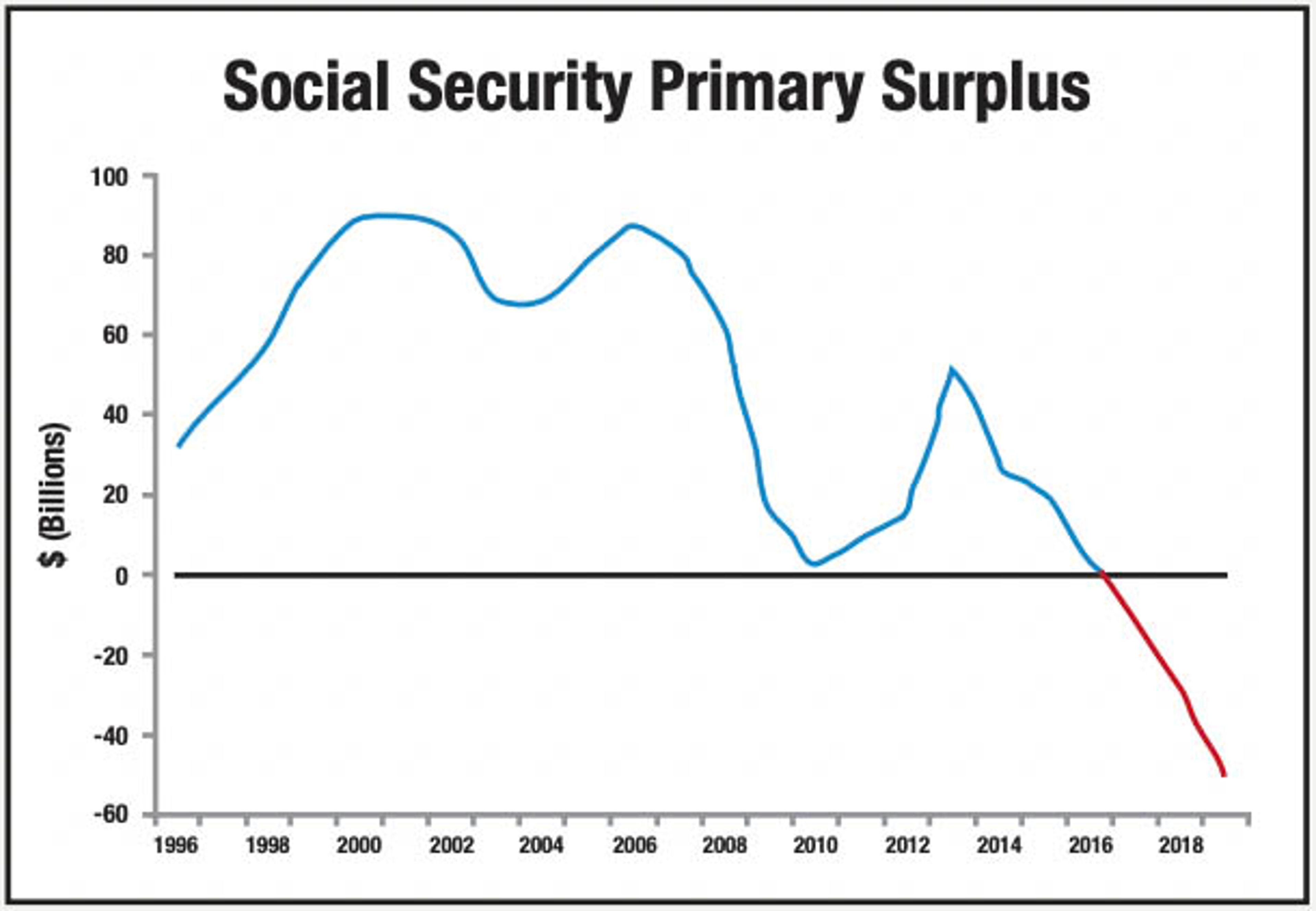
The nearby chart provides a case in point. We used to think that Social Security would have surpluses until 2017. Sadly, the economy has been so bad that in February of 2009 Social Security was in the red. A big reason is that workers who lose their jobs do not pay payroll taxes. The chart indicates that the Congressional Budget Office now believes that Social Security will have essentially no surplus next year.
The problem is, the assumptions that give us that scenario are far more optimistic than the assumptions required to justify, say, a $787 billion stimulus package. Indeed, the chart is almost comical in its miraculous ability to skirt negative territory. In reality, Social Security will almost surely have a deficit this year. Such a deficit requires urgent reform.
Back in 1981, the National Commission on Social Security Reform — more commonly known as the Greenspan Commission, after its chairman — was established because Social Security was borrowing money from Medicare to pay out monthly benefits. The crisis atmosphere motivated action. After considering a number of proposals, the commission suggested increasing Social Security taxes and gradually raising the retirement age from 65 to 67. These recommendations were enacted in the 1983 Social Security Amendments Act, along with a few other fixes.
But fixing Social Security now would get in the way of imposing card check, hiking taxes on corporations, and “reforming” health care this year. So Democrats are ignoring the problem.
As government looks for excuses to undercut free markets, it seems to be able to find a crisis everywhere it looks. Except for where the crisis is.
— KEVIN A. HASSETT
• It seems military commissions might not be so bad after all. In one of its recent Friday-night inconvenient-news dumps, the Obama administration let slip that trials by commission — the Bush military-justice model for war crimes that was vigorously attacked by Candidate Obama and his supporters, such as now–Attorney General Eric Holder — are back in play. In January, the administration ordered a four-month adjournment so it could study the commission proceedings now pending against 21 of the most notorious terrorists being held at Guantanamo Bay (including the 9/11 plotters and the bombers of the USS Cole). Though Obama and Holder continue to attack the Bush counterterrorism measures as a departure from the rule of law, it has evidently dawned on them that many dangerous terrorists cannot be tried under the rigors of their preferred civilian protocols. The administration is releasing many terrorist detainees, and intends to release several into the United States, but the president obviously understands that the public will not tolerate a Khalid Sheikh Mohammed in its midst. So commissions are back on the menu. This rule-of-law business turns out to be harder than it looks.
• Joe Biden has calmed the American public during the flu crisis by saying, “I wouldn’t go anywhere in confined places now. . . . In a confined aircraft, when one person sneezes, it goes all the way through the aircraft. . . . I would not be . . . suggesting they ride the subway.” Administration spokesmen quickly backtracked, but they needn’t have bothered, as the nation has already learned not to pay Biden any mind. Here is yet another sharp break with the Bush administration — a vice president so clownishly inept that portraying him as an evil genius would be like making Richard III out of Elmer Fudd.
• Any new president’s cabinet is something like a field of horses coming out of the gate. Some will not make it to the finish line. If the race is a steeplechase, some will fall at the first fence. To anyone running a book on Barack Obama’s cabinet, Homeland Security Secretary Janet Napolitano must look like a good prospect for early elimination. In mid-April she identified the two main threats to our security: Canada, and “right-wing extremist groups” (with returning military personnel a particular hazard). A few days later she told a TV interviewer that “to the extent that terrorists have come into our country or suspected or known terrorists have entered our country across a border, it’s been across the Canadian border.” The interviewer asked her whether she was talking about the 9/11 terrorists (who did not enter from Canada). “Not just those, but others as well,” said Janet. Let’s just hope that she will be led quietly from the field before Canada declares war.
• The less said about former senator John Edwards, the . . . oh, who are we kidding? He is vile, he is the personification of preening liberal self-regard, and he is under federal investigation for using campaign funds to pay more than $100,000 to videographer Rielle Hunter, who provided him with campaign services of an adulterous nature during the Democratic primary race. Edwards says he did nothing wrong in making the payments. He also says that Hunter’s new baby isn’t his and that he practiced perfect marital fidelity until his wife’s cancer went into remission. Two of those claims are inconsequential as public matters; should the first prove untrue, Edwards could go to prison for ten years. The man could use a good lawyer: someone manipulative, open to stretching the truth, willing to do whatever it takes to win. Someone like him.
• Opposed by Republicans such as Arlen Specter, and by Democrats such as Arlen Specter, “card check” provisions are expected to be stripped from the cynically named Employee Free Choice Act. In the matter of union-representation votes, card check would have replaced secret-ballot elections with a process vulnerable to pressure by union bosses. Card check was perhaps the most offensive feature of the bill, but other surviving measures are arguably more destructive. The worst would empower the federal government to impose union contracts on private firms that are unable to come to mutually agreeable terms with labor representatives. These contracts would be imposed by the National Labor Relations Board, soon to be dominated by union militants installed by President Obama. Among the president’s recent NLRB nominees is AFL-CIO lawyer Craig Becker, who has argued that workers should not have any right to vote on the matter of union representation, and who believes that nothing so quaint as an “affirmative vote” should be required to impose a union on a workforce. Card check may be gone, but no compromise that allows the likes of Becker to impose contracts on private businesses should be accepted.
• The Justice Department finally dropped its espionage case against two officials from the pro-Israeli lobbying group AIPAC. The case involved a criminalization of Washington’s stock-in-trade, the exchange of information. Under the Justice Department’s theory, any reporter who received potentially classified information from a government source would be subject to prosecution for passing it along or publishing it. Justice’s methods were also objectionable. To entrap its targets, the FBI used a sting operation that, rather than offering money or comforts (which appeal to the greed of the insulated criminals and corrupt politicians for whom stings are usually reserved), subjected the AIPAC officials to a moral dilemma: keep to themselves the planted “classified information” that Iranian operations were targeting Israelis, or pass the information to Israel in hope of saving lives. The Justice Department dropped the case when court rulings held that it would have to prove the defendants meant to harm the United States, and promised further revelations that would embarrass the government. It should never have come to that.
• ABC News revealed the identities of two CIA contractors — covert agents — who allegedly oversaw the harsh interrogations of terrorist detainees. The disclosure served no public purpose, but exposed the contractors and their families to the vengeance of jihadists and the antics of anti-war extremists. The media and Democrats demanded a scorched-earth investigation to smoke out Bush officials who leaked the CIA affiliation of Valerie Plame Wilson — at least until it emerged that the leaker was Richard Armitage, one of the Left’s favorite Republicans. Mrs. Wilson was not a consequential intelligence operative (her employment by the CIA was known to many), but she and her husband were against the war in Iraq, so she was transformed into a victim of felonious treachery. Will anyone demand an investigation to prosecute the officials who leaked the identities of secret operatives trying to protect Americans from terror attacks?
• If Charles Hurley, currently nominated to head the National Highway Traffic Safety Administration, gets his way, the law will forbid Beltway commuters and Montana ranchers alike to drive faster than 55 mph. Just in case the federal government isn’t quite powerful enough yet, you know.
• The Supreme Court ruled in Federal Communications Commission v. Fox Television Stations that the FCC could fine broadcasters who allowed even fleeting expletives to be aired. The case examined only the mechanics of the original ruling; the constitutionality of the ban looks likely to come up soon. One small sociological point merits attention. Justice John Paul Stevens, dissenting, argued that not every use of a four-letter word suggests sex or excrement. The decay of epithets into mere intensifiers is a familiar linguistic process. What keeps the four-letter word that begins with f tied to its origins is surely the billion-dollar porn industry, which fills every computer screen and hotel room (at least potentially) with paid performers exclaiming it. If the airwaves were loaded with blaspheming maniacs bellowing “God’s wounds” even Justice Stevens might not say zounds.
• Pakistan is on the edge. The reason for is clear: Pres. Asif Ali Zardari made the mistake of negotiating a deal with the local Taliban. He has promoted himself as a democrat, and democrats make deals, do they not? The Taliban were permitted to institute sharia, Islamic law, in territory they could claim as their own, and in return they would disarm. It cannot be a surprise that they cheated, invading yet more districts. Estimates number them at 6,000, with volunteers coming in from al-Qaeda on the Afghan side of the border. They are publicly beheading those opposed to them, including government officials; destroying schools; and brutalizing women. Half a million people have already fled. Washington is horrified by the prospect of this new terrorist haven, and further panicked by the fear that in the confusion the Taliban will get their hands on at least some part of the country’s nuclear arsenal. Gen. David Petraeus, head of U.S. Central Command, has warned that the next few weeks will determine whether the Pakistani government survives. Zardari is so evidently ineffectual that power could shift to his longtime rival Nawaz Sharif. A crypto-Islamist himself, Sharif might well cut yet another disastrous deal with the Taliban. Someone of stature has to rally the army, oppose the Taliban, and save the country.
• President Obama put on an amazing performance at the Summit of the Americas, held in Trinidad and Tobago. He was exceptionally friendly with Hugo Chávez, the Venezuelan strongman: giving him several handshakes, including one that was “soul brother” style; grinning and generally yukking it up; and then bidding him farewell with “Adiós, mi amigo.” Is Hugo Chávez a friend of the United States and democracy in general? How must Obama’s performance have looked to Chávez’s democratic opposition? Some days after the summit, Chávez’s principal opponent, Manuel Rosales, sought asylum in Peru.
• Jimmy Carter is a democrat, and a former American president. Fidel Castro is an absolute dictator and monster: If you doubt this, consult with his many political prisoners, and others. The other week, Carter commented on the Cuban situation, where Castro’s brother Raúl is now nominally in charge. Carter said, “I think Fidel is staying as aloof as he possibly can”; yet he also “reserves the right to come forward on a particular occasion when he feels his voice might be helpful in clarifying an issue.” Carter might have been talking about politics in Norway, rather than in a police state.
• Lewis Carroll brilliantly represented a collection of people who had lost touch with reality as a mad hatter’s tea party, and that is the exact metaphor for the U.N. conference known as “Durban II” but actually held in Geneva. The subject was supposed to be human rights, and the agenda was in the hands of those whose notion of such legalisms is — what shall we say: limited, murderous? In any case, human rights turned out to have nothing to do with Sudan, Tibet, or indeed Iran or Libya or anywhere else similar. Led by President Ahmadinejad of Iran, everyone contributed to a hatefest exclusively about Israel. The United States and other countries refused to attend, and many other delegates walked out in protest when Ahmadinejad began his racist rantings. Ahmadinejad’s goons actually harassed Nobel Peace Prize laureate Elie Wiesel. Remember the name of Navi Pillay, the high commissioner and secretary general of the conference. She allowed such gems as “9/11 is an unexplained mystery blamed on Arabs,” and finally fantasized that the conference was “a celebration of tolerance and dignity for all.” It might be tragic if it were not such pure and limpid farce.
• You may remember our old friend “Asian values”: the phrase used by Asian dictators and their apologists. The West may have elections, a free press, and all that democratic jazz, went the line; but we have “Asian values.” In fairly short order, Taiwanese, South Koreans, Filipinos, and some others put the lie to that. But Jackie Chan has given “Asian values” a comeback. He is the famed martial-arts actor, and he told a Chinese audience, “I’m not sure if it’s good to have freedom or not. I’m really confused now. If you’re too free, you’re like the way Hong Kong is now. It’s very chaotic. Taiwan is also chaotic. I’m gradually beginning to feel that we Chinese need to be controlled. If we’re not being controlled, we’ll just do what we want.” That must have warmed the cockles of Beijing’s heart, to the extent it has one. Of course, Jackie Chan went and did what he wanted: He moved to the West and found fame and fortune. But he would not have other Chinese pursue their own destinies, wherever they live.
• Gao Zhisheng is one of the many remarkable people who do China proud. A lawyer, he has defended Falun Gong practitioners, “house church” activists, and other citizens who are targeted by the Communist government. He himself has been targeted. In the fall of 2007, he was tortured for 59 days, almost to death. One of his crimes was to have written to the U.S. Congress. On February 4 of this year, he disappeared — which is to say, he was disappeared. This happened after his wife, Geng He, escaped with their two children to Thailand, and then to the United States. Now Geng He has written to Congress, asking that her husband’s case be on the agenda. Our relations with China can never be completely normal so long as it treats its Gao Zhishengs this way.
• Since tobacco came into general use four hundred years ago, compulsory smoking has not been a prominent feature of civilized life. The only instance we know of was at English boys’ boarding schools in the 1660s, when pupils were required to smoke to ward off the plague. A graduate of Eton College told diarist Thomas Hearne that “he was never so much whipped in his life as he was one morning for not smoking.” Employees of China’s Hubei Province are under a similar ukase today, though for economic, not health reasons, and with fines in place of whippings. The provincial government has ordered everyone on its payroll, including teachers, to smoke locally produced cigarettes, with a province-wide target of 230,000 packs a year. Work units that fail to meet their quota, or that are found smoking non-local brands, will be fined. Given the health costs of prolonged smoking, this is economic short-termism at its worst; but there’s a lot of that about, and not only in China.
• Ireland’s constitution requires punishment for blasphemy, and Irish statute law is framed accordingly. A 1996 commission recommended changing Ireland’s constitution in the direction of free speech, but that would involve a referendum, which the government cannot be bothered with. Justice minister Dermot Ahern has declared that the current law will be repealed and replaced with something milder, blasphemy being prosecutable only if it is “grossly abusive or insulting in relation to matters held sacred by any religion.” Whose religion? With a swelling Muslim population — 32,539 in the 2006 census, up 70 percent since 2002 — it is likely the Danish cartoon ruckus that disturbs Mr. Ahern’s sleep.
• In Aristophanes’ play Lysistrata, the women of Greece go on a sex strike in hopes of forcing their menfolk to end the Peloponnesian War. The first week of May saw a real-life Lysistrata strategy being acted out in Kenya. Recall the disturbances that followed the election of December 2007 in that country. It was widely believed that the election result had been rigged in favor of Pres. Mwai Kibaki. Supporters of losing candidate Raila Odinga took to the streets. Hundreds died; hundreds of thousands were left homeless. Matters were patched up by a coalition arrangement, with Kibaki as president and Odinga as prime minister. Power-sharing has not worked well, though, and government has been at a standstill. Now Kenya’s women have taken the initiative. To protest the continued political bickering, thousands of them have embarked on a week-long sex strike. Mrs. Odinga has declared her intention to join the strike. Mrs. Kibaki has not been heard from as we go to press. Since polygamy is tolerated in Kenya, the strike must have led to some interesting domestic scenes. In any case, let’s hope it had some effect, and that Kenyans will be spared more troubles like those of a year and a half ago.
• Who is Carrie Prejean? “A dumb bitch” with “half a brain,” says gay gossip columnist Perez Hilton. “An ignorant disgrace” who “makes me sick to my stomach,” says E! News anchor Giuliana Rancic. Keith Olbermann and Michael Musto, another gay gossip columnist, meanwhile discuss her breast implants on MSNBC. Carrie Prejean earned this obloquy by telling Hilton, a judge of the Miss USA pageant who had asked her what she, as Miss California, thought of gay marriage, that “marriage should be between a man and a woman. No offense to anybody out there, but that’s how I was raised.” If you do not embrace same-sex marriage, you will be dragged through the mud. This is the operational position of the same-sex-marriage movement, and of its well-wishers in the media. If this is how they behave when the issue is still up for public discussion, think how they will conduct themselves when they hold the whip of the law.
• In the Catholic Church’s view, abortion is a grave injustice, and support for its legality a sin at least as great as support for racial discrimination. So when Notre Dame invited President Obama to give the commencement address and pick up an honorary degree, many pro-lifers worried that the institution was signaling that it did not take its professed view of abortion all that seriously. The scholar Mary Ann Glendon was also invited to receive a prestigious award and to speak, briefly, on the same occasion. She balked for two reasons: The university had flouted the bishops’ guidelines about honoring supporters of the abortion license, and it was using her to deflect the resulting criticism. Glendon has always been willing to engage her opponents on abortion (as on other issues) with fairness and civility. But no institution can begin a fruitful engagement if it does not first know where it stands — something Glendon understands even if Notre Dame does not.
• The Harvard Crimson often has scoops in the local sphere, and one is to have recorded the opinion of the university’s Islamic chaplain Taha Abdul-Basser that there is “great wisdom” in killing Muslim apostates even if that makes some people in the modern world “uncomfortable.” Actually, “chaplain” sounds far too Christian a description. Asked to comment, Harvard Muslims are quoted condemning Abdul-Basser, but several refuse to give their names for fear of the reaction of the Muslim community. That tells you even more than Abdul-Basser’s retrograde passions do.
• One recent Sunday, at a flea market in Waterford, Mich., Dorothy Utley was selling knickknacks with her pet Chihuahua, Tinker Bell, at her side. Then a sudden gust of wind, estimated at 70 mph, lifted Tinker Bell up in the air just like her Disney namesake, snapped her leash, and carried her off. “She was last seen air-bound, heading south over Dixie Highway,” the Detroit News reported. While you don’t need a weatherman to know which way the wind blows, finding out where it blew a six-pound Chihuahua is a different matter, it seems: After offering a reward, putting up posters, and scouring the flea-market grounds with a large group of helpers, Utley and her husband, Lavern, finally consulted a pet psychic, who directed them to a field three-quarters of a mile away. Sure enough, the tempest-tossed Tinker Bell was there, tired and dirty but very happy to be found. The Utleys and their canine aviatrix went on Oprah, but the biggest winner was the pet psychic, Lorrie Woolums, whose rather specialized business, the News reports, “skyrocketed with Tinker Bell’s discovery.” It’s an ill wind.
• Krystian Zimerman is a Polish pianist, and one of the best musicians in the world. He also has no use for the United States. And at Disney Hall in Los Angeles, he called it quits where America is concerned. As the Los Angeles Times put it, Zimerman “indicated that he could no longer play in a country whose military wants to control the whole world. ‘Get your hands off of my country,’ he said.” And which countries have had their “hands on” Poland? Nazi Germany and Soviet Russia — both of which America opposed mightily. Anyway, we will see whether Zimerman makes good on his pledge. In 2004, a Scottish conductor, Donald Runnicles, who works in San Francisco and New York, said that he would leave the country if Americans reelected Bush. They did, and he didn’t. As we remarked at the time, “Another broken campaign promise.”
• Readers may recall how I. F. Stone was lionized during his long, laureled life. “Izzy” was beloved as the journalist’s journalist: iconoclastic, independent, truth-devoted. He went wherever the facts were, without fear or favor. And he was forever challenging the “Cold War mentality” with which Americans were afflicted. Of course, conservatives charged that he was a com-symp, or worse. But that’s what McCarthyites always did, right? Now John Earl Haynes and Harvey Klehr, the foremost historians of the American experience with Communism, have published a book called Spies: The Rise and Fall of the KGB in America. They have done so with a third historian, Alexander Vassiliev, formerly of the KGB. And they present proof positive that Izzy Stone was a spy. For Stalin. And a lifelong liar. Of course — just as the “McCarthyites” always said.
• Gov. Sarah Palin’s youngest child, Trig, has Down Syndrome. In the fever swamps of the Left, it is bruited about that Trig is not Palin’s child at all — but the offspring of her eldest daughter, Bristol. Some have also claimed that Trig is the product of Todd Palin, the governor’s husband, and Bristol — in other words, that he is the product of incestuous rape. Bristol recently had a baby, and the websites of both Vanity Fair and MSNBC referred to that infant as “Sarah Palin’s first acknowledged grandchild.” The network is as partisan as Colonel McCormick, and twice as nasty.
• A world event occurred in April — on a TV show called Britain’s Got Talent. A middle-aged woman from Scotland, Susan Boyle, came on to sing “I Dreamed a Dream” from Les Misérables. She could not have looked more unremarkable: dowdy, double-chinned, forlorn. She had had a caged-in life, deprived of normal pleasures. She mainly took care of her mother, who died at 91. And she now lived with a cat named Pebbles. Her main joy, it appeared, had been singing in church, and occasionally in karaoke bars. On the television show, she sang beautifully and touchingly: and the audience went wild. So would a world audience, thanks to web videos. Before you knew it, there were naysayers: people who tried to throw cold water on Boyle’s success, and even claimed she had no talent. Baloney. Hundreds of millions are gaga over this plain but extraordinary Scottish lady, and they are quite right.
Obama’s Year Zero
It is no accident that “hitting the reset button” became one of the regnant clichés of the early weeks of the Obama administration. The president spent his first 100 days acting as though he had the power to make the world anew: to turn enemies into allies by the force of his personal charm and his self-presentation as a break with the sordid past; to re-create the automotive industry, the energy sector, and the economy in general along lines he considered more fruitful and pleasing; to ignore any vestiges of conservatism still present in the populace; to dismiss any criticism as the grunting of dinosaurs. It is Year Zero of a pallid revolution.
Sen. Charles Schumer of New York recently expressed the key political assumption of the governing Democrats with a frankness that he might not have ventured before the election: The era in which traditional values, a strong foreign policy, and skepticism about overgovernment were winning issues is over. If that assumption is correct, then Obama will move from triumph to triumph.
If it is incorrect, however, Obama’s hubris will prove his undoing. He has given the conservative portions of the country a new energy and a new unity. His apology tour and his preening over “torture” have worried hawks. He has signaled his aggressive intent toward social conservatives by opening the door to human cloning, naming a pro-abortion extremist as his secretary of health and human services, and rescinding rules to protect the conscience rights of pro-life health-care workers. He has healed divisions among economic conservatives by proposing to raise both taxes and spending.
The president is still personally popular, and that popularity may persist for some time. Even people who have misgivings about his program are rooting for him to succeed, because of both the recession and his race. But some of his top legislative initiatives are in trouble. Card check is dead in its present form, and cap-and-trade is on life support. There is no evidence that Obama’s popularity is transferring to congressional Democrats.
We cannot say whether the conservative resurgence for which we hope will come to pass. If it does, President Obama will deserve much of the credit.
After Souter
It has been widely noted that Supreme Court justice David Souter proved a disappointment to the Republicans who had supported his confirmation in 1990. The cause of this disappointment was not that Souter turned out to have a complex and nuanced jurisprudence that deviated from the party line. Nor was it that Souter had more respect for precedent than other Republican appointees — a laughable theory that various reporters have assayed in the days since Souter announced he would retire. Souter ended up being an extremely predictable vote for the left wing of the Court, and his attitude toward precedent depended mostly on whether precedent would yield liberal policy results.
More often than not, he took issues that the Constitution leaves to be decided by the democratic process and voted to impose liberal solutions. His votes on everything from school vouchers to gay rights to the death penalty to national-security law followed that pattern. His opinions were neither insightful nor eloquent nor otherwise memorable. He assumed vast imperial powers but issued his commands in a plodding bureaucratese.
The papers are now full of speculation about Souter’s replacement, complete with fine distinctions between different species of liberals that will make almost no difference in how the eventual justice votes. President Obama says that he is looking for someone who will have “empathy” for, among others, single mothers and gays. He is not looking for someone with empathy for small-business owners: Empathy is simply a codeword for an inclination toward liberal activism. Obama announced during the campaign that he would also look for someone loyal to Roe v. Wade rather than to the Constitution it traduced. “News analyses” stress that Obama is a “pragmatist” who does not care about high-flown legal theories. Just so: He cares about getting another vote for liberal results.
Those of us who believe in the “theory of originalism” — what was once called, simply, “judging” — have little leverage. The Democratic Senate will be a rubber stamp for Obama. Republicans should nonetheless press for an extended debate about the extent to which judges have supplanted self-rule and the role of modern liberalism in that slow-motion coup. (Is there something else they would rather this Congress spent its time on?)
Republicans have grown attached to their own misbegotten theory of judges: that presidential picks deserve deference so long as they have the right credentials and no major ethical lapses. This political norm made sense in an era when judges stayed within their constitutional authority. In our time, it makes constitutionalist senators complicit in the erasure of the Founders’ legacy. It doesn’t even calm the waters. Republicans let President Clinton’s Supreme Court appointees skate by with nearly unanimous consent, and in return got eight years of filibusters during the next GOP presidency.
Unless Obama does something truly shocking, such as appointing a liberal committed to following the original understanding of the Constitution and its amendments, the proper course for Republicans — inside and outside the Senate — is to build a case for saying no.
For months, President Obama had talked of focusing on the future rather than the past when it came to the Bush administration’s interrogation techniques. Then he released four previously classified legal memos, written by Bush officials, that sanctioned coercive methods. The release inevitably ignited a firestorm, with the Left demanding a truth commission and even prosecutions. It took just a few days for Obama to back off his determination to look ahead and to say instead that he was referring the matter — specifically the propriety of the work of the Bush lawyers — to his Justice Department (see Andy McCarthy elsewhere in this issue on the merits of this investigation).
The controversy has run a well-worn course. After 9/11, everyone wanted the government to do whatever it could, within the limits of the law, to protect us from another attack. Now that the terrorist threat seems to have receded, it’s possible to turn on those who had to make excruciating choices in real time. Top members of Congress were briefed about the interrogation program as it was getting under way and, according to former representative Porter Goss, their concern was only that the CIA might not be getting the support it needed from Congress. Speaker Nancy Pelosi has resorted to hilariously shifting explanations in order to wiggle out of the fact that she was briefed about and didn’t raise any objection to what are now portrayed by her supporters as war crimes.
The memos themselves are careful and sober, a testament to a society of laws trying to balance the imperative of protecting itself with its tradition of treating wartime captives humanely and within the boundaries of the law. Each technique was carefully parsed to determine whether it would cause “severe physical or mental pain or suffering.” Several of the harshest methods — sleep deprivation, stress positions, and waterboarding — could easily constitute torture, depending on their application. This is why each was closely monitored by the CIA, and its legal limits delineated in the memos — literally down to the second in the case of waterboarding.
This simulated drowning is the most controversial technique, and understandably so. On one hand, it has been used by some of history’s nastiest governments; on the other, members of the U.S. military have been subjected to it as a routine part of survival training. Resorting to it could be justified only in the most exigent circumstances, with the most valuable captives — exactly why only three al-Qaeda captives were waterboarded, in the early days after 9/11.
Top intelligence officials all say the CIA program worked. Memos outlining what intelligence was gained through interrogation have, conveniently enough for Obama, not been released. Of course, the success of the methods is one of the premises of the current debate. If they and other measures had failed, we’d be having another debate entirely — on why we hadn’t done more.
D., Himself
Arlen Specter belongs to a type familiar to Congress: the time-serving hack devoid of any principle save arrogance. He has spent three decades in the Senate but is associated with no great cause, no prescient warning, no landmark legislation. Yet he imagines that the Senate needs his wisdom and judgment for a sixth term. He joined the Republican party out of expediency in the 1960s, and leaves it out of expediency today.
Those who attribute his defection to the rise of social conservatism are deluding themselves. It is not as though he has been a reliable vote for any other type of conservatism. He has stood apart from the mainstream of his party on welfare reform, trade, taxes, affirmative action, judicial appointments, tort reform, and national-security law. The issue that finally caused an irreparable breach with Republicans was the stimulus bill. (Those who say the party has moved too far to the right should tell us in what year Republicans would have blessed a $787 billion stimulus.)
Some Republicans are blaming Pat Toomey for pushing Specter out of the party by challenging him from the right. But it is not Toomey’s fault that Specter is out of step with Pennsylvania Republicans. Whatever they think of the prudence of his challenge at the time he announced it, conservatives should be rooting for Toomey — a smart and principled conservative — now.
Reporters are lazily saying that the Democrats will now have a filibuster-proof majority in the Senate, but in truth whether that majority holds will depend on the issue. Specter’s defection by itself will not make it possible for Democrats to pass their bill to effectively abolish the secret ballot in unionizing elections, or to enact a cap on carbon emissions. We can safely assume that the Republicans’ task, already difficult, just got harder. They will have less room to play an inside game of parliamentary maneuvers, and will therefore need even more to appeal to the public at large. They will, that is, have to work to make bad ideas unpopular ideas as well. Which is what their principal task was already.
We are not sure why self-respecting liberals would vote to have Specter as their representative. Most Democrats believe the country is with them and Pennsylvania even more so; why not have a true believer in the seat? We rarely give Democratic primary voters advice and still less frequently see it taken. But here’s hoping that Pennsylvania Democrats become the second party to turn down Specter’s dubious services.
Quarterback Jack
A Democrat tells the story. Sometime in the 1980s, there was a big GOP bash in D.C. The Democrat (a neighbor) watched the glittering elephants arrive, one of them being Jack Kemp, who, alone among the guests, stopped to chat up the cops on duty outside before going in. He did it with the manly bonhomie of an ex-jock and the ease of a born politician. Oh, no, thought the Democrat gloomily, another Republican with the common touch.
The other Republican the Kemp-watcher had in mind was Ronald Reagan, and the two men’s careers were intertwined. As a young congressman from the suburbs of Buffalo, Kemp was instrumental in converting Reagan to supply-side economics in the late 1970s. He backed Reagan in the 1980 election and backed his program to the hilt in the House — more strongly, sometimes, than Reagan himself. Many conservatives (including the editors of this magazine) saw him as Reagan’s heir.
Kemp was an autodidact. He focused on sports in his early life, becoming quarterback of the Buffalo Bills in the old AFL. Yet he nourished a nascent interest in politics by reading, reading, reading — WFB, Ayn Rand, economics, history. He honored ideas with the fervor of a young lover. His second passion, equal to his devotion to tax cuts, was his concern for black advancement. This was part conviction, part experience: As his friend Newt Gingrich liked to say, Jack had showered with people whom most Republicans never meet. Kemp believed that the party of Lincoln had to regain its role as the champion of black America. The welfare state had not completed the civil-rights revolution; free-enterprise programs targeted at the inner city (such as enterprise zones) would do the trick instead.
Kemp never completed the touchdown drive of his career. When he sought the Republican presidential nomination in 1988, he was squeezed between Vice President George H. W. Bush and the Rev. Pat Robertson. Bush tapped Kemp to be his secretary of housing and urban development, where he served loyally even after Bush abandoned the tax-cutting gospel. When Bob Dole tapped Kemp to be his running mate in 1996, it came as a shock — Kemp already seemed emeritus — and indeed his campaign did the ticket no good and him little credit.
He had his flaws: a vein of pep-talk oratory that bled and bled; a tendency to pat himself on the back for his racial views (the wages of virtue can be as corrupting as the wages of sin); an indifference to the effects of 25 (and 35, and soon 45) years of unrestricted immigration, legal and illegal. But he was a bright and earnest man, and a great friend of NR — and did anyone else ever have his enthusiasm? Churchill said that being with FDR was like opening a bottle of champagne. Being with Jack Kemp was like chugging a can of Red Bull. How could someone so alive be gone? Yet it is so. R.I.P.












Comments