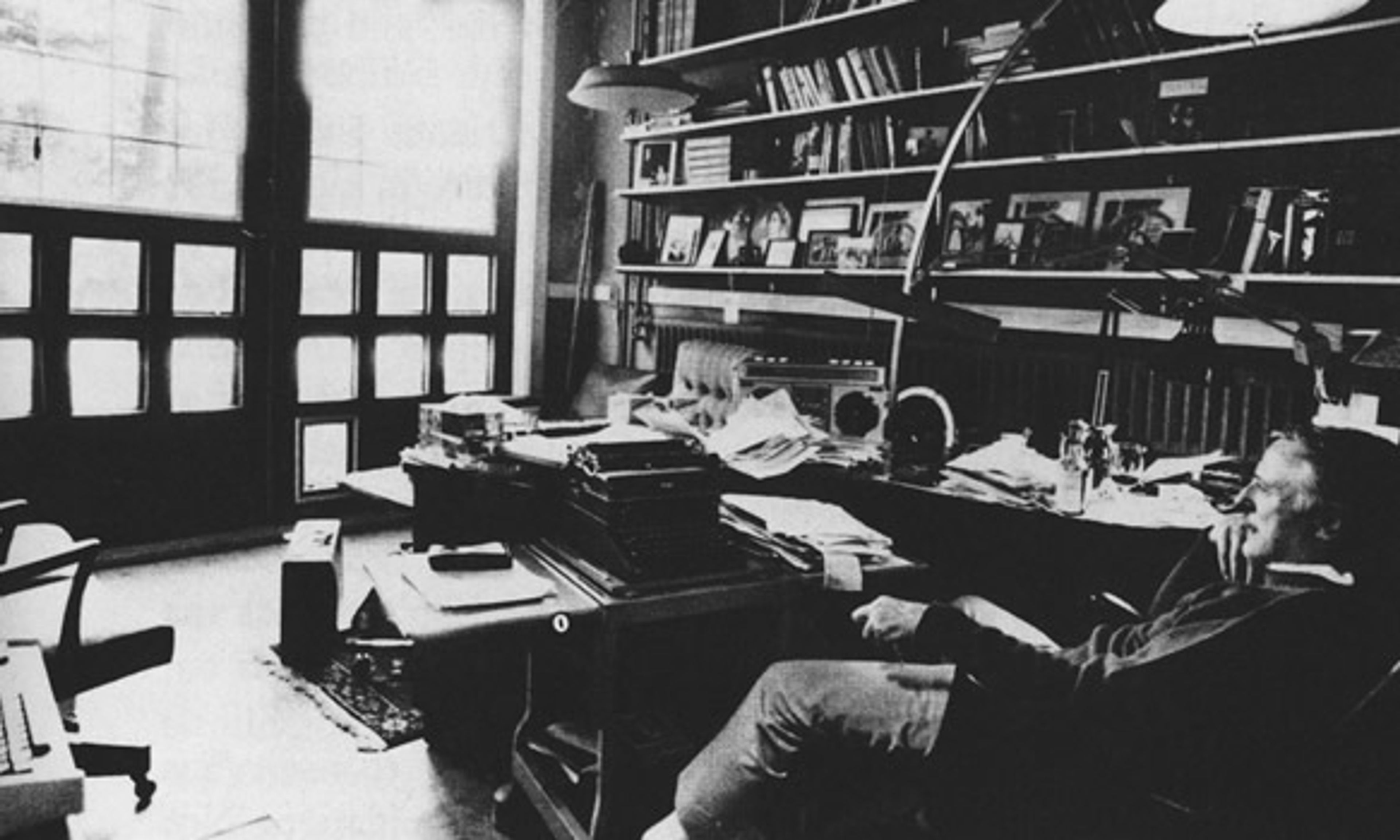
In my long association with Bill Buckley, I had only two serious arguments with him. One was about the Iraq War, and it lasted for a handful of years. The other was about books — and that one lasted from just about the day I met him, in 1963, until nearly the day he died, in 2008.
Bill was a man of many books, and it required three libraries to house them all. At his duplex on East 73rd Street in New York, he displayed copies of his own books, handsomely bound, alongside special editions from a few other authors. Dinner guests would browse furtively while sipping a preprandial cocktail. A much larger library was constructed at National Review, a working library that, although compact, seemed to contain all of the basic texts of political discourse; it was perfectly right-sized for deadline writing. His personal library, by far the largest of the three, was pack-ratted in the capacious garage of his weekend home in Stamford, almost 5,000 volumes stacked in rickety shelving rising to a height of twelve feet. On seeing Bill hunched over his desk in the well of these listing towers, a visitor could easily conjure the headline, Famous Author Missing / Feared Lost in Book Avalanche.
I always thought of the garage as Bill’s reading library. Those books were in a sense who he was, if it can be said that you are what you read. It was in the garage that he kept his sailing books, his world-class collection of dictionaries, and the many books, well over a thousand, inscribed to him by admirers and friends named Galbraith, Wolfe, Nixon, and the like. Most important, it was here that he kept the books he had actually read or planned to read — the biographies, novels, histories, and memoirs; the works of political philosophy; the occasional tome on economics.
This astonishingly eclectic collection never failed to provide occasion for argument. A good place to start was with Willmoore Kendall, the gifted and contumacious political theorist. Bill and I had both studied (or cowered) under him as undergraduates, and we had both attempted to manage him in later associations, Bill as his editor at NR and I as the director of a political campaign Willmoore had agreed to serve as policy adviser. For both Bill and me, these collaborations proved to be more memorable than productive. Willmoore had the soul of an insubordinate and, when even slightly inconvenienced, would produce long, explosive letters of resignation, painstakingly composed by hand in bright green ink. Of our friend Willmoore and his books, as they stood trial years later before their peers in the garage, the principal question was hierarchical: Where should he be placed in the ranks of political philosophers, conservatives, and polemicists? Just how important had his intellectual contribution really been? It was a question, agreeably, to which a definitive answer could never be affixed. (I note for the record that Willmoore would never have acknowledged Bill, much less me, as his peer. Augustine, probably. Spinoza, maybe.)
Of other authors, the arguments would involve questions of trajectory. For example, as we pondered the half-shelf of Theodore White’s groundbreaking campaign books, which appeared quadrennially under the designer-label The Making of the President, we would ask: At exactly which point did Teddy peak before beginning the inexorable if still highly profitable slide into tedium and reportorial astigmatism? (I can say without fear of contradiction now that it was 1968.)
Of still other books we were more concerned with the relationship to, and the collateral damage inflicted by, the Zeitgeist. Bill was pleased to identify our instrumentation in this inquiry as the Freeman Gap, by which we sought to measure the disparity between an author’s intrinsic merit and the critical esteem he contemporaneously enjoyed. I would advance the claims of, say, Louis Auchincloss and Bill would demur. He would then advance the claims of Constantine Fitzgibbon and I would demur. And so on down through the years.
The most richly layered arguments swirled around proxy books, by which I mean books that stood not just on their own feet but as representatives of either the ideas that animated them or the people who wrote them. A classic case was The Warren Revolution, by L. Brent Bozell Jr., Bill’s brother-in-law and a once-in-a-generation talent gone astray. Bill and I had snippet-conversations about The Warren Revolution, as an antiseptic way of talking about Brent, for more than three decades. (For a definitive account of the late Brent Bozell, I recommend a biography by the fine scholar and writer Daniel Kelly. I have not seen a word of it — indeed, it may not be published for another year or two — but Brent’s story is hellacious and Kelly will tell it well.)
On my last visit to the garage, we talked of many things, personal and practical, both of us aware that the conversation was likely to stand as a summing up of our long friendship. (He was never a careless writer; his invitation had described his condition as “terminal.”) As always, he was the fussy librarian. He was mortified, as he put it, to have discovered that a book he had given me actually belonged to a British friend. Would I be sure to get it to him? Of course I would. Was there another book I wished to accept in its place? There was not. . . . I did not wish to violate his library’s — what’s the word? — integrity. He nodded, looked around, and with a hint of the old wolfish grin said, “I’ll have to give it away, you know.” On my long drive home that day, much of it observed through misty eyes, I thought of how much he had meant to my life and how much I would miss him.
Shortly after Bill’s death, it became clear that he had made no special provision for the books and that his estate had decided, sensibly, to convey the collection intact to a local library. But one day, months later, word raced around the Buckley grapevine that the library was preparing to sell Bill’s books. One of our old brothers-in-arms called and, almost puling, stated the obvious: “You have to do something.” I dashed off a precatory note with an offer to buy the books, at which point the deliberations took an abrupt and disappointing turn into bureaucratic underbrush. The library’s evolving position was that it would proceed with the sale through its bookshop of the “like new” volumes, many of them review copies submitted to WFB by publishers and publicists. Other titles, in good but not quite mint condition, would be shuffled into the library’s public stacks. A third batch, the books inscribed by Bill’s intergalactic circle of friends and acquaintances, would be sequestered as a permanent WFB collection. The fourth and most forlorn bunch — the tatty, tagged, ballpoint-pen-flecked volumes — were deemed unpresentable to the reading public and would be consigned to a cobwebbed corner of the basement.
If you have read this far in the story, you will anticipate that a happily Solomonic resolution would ensue. As dust settled over Bill’s books, what surely must have been the hand of God so arranged matters as to allow the library to sell some spiffy volumes and make a buck, freshen its own holdings with some fine works, and allow me — with the blessing of Bill’s estate — to acquire the books I most dearly prized: the ones he had read, marked up, and stickered, the ones that traced his own supersonic intellectual journey.
I am working my way through the books now. Some he read for research on current writing projects: How else to explain the books on Elvis and harpsichords and Micronesia, not to mention a Joe McCarthy file that would impress even M. Stanton Evans? Some books he read out of a manic, undifferentiated curiosity — authors ranging from Vladimir Nabokov to Ann Coulter. (Years ago, when we were both young, he insisted that I take him to a “Rob Dylan” concert. He didn’t much enjoy the evening, but he was relieved to have plugged an ignorance hole.) I can’t wait to read the marginalia scratched in the Tanenhaus biography of Whittaker Chambers.
There is much more here, four more cases yet to be opened — more books, possibly, than I will be able to get to. But not to worry, Bill. I’ll give them all a good home.











Comments