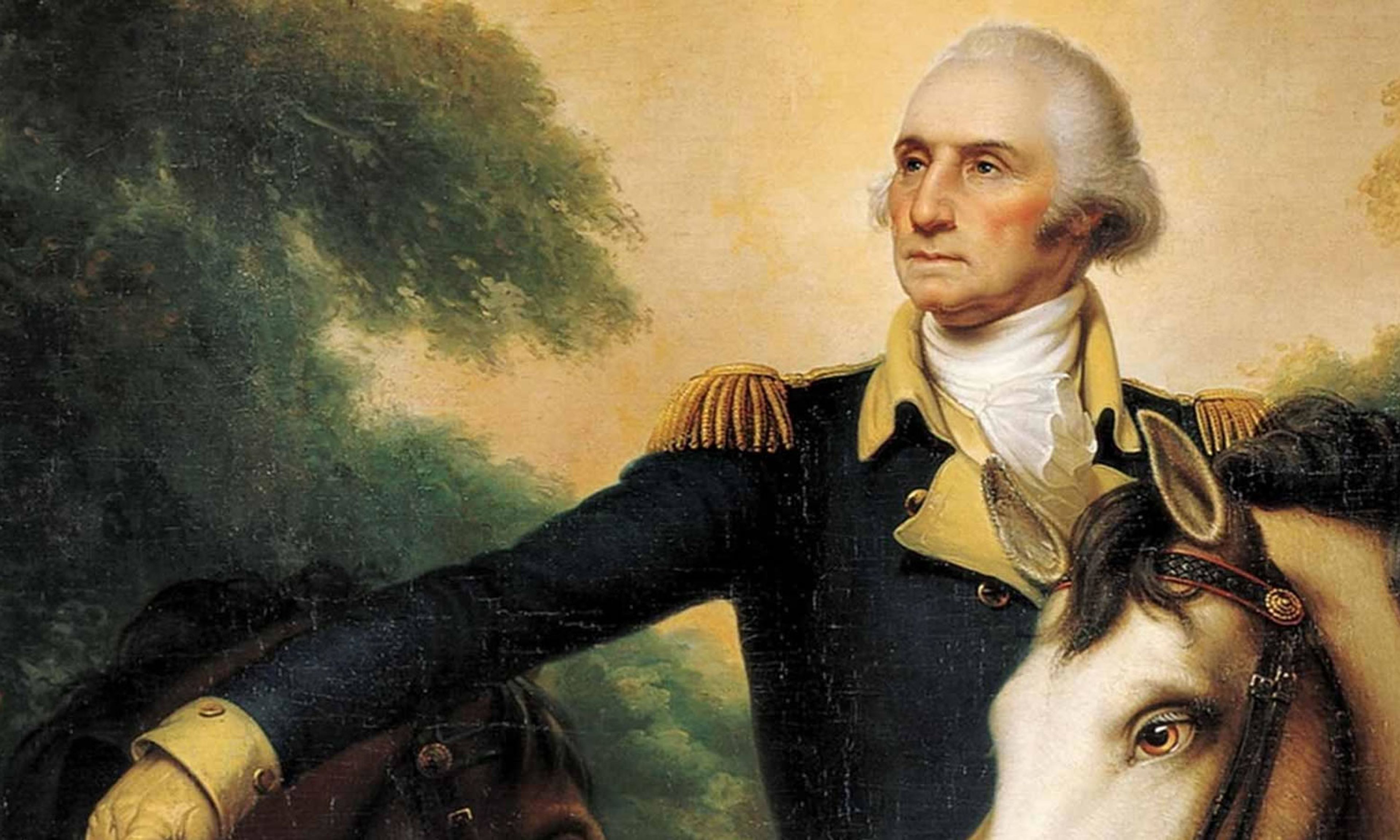
Every generation gets the George Washington it deserves. In the polyester, Watergate-era Seventies, Gore Vidal reduced America’s most revered president to a pompous figure of fun in his novel Burr, with ill-fitting false teeth and carbuncles: “a planter with a sore bottom,” in Gore’s dismissive phrase. In the Nineties Richard Brookhiser’s Founding Father revived the heroic Washington of old, both as a historical corrective and as an antidote to the moral decay of the Clinton years.
Now we need a Washington for the tea-party generation. Sadly, Ron Chernow’s Washington: A Life isn’t it. The author of The House of Morgan and biographer of Alexander Hamilton wants to give us instead a Washington for the age of Obama: an existential visionary with “a fiercely guarded emotional life” who self-consciously made himself a pillar of strength his countrymen could cling to — “people felt the inner force of his nature,” Chernow gushes, “even if they didn’t exactly hear it or see it” — on their uncertain path to the American future.
So we get paragraphs like this, describing the young Washington on the verge of his first command in the French and Indian War:
This young careerist brooded interminably over the discrimination leveled against colonial officers and betrayed a heightened sense of personal injustice — feelings that would assume a more impressive and impersonal ideological form during the American Revolution. Nevertheless there was a gravitas about the young Washington, a seriousness of purpose and a fierce determination to succeed, that made him stand out in any crowd.
The media catchphrase “gravitas” is particularly jarring. What should be the best one-volume life of George Washington reads at times more like The Audacity of Hope in 18th-century fancy dress.
Still, it doesn’t pay to give up on Chernow so quickly. His exhaustive research and command of detail supply more than enough material to make a Washington who does speak to our time — and also, like the one in Richard Brookhiser’s volume, for all time.
“It was Washington’s nature to ponder the dark side of things,” Chernow writes. Born in 1732 — the same year as Haydn — George Washington grew up divided between two powerful impulses. One was a desire to enjoy the serenity and domestic peace of his rural Virginia boyhood and, later, Mount Vernon: a world of foxhunting (he was the finest horseman of his age, admitted Thomas Jefferson, no mean equestrian himself), crop growing, and adventurous business schemes with friends, framed by the domestic intimacy of fussing with children and grandchildren. Washington borrowed a phrase from Micah 4:4 to describe this peaceful life in his famous “Answer to the Hebrew Congregation of Newport”: “Every one shall sit in safety under his own vine and fig tree and there shall be none to make him afraid.”
Against this ran a growing sense that a faraway government in London had grown too large and tyrannical, and was set to tax and oppress its American children without regard to their wishes or interests. Washington realized that confronting the challenge of the one might mean giving up the pleasures and happiness of the other. This seemed intolerable. Washington’s life became a quest to discover how men might achieve liberty without giving up the things that make it sweet. Like almost all the Founding Fathers (Alexander Hamilton might be the sole exception), he entered public life primarily as a defensive measure — not in order to exercise power, but in order to keep power at arm’s length and out of people’s lives.
This required an ever more extraordinary balancing act the more famous Washington became, as well as considerable self-discipline. It was in some ways easier for Washington because he was a soldier. The discipline of military life, and the responsibilities of command earned during the French and Indian War, convinced him that fulfilling both our public and our private duties requires a constant inner strength, buttressed by moral rectitude on one side and unhesitating self-sacrifice on the other, and bolstered by a deep religious faith.
Washington stuck to this formula all his life. The ancient Romans had a name for it: virtue. No wonder contemporaries compared Washington to the ancient Romans, and no wonder Washington loomed as the inevitable choice for commander-in-chief when the Continental Congress desperately needed one in 1775.
He was not only the logical choice (the other candidate, Israel Putnam, was too old) but the only one with any strong strategic sense. Washington realized that if he couldn’t win the war, he could keep the other side from winning — and that eventually patience across the Atlantic would run out and independence would be achieved. This too required extraordinary self-control, to wait out an enemy and avoid the temptation of a decisive battle. But with some help from the French, especially on the naval side, this is precisely what happened. After the war, Washington was able to step down as commander-in-chief but remain the most revered man in America — the true father of his country or pater patriae, in the classic Roman formula.
“Having now finished the work assigned me,” he told Congress, “I retire from the great theater of Action” — and back to his beloved Mount Vernon. What drew him back four years later was the failure of another government, the one established by the Articles of Confederation, to honor its commitment to pay his veterans who had served him loyally in the Continental Army and now faced financial ruin.
The problem this time, he concluded, was not a government that was too strong but one that was too weak. Although he sat only as an ordinary delegate, such was Washington’s reputation at the Constitutional Convention in the autumn of 1787 that when he heard his young friend James Madison’s sketch of a new Constitution, his approval virtually ensured its passage, while its new chief executive’s powers and prerogatives were as clearly composed with Washington in mind as High Noon was written for Gary Cooper.
Once again he had to give up the pleasures of Mount Vernon — “the most charming seat I have seen in America,” a Philadelphia visitor said, and where, writes Chernow, “light portable tables [were] brought onto the piazza in warm weather, which allowed guests to enjoy alfresco dining, cooled by river breezes and serenaded by parrots.” Yet Washington saw that his private serenity and his business ventures, including cutting a canal from the Potomac to the Ohio Valley, would have no secure future with a government that could not enforce its laws and was swimming in debt — and unless he assumed and molded the office of chief executive to be a bulwark for, not an obstacle to, free government.
It was an awesome task. More people, slave and free, worked at Mount Vernon than worked for the entire executive branch of the federal government. With everything he did becoming instant precedent, President Washington tried to keep the focus away from himself and on making a government that worked. One of his major challenges was keeping the quarreling factions of Federalists and Democrats from tearing each other, and the country, apart. Their leaders, Hamilton and Jefferson, were deeply critical of Washington’s seeming diffidence, for different reasons. But they showed he was right when they broke off their feud to beg him to stay for a second term.
This he did, while setting the future of the American presidency in two decisive ways. The first was raising and taking command of the army that would suppress the Whiskey Rebellion in 1794, an army five times larger than the one he had commanded at Yorktown. Self-restraint must never be mistaken for lack of decision, as Washington powerfully proved; and the presidency’s twin roles as chief executive and commander-in-chief became melded into one, not just for Washington but for every president since.
The second was making the president the prime mover in American foreign affairs.
His Farewell Address of 1796 is truly the foundation of a distinctly American diplomacy, one that balanced the ideals of American exceptionalism with the realities of dealing with the world. It tends to be remembered more for the quasi-isolationist line, “’Tis our true policy to steer clear of permanent alliances,” than for what Washington said next: “so far, I mean, as we are now at liberty to do it — for let me not be understood as capable of patronising infidelity to existing engagements.” From Britain in World War II, to Israel and Iraq today, Washington’s enduring pledge was that America’s honor rested on supporting its friends.
When Washington died at Mount Vernon on Dec. 14, 1799, many feared the American republic could not survive without his presence. They were wrong. His presence would persist, as it still does, in the formula according to which he lived his life. The eternal price of liberty is not just vigilance, but also self-discipline; and the pursuit of happiness requires a framework for fulfilling our public obligations, as well as our private passions.
It was Parson Weems — the same one who gave us the cherry-tree-chopping boy Washington so despised by later biographers, including Chernow — who said, “Think of Washington — and HOPE.” It’s still the watchword for our future.











Comments