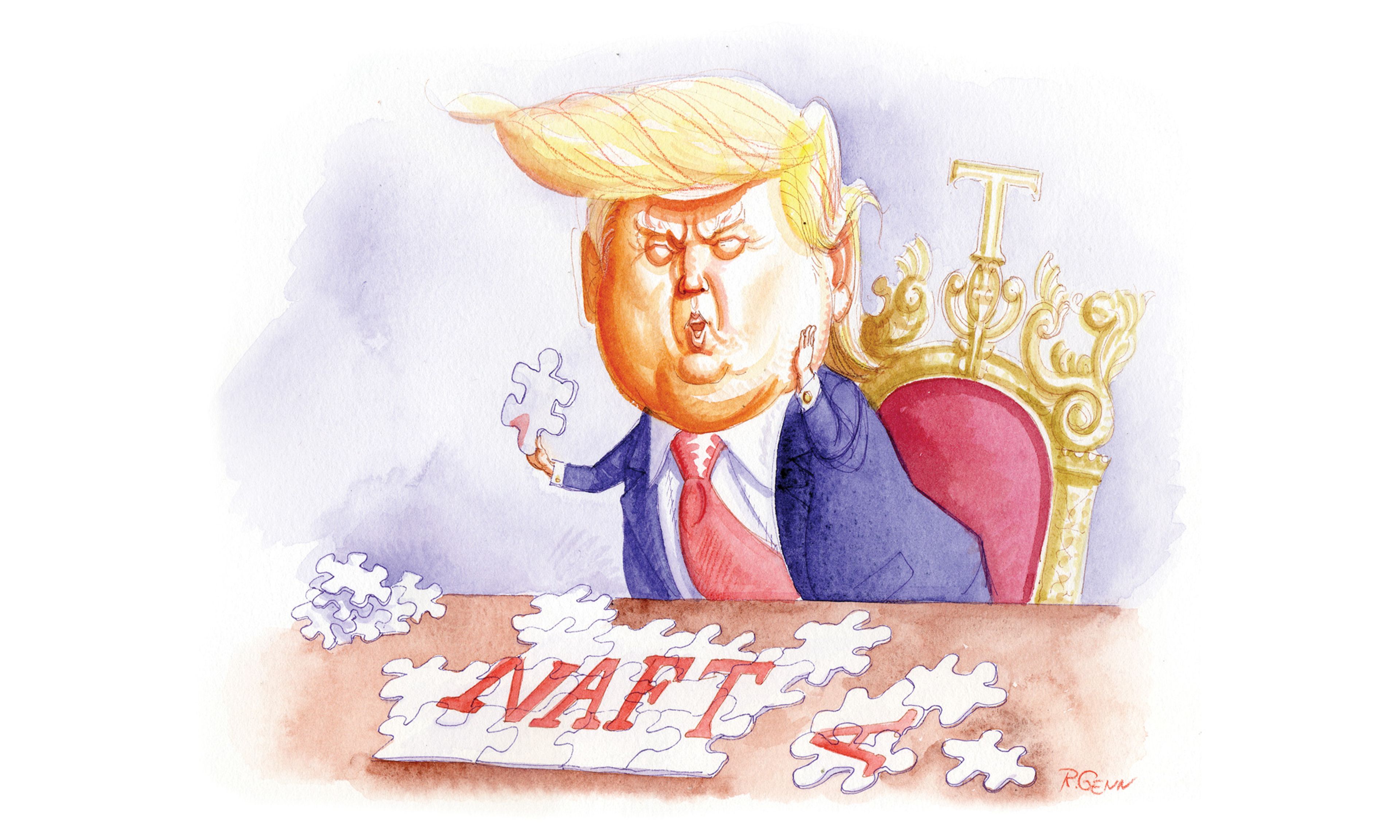
President Donald Trump has a thing about NAFTA. He doesn’t seem to know what’s in it — President Trump’s many public statements on the trade accord have not identified any substantive provision to which he objects — but he is sure that he hates it, that it is, in his tediously hyperbolic assessment, the “worst deal ever made.”
He has instructed his administration to renegotiate NAFTA, and Secretary of Commerce Wilbur Ross has set about doing so incompetently, making absurd demands of Canada and Mexico to which they could not consent even if they were inclined to, inasmuch as those demands would put those countries in violation of their legal obligations as members of the World Trade Organization. The Trump administration has demanded the elimination of NAFTA’s dispute-resolution mechanism — i.e., NAFTA’s institutional raison d’être — and Ross, who apparently believes that what U.S. investors and business managers really need is a little more suspense, has put forward a truly bonkers proposal to renegotiate NAFTA every five years, putting North American trade — that’s $3.3 billion a day in commerce and 14 million American jobs — in a constant state of regime uncertainty. The administration also wants to raise the required minimum percentage of North American components for NAFTA-traded automobiles. NAFTA already imposes the highest domestic-origin floor in the world, and the administration’s plan to raise it from 62.5 percent to 85 percent — with a 50 percent made-in-the-U.S.A. requirement — is both impracticable (it may in fact be impossible) and at odds with U.S., Canadian, and Mexican obligations under other trade compacts.











Comments