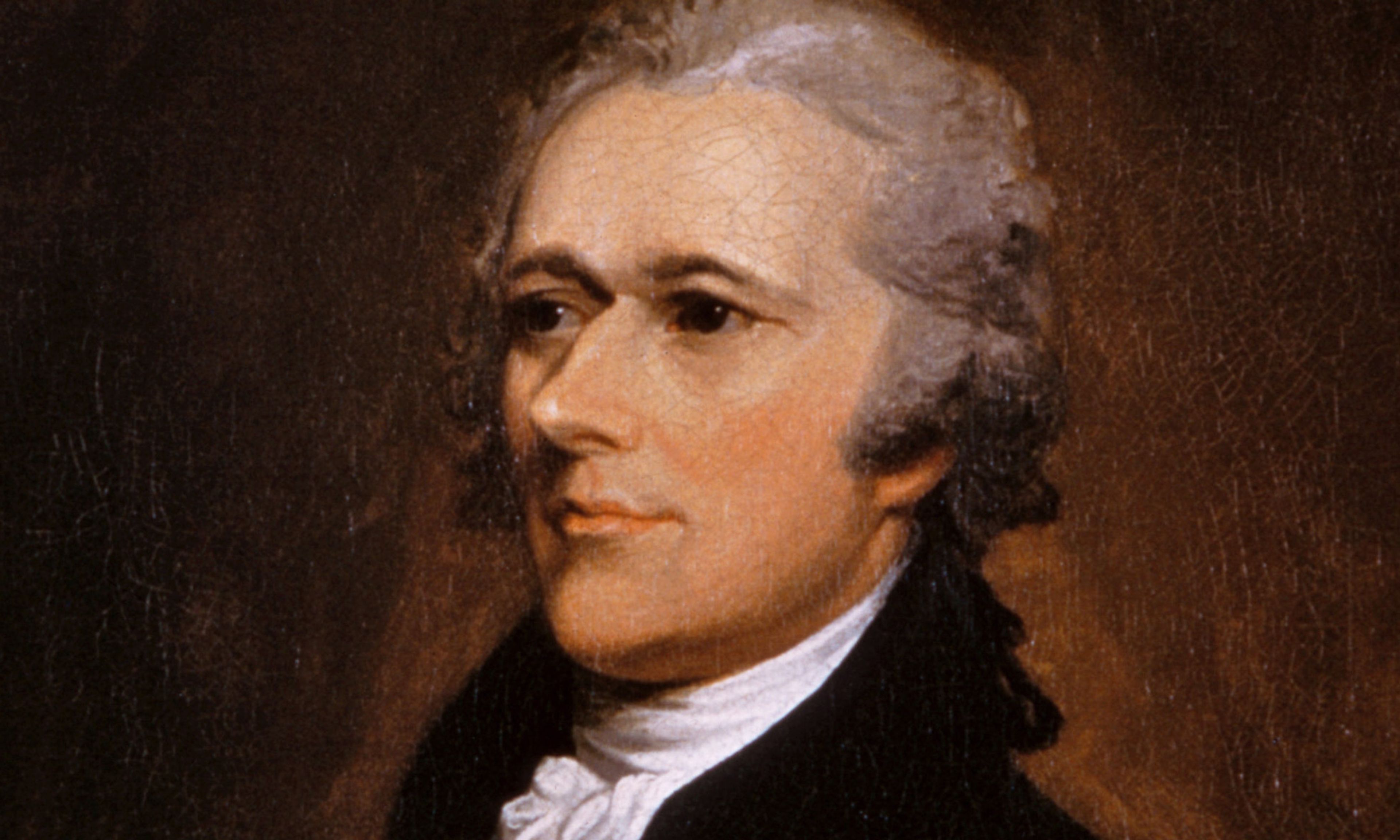
We are not Hollywood, yet we are dotted with camera crews: TV news vans with pop-up antennas covering celebrity appearances or disasters; movies and TV shows that want “real” urban locations, even though Toronto is cheaper; kids from the New York Film Academy learning to block and frame and focus. Recently I joined all this activity, for the last day of filming a PBS documentary on Alexander Hamilton. I am the writer and host; the director/producer is Michael Pack. The Hamilton film is a very Gotham project: Michael was born in the city but moved away; Hamilton and I were born elsewhere but moved here.
We had three assignments for our last day. The first was to plug a few holes with stand-ups. An on-camera host telling you what it all means can be as intrusive as a robo-caller, but in moderation he can provide a thread through a subject, and relief from other footage. One of my tasks was to explain the election of 1800. This election joins 1824, 1876, and 2000 on the list of royally screwed-up presidential elections, and since it came first, the potential for panic was greatest, because Americans did not yet know that the system could take a hit and roll on.
Telling the story is complicated by the fact that it occurred before the Twelfth Amendment, which gave legal reality to tickets, with candidates for president and vice president, as we know them today. According to the original Constitution, each elector in the Electoral College cast two separate votes. Whoever got the most became president; whoever finished second was veep. In 1800, Thomas Jefferson and Aaron Burr, candidates of the first Republican party, beat their Federalist opponents, John Adams and Charles Pinckney. But thanks to Republican-party discipline, Jefferson and Burr tied, sending the election to the House. (Hamilton’s role in the fracas was clumsy and honorable — clumsy, because he tore down Adams, his own party’s choice; honorable, because when the tie reached the House he advised Federalists to back Jefferson over Burr — good for the country, though not for him, as he would find at Weehawken four years later.)
If you want to explain political reality in 1800, you can’t do it much more briefly than the sentences above. But they consume an eternity of air time, which Michael did not want to spend lingering over ye olde portraits, as I lectured in voice-over. So I stood on lower Broadway, near where Hamilton lived and worked, explaining 209-year-old legalisms against a backdrop of the daily scrimmage, which suggests urgency and cross-purposes as well as anything.
Another stand-up took us to Chinatown. During the Revolution, Captain Hamilton briefly led his artillery company to a fort north of the city. Legend has it that he was given warning to retreat from the advancing British by Major Burr, though this is almost certainly apocryphal. What is not apocryphal is that the fort stood at the intersection of Grand and Center streets. Who would hesitate to throw a little Chinese atmosphere into a film that spends so much time in Independence Hall? So we found a corner with street vendors selling sunglasses and lemongrass, the cameraman stood on top of a siamese standpipe, and I walked toward him explaining the retreat from New York.
Our second task for the day concerned the finale. The last shot of the film will be at Hamilton’s grave, in Trinity churchyard at the head of Wall Street. My role in the scene was to walk among the headstones, considering mortality. The star of the shot was the camera crane, and its jib arm. The jib is a twelve-foot beam, resting on a pivot. By working the short end, the cameraman can make the camera swoop around in a flat arc, or change elevation. We wanted to end with an upward swerve: Here he lies, but this — the New York mountain range — is what he built. I walked and walked, alone in the green yard of the dead, for take after take. At one point, a tour of schoolchildren swarmed in to pay their respects. I felt like the hero of an art-house release, surrounded after all his trials by innocence. But we have not been making the movie about my trials.
The third and last task had to do with our score. Hamilton was born on Nevis and raised on St. Croix, and we wanted to decorate his story with calypso music. Hamilton never heard calypso, but we wanted to suggest his foreignness, which no one, especially his enemies, ever forgot. Where better to find a calypso musician than New York? We managed it this way: Our production assistant from St. Croix, who happened to be visiting the city, heard a musician on the Battery playing a steel pan, and took his name. When he showed up for his audition, he brought three songs that he had written just for us. He was a 61-year-old man from St. Vincent; we loaned him a guitar, and let him perform.
One song was about money, and we filmed him, naturally, outside the Stock Exchange. Another song was about lust, for Hamilton had a sex scandal, and for that we put him in a dark spot with faux old lanterns. His third song was a paean to our subject, with this chorus:
Alexander Hamilton
You were a great man.
We miss you, my brother man,
More than anyone.
Why did it move me so? The island music, I realized, was our attempt to give Hamilton back his youth. He didn’t want it: For him the islands meant poverty, loneliness (his father took off, his mother died), shame (they were not married). Even if he had wanted it, it’s too late: He’s been dead for two centuries. But when you enter a man’s life, you take him into yours. It is right to honor him, and to wish him well. This is for you, my brother man.











Comments