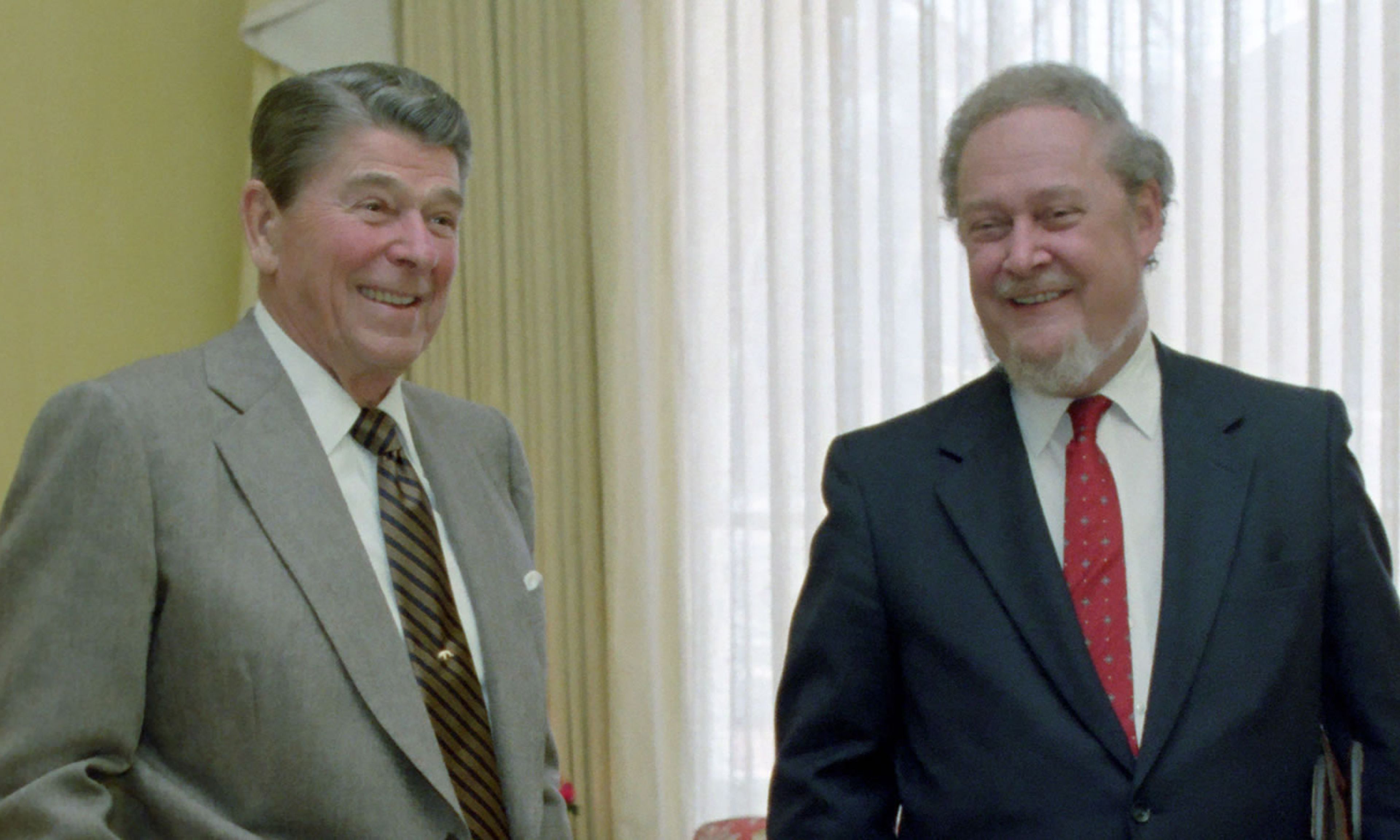
The title of this big book is taken from the passage in Ecclesiastes that says “to every thing there is a season, and a time to every purpose under heaven,” including “a time to speak.” Robert Bork, now 82, has been “speaking” at various times over the past half century. A Time to Speak is a collection of the best of what he has said. And it is an unusual collection. Among the “selected writings and arguments” are articles, both academic and popular, but there are also briefs filed in courts, transcripts of oral arguments before the Supreme Court, judicial opinions, and letters to the editor. Bork sees his books — on antitrust law, constitutional interpretation, cultural degradation, and international law — as primary, and this “body of shorter works” (it contains 62 of them) as augmenting and extending them. A Time to Speak does accomplish that end, but it will also serve as an introduction to a rising generation unfamiliar with his work.
Bork happens to be one of the great lawyers of the past half century. He was a law professor at Yale before serving as solicitor general in the Nixon administration. In 1981, President Reagan appointed him to the appeals court in Washington. In 1987, Reagan nominated him to the Supreme Court. And while the Senate’s rejection of his nomination may be all that many Americans know about him, Bork’s influence on the law and in the ongoing debates about its interpretation is enormous.
The subject Bork specialized in when he began teaching at Yale, in 1962, was antitrust, which he found in “crisis.” As he explained in a 1963 article in Fortune included in this volume, it was a crisis caused by the rapid acceleration of protectionist trends such that anti-free-market forces had gained the upper hand and were threatening “to destroy the antitrust laws as guarantors of a competitive economy.”
Applying law-and-economics principles, Bork contended that the basic purpose of antitrust is to promote consumer welfare. He pressed the particulars of his argument in a series of law-review articles in the 1960s and 1970s (two of which are republished here). The Antitrust Paradox, published in 1978, was Bork’s comprehensive statement of the matter. His steadfast focus on consumer welfare changed minds, including on the Supreme Court, and lent support to the movement for deregulation that reshaped policy in the 1970s and 1980s.
Bork acquired another interest in his first years at Yale, namely constitutional law, on which he published his first major article in 1971 in the Indiana Law Journal. Constitutional law, he argued in “Neutral Principles and Some First Amendment Problems” (included here), was notable for its lack of theory. As a result, “courts are without effective criteria and, therefore, we have come to expect that the nature of the Constitution will change, often quite dramatically, as the personnel of the Supreme Court changes.”
Unwilling to assume the legitimacy of judicial review, Bork derived his conclusion about when it can be legitimate from the very foundations of our constitutional system. He advanced a theory about constitutional law that sought to demonstrate that there can be no rule of law in constitutional adjudication unless the original understanding of the Constitution — its public meaning at the time of its enactment — is the judge’s guide. Absent such a rule of law, judges have nothing to apply and a self-governing people may legislate (or not).
Bork believes that “Neutral Principles” is “the first modern exposition” of originalism, and he is probably right about that. It was a remarkable achievement. As John Harrison, a student of Bork’s at Yale and now a law professor at the University of Virginia, has put it: “A scholar primarily of antitrust law, without the benefit of the relatively more sophisticated conceptual tools that are available to us, many years later, in thinking about the Constitution, Bork came to the field and, largely on his own, reasoned in the right way when so many were reasoning in the wrong way. While others were taking judicial review for granted, Bork started with more fundamental considerations and came to conclusions that remain powerful and persuasive today.”
By the early 1970s, Bork had become a conservative, and was one of the few conservatives teaching in a law school as prestigious as Yale. He was an ideal choice for solicitor general, his views on constitutional interpretation congruent with those (at least as announced) of President Nixon. And as briefs and oral arguments included here illustrate, Bork, the government’s chief appellate lawyer, did not shrink from his convictions about originalism.
For example, in Gregg v. Georgia (1976), in which Bork helped persuade the Court to reinstate the death penalty, he told the justices that those who framed the Eighth Amendment’s prohibition of cruel and unusual punishments did not intend “as an original matter” to outlaw capital punishment because “they prescribed the procedures that must be used in inflicting it” elsewhere in the Constitution. Thus, the Court should not “substitute its judgment about the propriety of the death penalty for that of the legislatures both more properly charged with the duty of making that judgment and more advantageously situated to collect and assess the relevant information.”
By the early 1980s, Bork had become the leading advocate of originalism. When he was nominated for the Supreme Court, the debate over constitutional interpretation intensified, with Bork vigorously contending for his views before the Senate Judiciary Committee. “The defeat of his nomination,” another of his former students, law professor Steven G. Calabresi, has written, “turned Bork into a martyr for the cause of originalism.” In 1990, Bork wrote The Tempting of America: The Political Seduction of the Law, a compelling elaboration and defense of originalism that notwithstanding its arcane subject matter became an instant bestseller.
Not surprisingly, A Time to Speak devotes more space to articles on constitutional law than to ones on any other subject. These articles defy quick summary. Bork doesn’t just take on courts that have strayed from the original understanding (see, e.g., Roe v. Wade) and challenge “non-interpretivists” — liberal professors like Ronald Dworkin and Paul Brest, who “assign to judges not the task of defining values found in the Constitution but the task of creating new values and hence new rights for individuals against the majority.” Bork also takes issue with conservatives who hold interpretive views he judges to be at odds with the original understanding and likely to lead to judicial activism of the Right.
Thus, Bork rejects the notion that judges should presume the unconstitutionality of all economic regulations. The “historical Constitution,” he writes, does not provide for the “more general spirit of libertarianism” that a judge would need for its enforcement. Likewise, Bork takes issue with the idea that the Constitution is pro-life and thus prohibits abortion; he does so on the grounds that the Constitution in its original meaning does not take sides on the issue and leaves it to be decided by a self-governing people. As well, Bork rejects efforts by some conservatives to read the Constitution in terms of “natural law,” finding it “no more reputable than the labors of liberals to read the Constitution in terms of ‘moral philosophy.’”
As for the articles in this volume on foreign law, they invariably say sensible things. And one of them stands out: a 2003 piece from this magazine in which Bork sits in judgment of justices infatuated with international law. Of Sandra Day O’Connor’s contention that “the differences between our nations are fewer and less important than our similarities,” Bork says that it is “a serious mistake,” pointing out the obvious — that “we have few ideas about law and human rights in common with radical Islam, Russia, China, most of Africa, Cuba, and much of South America.” Bork also mentions as an example of this “absurd turn in our jurisprudence” Justice Anthony Kennedy’s citation of a decision by the European Court of Human Rights in his opinion in Lawrence v. Texas (2003) creating a constitutional right to homosexual sodomy. (The references to O’Connor and Kennedy occasion thoughts of what might have been, had either of their seats been taken by Bork instead.)
Among the articles on politics and public policy collected here, several concern the independent-counsel statute. Enacted in 1978, this law hobbled our politics until Congress finally declined to reauthorize it in 1999. Bork writes soundly about every aspect of the law, including its unconstitutionality and its weakening of the presidency.
In Slouching Towards Gomorrah (1996), Bork took up a topic addressed nowadays only by a brave few — public morality. There he detailed multiple manifestations of cultural decline. A Time to Speak includes articles covering some of the same ground. In a 1995 piece from First Things, Bork attributes the unraveling of the culture to the rise of modern liberalism and in particular its pursuit of radical egalitarianism (equality of outcomes) and radical individualism (“a refusal to admit limits to the gratifications of the self”), the two forces working together to undermine traditional mores and authorities. Statism (“government [that] is likely only to get bigger and more intrusive”) and moral anarchy are what we have now and will continue to have, he writes, unless a great cultural reversal occurs. Bork thinks that could happen if we have a revival of Biblical religion. Though he is not optimistic about such an eventuality, Bork here assumes the utility of Christianity in generating a virtuous people. What he does not explore, but surely understands, is that people turn to Christianity not because it may produce a healthier culture but because it offers a cure for sin.
A Time to Speak closes with pieces of a personal nature, including appreciations of Bork’s friend Alexander Bickel, who taught with Bork at Yale and died at 49, in 1974; and of his law teacher at the University of Chicago, Edward Levi, who was attorney general when Bork was solicitor general. Bork writes perceptively about the character of the men and their achievements in the law. And, like all of Bork’s articles, the appreciations are very well written.
Bork’s prose deserves special notice, for it is unfailingly clear and direct — and lively. Bork also has a talent for the memorable aphorism. Consider: “The truth is that the judge who looks outside the Constitution always looks inside himself and nowhere else.” And: “As government regulations grow slowly, we become used to the harness.”
The title of this book does not do justice to its contents. Bork has had many times to speak, but so have others. It’s what he’s had to say that matters. And during his long career, there has been no greater advocate of constitutional liberty and constitutional self-government than Robert Bork.












Comments