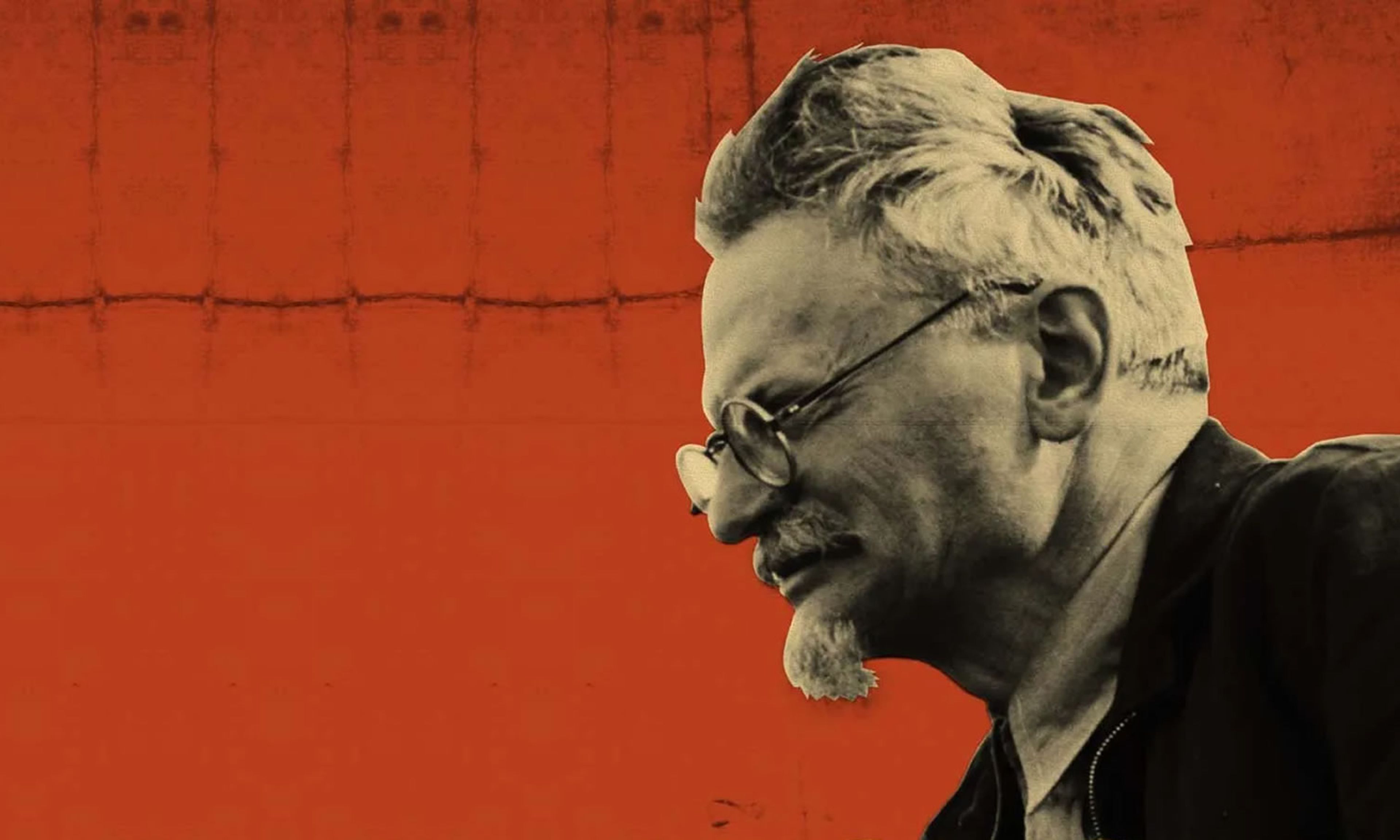
What are we to make of Trotsky? Nowadays, young people do not know much about him, and it is not easy to explain to them exactly who he was and why he was important. Hoover Institution scholar Bertrand Patenaude’s new book will help. It is based on a great deal of research and contains much new material. But it is a pity he adopted the sensational device of flashbacks to recount Trotsky’s career. A straightforward narrative biography would have been more useful.
Leon Trotsky was born Lev Davidovich Bronstein in 1879, in Ukraine. His father was an assimilated Jew who sought to be a farmer on the steppes, but his mother came from the educated middle class. His hometown was Odessa, the most brilliantly cosmopolitan center in Tsarist Russia. He became a Marxist at 19, and in 1898 he was arrested; he spent over four years in prison and Siberian exile, finally escaping to London on a forged passport bearing the name Trotsky, which he adopted. He got back to Russia in 1905, joined the Petersburg Soviet, was jailed again and sent to Siberia, and escaped once more. His political views were Social Democrat and Menshevik rather than Bolshevik, but it is hard to pin him down as an ideologue. His chief contribution to the political debate was his idea of the permanent revolution. On most issues he changed his mind, often more than once, and his published writings, though voluminous, do not make it easy to construct a Trotskyist ideology.
After being in Vienna, the Balkans, Paris, and Switzerland, he was in New York when the Russian Revolution broke out early in 1917. He got back to Petrograd in May, and became leader of the left-wing Mensheviks. Arrested again, and in jail, he finally decided to join the Bolsheviks, and was immediately put on the Central Committee. Out of jail in September, he took over the military leadership in Petrograd, and had made it a Bolshevik stronghold by the time Lenin emerged from underground on November 7. Trotsky led the troops in defeating Kerensky at the battle of Pulkovo on November 13, and when Lenin formed his government he put Trotsky in charge of foreign affairs. The Peace of Brest-Litovsk with Germany was to a great extent his doing, though he changed his mind twice during the negotiations. After it was signed, Lenin made him war commissar, and it was Trotsky who organized and commanded the victorious Bolshevik forces in the desperate civil war that followed.
Trotsky thus created the Red Army, which he formed as a small, expert, professional force. Its decisive defeat of the White Army in and around Petrograd was an important moment in history, his “finest hour.” Trotsky was unusual for a revolutionary thinker, being a man of action and a brilliant mass orator as well as a clever propaganda writer. The most remarkable quality he possessed was superabundant energy. When he was awarded the Order of the Red Banner, this aspect of his character was singled out in the citation, which called him “indefatigable and indestructible.” It continued: “In the days when Red Petrograd came under direct threat, Comrade Trotsky, in setting off for the Petrograd front, took the closest part in the organization of the brilliantly executed defence of Petrograd, inspiring with his personal bravery the Red Army units under fire at the front.”
What Trotsky was not good at was political maneuvering in secret, or building up a reliable personal following among party bureaucrats — at these things, Stalin was the master. In December 1922, the ailing Lenin drew up his political “Testament,” in which he warned about Stalin’s faults and sinister ambitions. Trotsky he categorized as a man of “exceptional abilities,” though also of “too far-reaching self-confidence.” It is clear that he would have tried to use Trotsky to destroy Stalin, had he lived. As things turned out, from Lenin’s death onwards, Trotsky, by failing to concentrate persistently on the intraparty battle, and by an unfortunate illness at a critical time, lost heavily to Stalin and his backers. In 1927 he was pushed out of all his posts, and the following year from the party itself. In 1929 he was exiled from the Soviet Union.
First in Turkey, then in Mexico, Trotsky led a precarious existence. He had a number of followers, who provided him with a degree of armed protection. But, like most long-term exiles, he tended to be quarrelsome. In Mexico he was befriended by the leading mural painter, Diego Rivera, a person of great influence and some power. But Trotsky was sexually very active, as one would expect from a man of his temperament, and had an affair with Rivera’s striking wife, Frida Kahlo. He quarrelled with Rivera, as a result of confused ideological differences and misunderstandings, and broke with him. In due course, both Rivera and Kahlo became enthusiastic Stalinists.
Patenaude describes all this, and Trotsky’s life in exile, in great detail. It is not clear when Stalin first decided to have him murdered, or why he did not do so before 1929, when Trotsky was still in his power and could so easily have been executed. In the notorious treason trials of former Bolsheviks held in Moscow in 1936–38, Trotsky was presented as the chief conspirator, on evidence later shown to be entirely fictitious. The first assassination attempt, with a machine gun, failed. The second, in August 1940, by a Spanish Communist called Ramón Mercader (he had many other names), using an ice axe, succeeded.
Though the Soviet government, then in virtual alliance with Nazi Germany, disclaimed any responsibility, there is no doubt that Mercader, who had managed to infiltrate Trotsky’s household, acted as an agent of Stalin’s secret police. He was a complex and mysterious figure, about whom Patenaude has a good deal to say. Mexico having abolished the death penalty, he was sentenced to the maximum 20-year jail sentence. His true identity was not discovered until 1950, ten years after his crime, and he never admitted his ties to Soviet intelligence and the Soviet secret police. His story was that he was a disgruntled Belgian follower of Trotsky, named Mornard. However, when he was released in May 1960, he went to Cuba, then Czechoslovakia, and finally Russia. On June 8, 1961, Leonid Brezhnev, in a secret Kremlin ceremony, awarded him the title of Hero of the Soviet Union. The citation claimed that he had shown “heroism and courage” in carrying out “a special task.” For good measure he was given the Order of Lenin and the Gold Star.
Trotsky aroused strong emotions in Russia long after his death, especially among the Soviet hierarchy. I witnessed an instance of this when Khrushchev and Bulganin paid their celebrated visit to Britain in the 1950s. They held a vast press conference, dominated by Khrushchev, in the Central Hall at Westminster. Reporters were told to put their questions in writing, to be sorted out by the Soviet ambassador. But Isaac Deutscher, a prominent Trotskyite and author of a controversial life of Stalin, was not having this. He jumped up and addressed Khrushchev in Russian. What exactly he said I never discovered (it certainly involved Trotsky), but it made Mr. K. furious. He replied in a torrent of Russian invective, and, while he did so, shook his fist deliberately and menacingly in Deutscher’s direction. It is the only time I have ever actually seen a man, not least a world ruler, shake his fist. Quite a chilling moment. It all reminded me of a saying of the wretched Alger Hiss: Stalin always “played for keeps.” Trotsky discovered that to his cost.











Comments