On September 12, the American Institute for Economic Research celebrated the launch of the online journal Fusion: In the Tradition of Liberty. Edited by George Washington University political scientist Samuel Goldman, Fusion will publish a monthly essay, along with responses, defending individual freedom against challenges from both the Left and the Right. “The arguments will vary,” Goldman wrote in an editor’s note, “but they are consistent with our belief that freedom is a contributing element, not an enemy, of human flourishing, the common good, and public sentiment.”
Hear, hear. Fusion is elegantly designed and gracefully written. And it is well timed. Its founders understand that the American tradition of constitutional liberty under law is threatened as rarely before. They belong to a growing movement of conservatives who express gratitude toward the United States and are willing to stand for a love of freedom and community.
Their project is like — though not identical to — the “Freedom Conservatism” manifesto organized by John Hood of the John William Pope Foundation and Avik Roy of the Foundation for Research on Equal Opportunity. At this writing, more than 200 people have signed the Freedom Conservatism statement. Several are editors and writers at National Review. And the list is growing.
For good reason. This is a consequential moment. In recent years, mainstream American conservatism has been on the intellectual ropes. Now it is fighting back. Fusion is not only a part of this effort. Its name points to a strategy of conservative renewal.
“Fusion,” of course, was the term that came to be associated in the middle of the 20th century with the political philosophy of National Review and of its senior editor Frank S. Meyer. Intended as an insult, the fusionist label was appropriated by conservatives as shorthand for their synthesis of freedom and order grounded in the ideas and institutions of the American founding. This wide-ranging outlook offers a way of thinking about the Right that joins libertarian means to traditionalist ends, connects abstractions to policy particulars, and remains the best description of how most American conservatives live.
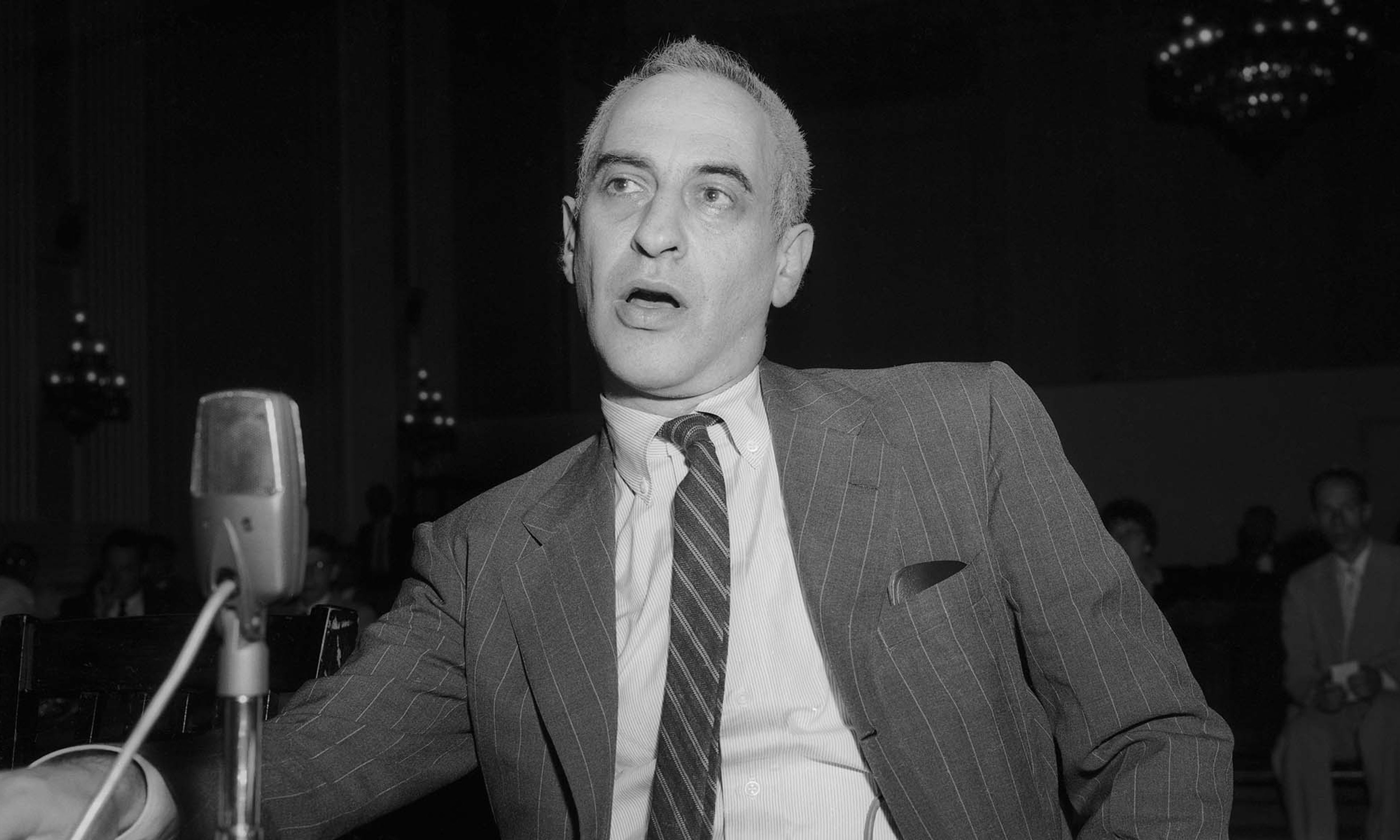
Meyer deserves a revival. He was born on May 9, 1909, in New Jersey. He studied at Princeton, then at Oxford. While in England during the 1930s, he joined the Communist Party. Later, as a soldier in World War II, he came across a copy of The Road to Serfdom, by Friedrich A. von Hayek. It changed his life.
Meyer became convinced that communism and fascism were totalitarian brothers. By 1945, he’d been deradicalized. He left the party and joined the anti-communist cause. He began contributing to libertarian or “individualist” periodicals such as the Freeman. And he was present at the creation of National Review in 1955.
Meyer was a complicated figure. He lived at the intellectual extreme. Over the course of his life, he was a communist and an anti-communist, a Jewish atheist and, on his deathbed, a Catholic. He was principled to the point of dogmatism. But he also filled the books-and-arts pages with eclectic literary and cultural criticism by young contributors such as Joan Didion, John Leonard, Guy Davenport, and Garry Wills, who did not check all the movement-conservative boxes.
The man was contradictory. He slept during the day and worked at night. Yet he maintained an extremely busy social calendar, welcoming an endless stream of visitors to the house in Woodstock, N.Y., where he lived atop a secluded mountain with his beloved wife Elsie and their two sons. When he wasn’t entertaining, he was talking, gossiping, or arguing over the phone. “His phone bill was rumored to be just a bit smaller than the national debt,” quipped White House speechwriter John R. Coyne Jr., in one of the many tributes to Meyer published after his death.
William F. Buckley Jr.’s nickname for Meyer was “Air-Traffic Control.” That was because Meyer’s self-imposed assignment was to understand and manage the varieties of American conservatism. He lined up ideas on the conceptual tarmac and made sure they remained on course and on schedule.
He was suited for the job. In his past life as a communist organizer, Meyer had learned techniques of organization and institution-building, which he later applied to the budding conservative movement. He was instrumental not only in the formation of NR but also in the creation of the Philadelphia Society discussion group, the New York Conservative Party, and the American Conservative Union.
Just as important is his intellectual legacy. Meyer was a sectarian man with a dialectical mind. He was committed to his positions, but he recognized the interplay of ideas. When he looked at the world, he saw a series of dichotomies: freeman and slave, man and society, reason and tradition, universal liberalism and national culture.
His reading and experience with thinkers and activists led him to identify the common ground of American conservatism. Meyer did not simply dream up his theory — he wasn’t French. His doctrinal writing was based on observation and description of how the conservatives he knew operated in the real world.
Meyer’s conclusions go something like this: American conservatism is unique; it is unique because it defends the inheritance of the American founding; and this inheritance is special because that founding occurred at a time when faith and reason, and culture and markets, operated in tandem.
Or as Meyer put it: “A concept such as that underlying American conservatism today — the concept that respect for the tradition of metaphysical truth does not contradict a politics of individual liberty — is not a ‘fusionism’ of disparate European traditions (as its more extreme authoritarian and libertarian critics have insisted), but is rather born out of the most fundamental American experience.”
In Meyer’s view, European civilization was torn apart beginning in the 19th century. In the aftermath of the French Revolution, utilitarian philosophers believed in markets but not in a transcendental moral order. The problem, Meyer continued, is that you can’t maintain a belief in individual freedom, economic or otherwise, without belief in the inherent spiritual dignity and value of the person. Freedom and authority, and liberty and tradition, thus became enemies on the Continent. In America they remained friends.
But not forever. A terrible distortion, according to Meyer, erupted in the United States in 1932. It came in the form of Franklin Delano Roosevelt and the New Deal. FDR changed the American social contract. He concentrated power in the nation’s capital, within the executive office of the president and then in the alphabet soup of bureaucracies insulated from public accountability. For Meyer, and most post–World War II American conservatives, the New Deal was a radical departure from the American consensus. “We are today,” he wrote in 1960, “historically in a situation created by 30 years of slow and insidious revolution at home and a half-century of violent open revolution abroad.”
The conservative task, Meyer believed, was to recover the pre–New Deal understanding of government, federalism, constitutionalism, and citizenship. That meant preserving and extending individual freedom in political life while strengthening the formative institutions of personal responsibility in civil society. Meyer lived during an era when many such institutions, from the family to religion, were much stronger than they are now. He emphasized freedom because the leviathan state was the most visible threat to civilization.
That did not make him a capital-L Libertarian. Some of Meyer’s fiercest arguments were with libertarians whose opposition to the state extended to the military and the police. Meyer believed that America needed soldiers and officers to fight barbarians at home and abroad. He wanted to articulate the proper balance between freedom and order, and liberty and virtue, that he saw in the Founding and in the best of the American political tradition.
The job wasn’t easy. “The two ingredients in the conservative goo require the leavening of each other,” observed journalist David Brudnoy. “Yet they have never entirely jelled into a smooth pudding, not even in the hands of Frank Meyer, who stirred the mix longest, and best.”
Meyer’s most controversial proposition was that freedom ought to be the goal of politics, and virtue the goal of ethics. True virtue, he went on, was uncoerced, and a government that tried to impose virtue on the people would fail. His reasoning drew a rebuke from his good friend L. Brent Bozell Jr., another National Review founder, whose own ideological development carried him into traditionalist Catholicism. Bozell may have given fusionism its name, but the decades-long focus on his quarrel with Meyer over the nature of morality distracts from Meyer’s larger accomplishment. Fusionism might not always work in theory. It does work in practice.
Toward the end of his life, Meyer urged conservatives to tackle concrete problems. He became interested in the mediating structures of society, the institutions between the individual and the state. Conservative public policy, he suggested, would bolster these mediating structures so that individuals would not be dependent on government. No doubt he would have been a strong supporter of the educational-freedom movement, which uses choice and competition to promote traditional forms of learning. And it is possible that, in an era when one may no longer assume a well-functioning civil society, Meyer might have shifted his emphasis from freedom to order.
We’ll never know. Meyer died half a century ago, in 1972, at age 62. Cancer deprived American conservatism of a great leader and an irrepressible personality. Yet he has never been forgotten. That Meyer’s beliefs continue to be contested and celebrated is evidence of his insight. The historical situation may have changed, but the search for conservative consensus goes on. The dialogue between freedom and tradition hasn’t stopped. “The next time you see sheet lightning,” wrote Hugh Kenner, “you can fancy it’s Frank Meyer taking on Carlyle.”












Comments