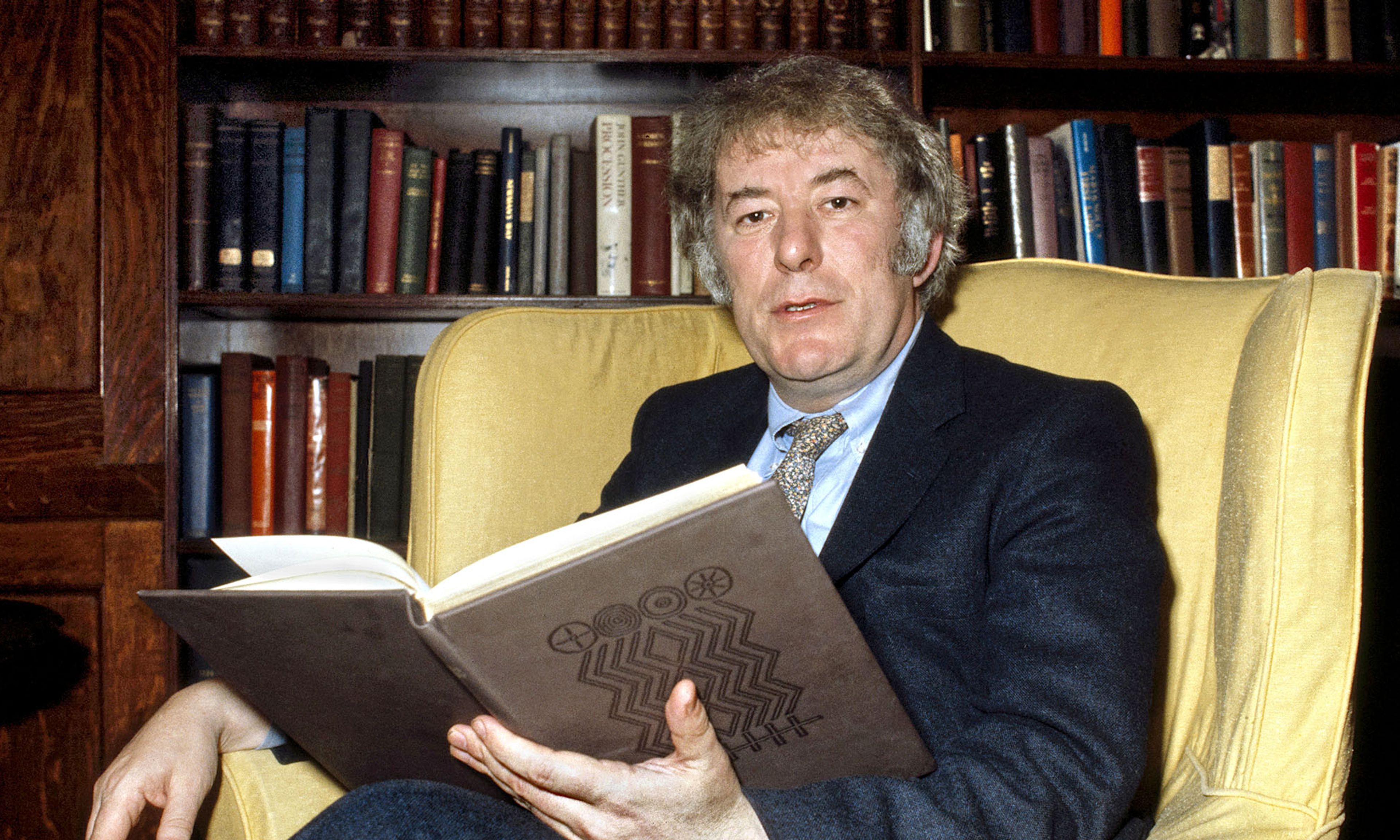
‘I was always haunted by the feeling that I might have had a vocation,” Seamus Heaney wrote on a postcard in 1996, “and when I saw your man front left I realized how it could all have turned out.” He had won the Nobel Prize in Literature the year before and was writing to a childhood friend from St. Columb’s College, their Catholic boarding school for boys in Derry. On the front of the postcard was a reproduction of the painting La Noce, by Henri Rousseau, and Heaney was referring to how the priest in the painting looked like him. The observation was classic Heaney: a quip as the vehicle for truth.
Close readers of Heaney’s poems have long detected his Catholic sensibility as more than nominal. Now, his letters, selected and edited by Christopher Reid, reveal not merely a Catholic poet but a Catholic man — forged by the religious education of his youth, which he called “earnest and admirable.” Beyond his youth, the ritual and culture of Catholicism anchored his elegiac sense.
Covering a time span beginning in 1964 and ending with the text message Heaney sent to his wife minutes before his death in 2013 — “Noli timere,” Latin for “Don’t be afraid” — Reid’s selections are comprehensive and presented with useful context. Heaney’s correspondence reveals the trajectory of a literary life, from young ambition to a growing sense of his mortality.
In fact, awareness of mortality was endemic to Heaney’s Irish Catholicism. “I grow old,” he wrote when he was 27. His poetic lodestar was W. B. Yeats, who warned: “That is no country for old men,” for “an aged man is but a paltry thing, / A tattered coat upon a stick.” As a fount of literature, Catholicism has a power that arises from its having death at its narrative center, not as a mere abstraction but as a daily refrain. This flesh, this blood: It won’t last. That Heaney refined his sense of mortality through reading Yeats, his Protestant compatriot, added more layers to his imagination.
“It’s not that I have been waiting for to be old,” Heaney wrote to the English writer Jane Miller, “more that from early on I was (in Yeats’s phrase) ‘beginning the preparation for my death.’ ” The quote is a slight reframing of a line from Yeats’s poem “Vacillation”: “Begin the preparation for your death / And from the fortieth winter by that thought / Test every work of intellect or faith, / And everything that your own hands have wrought / And call those works extravagance of breath / That are not suited for such men as come / Proud, open-eyed and laughing to the tomb.”
The final line of that stanza perfectly describes Heaney. After the publication of his second book of poems, Door into the Dark, he wrote: “I am convinced I am one of the lucky authors who has found an ideal audience.” Yet in the same letter, he added: “My good luck in all spheres of life makes my Irish Catholic consciousness apprehensive that, as my mother would say, ‘something is going to happen,’ but all that occurs is the returning tide of kindness which no one could predict for himself.” That good fortune included his receiving the Somerset Maugham Award, which required international travel. Heaney spent some time on a French farm, where he wrote in “a big shed/garage/playroom,” while birds nested above: “I’ve meditated on a swallow’s flight in various stages of vinous concentration.” Perhaps we shouldn’t be surprised when a brilliant writer’s correspondence sparkles, but Heaney’s letters are also sharp. His description of the area: “The village has about six hundred people — a secretive assembly of Basque berets, straw hats, gutty slippers and widow’s weeds. The women spend most of their time just behind the shutters and the men are mostly arising about with fishing rods.” Precise, playful, and poetic.
Yet more than anything else, perhaps, Heaney was solemn: “I’ve always had a weakness for the elegiac.” The gravitas of his poems, even in their lighthearted moments, was remarkable. His letters, likewise, are funereal without a touch of the moribund. He was effusive in praise for his fellow poets and equally generous in his words of consolation. He wrote of faith as offering comfort yet voiced some resignation about the limits of his own belief: “There are times when we wish we could use the word ‘pray’ without hesitation.”
I read that statement as the genuine lament of one who has fallen away from belief, and yet recognizes its grace. Heaney’s generation of poets and writers were perhaps the last who arose from such a spiritual architecture. The foundation permeates his sensibility and his references. In another letter, he quoted from “The Flower,” by George Herbert: “And now in age I bud again, / After so many deaths I live and write; / I once more smell the dew and rain, / And relish versing.”
One of those deaths was that of his mother. In a letter to the poet Henri Cole, Heaney conveyed his thanks for Cole’s handling of the topic in a feature he’d written: “I also greatly appreciate your delicacy and discretion in asking about the non-communion taking and so on.” Heaney did not take the Eucharist at his mother’s funeral Mass, and the decision stayed with him. The border between faith and doubt was a precipice for him, likely sharpened by nostalgia. (Channeling James Joyce, he once wrote, “I always loved Holy Week when I was an adolescent,” feeling “ascetic and rhapsodic, all bulb and bloom.”) In a 1996 letter to poet Ted Hughes, Heaney described his trip to Santiago de Compostela, where he attended an ordination Mass. He was moved: “Litanies in Latin, Gregorian chant, murmurous responses — the whole underlife of my childhood and teens rallied and wept for itself.” A storm raged around the cathedral, causing Heaney to note the poignancy of the moment: “It was potent because there is just enough ‘living faith’ around the place to make you feel the huge collapse that has taken place at the centre of the Christian thing.”
Heaney’s elegiac sense extended to his politics. When contacted in 2002 for comment on current affairs, he responded: “I feel I’ve talked myself out on this art and politics topic. It’s forever new and forever old and there are only individual solutions to it.” We should not read this as a stance of avoidance. Heaney longed for “the truth — artistic as well as moral truth.” That’s what “counts,” he wrote. “That’s what people want, and they recognize it not in the volume or the message, but in the pitch of the tuning, the emotional urgency of what’s at stake.”
In youth, his “consciousness was formed, maybe better say dominated, by Catholic conceptions, formulations, pedagogies, prayers, and practices.” That is the language of stricture; of rote instruction. “And yet,” he realized, “in maturity, my growing familiarity with the myths of the classical world and Dante’s Commedia (Irish Catholic subculture with cultural ratification) provided an imaginary cosmology that corresponded well enough to the original: poetic imagination proffering a world of light and a world of dark, a shadow world, not so much an afterlife as an after-image of life.”
Heaney’s letters do not reveal a hidden piety. They reveal something perhaps a bit deeper and more complex. As Heaney aged, he wrote that his life had “been a matter of fitting in with those archetypal patterns.” He noticed that in his own poems, he often returned to “ghosts” and “shades” of the self. Consider “Fosterling,” a poem about a painting seen at school, full of “heavy greenness — / Horizons rigged with windmills’ arms and sails.” The memory spurred a short lament for the intervening years: “Heaviness of being. And poetry / Sluggish in the doldrums of what happens.”
Maturity, firmed by a return to the Catholic sensibility of his youth, changed his vision. His return to the past made all things new: “Me waiting until I was nearly fifty / To credit marvels. Like the tree-clock of tin cans / The tinkers made. So long for air to brighten, / Time to be dazzled and the heart to lighten.”








Comments