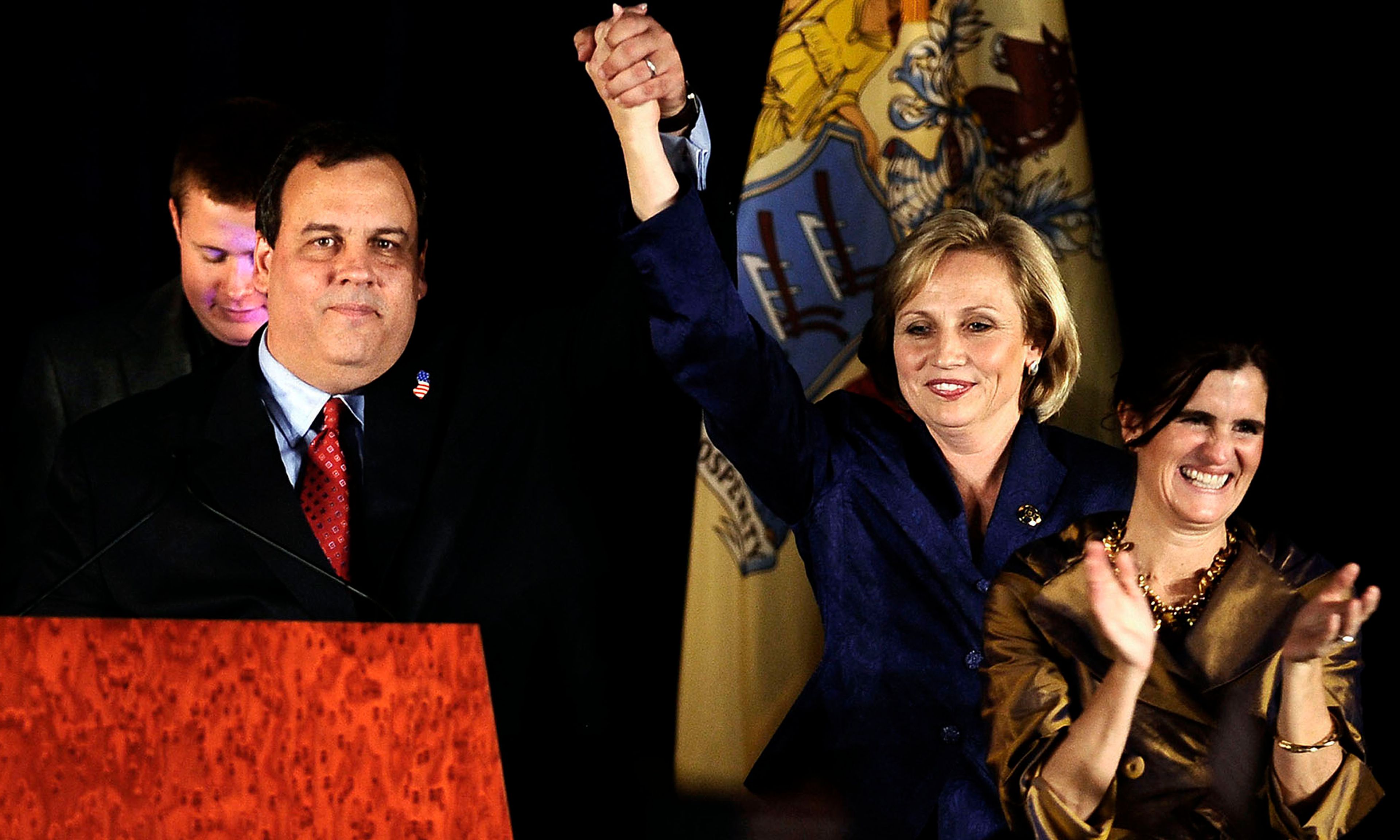
• Bad election news for Republicans: Now they have to govern New Jersey.
• Presidents have been complaining about the press since George Washington. Smart presidents, also since Washington, do their complaining behind closed doors. The disproportion of stature, ironically, makes the press seem stronger: When presidents behave like Goliath, critics turn into Davids. Someone tell the Obama administration. All fall it has been on a tear against Fox News. The White House website teases a “Truth-o-Meter” to rebut “Fox lies.” “Let’s not pretend they’re a news network,” said White House communications director Anita Dunn. “Not really a news station,” David Axelrod agreed. In October, the Treasury Department tried to exclude Fox from a pool interview with executive-pay czar Ken Feinberg. To their credit, other news organizations refused to participate unless Fox was included. President Obama has trouble conceding the legitimacy of his opponents — perhaps because he has encountered so few of them in his charmed public life.
• When she went on the warpath against Fox, Dunn became famous. Before long, a video was making its way around the Internet. It showed Dunn speaking at a forum in the Dominican Republic last January. (No word on whether she stayed at Charlie Rangel’s pad.) Talking about the Obama presidential campaign, she said, “Very rarely did we communicate through the press anything that we didn’t absolutely control.” Getting more specific, she said, “One of the reasons we did so many of the David Plouffe videos was, not just for our supporters, but also because it was a way for us to get our message out without having to actually talk to reporters.” (Plouffe was the campaign manager.) “We just put that out there and made them write what Plouffe had said as opposed to Plouffe doing an interview with a reporter. So it was very much we controlled it as opposed to the press controlled it.” Would it have made that much of a difference?
• The fall of the Berlin Wall marked the beginning of the end of the short and horrible 20th century (1914–1989), characterized by bloodshed and totalitarianism. On November 9 Germany celebrates the 20th anniversary of the fall of the wall with a grand fete. Lech Walesa and Mikhail Gorbachev will be there. So will the leaders of three of the World War II allies that occupied divided Berlin — Britain’s Gordon Brown, France’s Nicolas Sarkozy, Russia’s Dmitry Medvedev. Secretary of State Hillary Clinton will also be there — subbing for Barack Obama. We know that presidents are busy men; they can’t be everywhere they ought to be (Obama will be in Asia). But would he have made the time if the wall fit some historical narrative that he cared more about? It’s unlikely that he deplores America’s fight for freedom or the downfall of Communism. More probably these events don’t register with him. Our young post-racial president seems to be post-historical too.
• Economic growth for the third quarter of the year clocked in at 3.5 percent. Some federal programs, notably Cash for Clunkers, boosted that figure, in effect redistributing income from the fourth quarter to the third. The administration gives its stimulus bill the credit, claiming that it “created or saved” 640,329 jobs. Ed Lazear, chairman of the Bush administration’s Council of Economic Advisers, notes that his report in January predicted that a recovery would happen right around now, even without the stimulus. The truth is that it is impossible to determine how many jobs would have been lost without the stimulus; but if we divide the number of dollars spent by the number of jobs the White House claims were saved or created, the result is a cost of $160,000 for each job. The White House dismisses this as “calculator abuse.” At press time, Rahm Emanuel and Anita Dunn have not launched a campaign to delegitimize calculators. Wait for Q4.
• It is almost impossible to hand out truckloads of cash without some of it falling into the hands of swindlers, but Congress’s stimulus dollars seem to have been particularly susceptible to graft. This year, lawmakers expanded a program that gave first-time homebuyers a tax credit worth 10 percent of the purchase price, up to $8,000. (People who owed less in taxes than the credit was worth got checks for the difference.) The problem? As Kevin Hassett detailed in a Bloomberg.com commentary, there is no reliable way to tell whether someone is buying a home for the first time; and worse, the law did not give the IRS the authority to demand documentation that a home had been purchased at all. Anyone could simply assert that the government owed him $8,000. When the Treasury Department investigated, it found 19,300 claims based on homes that had not yet been purchased, 74,000 claims by taxpayers who probably were not first-time buyers, and more than 580 claims by taxpayers who were younger than 18 (some as young as four). They amounted to about $504 million in stolen taxpayer money. We can only hope the fraudsters spent it in a stimulative manner.
• Kenneth Feinberg, President Obama’s pay czar, hath spoken: Thou shalt not collect cash bonuses, thou shalt accept the halving of thy pay, thou shalt do penance. The pay restrictions directed at the highest-paid employees of the seven firms that took the most taxpayer money are the product of both politics and emotion (the desire to punish), not of sound thinking. The typical Wall Street bank CEO had ten years’ worth of his annual compensation tied up in company stock, he didn’t dump his shares, and most of the mortgage-backed assets he got burned on were rated Triple-A: which is to say, the popular version of the financial crisis — it was caused by greed-crazed CEOs who loaded up on risky junk and then cashed out — is folk economics. President Obama promised to base his policies on science rather than superstition, but when the science is economics and the superstition is popular, he’s a Flat Earther, a pre-Copernican. He may as well be throwing stones at the moon.
• When the cost of living rises, Social Security checks rise too, which seems reasonable. In the rare case when the cost of living falls, as over the last year, Social Security checks stay flat — which means that those checks buy more. But a bipartisan clamor has arisen to protest that it is unfair to deprive seniors of a cost-of-living adjustment just because there is nothing to adjust. President Obama has responded by proposing to send every senior a $250 check. Thus are they to be saved from the calamity of only slightly increased benefits.
• The Obama administration hoped to have 40 million doses of swine-flu vaccine available by the end of October, but came up 12 million doses short. This is not a problem only for them, but a seemingly intractable defect of early government responses to feared epidemics. Vaccine production is a somewhat antiquated oligopoly; at the same time, scientists and the public are right to be cautious when it comes to new cures. Meanwhile the media, to tell the story, oversell it, recycling all the photos of pigs with thermometers in their mouths that they ran during the last swine-flu epidemic, in the Ford administration. There: That is the first time the 38th and 44th presidents have been compared.
• President Obama signed a bill that expanded federal hate-crimes laws and added crimes motivated by bias against homosexuals to the list. The bill will also allow the Justice Department to provide assistance to police investigating these crimes. There can be two justifications for such measures. Either hate crimes are more heinous than other crimes, or we think that those who commit them are more responsive than other criminals to additional penalties and law-enforcement resources. We have yet to hear a persuasive argument for the first claim, or any argument at all for the second. Which makes us think the real purpose of these laws is to score a cultural point that should have nothing to do with the criminal law.
• Eric Holder’s Justice Department strikes again. In Kinston, N.C., two-thirds of the 15,000 registered voters are black. Discriminatory barriers to voting are a distant memory: Black registration is higher than the black voting-age population, black public officials are routinely elected, and Barack Obama won the district by a wide margin. In 2008, Kinston also approved — two-to-one — a referendum to make city-council elections nonpartisan by omitting candidates’ party affiliation from ballots. For a small town where citizens often know their representatives personally, that makes sense. But thanks to the 1965 Voting Rights Act (VRA), voting-rules changes in Kinston and numerous other districts must still be approved by the Justice Department. The partisans in Holder’s Civil Rights Division rejected the people’s will on the astounding theory that voters had a right to be represented by Democrats and, without the party label, could not be trusted to make their own decisions about which candidates to support. The point of the VRA was to protect voters in a time of systematic discrimination. Under Holder, the point is to protect the Democratic party.
• The Justice Department has announced that it intends to take a light hand when it comes to investigating medical-marijuana transactions in states such as California, where they are legal. True to Obama-administration practice, the new guidelines are vague and contingent, and the DOJ retains the prerogative of conducting arbitrary and selective prosecutions. But Washington has been nudged, just a little bit, toward sanity when it comes to marijuana prohibition.
• Democrats talk a good game about the middle class, but their party doesn’t much represent it: A recent USA Today analysis finds that Democratic members of the House represent the majority of the wealthy and the majority of the poor. This isn’t much of a surprise, inasmuch as the Democrats have long been the party of the very rich — Kennedy-style trust-funders, Wall Street traders, Barbra Streisand — as well as the party of the housing projects, social pathology, and welfare checks set. What is really notable in the findings is that Democrats are making downward progress from the very wealthy to the merely affluent, now representing a majority of those whose families are not superrich but make more than $200,000 a year. Of course, $200,000 a year goes a lot farther in traditionally conservative states such as Texas and Arizona than it does in such Democratic strongholds as New Jersey and New York City, a fact that may come to be rued by those relatively affluent Americans who voted themselves a tax hike when they voted for Barack Obama. Kansas is fine — what’s the matter with Greenwich?
• For some time now, Human Rights Watch has been zealously anti-Israel. One person who has noticed this is Robert L. Bernstein, who founded HRW, served as its chairman for 20 years, and is now founding chairman emeritus. He took to the op-ed page of the New York Times to rebuke his child, saying, “Human Rights Watch had as its original mission to pry open closed societies, advocate basic freedoms and support dissenters. But recently it has been issuing reports on the Israeli-Arab conflict that are helping those who wish to turn Israel into a pariah state.” He went on to say that there is a difference between open societies and closed societies: The former have the means of addressing any abuses, while the latter do not. And yet HRW “has written far more condemnations of Israel for violations of international law than of any other country in the region” — a region of closed, rights-abusing societies. The founding of HRW was a noble act, and this op-ed rebuke, painful as it might have been to its author, was too.
• Rocco Landesman, head of the National Endowment for the Arts, says Obama will be good for creative types because he is “the first president that actually writes his own books since Teddy Roosevelt and arguably the first to write them really well since Lincoln.” That sentence is vulnerable on numerous factual grounds (Landesman admitted afterwards that it was “probably just wrong”), not to mention grammatical ones, but even the central premise is shaky: Writers are not uniformly generous toward other writers’ work. Landesman continued his presidential tongue bath by saying that if “the United States is the most powerful country in the world, then Barack Obama is the most powerful writer since Julius Caesar.” Disagree with that? The joke’s on you, explains Landesman: “I made a deliberately outlandish remark, with the delicious (for me, anyway) twist that the last thing people think of with Julius Caesar is that he was a writer. [Speak for yourself, Rocco.] I enjoyed the conceit and never imagined that it would be taken literally. If I have to edit every remark I make because someone somewhere might misunderstand, I’m going to become very dull very fast.” He may be there already.
• Referendum 71 was a referendum on the ballot of Washington State, put there by marriage supporters who wanted to overturn the state’s latest domestic-partnership law, for being too close to gay marriage. A month before the vote, the state planned to release the names of those who signed petitions for Referendum 71, on the grounds that they had taken part “in the legislative process,” like lobbyists. The Supreme Court blocked the state. The reality is that gay-rights activists wanted the names to subject petition signers to harassment. It happened in California, after last year’s fight over Proposition 8; several who gave money to that cause lost jobs. Making contributions is a form of organized political speech that ought to be transparent; signing a petition is a private act, like voting. Expressing your civic opinion should not leave you open to what George Will calls “thuggish liberalism.”
• Ken Cuccinelli, the successful Republican candidate for attorney general of Virginia, told an interviewer, “My view is that homosexual acts — not homosexuality, but homosexual acts — are wrong.” He added that “it’s appropriate to have policies that reflect that.” He further said that he did not consider homosexual acts “healthy” for either individuals or society. The Washington Post editorially condemned him for “bigotry” and “ugly nonsense”; it predicted that if elected he would be “an embarrassment to the commonwealth.” Reasonable people can certainly disagree with the candidate. But half the country shares his moral views about homosexuality (Gallup found a 48–48 split last year on whether “homosexual relations” are “morally acceptable or morally wrong”). If the Post wants to argue that this half of the country — including most Christians — is too bigoted to serve in office, it should make an argument to that effect instead of relying on scare words. But in that case, it might not be so easy to tell just which party is being illiberal here.
• When Atlanta elected its first black mayor, in 1973, it was a huge step forward for the entire South. In years since, the city has always chosen a black mayor, but this fall a white woman, Mary Norwood, was the frontrunner in pre-election polls. Her popularity across racial lines alarmed a pair of political-science professors, who circulated a memo urging their fellow black Atlantans (57 percent of the population) to unite behind a single black candidate and keep the white woman out of office. Despite this attempt to stoke the fires of racial animosity, Atlanta lived up to its reputation as a post-racial city by giving Norwood the largest number of votes, though she will face a runoff. The election represents yet another advance: Having secured the right to vote regardless of race, many Atlantans are choosing their candidates regardless of race as well.
• MSNBC snarler Keith Olbermann, who specializes in hysterical vituperation, referred to “the total, mindless, morally bankrupt, knee-jerk, fascistic hatred without which Michelle Malkin would just be a big mashed-up bag of meat with lipstick on it.” Charming . . . but somewhat vexing to feminists. They agree with Olbermann’s opinion of Malkin, of course, but he’s a guy and she’s a gal, and is there not some tiny flicker of sexist contempt to be glimpsed behind his words? The offense was compounded by Olbermann’s having read out an e-mail communication from Malkin in a ditzy valley-girl voice. Feminists labored mightily to square the circle, with much agonized groaning about how “gendered language is so deeply ingrained in our discourse.” Meanwhile, the doughty Michelle did not miss the opportunity to hoist the feminist Left with its own petard: “The ‘M’ in ‘MSNBC’ stands for ‘misogyny,’” she chortled on her blog. It sure doesn’t stand for “manners.”
• “Police, so what? Police die too! Feds die too! Do not carry a pistol if you’re going to give it up to police. You give them a bullet.” That was the lesson Luqman Ameen Abdullah, a radical imam in Detroit, once shouted at his followers. When FBI agents attempted to arrest Abdullah (a Muslim convert formerly known as Christopher Thomas) and ten followers on firearms and other charges, Abdullah allegedly practiced what he had preached. He was killed in the resulting shootout. The feds say Abdullah led a violent Islamist group, called “the ummah,” which sought to establish a sovereign Muslim enclave in the United States. It would be governed under Islam’s sharia law by Jamil al-Amin (the former H. Rap Brown), who is serving a life sentence for the 2000 murder of a Georgia police officer. Abdullah advocated spreading Islam, and imposing sharia, through violent jihad, viewing himself and his flock as fighting a war against the United States and non-Muslims. On cue, the usual suspects groused that the real problem is the government’s use of informants to infiltrate suspect mosques. We suspect we could use more of them.
• The great Afghan election drama ended in a fizzle. After the administration strong-armed Hamid Karzai into accepting a runoff, his rival, Abdullah Abdullah, dropped out, and Karzai was declared the winner. This was all much ado, for two reasons: 1) Abdullah was in all likelihood going to lose a runoff anyway; 2) ordinary Afghans surely care more about the government’s performance on the most basic matters — security, corruption, rule of law — than the niceties of electoral process. The post-election crisis held two main risks, both of which seem to have been averted for now. A schism in the country’s elite could have erupted into civil war, which hasn’t happened (Abdullah’s supporters didn’t even take to the streets in protest). Or the power struggle could have been internalized in the regime, making it even more dysfunctional, if we had forced a shotgun marriage between Karzai and Abdullah. The question now is how to increase the government’s legitimacy by improving its performance. That will be predicated — as so much else in the region — on giving General McChrystal the troops he needs to implement an effective counterinsurgency campaign. Prime Minister Maliki in Iraq seemed hopelessly weak and ineffective as well, so long as we didn’t have enough troops in the country to impose basic order. As security improved, so did Maliki. The same could happen in Afghanistan — if President Obama heeds the advice of his commanding general.
The Poor Need Capitalism
The Left’s version of recent economic history boils down to one terrible fact: The distribution of income has gradually become more unequal. Within the United States, that fact is incontrovertible. It is not clear, however, that increased inequality has been bad.
Inequality is, after all, the foundation of a capitalist society. When individuals work hard, or innovate, they receive outsized rewards. When others see those rewards, they are motivated to work hard and innovate. As the lottery-ticket market has demonstrated, the bigger the prize, the bigger the motivation.
But a society that focused all rewards on the very wealthy would be unacceptable. Individuals born in poverty would be condemned to stay there. The inequality that accompanies a vibrant capitalist society is attractive because it enables growth that benefits all. If capitalism is working well, then as growth advances, the welfare of even the poorest members of society improves. A capitalist can accept the fact that the fellow at the top has a lot more money than the fellow in the middle, because the system that allows that to happen helps the fellow at the bottom.
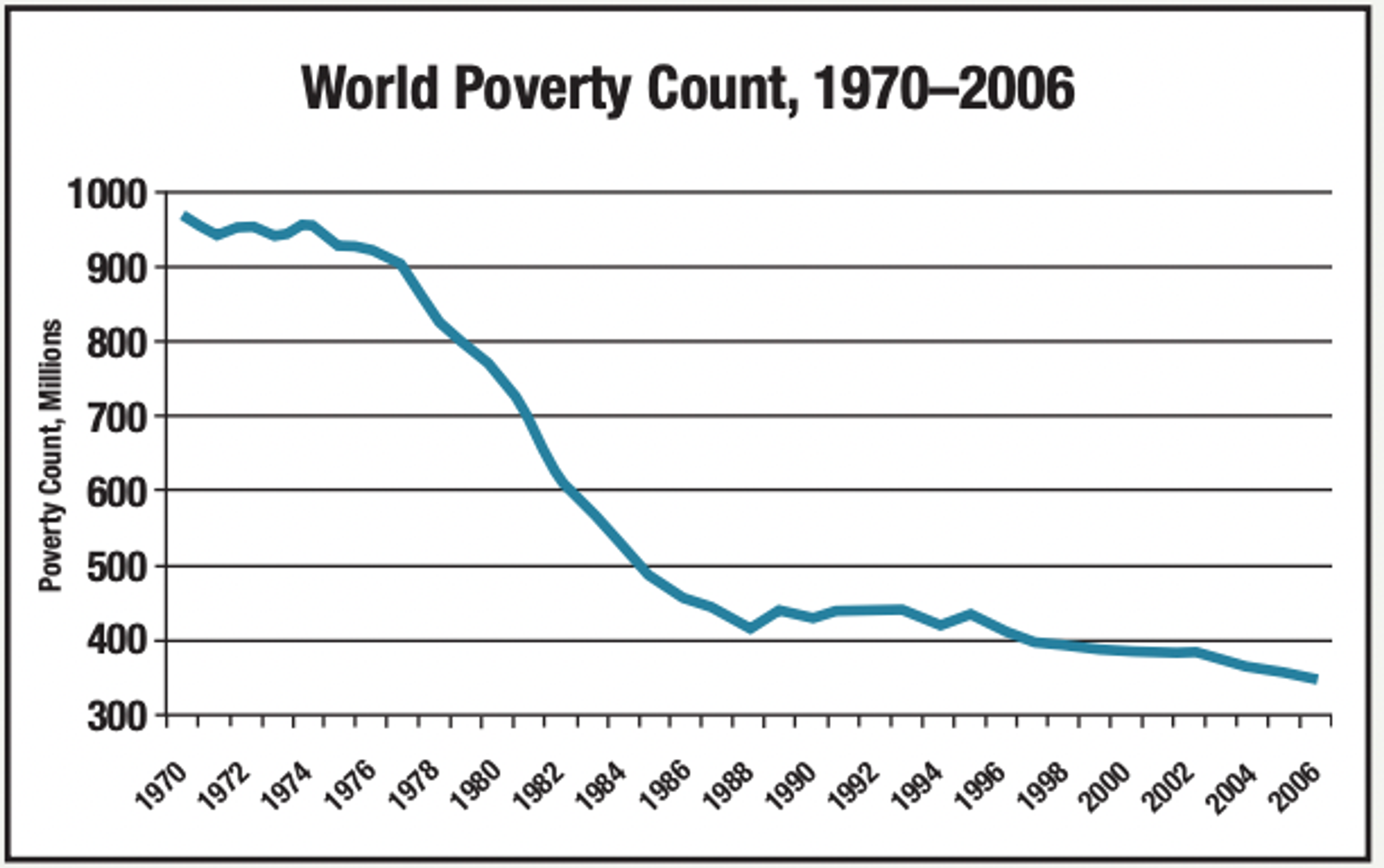
The nearby chart draws on a landmark new study by economists Maxim Pinkovskiy and Xavier Sala-i-Martin. The authors set out to study changes in the world distribution of income by gathering data from many different countries. As a byproduct of their work, they are able to count the number of individuals who live on $1 per day or less, a key measure of poverty.
According to their calculations, the number of people living in poverty so defined has plummeted, from 967,574,000 in 1970 to 350,436,000 in 2006, a decrease of a whopping 64 percent. Whence the reduction? The biggest factor is the emergence of middle classes in previously poverty-stricken China and India. And the spread of capitalism to other countries has similarly been followed by prosperity. The trend is even more impressive if one considers that the world population skyrocketed over that time, increasing by 3 billion.
If the trend continues for just 40 more years, poverty will have been essentially eradicated from the globe. And capitalism will have done it. Socialism offers itself as an alternative to capitalism that is more just to the poor. To test that view, the authors reconstruct the distribution of income for the countries of the former Soviet Union. Back in the Communist days, poverty was much, much higher in the Soviet Union than it is today.
There are those who have argued that the current financial crisis has served as proof that capitalism is a failed ideology. The work of Pinkovskiy and Sala-i-Martin suggests that there are about a billion people whose lives prove otherwise.
— KEVIN A. HASSETT
• The premise of Obama’s Iran policy effectively has been that the mullahs are reasonable and reasonably trustworthy, and that it takes little but carrot-heavy diplomacy to influence them. It was therefore an embarrassment to the president when the world learned that the Iranian regime was operating an undisclosed uranium-enrichment facility. That is why his administration strove so mightily to present subsequent negotiations with Tehran — which seemed to yield a commitment on its part to ship 70 percent of its uranium to Russia and France for enrichment to levels suitable for a nuclear reactor — as an unmitigated triumph. In reality it was far from that: The uranium, once shipped back to Iran, could be further enriched to weaponizable levels, its foreign custodians having already gotten it partway there; and there was still every reason to believe that Iran’s lying rulers were operating a covert weapons program in addition to whatever “civilian” activities they deigned to disclose. Now matters have gotten even worse, with the regime balking at almost every aspect of the agreement: Sorry, not 70 percent; and we don’t feel like sending it all at once; and actually we’d rather it were enriched on our own soil, but maybe you can come visit if you stand behind this yellow line. Just as the mullahs intend, the twists and turns of this pathetic saga obscure what they are really up to: stalling for time with procedural games while moving full speed ahead with their illicit nuclear activities. And the leader of the free world acquiesces. The audacity of naïveté is a dangerous thing.
• When democratic protests broke out in Iran last summer, the Obama administration gave the impression of considering such protests a nuisance — a hindrance to the real work of dealing with the regime in place. The administration has now cut off funding to several groups working to help the Iranian democrats. One of them is the Connecticut-based Iran Human Rights Documentation Center, which does much to let the world know what is going on inside that dark country. The center will have to shut down unless private funds come in. The administration is right to deal with the world as it is. But the Iranian democracy movement, and the weakness of the regime of the mullahs, are realities too.
• What just happened in Honduras? Some initial headlines suggested that Manuel Zelaya had been reinstated to the presidency. Not quite. As part of the deal that was announced on October 30, Honduran officials agreed to create a temporary unity government and let the Honduran congress decide whether to restore Zelaya as president for the remainder of his term, which was originally scheduled to end in January. The Honduran supreme court will tell lawmakers whether Zelaya’s reinstatement would (in its opinion) be legal. Considering that Honduran congressmen are preoccupied with the November 29 national elections, and that the court ordered Zelaya’s arrest in the first place, we doubt that “Mel” will be returned to the presidential palace. Either way, the agreement represents a victory for Honduras’s democratic institutions. In a reversal of its earlier position, the Obama administration pledged to lift sanctions and recognize the upcoming Honduran elections even if Zelaya is not restored. After months of unfairly being treated like a pariah, Honduras will now be allowed to decide its political future democratically.
• There is a newish group called J Street, which is a left-liberal American Jewish organization, meant to counter the traditional Jewish organizations, which it considers too hawkish. J Street’s slogan is “Pro-Israel, Pro-Peace,” which may raise the question, “Who among Israel’s supporters is not pro-peace?” At any rate, J Street’s university arm has dropped the “Pro-Israel” part, because it is too much of a turnoff to its core constituency. J Street is against sanctions on Iran, okay with the Goldstone Report, and so on. Its spokesmen lean toward moral equivalence, whereby, for example, both Tehran and Jerusalem must “cool the rhetoric.” (Though J Street seems far more interested in criticizing pro-Israel hawks than in criticizing, say, Hamas.) The organization just held its first conference, which ran into trouble when it was reported that at least one of its invited guests had analogized Israel to Nazi Germany. Congressmen who were to attend the conference dropped like flies, many saying they had been unaware of the group’s nature; the Israeli ambassador declined to attend, citing Israel’s interests. The White House is quite high on J Street, however, and sent the national security adviser, James Jones. He told the gathering, “You can be sure that this administration will be represented at all future J Street conferences.” Which is a believable promise. J Street is the Obama administration’s kind of American Jewish organization, although it is not the sort of organization whose policies are likely to lead to something deserving the name of peace.
• In 1992, Bill Clinton campaigned mercilessly against Bush 41 as a friend of China’s Communist government and therefore not a friend to Chinese people, certainly Chinese democrats. In the newly published Clinton Tapes, Taylor Branch tells about a 1993 meeting between President Clinton and Jiang Zemin, the Chinese No. 1. Jiang insisted on reading a speech to Clinton, says Branch, “about the glorious history of China and the folly of attempts to influence her internal affairs.” This went on for so long that Clinton eventually felt obliged to cut him off. “Speaking in direct sentences, with all the charm he could muster, he invited the Chinese leader to get down to business. He told Jiang he didn’t want to change China’s political institutions. Nor did he object to prisons. In fact, America had lots of people in prison, and Clinton wanted to put away even more.” Of course, there is a difference between Chinese prisons and American prisons. To find out that difference, you could consult any former political prisoner from China.
• Pope Benedict created an express lane for disaffected Anglican congregations to join the Catholic Church, with their married priests. To analyze the move solely in terms of market share — as if the pope were seeking to boost his — is a mistake. Catholics believe that Christian disunity is a scandal, and that their church has a special obligation to work to end it. The pope has therefore taken a bold step toward the goal that all Christians be in full communion. If this move decimates the Anglican church, it will be one more piece of evidence that the progressive dilution of Christianity cannot be its path forward through modernity.
• Some 2.3 million immigrants have settled in Britain so far this decade. Official government statements have justified this generous immigration policy with economic arguments, citing labor shortages. A former senior adviser to the government has now, however, revealed that the true motivation was political: “to rub the Right’s nose in diversity and render their arguments out of date.” Writing in the London Evening Standard, Andrew Neather alleges that government ministers, “passionately in favor of a more diverse society,” proceeded by stealth for fear of alienating their working-class voting base. This is disgraceful if true: the demographic transformation of an entire nation under false pretenses, by elite ideologues who hold the common people in contempt. Thank goodness no such thing could happen in the United States!
• In recent elections for the European parliament in Brussels, the British National party got about 900,000 votes, entitling it under the system of proportional representation to two seats. One of those seats goes to Nick Griffin, the BNP leader. The BBC felt obliged to invite him on to Question Time, its flagship program for debating social and political issues. A racist, an anti-Semite, and a liar about the unsavory things he has said and done on his way to the top of the BNP, Griffin is nevertheless no Hitler. A poor speaker, he has only one point to make, that immigration is out of control and many British people feel that they have lost their country. The other panelists and the audience behaved as though out for a lynching. Opinion polls afterward showed that this rudeness created a backlash, and as many as 22 percent said they would now consider voting BNP. Post-WWII governments one and all have pretended that immigration either is not happening or does not matter, and this has generated rival extremisms that sustain each other. The BNP and Griffin will have a baleful impact until the political incompetence and dissembling of the mainstream parties stops.
• In the English city of Norwich, 67-year-old grandmother Pauline Howe joined a peaceful protest by Christians against the city’s gay-pride parade. Some of the paraders took time out to insult Mrs. Howe in person, with remarks of an offensively salacious nature. The lady wrote a letter of complaint to the city council. For her trouble, she was visited by two uniformed police officers, who interrogated her in her home to determine whether she had perpetrated a “hate incident.” After scrutinizing Mrs. Howe’s responses, the officers of the law graciously allowed that her hate did not rise to the level where she might be a danger to society, so there will be no prosecution. Sighed Mrs. Howe: “Our freedoms as Bible-believing Christians have been squashed.” Indeed. To avoid the attention of the authorities in today’s Britain, it is wiser to be a Koran-believing Muslim.
• At the end of August, the Lockerbie bomber Abdelbaset Ali Megrahi was sent home to Libya, officially on grounds of compassion. In July, he had been said to have terminal cancer and a life expectancy of three months at most. Moammar Qaddafi and his son and heir staged a dramatic welcome. Photographs then showed Megrahi undergoing serious treatment in hospital. There was something fishy about it, especially because British companies immediately sealed lucrative oil and gas deals with Libya. The three months are now up, and Megrahi is back in his house in Tripoli. His telephone calls are monitored, and he keeps up five- and ten-minute conversations in a normal voice. The British doctor responsible for the forecast of three months tries to save his reputation by saying that Megrahi must be on morphine in the last stages. Or perhaps it is a medical miracle.
• When the U.N. Human Rights Council takes a break from criticizing Israel, it turns to its next-highest priority: ensuring that counterterrorism measures do not interfere with the full self-realization of anyone’s socially constructed sexual identity. In a draft report, a special rapporteur frets that “enhanced immigration controls that focus attention on male bombers who may be dressing as females to avoid scrutiny make transgender persons susceptible to increased harassment and suspicion.” A case in point: Yousef Mohammed al-Shihri, an al-Qaeda veteran who was released from Guantanamo in 2007. Last month Saudi border guards stopped him as he tried to enter the country from Yemen dressed as a woman. In a case of insensitivity to non-traditional gender norms, things escalated to the point where al-Shihri opened fire, and the Saudi police shot him. A search of his car revealed automatic weapons, hand grenades, and explosive belts. And to think that this misunderstanding could so easily have been avoided — if only the Saudis had understood that terrorists sometimes just like to feel pretty.
• In Scotland, it’s a crime to have fat children. A year and a half ago, authorities ordered a hefty Dundee couple to send three of their children to dancing and soccer lessons to slim them down. When the mambo cure didn’t work, friendly social workers pulled two of the “endangered” kids from their home and sent them to foster care; this fall they took away the other five, including a girl who had been born just hours earlier (she was later returned). Speaking of excess pounds, the local government has spent more than £100,000 to save these children from weighing more than its health experts deem appropriate. A bloated state hungry for problems to solve is a much greater threat to its citizens than a few chubby children.
• Rush Limbaugh lost his bid to be part-owner of the St. Louis Rams. The National Football League may properly choose to distance itself from political figures (though why does Keith Olbermann appear on Sunday Night Football?). But the NFL should make its decision uninfluenced by lies. During the Rush/Rams flap, CNN’s Rick Sanchez and Bryan Burwell of the St. Louis Post-Dispatch recycled a Limbaugh quotation about slavery (“Slavery built the South. I’m not saying we should bring it back; I’m just saying it had its merits”). Months earlier, MSNBC’s Rachel Maddow quoted Limbaugh’s saying that James Earl Ray should have gotten the Medal of Honor. The problem: Both quotations were bogus, fabricated by one Jack Huberman and circulated on Wikiquote. Bearing false witness would be a problem if the false were embarrassed by it: Burwell and Maddow offered notably evasive and graceless retractions. Roll on, Rush; lies have long legs, truth’s are longer.
• The management of an apartment building in Albany, Ore., forbade the flying of flags or display of flag decals anywhere on the premises. A tenant whose son was serving in Iraq was told he couldn’t fly an American flag from the back of his motorcycle. A different tenant, inquiring the reason for the ban, was told: “Someone might be offended.” Whereas, of course, nobody could be offended by an insult to Old Glory. After much negative commentary and some protests, the building’s management rescinded the ban.
• If you think you can’t use the word “black,” and must use “African-American” instead, you may find that you can’t talk straight. At the 2002 Winter Olympics, an American woman won a gold medal in the bobsled. She was the first black woman ever to win a gold medal in the Winter Games. But NBC, the network covering the Games, had no way of conveying this fact to its viewers. An announcer was reduced to saying, “She’s the first African-American woman from any country to win the gold medal.” In the American media, Nelson Mandela has been called “the first African-American president of South Africa.” Students have written that Othello was “African-American.” And so on. The latest comes from The New Republic, whose review of a biography of Booker T. Washington began this way: “Once the most famous and influential African American in the United States (and probably the world), Booker T. Washington . . .” Surely the writer meant that Washington was probably the most famous and influential black man in the world. And there is nothing wrong with saying so, for, as we used to say in a bygone era, “black is beautiful.”
• Penguin Classics has come out with a “deluxe edition” of Huey Newton’s memoir, Revolutionary Suicide. (Yes, classics aren’t what they used to be.) Of interest is the name of the jacket illustrator. Anyone can bear the name of one revolutionary killer, but you are really something if you bear the name of two. And that’s the case with Ho Che Anderson. Kind of a shame that “Anderson” has to be so bland — so non-murderous.
• NR will review the new biographies of Ayn Rand in due course. We reviewed another Rand-related book once upon a time (“Out of a lifetime of reading, I can recall no other book in which a tone of overriding arrogance was so implacably sustained. Its shrillness is without reprieve. Its dogmatism is without appeal” — Whittaker Chambers on Atlas Shrugged, Dec. 28, 1957). Rand’s abilities as a storyteller are hardly controversial: She still sells hundreds of thousands of copies a year, 52 years later. The financial crisis and the Obama crisis have made her analysis of liberalism and the welfare state timely again. She admired the country she came to as a refugee from Communism. But the most glaring weakness of her thought glares still. A political movement one of whose premises is that theists are stupid and theism wicked is a non-starter in the United States — and would have been with every one of its founders, including Jefferson and Thomas Paine.
• Claude Lévi-Strauss was one of the outstanding intellectuals of the 20th century. A Jewish Parisian born in 1908, he was an anthropologist, primarily. But he was also a thinker and researcher of diverse talents and interests. Anthropology gives a practitioner license to investigate and comment on almost anything. Lévi-Strauss could write, too, and reached a mass audience. His books include Tristes Tropiques, La Pensée Sauvage, and Mythologiques. Early in his life, he did fieldwork in Brazil. He once said that, when in the Brazilian jungle, he felt close to Paris, and that, when in Paris, he felt close to the Brazilian jungle. He met and mixed with most of the anthropologists who ever were. (Anthropology is still a young discipline.) One of those was Franz Boas, the “Father of American Anthropology.” In fact, Boas died in Lévi-Strauss’s arms, in 1942. The two were having dinner at Columbia University’s Faculty House when Boas suffered a heart attack. Lévi-Strauss died on October 30 of this year, a few weeks short of his 101st birthday. He was a big figure in a century crowded with big figures. And, in contrast with many of the famous, his life and work were not frivolous. R.I.P.
The Comeback Begins
Conservatives scored some impressive victories on Election Day. In Virginia, Robert McDonnell won the governor’s race in a landslide that carried other conservative statewide officeholders and legislative candidates to victory. New Jersey’s Chris Christie won his race by a larger margin than any Republican had mustered since 1985 — and as a candidate significantly to the right of previous Republican governors such as Tom Kean and Christie Todd Whitman. Maine repealed a law that accorded official recognition to same-sex unions as though they were marriages.
The disappointment of the evening came in a special election for Congress in upstate New York, where Conservative-party nominee Doug Hoffman narrowly lost to Democrat Bill Owens. Local GOP party officials bollixed the race from the beginning by picking liberal Dede Scozzafava. With her campaign sinking beneath the waves, she pulled out the weekend before the election and then capped her disastrous foray by endorsing Owens. Hoffman was a much better candidate, and demonstrated the passion that is animating the conservative grassroots on fiscal issues. But, a first-time candidate, he lacked polish and a ready knowledge of local issues. If there’s a lesson from the race besides the obvious — don’t let out-of-touch GOP officials pick liberal congressional candidates — it is that conservatives need to run campaigns based not only on their philosophical soundness but on the improved conditions that this soundness can be expected to generate. That was the template for McDonnell’s huge victory. If his governance delivers on his promises, explicit and implicit, he will be a model for Republicans nationwide.
Democrats are taking solace in the banal truth that these elections were not solely referenda on President Obama. The Democratic candidate in Virginia ran a pathetic campaign, and the Democratic governor of New Jersey was a failure. The elections nonetheless offered proof (not that any should have been needed) that Obama cannot transfer his popularity to his allies. They showed that the powerful negative reaction to President Bush may have run its course. And they suggested that important aspects of Obama’s agenda are encountering formidable resistance, not only from the core supporters of the Republican party but also from independent voters. We would not blame the president if he took up smoking again.
The Inevitable Debacle
The latest health-care bill, offered by Speaker Nancy Pelosi, is more of the same. Like every other Democratic bill before Congress, this “comprehensive reform” has two major features: First, it transforms insurance into a product that few rational people would buy. Second, it forces them to buy it.
Like the Baucus bill, Pelosi’s alternative imposes massive costs on states and individuals so that its sponsors can describe it as “cheap” for the federal government. Like the Baucus bill, it contains disguised tax increases on middle-class Americans: In the case of Pelosi’s bill, the chief subterfuge is to impose taxes on “the rich” with no adjustment for inflation; over time, more and more Americans will pay the higher taxes.
Pelosi’s bill is being called “less liberal” than previous House bills because the government-run insurance program it creates would not be allowed to force bargain-basement rates on doctors. To dwell on this question — unless you are a lobbyist for one of the affected interests — is to miss the forest fire for the trees. The details of the “public option” are not what make the bill a mistake; and it would remain a mistake even if it lacked a public option altogether.
All of the Democratic bills are likely to increase premiums. All of them are too expensive, too coercive, too likely to generate government interference with medical practice, and too disruptive. All of them subsidize abortion. All of them reject incremental reform in favor of liberal hubris. House Republicans are wise to promote alternatives that are the opposite on every count.
None of this is to say that the differences between the Democratic bills have no import at all. They suggest that there is less than meets the eye to Democratic claims that passage of what they style “reform” is inevitable. Democrats have not agreed on how to pay for reform, for example, which is no small matter. Senate majority leader Harry Reid thought that a bill to increase Medicare payment rates would inevitably pass, too, and was surprised when 13 Democrats joined the Republicans in defeating it.
The Democrats’ approach to health care remains unpopular. What seems most inevitable is that sooner or later they will pay for it politically.












Comments