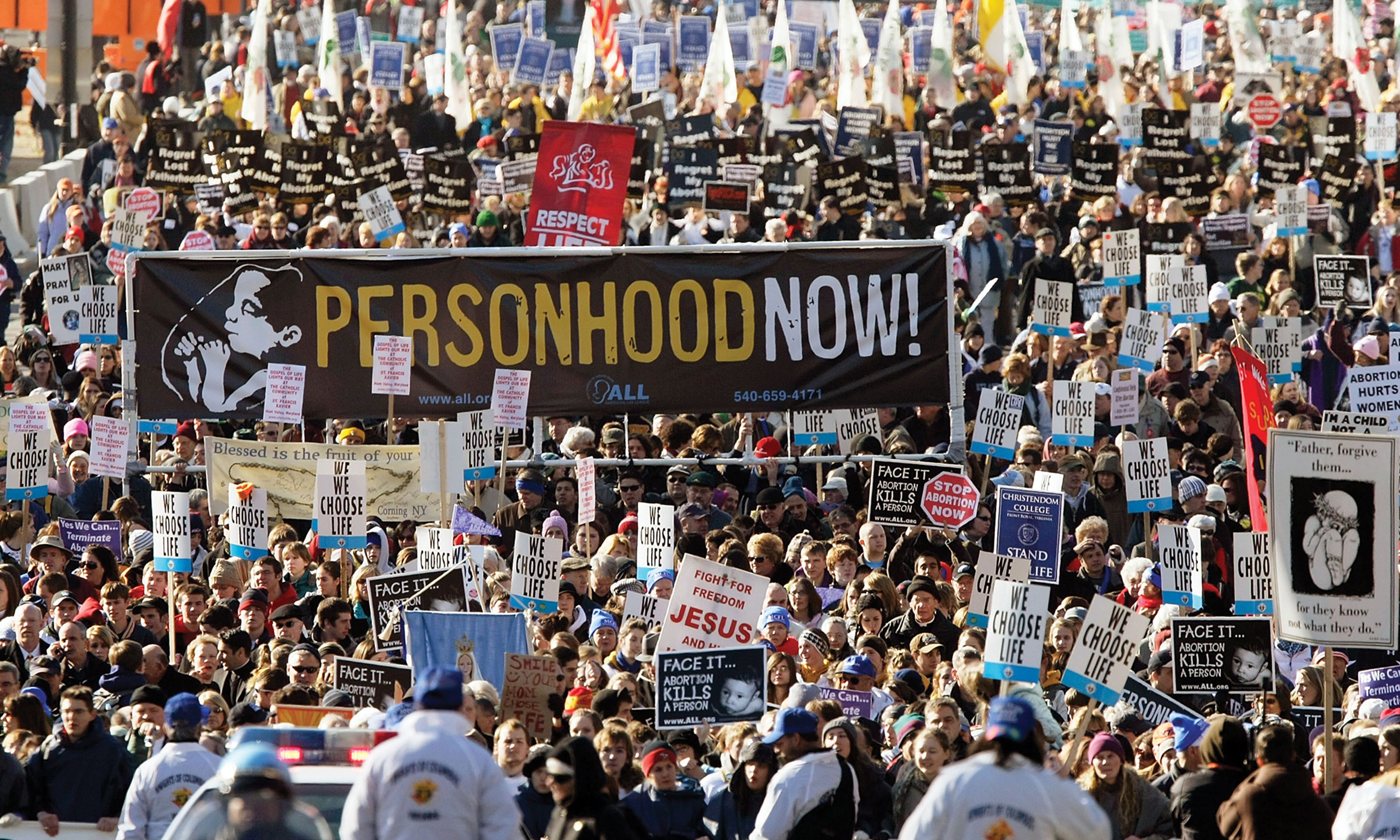
In the upcoming Supreme Court case Dobbs v. Jackson Women’s Health Organization, the Court very well might uphold Mississippi’s prohibition on most abortions after 15 weeks’ gestation, and most observers expect it to do so. In that case, the decision will strike at the heart of the Court’s two previous landmark abortion cases: Roe v. Wade and Planned Parenthood v. Casey.
In response, proponents of legal abortion will use every strategy at their disposal to discredit the ruling. One essential element of such a strategy will be a PR campaign condemning the reversal of Roe and Casey as contrary to American public opinion, and an effort to channel voter anger about the ruling against Republican candidates in next fall’s midterm elections.
But the pro-life movement should not let abortion-rights supporters get away with it. Judging from public-opinion polling over the most recent decade, though American sentiment is fairly complex when it comes to whether and when abortion should be legal, a clear majority opposes the status quo in abortion law and policy.
Most Americans, in reality, would prefer states to set their own abortion policies, and a clear majority supports policies far more restrictive of abortion than can currently be enacted under Roe.
Abortion-advocacy organizations such as Planned Parenthood and NARAL Pro-Choice America commonly peddle the statistic that seven in ten Americans support Roe v. Wade. But few Americans actually know what the ruling meant for abortion policy. One poll, for instance, found that only 62 percent of Americans even knew Roe had to do with abortion, and among respondents under 30, that percentage fell to just 44 percent. Even fewer are aware that Roe and Casey make it nearly impossible to regulate or limit abortion in any serious way.
Consider a recent Fox News poll that found that 65 percent of Americans oppose reversing Roe v. Wade, compared with 28 percent who want the decision overturned. Absurdly, however, the same survey indicates that Americans are perfectly split on whether abortion should be legal, tied at 49 percent.
A substantial number of Americans, in other words, both want abortion to be illegal and want to preserve the jurisprudence making it nearly impossible to prohibit abortion. Such a polling outcome is possible only if a sizeable percentage of the population is unaware that, before laws can be passed making abortion illegal, Roe must go. Roe legalized abortion on demand before fetal viability under the constitutionally dubious right to privacy, and in its companion case, Doe v. Bolton, the Court required all abortion regulations after viability to have an expansive “maternal health” exception, which included factors such as emotional, financial, and familial health. Roe thereby made it impossible for states to impose effective restrictions on abortion.
Among its many unfortunate results, Roe wrested abortion policy from the democratic process. When the decision came down, 30 states had laws on the books prohibiting nearly all abortions except in cases when a mother’s life was at risk. In many of those states, legislatures had already debated the abortion question shortly before Roe and decided in favor of strict regulations. Even in the few states where elective abortion was legal at the time Roe was decided, lawmakers set gestational-age limits on the procedure and did not allow, as Roe does, abortion throughout pregnancy.
Roe, then, not only created a constitutional right that is nowhere to be found in the Constitution but also turned a properly political and legislative issue into a matter of court control. Since Roe and its modified rearticulation in Casey in 1992, pro-life lawmakers in most states have sought to impose significant restrictions on abortion procedures. But, citing the high court, judges have prevented nearly all of those restrictions from taking effect.
This has trapped pro-life states in a five-decade standstill, with little choice but to permit abortion, often unable even to enact policies as anodyne as a mandatory 24-hour waiting period or an informed-consent requirement. Progressive states, meanwhile, have had no trouble liberalizing abortion policy well beyond what Roe explicitly required, in some cases even declaring unborn children nonpersons — meaning there can be no legal consequences for fetal homicide or wrongful fetal death — and establishing a “fundamental right” to abortion under state law.
In short, the effect of Roe, Doe, and Casey has been a federal presumption of a right to abortion on demand, throughout all nine months of pregnancy, limited slightly at the edges by creative pro-life lawmakers.
Notwithstanding the reality that a majority of Americans tends to favor allowing abortion in at least some circumstances, the status quo is demonstrably unpopular. According to a Gallup poll from 2018, for instance, just 13 percent of all Americans said they supported elective abortion in the last three months of pregnancy, the de facto policy mandated under Roe and Casey.
A Marist poll from January 2021, meanwhile, found that about three-quarters of Americans would prefer either that abortion be limited to the first three months of pregnancy (25 percent); that it be available only in cases of rape or incest or when a mother’s life is at risk (39 percent); or that it be entirely illegal (12 percent). A plurality also said it would prefer to see abortion law decided at the state level. Under the Roe regime, however, none of these positions can be enacted into federal or state law.
Planned Parenthood and NARAL, then, along with their Democratic Party sympathizers, will be relying on falsehoods if, after a loss in Dobbs, they insist that the Court has contradicted public opinion.
Of course, if they do their duty, the justices will consider not what outcome Americans might prefer but rather the text, history, and structure of the Constitution, and they will come to the conclusion that there is no right to abortion discernible under any accurate reading of our fundamental law.
But even if the justices consider the pushback they might receive, they should not be swayed by the notion that Americans would prefer to see Roe jurisprudence stay in place. Nor should pro-life politicians shy away from defending a Dobbs decision that overturns Roe, even if Democrats argue in the 2022 midterm campaigns that, in such a case, the Court will have thwarted the will of the people.
The present division over abortion policy proves the point. Though the public remains divided on whether and when abortion should be legal, most people find the status quo unacceptable, even if they don’t realize that it is the fault of Roe. Fifty years after that flawed ruling, abortion is perhaps the most hotly contested political question in American public life, and it is long past time for the Court to step out of the way and let the American people resolve it.












Comments